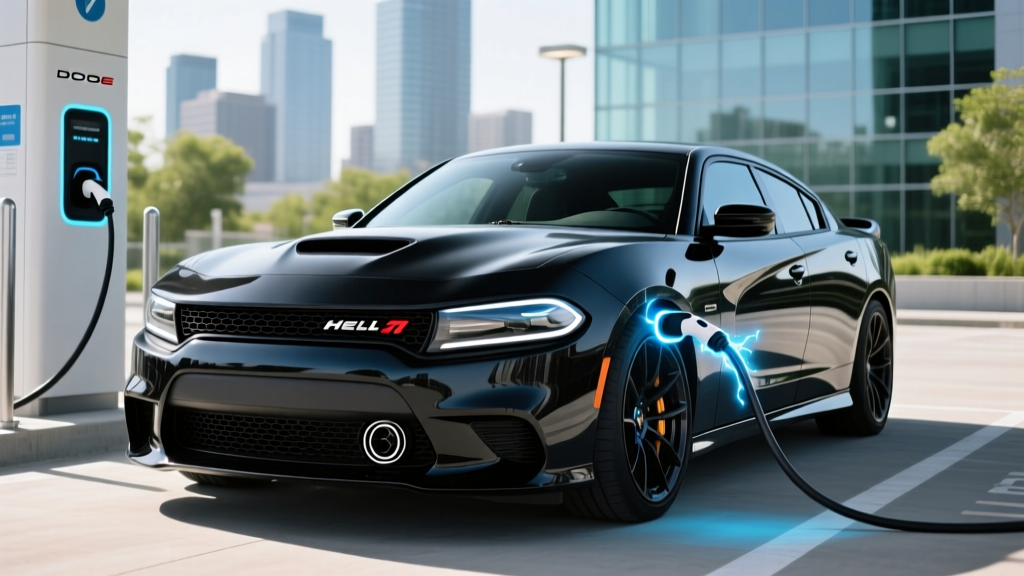
The Dodge Charger Daytona EV has redefined what an electric muscle car can be, packing up to 670 horsepower and a 100.5 kWh battery into a platform that channels its Hellcat heritage. But for buyers coming from the supercharged V8 world, one pressing question dominates search queries: what's the hellcat supercharger size equivalent in the EV realm? The answer lies in understanding the Charger Daytona's charging architecture, battery capacity, and how to keep this electric muscle car fed — whether at home or on the road.
This guide breaks down everything Charger Daytona owners and prospective buyers need to know about charging: DC fast-charge speeds, Level 2 home setup, connector compatibility, real-world costs, and the electrical work required to support a 100+ kWh battery in your garage.
2026 Dodge Charger Daytona EV — Quick Specs
| Battery (usable) | 100.5 kWh (NMC lithium-ion) |
| EPA Range (R/T) | 317 miles |
| EPA Range (Scat Pack) | 260 miles |
| Max DC Fast Charge | 150 kW (peak) |
| 10–80% DCFC Time | ~34 minutes |
| Level 2 AC Charge | 11 kW (48A) |
| Connector | CCS1 (NACS adapter available) |
| Horsepower (Scat Pack) | 670 hp / 627 lb-ft |
| Starting MSRP (R/T) | $59,595 |
From Hellcat Supercharger to Electric Supercharger: What Size Matters Now
The original Dodge Hellcat's 2.4-liter twin-screw supercharger forced 11.6 psi of boost into a 6.2L HEMI V8, producing up to 797 hp in the Redeye variant. In the EV world, the "supercharger" metaphor shifts from air displacement to electrical power delivery — measured in kilowatts (kW), not liters or psi.
The Charger Daytona's 100.5 kWh battery stores the energy equivalent of roughly 3 gallons of gasoline (in raw energy terms), while its 150 kW peak DC fast-charge rate represents how quickly that "tank" can be refilled. Think of kW as the diameter of the fuel hose and kWh as the tank size. A higher kW rating means faster filling — the EV equivalent of a bigger supercharger pushing more air per revolution.
Stellantis engineered the Charger Daytona on the STLA Large platform with a 400-volt architecture (not the 800V systems found in Hyundai/Kia E-GMP or Porsche Taycan). This caps peak DC charging at 150 kW rather than the 250–350 kW seen on 800V platforms. For a 100.5 kWh battery, that means a 10–80% session takes approximately 34 minutes at a capable DC fast charger — adequate for road-trip stops, but not class-leading.
Charging Levels Explained: Speeds, Power, and Miles Per Hour
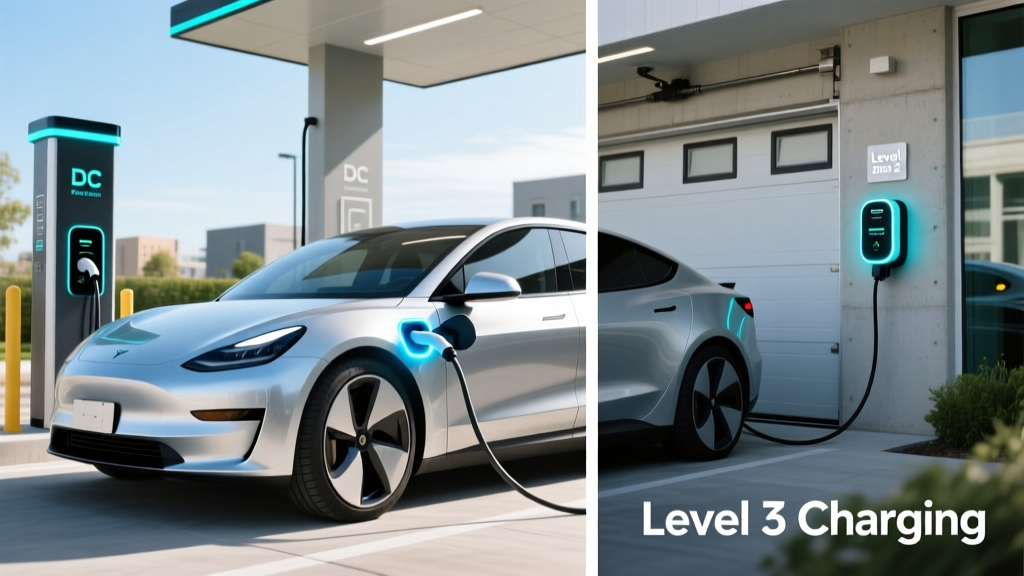
Understanding the three charging levels is essential for Charger Daytona ownership. Each level delivers different power (kW), which translates to different miles of range added per hour of charging.
| Level | Voltage / Amps | Power (kW) | Miles of Range / Hour | 0–100% Time (100.5 kWh) |
|---|---|---|---|---|
| Level 1 (120V) | 120V / 12A | 1.4 kW | ~3–4 mi/hr | ~72 hours |
| Level 2 (240V) | 240V / 48A | 11.5 kW | ~30–35 mi/hr | ~9 hours |
| DC Fast (CCS/NACS) | 400V DC | 150 kW (peak) | ~200+ mi/hr (to 80%) | 10–80% in ~34 min |
Level 1 is the emergency trickle — plugging into a standard 120V household outlet via the mobile charging cord. At 1.4 kW, fully recharging the Charger Daytona's 100.5 kWh battery would take nearly three full days. This is practical only for topping off a few miles overnight.
Level 2 is the daily workhorse for EV owners. A 240V, 48-amp home wallbox delivers 11.5 kW (the car's onboard charger caps at 11 kW). Starting from 20% state of charge, a full overnight session restores the battery by morning — roughly 9 hours from near-empty. This is the setup every Charger Daytona owner should install.
DC Fast Charging bypasses the onboard charger entirely, feeding DC current directly to the battery. The Charger Daytona peaks at 150 kW, but like all EVs, it follows a charge curve: peak speed is sustained only between roughly 10–40% state of charge, then tapers progressively. Expect 150 kW in the low SoC range, dropping to ~100 kW around 50%, ~60 kW around 70%, and ~30 kW approaching 80%. This is why the 10–80% metric (approximately 34 minutes) is the industry standard — charging beyond 80% becomes significantly slower.
Home Charger Installation: Electrical Requirements and Costs
Installing a Level 2 home charger for a 100.5 kWh battery like the Charger Daytona's requires a dedicated 240V circuit — typically 60 amps to support a 48-amp continuous charge (electrical code requires circuits rated at 125% of continuous load). Here's what that involves and what it costs.
Electrical Requirements
- Circuit: Dedicated 60A, 240V breaker (NEMA 14-50 outlet or hardwired)
- Wire gauge: 6 AWG copper (or 4 AWG aluminum) for a 60A run
- Panel capacity: Minimum 200A service recommended; older homes with 100A panels will likely need an upgrade
- GFCI protection: Required by NEC 2020+ for EV receptacles in garages
- Permit: Required in most jurisdictions; inspection follows installation
Installation Cost Breakdown
| Item | Low Estimate | High Estimate | Notes |
|---|---|---|---|
| Level 2 Charger (hardware) | $400 | $750 | 48A smart charger (ChargePoint, Wallbox, Emporia) |
| Electrician labor | $500 | $2,000 | Depends on run length, conduit, panel proximity |
| Electrical permit | $50 | $250 | Varies by municipality |
| Panel upgrade (if needed) | $1,500 | $3,500 | 100A → 200A service upgrade |
| Additional materials (conduit, wire) | $100 | $500 | Longer runs from panel to garage cost more |
| TOTAL (no panel upgrade) | $1,050 | $3,500 | |
| TOTAL (with panel upgrade) | $2,550 | $7,000 |
For a straightforward installation where the electrical panel is adjacent to the garage, expect to spend $1,200–$2,000 total. If the panel is on the opposite side of the house, requires trenching, or needs upgrading, costs climb toward $4,000–$7,000. Always get at least three quotes from licensed electricians, and confirm they hold appropriate EV charger installation experience.
Connector Compatibility: CCS1, NACS, and Adapter Options
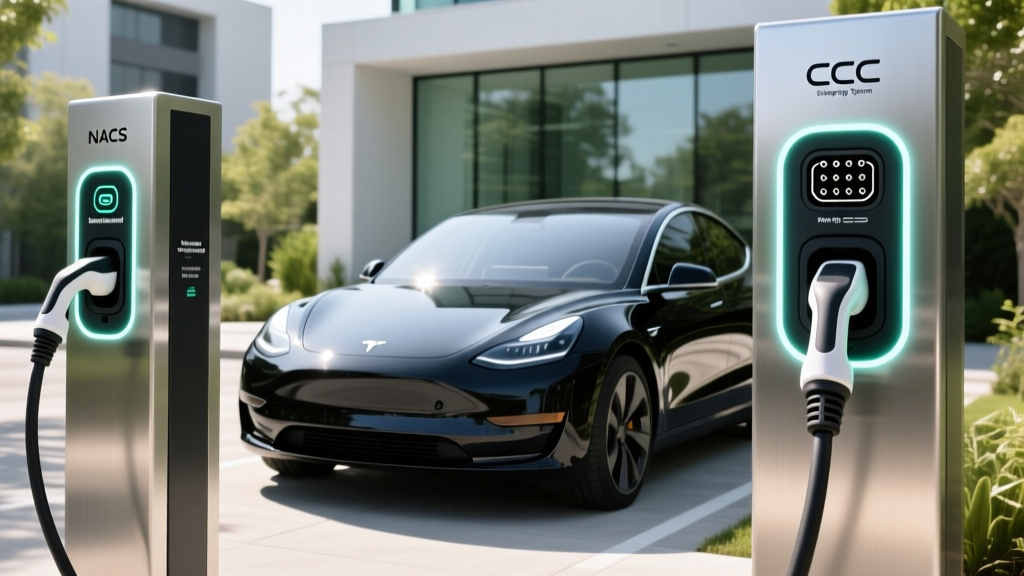
The 2025–2026 Dodge Charger Daytona ships with a CCS1 (Combined Charging System) port, which is the legacy standard used by most non-Tesla automakers. However, the North American charging landscape is rapidly shifting toward NACS (North American Charging Standard), the Tesla-designed connector now adopted by Ford, GM, Rivian, and others.
| Connector | Used By | Charger Daytona? | Adapter Needed? |
|---|---|---|---|
| CCS1 | VW, Hyundai, BMW, Stellantis, legacy networks | Native port | None — plug directly |
| NACS | Tesla, Ford, GM, Rivian (2025+) | Via adapter | CCS-to-NACS adapter (~$200–$250) |
| CHAdeMO | Nissan Leaf (legacy) | Not compatible | N/A — standard is obsolete |
Why the adapter matters: Tesla's Supercharger network — the largest and most reliable DC fast-charging network in North America with over 25,000 stalls — is opening to non-Tesla vehicles, but primarily via NACS connectors. To access Tesla Superchargers (including V3 stalls at 250 kW and V4 stalls) with a Charger Daytona, you'll need a CCS-to-NACS adapter. Stellantis has indicated adapter availability through Mopar accessories, and third-party options from Lectron and A2Z exist. Confirm that any adapter is rated for the Charger Daytona's 150 kW peak before purchasing.
For Level 2 home charging, your wallbox will either have a J1772 connector (universal for CCS vehicles) or a NACS connector. A J1772 home charger works natively with the Charger Daytona. If you install a Tesla Wall Connector (NACS), you'll need the same adapter.
Cost to Charge: Home vs. Public vs. Gas Comparison
One of the strongest arguments for the Charger Daytona over a gas-powered Hellcat is fuel cost. Let's break down the actual cost per mile across different charging scenarios and compare it to premium gasoline.
| Scenario | Rate | Cost for Full 100.5 kWh | Cost per Mile (R/T, 317 mi) |
|---|---|---|---|
| Home (off-peak utility rate) | $0.10/kWh | $10.05 | $0.032/mile |
| Home (avg US residential) | $0.17/kWh | $17.09 | $0.054/mile |
| Public Level 2 (ChargePoint, etc.) | $0.30/kWh | $30.15 | $0.095/mile |
| DC Fast (Electrify America) | $0.48/kWh | $48.24 | $0.152/mile |
| Gas Hellcat (16 MPG combined, $3.80/gal premium) | $3.80/gal | $75.29 (equiv. distance) | $0.238/mile |
Even at the most expensive DC fast-charging rates, the Charger Daytona costs roughly 36% less per mile than a Hellcat on premium gasoline. At home off-peak rates, the savings are dramatic — approximately 87% less per mile. Over 15,000 miles of annual driving, home charging at $0.17/kWh saves roughly $2,760 compared to fueling a 16-MPG Hellcat with premium.
For context, the Charger Daytona R/T achieves an EPA-estimated 97 MPGe combined (approximately 34 kWh/100mi). The Scat Pack, with its wider tires and higher output, drops to roughly 82 MPGe (41 kWh/100mi). These figures align with fueleconomy.gov data for the 2025 model year.
Recommended Home Chargers for the Charger Daytona
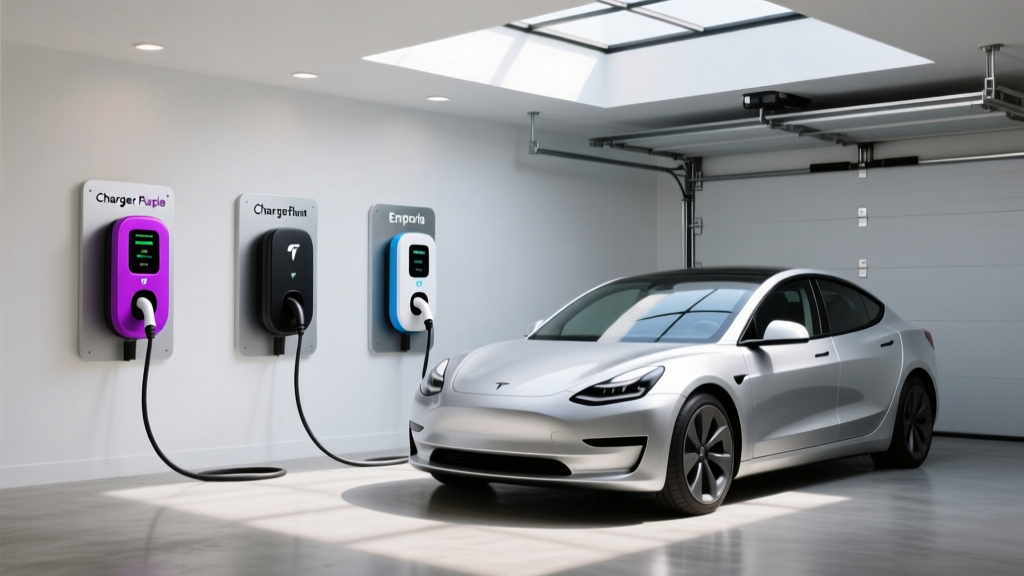
With an 11 kW onboard charger and a 100.5 kWh battery, the Charger Daytona benefits from a 48-amp Level 2 wallbox. Here are three proven options that match its requirements:
ChargePoint Home Flex
- Power: Up to 12 kW (50A) — configurable down to 16A
- Connector: J1772 (works natively with CCS1)
- Cable length: 23 feet
- Smart features: Wi-Fi, app scheduling, Alexa integration, energy tracking
- Price: ~$550–$650
- UL listed, indoor/outdoor rated
Best for: Charger owners who want flexible amperage settings for older panels.
Wallbox Pulsar Plus
- Power: 11.5 kW (48A)
- Connector: J1772
- Cable length: 25 feet
- Smart features: Wi-Fi + Bluetooth, load balancing, Power Sharing (daisy-chain two units on one circuit)
- Price: ~$450–$550
- UL listed, NEMA 4 outdoor rated
Best for: Two-EV households needing dual charging on a single 60A circuit.
Emporia Vue Level 2 Charger
- Power: 11.5 kW (48A)
- Connector: J1772
- Cable length: 24 feet
- Smart features: Integrates with Emporia Vue energy monitor for whole-home load management, solar-aware charging
- Price: ~$400–$500
- UL listed, outdoor rated
Best for: Solar-equipped homes wanting to charge on excess production.
All three chargers deliver the 48 amps the Charger Daytona can accept. Hardwired installation is preferred over a NEMA 14-50 receptacle for reliability — receptacles can loosen over time and some jurisdictions now require GFCI breakers on 14-50 outlets, which can cause nuisance tripping with certain chargers. A hardwired connection eliminates both issues.
Charging Time Examples: What to Expect with 100.5 kWh
The Charger Daytona's large battery means longer fill times than smaller EVs. Here are realistic charging scenarios:
- Daily commute top-up (30% → 80%): ~5 hours on Level 2 at 11 kW — easily achieved overnight
- Near-empty to full (5% → 100%) on Level 2: ~9 hours — plan for a full night
- Road-trip DC fast stop (10% → 80%): ~34 minutes at a 150+ kW station
- DC fast top-up (30% → 80%): ~20 minutes — enough for a quick meal stop
- DC fast charge above 80%: Expect an additional 25–30 minutes from 80% → 100% due to aggressive tapering — avoid this on road trips unless necessary
Charge curve reality check: The 150 kW peak applies only in optimal conditions — battery preheated (the car does this automatically when you navigate to a charger), state of charge below 40%, and ambient temperature above ~50°F. In cold weather (below freezing), expect peak rates of 100–120 kW until the battery warms, adding 5–10 minutes to a 10–80% session. Always precondition the battery by entering a DC fast charger as your navigation destination — this activates thermal management and ensures peak charge speeds on arrival.
Safety, Code, and Installation Best Practices
EV charging involves sustained high-current electrical loads — more demanding than any other appliance in your home. Follow these safety principles:
- Dedicated circuit only: Never share the EV charger circuit with other appliances. A 60A dedicated breaker is mandatory.
- GFCI protection: NEC 2020 and later requires GFCI protection for 125V/250V receptacles used for EV charging. Hardwired installations are exempt from this requirement and avoid nuisance tripping.
- Outdoor rating: If installing outside, ensure the charger carries a NEMA 4 or NEMA 4X rating for weather resistance. All three recommended chargers above qualify.
- Permit and inspection: Always pull a permit. An inspection ensures the installation meets code and protects your homeowner's insurance coverage. Unpermitted work can void claims in the event of an electrical fire.
- Cable management: A 23–25 foot cable is standard. Use a wall-mounted cable organizer to prevent tripping hazards and cable damage.
- Surge protection: Consider a whole-home surge protector ($200–$400 installed) to safeguard the charger's electronics from lightning and grid surges.
Federal Tax Credit: Does the Charger Daytona Qualify?
Under current IRS §30D rules, the Dodge Charger Daytona's eligibility for the up-to-$7,500 federal clean vehicle credit depends on several factors that shift frequently:
- MSRP cap: Sedans must be under $55,000 to qualify. The Charger Daytona R/T starts at $59,595 — above the cap. This currently disqualifies new purchases from the full credit unless Stellantis reclassifies the vehicle or adjusts pricing.
- Buyer income limits: AGI must not exceed $150,000 (single), $225,000 (head of household), or $300,000 (joint).
- Battery sourcing: Critical minerals and battery components must meet escalating domestic-content thresholds. These requirements tighten annually through 2029.
- Point-of-sale transfer: If eligible, the credit can be transferred to the dealer at purchase, reducing the out-of-pocket price immediately rather than waiting for a tax refund.
As of early 2026, the Charger Daytona's MSRP exceeds the §30D sedan cap. However, buyers should verify current eligibility at fueleconomy.gov and consult a tax professional before purchase. State-level incentives (California, Colorado, Massachusetts, and others) may offer additional rebates independent of federal rules.
Frequently Asked Questions
How much does it cost to install a home EV charger for the Dodge Charger Daytona?
Between $1,050 and $3,500 for a standard installation (equipment, electrician, permit) without a panel upgrade. If your home needs a 100A-to-200A panel upgrade, total costs range from $2,550 to $7,000. The charger hardware itself costs $400–$750 for a quality 48A unit.
How fast will each charging level add range to the Charger Daytona?
Level 1 (120V) adds roughly 3–4 miles per hour. Level 2 (240V, 48A) adds approximately 30–35 miles per hour. DC fast charging at 150 kW can add over 200 miles of range per hour in the optimal 10–40% state-of-charge window, tapering significantly above 80%.
Which connector is compatible with the Dodge Charger Daytona?
The Charger Daytona uses a CCS1 connector natively. To access Tesla Superchargers or NACS-equipped public stations, you'll need a CCS-to-NACS adapter (approximately $200–$250 from Mopar or third-party manufacturers like Lectron). For home Level 2 charging, any J1772-equipped wallbox works directly.
How much does charging cost per mile compared to a gas Hellcat?
At the US average residential electricity rate of $0.17/kWh, the Charger Daytona R/T costs about $0.054 per mile. A Hellcat on premium gasoline at $3.80/gallon and 16 MPG combined costs $0.238 per mile — roughly 4.4x more. Over 15,000 annual miles, that's a savings of approximately $2,760 per year with home charging.
What electrical upgrades might I need for a Charger Daytona home charger?
The most common upgrade is a panel capacity increase from 100A to 200A service ($1,500–$3,500), required when your existing panel can't accommodate a new 60A circuit alongside existing loads. You'll also need a dedicated 60A, 240V breaker with 6 AWG copper wire. Homes with the panel near the garage typically face minimal additional costs; longer wire runs increase material and labor expenses.
Can I use a Tesla Supercharger with the Dodge Charger Daytona?
Yes, with a CCS-to-NACS adapter. Tesla's Supercharger network is progressively opening to non-Tesla vehicles, but access requires the NACS connector. Once you have a compatible adapter, you can use the Tesla app or in-car navigation (on supported Supercharger stalls with Magic Dock) to initiate charging. Confirm adapter compatibility with your specific model year before purchasing.
How long does the Charger Daytona battery last, and what's the warranty?
Stellantis provides an 8-year/100,000-mile battery warranty that guarantees at least 70% capacity retention. The NMC chemistry in the 100.5 kWh pack is expected to retain 85–90% capacity after 100,000 miles based on industry degradation data for liquid-cooled NMC packs. To maximize longevity, avoid routinely charging to 100% — set your daily limit to 80–90% and reserve full charges for road trips.