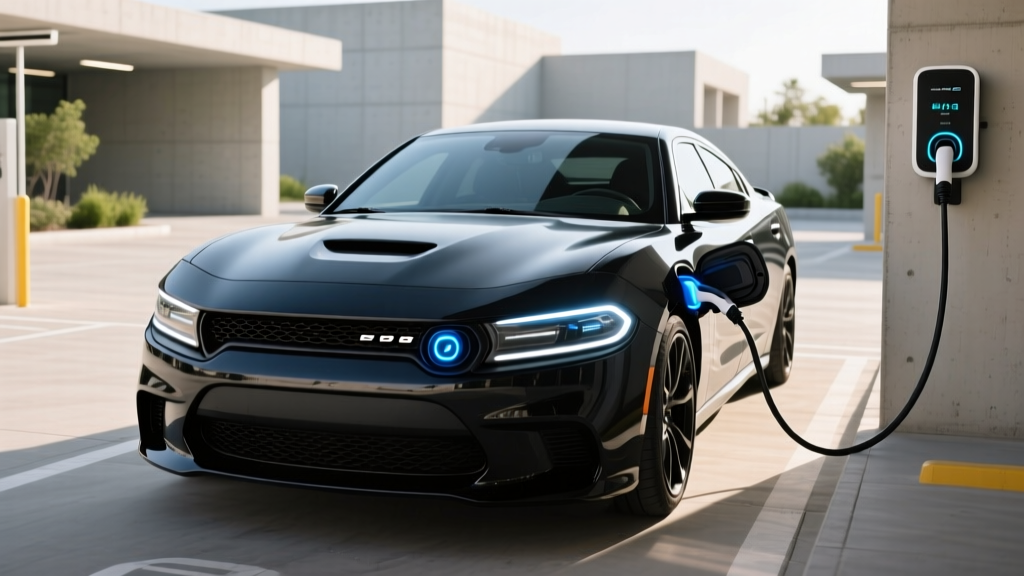
If you've been asking are the new Dodge Chargers electric, the answer for the 2026 model year is a definitive yes — at least for the Charger Daytona lineup. Dodge has fully committed to battery-electric muscle with the Charger Daytona Scat Pack and R/T, built on Stellantis' STLA Large platform. But owning an EV muscle car means rethinking how you "fill up." This guide breaks down exactly how to charge a 2026 Dodge Charger Daytona at home and in public, what it costs, and what electrical work your garage might need.
Battery: ~100.5 kWh usable (NMC chemistry) | EPA Range: 317 miles (R/T), 260 miles (Scat Pack)
Peak DC Fast Charge: up to 175 kW | 10–80% in ~32 minutes
Level 2 AC Charge: 11 kW onboard | 0–100% in ~9.5 hours
Base MSRP: ~$51,990 (R/T) / ~$61,990 (Scat Pack) before incentives
Charging Levels Explained: How Fast Will Each Add Range?
Understanding EV charging starts with one critical distinction: kW (kilowatts) measures power — the rate of energy flow, like water pressure from a hose. kWh (kilowatt-hours) measures energy — the total amount stored in the battery, like gallons in a tank. The Charger Daytona's battery holds roughly 100.5 kWh of energy. How fast you refill it depends on the charging level.
| Level | Voltage / Amps | Power (kW) | Miles of Range Added per Hour | Best Use Case |
|---|---|---|---|---|
| Level 1 | 120V / 12A | ~1.4 kW | ~3–5 mi/hr | Emergency / overnight trickle |
| Level 2 | 240V / 40–48A | 9.6–11.5 kW | ~25–35 mi/hr | Daily home charging |
| DC Fast Charging | 400V+ DC | 50–175 kW | ~150–500+ mi/hr (peak) | Road trips, quick top-ups |
For the Charger Daytona's large 100.5 kWh battery, Level 1 is essentially a maintenance trickle — it would take over 70 hours for a full charge. Level 2 is the practical daily solution: plug in when you get home, wake up to a full battery every morning. DC fast charging is your road-trip lifeline, though real-world charging curves mean you won't sustain peak speeds the entire session.
Real-world charging curve reality: The Charger Daytona's peak 175 kW rate applies at a low state of charge (around 10–20%). As the battery fills past 80%, the charge rate tapers significantly to protect cell health — expect speeds to drop to 50 kW or below above 80% SoC. This is why manufacturers quote 10–80% times rather than 0–100%.
Home Charger Installation: Electrical Requirements and Costs
Installing a Level 2 home charger is the single most impactful upgrade for EV ownership. For a car with the Charger Daytona's ~100 kWh battery, you'll want a 48-amp charger on a dedicated 60-amp circuit to maximize the car's 11 kW onboard charger capability.
Electrical Requirements
- Circuit: Dedicated 60-amp, 240V breaker (for a 48A continuous-load charger)
- Wire: 6 AWG copper (THHN in conduit or NM-B/Romex where code permits)
- Panel capacity: Your main service panel needs sufficient spare capacity — typically 200A service is adequate for most homes adding a 60A EV circuit
- GFCI protection: Required by NEC 2020+ for EV charging outlets in garages (hardwired units may bypass this requirement depending on local code)
- Permit: Most jurisdictions require an electrical permit and inspection for new 240V circuits
How Much Does It Cost to Install a Home EV Charger?
Costs vary widely depending on your panel's location relative to the garage, whether you need a panel upgrade, and local labor rates. Here's a realistic breakdown for 2026:
| Component | Simple Install (panel near garage) | Complex Install (long run, panel upgrade) |
|---|---|---|
| Level 2 Charger (48A, hardwired or NEMA 14-50) | $400–$700 | $400–$700 |
| Electrician labor (2–4 hrs simple / 6–10 hrs complex) | $300–$600 | $900–$2,000 |
| Materials (wire, conduit, breaker, outlet) | $100–$200 | $250–$600 |
| Permit & inspection | $50–$150 | $50–$200 |
| Panel upgrade (100A → 200A, if needed) | N/A | $1,500–$3,500 |
| TOTAL | $850–$1,650 | $3,100–$7,000 |
What Electrical Upgrades Might I Need?
Beyond the panel itself, consider these potential upgrades:
- Conduit run: If your panel is on the opposite side of the house from the garage, expect a longer wire run through attic or crawlspace, increasing labor and material costs.
- NEMA 14-50 outlet vs. hardwired: A 14-50 outlet gives you flexibility to unplug and take your charger when you move, but requires a GFCI breaker ($100–$150 extra). Hardwired installations skip the outlet and GFCI requirement in many jurisdictions, reducing cost.
- Smart panel / energy management: If your panel is maxed out but you want to avoid a full upgrade, devices like the Emporia Smart Panel or Span.IO can dynamically manage loads, allowing EV charging without exceeding your service limit. These cost $500–$2,000 installed.
Connector Compatibility: Which Plug Does the Charger Daytona Use?
The 2026 Dodge Charger Daytona ships with a CCS1 (Combined Charging System) port. This is the standard connector used by most non-Tesla EVs in North America. However, the industry is rapidly transitioning to NACS (North American Charging Standard, pioneered by Tesla), and Stellantis has signaled future models may adopt it.
| Connector | Used By | Charger Daytona Compatible? | Adapter Needed? |
|---|---|---|---|
| CCS1 | Dodge, Hyundai, Kia, BMW, VW, GM (2024 and earlier), Ford (2024 and earlier) | ✅ Native — no adapter | No |
| NACS (Tesla) | Tesla, Ford (2025+), GM (2025+), Rivian, Volvo | ⚠️ With adapter | Yes — CCS-to-NACS adapter (~$200–$300) for Supercharger access |
| CHAdeMO | Nissan Leaf (legacy), Mitsubishi | ❌ Not compatible | N/A — obsolete standard |
| J1772 (Level 2 AC) | All non-Tesla EVs (AC charging) | ✅ Native — CCS includes J1772 | No |
Practical advice: For home Level 2 charging, any J1772 charger works natively. For DC fast charging on road trips, the Charger Daytona accesses Electrify America, EVgo, and other CCS networks directly. If you want access to Tesla's Supercharger network (the largest and most reliable in North America per Tesla's Supercharger page), you'll need a CCS-to-NACS adapter. Check with Dodge for approved adapter compatibility before purchasing.
Charging Cost Per Mile: EV vs. Gas Muscle Car
One of the strongest arguments for the electric Charger Daytona is fuel cost savings, especially versus the supercharged Hellcat V8 it effectively replaces. Here's a realistic cost comparison using 2026 energy prices.
| Scenario | Rate | Cost per Full Charge / Fill | Cost per Mile |
|---|---|---|---|
| Home charging (off-peak utility rate) | $0.09/kWh | $9.05 (100.5 kWh) | $0.029/mi |
| Home charging (national avg residential) | $0.16/kWh | $16.08 | $0.051/mi |
| Public Level 2 (workplace / shopping) | $0.25/kWh | $25.13 | $0.079/mi |
| DC Fast Charging (Electrify America, EVgo) | $0.40/kWh | $40.20 | $0.127/mi |
| Gas: 2023 Dodge Charger Hellcat (12 MPG city) | $3.40/gal | $61.20 (18-gal tank) | $0.283/mi |
At the national average residential electricity rate, charging the Daytona at home costs roughly $0.05 per mile — nearly 6× cheaper than fueling a Hellcat at $0.28/mile. Even DC fast charging on road trips ($0.13/mile) undercuts gasoline significantly. According to the EPA's fueleconomy.gov EV calculator, an EV driver charging primarily at home saves $800–$1,200 annually versus a comparable gas performance car.
Pro tip: Many utilities offer time-of-use (TOU) plans with off-peak rates as low as $0.06–$0.09/kWh between midnight and 6 AM. Set your charger's schedule to take advantage — a full charge for under $10 is realistic.
Charging Time Examples: 10–80% for the Charger Daytona
With a ~100.5 kWh battery, the Charger Daytona has one of the largest packs in its class. Here's how long a 10–80% session takes at various charging speeds (adding roughly 70 kWh):
- 175 kW DC fast charger (peak): ~32 minutes (10–80%). Expect the first 20% to charge rapidly at 150–175 kW, then taper to ~100 kW through the 50–80% range.
- 150 kW DC fast charger: ~36 minutes (10–80%). Common at Electrify America 150 kW stalls.
- 50 kW DC fast charger (older stations): ~85 minutes (10–80%). Avoid these on road trips if faster options exist.
- 48A Level 2 home charger (11.5 kW): ~6 hours (10–80%). Ideal for overnight.
- 32A Level 2 charger (7.7 kW): ~9 hours (10–80%). Still sufficient for overnight on most schedules.
- Level 1 (1.4 kW): ~50 hours (10–80%). Impractical except as emergency backup.
Recommended Home Charging Equipment
For a vehicle with the Charger Daytona's 11 kW onboard charger and 100+ kWh battery, you want a 48-amp Level 2 unit to minimize overnight charge time. Here are top picks for 2026:
Emporia Level 2 Smart Charger
- Power: 48A / 11.5 kW (240V)
- Connector: J1772 (CCS-compatible)
- Cable length: 24 ft
- Smart features: Wi-Fi, app scheduling, energy monitoring, solar integration
- Price: ~$399
- Best for: Budget-conscious buyers who want smart scheduling and energy tracking
ChargePoint Home Flex
- Power: Up to 50A / 12 kW (240V, adjustable)
- Connector: J1772 (CCS-compatible)
- Cable length: 23 ft
- Smart features: Wi-Fi, app scheduling, Alexa, amperage configurable via DIP switch
- Price: ~$549
- Best for: Flexibility — adjust amperage to match your circuit without buying a new unit
Tesla Universal Wall Connector
- Power: 48A / 11.5 kW (240V)
- Connector: Built-in NACS + J1772 adapter included
- Cable length: 24 ft
- Smart features: Wi-Fi, OTA updates, power sharing between two units
- Price: ~$599
- Best for: Multi-EV households with both Tesla and non-Tesla vehicles
Grizzl-E Smart
- Power: 40A / 9.6 kW (240V)
- Connector: J1772 (CCS-compatible)
- Cable length: 24 ft
- Smart features: OCPP-compatible, app control, extreme cold rated (-40°F)
- Price: ~$449
- Best for: Cold-climate and outdoor installations — built in Canada, ruggedized
Safety, Code, and Installation Best Practices
EV charging draws sustained high current for hours — this is fundamentally different from intermittent loads like a dryer. Follow these safety guidelines:
- Dedicated circuit: Your Level 2 charger MUST be on its own dedicated breaker — never share a circuit with other appliances. A 48A charger requires a 60A breaker (NEC requires circuits rated at 125% of continuous load).
- Outdoor rating: If installing outside, ensure the charger carries a NEMA 4 (weatherproof) rating. All recommended units above are outdoor-rated.
- GFCI protection: NEC 625.54 requires GFCI protection for EV charging receptacles (outlets). Hardwired chargers may be exempt in some jurisdictions — confirm with your electrician and local AHJ (Authority Having Jurisdiction).
- Cable management: Use a wall-mounted cable organizer to prevent the charging cable from contacting the garage floor, where it can collect moisture and debris.
- Surge protection: Consider a whole-home surge protector ($200–$400 installed) to protect your charger and vehicle from voltage spikes, especially in areas with frequent lightning or grid instability.
- Professional installation only: Always hire a licensed electrician. DIY 240V work is dangerous and will void your homeowner's insurance if an unpermitted installation causes damage. Verify the electrician has EV charger installation experience.
Frequently Asked Questions
Are all new Dodge Chargers electric?
For 2026, the Dodge Charger Daytona lineup (R/T and Scat Pack) is fully battery-electric, built on Stellantis' STLA Large platform with a ~100.5 kWh NMC battery. Dodge has not announced a gas-powered variant of the new-generation Charger as of early 2026. The previous-generation Charger with V6 and V8 Hemi engines was discontinued after 2023.
How much does it cost to install a home EV charger for the Charger Daytona?
A straightforward installation with the electrical panel near the garage typically costs $850–$1,650, including a 48A Level 2 charger, electrician labor, materials, and permit. Complex installations requiring long wire runs or a panel upgrade can reach $3,100–$7,000. Always get 2–3 quotes from licensed electricians.
Can I charge the Dodge Charger Daytona at a Tesla Supercharger?
Not natively — the Charger Daytona uses a CCS1 port, while Tesla Superchargers use NACS. However, you can purchase a CCS-to-NACS adapter (approximately $200–$300) to access Tesla's Supercharger network. Confirm adapter compatibility with Dodge before purchasing, as not all adapters support all vehicles' communication protocols.
How much does charging cost per mile vs. gas?
Charging at home at the national average electricity rate (~$0.16/kWh) costs about $0.05 per mile in the Charger Daytona. DC fast charging on road trips runs roughly $0.13/mile. Compare this to a gas-powered muscle car at 12–16 MPG, which costs $0.21–$0.28 per mile at $3.40/gallon. Home charging saves 5–6× on fuel cost per mile.
Will the Charger Daytona qualify for the federal EV tax credit?
The federal §30D tax credit offers up to $7,500 for qualifying new EVs, but eligibility depends on MSRP caps (sedans must be under $55,000), buyer income limits ($150K single / $300K joint), and battery sourcing requirements. The Charger Daytona R/T's ~$51,990 MSRP falls under the cap, but the Scat Pack at ~$61,990 exceeds it. Battery sourcing rules change frequently — verify current eligibility on IRS.gov's clean vehicle credit page and consult a tax professional before purchasing.
What happens if I charge to 100% every night?
NMC batteries (like the Charger Daytona's) degrade faster when held at 100% state of charge for extended periods. For daily driving, set your charge limit to 80–90% and only charge to 100% before long road trips. The vehicle's battery management system includes a buffer that protects against extreme overcharge, but limiting routine charge to 80% will maximize long-term battery health and help you stay well within the 8-year/100,000-mile battery warranty coverage.
How fast will each charging level add range?
Level 1 (120V) adds roughly 3–5 miles of range per hour — suitable only for emergencies or very low daily mileage. Level 2 (240V, 48A) adds approximately 30 miles per hour, enough to fully replenish the Daytona's battery overnight. DC fast charging at 175 kW can add up to 150+ miles in 15 minutes at a low state of charge, tapering as the battery fills.
Sources: EPA fueleconomy.gov, IRS §30D Clean Vehicle Credit, Stellantis North America press specifications. All pricing and specifications reflect 2026 model year data available at time of publication. Tax credit eligibility is subject to change — consult IRS.gov and a qualified tax professional for your specific situation.