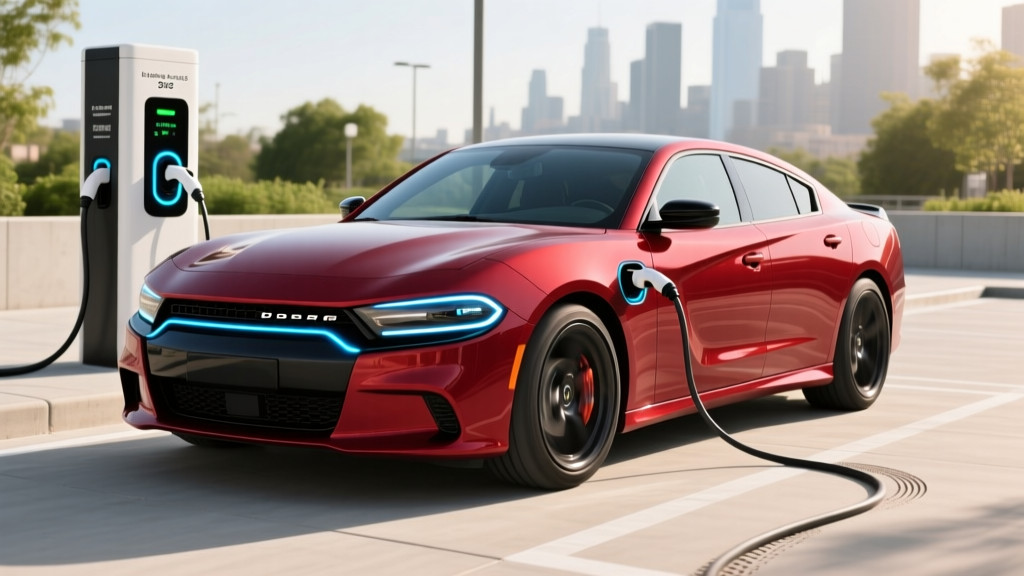
When shoppers ask "are Dodge Chargers all wheel drive?" in 2026, the answer depends entirely on which Charger you're looking at. The new all-electric Dodge Charger Daytona — built on Stellantis' STLA Large platform — offers both rear-wheel-drive (RWD) and all-wheel-drive (AWD) configurations, while the returning Hurricane inline-six gas models also offer AWD on select trims. But buying an AWD EV Charger is only half the equation. Understanding how to charge it efficiently at home and on the road is where most new EV buyers get tripped up.
This guide answers the drivetrain question with exact specs, then walks you through everything you need to charge a Dodge Charger Daytona EV at home or in public — from electrical panel requirements to connector types, real charging speeds, and cost-per-mile math.
2026 Dodge Charger Daytona: AWD, RWD, and Drivetrain Breakdown
The 2026 Dodge Charger Daytona EV is available in multiple powertrain configurations. Here is the drivetrain layout by trim:
| Trim | Drivetrain | Motor Config | Horsepower | 0-60 mph | EPA Range (est.) | Base MSRP |
|---|---|---|---|---|---|---|
| Daytona R/T | RWD | Rear single motor | 496 hp | ~4.7s | ~317 mi | ~$59,595 |
| Daytona Scat Pack | AWD | Dual motor (front + rear) | 670 hp | ~3.3s | ~260 mi | ~$73,590 |
| Daytona Banshee (announced) | AWD | Dual motor, 800V arch. | ~800+ hp (prelim.) | ~2.3s (prelim.) | TBD | TBD |
The short answer: Yes, the Dodge Charger Daytona Scat Pack and the upcoming Banshee are all-wheel drive, using a dual-motor configuration. The R/T trim is rear-wheel drive only. If AWD is a priority — for snow traction, launch grip, or year-round confidence in northern climates — you'll need the Scat Pack or higher.
Charging Levels Explained: How Fast Will Each Level Add Range?
Before installing anything, you need to understand the three charging levels. The single most important distinction in EV charging: kW (kilowatts) measures power — how fast energy flows into the battery. kWh (kilowatt-hours) measures energy — the total capacity of the battery, like gallons in a fuel tank. A 100 kWh battery charged at 10 kW takes roughly 10 hours from empty to full.
| Level | Voltage | Power Output | Miles of Range Added Per Hour | Typical Use Case |
|---|---|---|---|---|
| Level 1 | 120V AC | 1.0 – 1.4 kW | 3 – 5 mi/hr | Emergency / overnight trickle (adds ~30-45 mi in 10 hrs) |
| Level 2 | 240V AC | 3.3 – 19.2 kW | 12 – 75 mi/hr | Home daily charging, workplaces, hotels |
| DC Fast Charging | 400V–800V DC | 50 – 350+ kW | 150 – 1,000+ mi/hr (peak) | Road trips, highway corridors, quick top-ups |
For the Charger Daytona's estimated ~100 kWh battery pack, here's what charging times look like in practice:
- Level 1 (1.4 kW): 0-100% in ~71 hours. Impractical as a primary method.
- Level 2 at 11.5 kW (48A): 0-100% in ~9 hours. Ideal for overnight home charging.
- Level 2 at 7.7 kW (32A): 0-100% in ~13 hours. Adequate if your panel limits you to a 40A circuit.
- DC Fast Charging (peak ~175 kW, CCS1): 10-80% in approximately 27-32 minutes, depending on battery temperature and state of charge.
Home Charger Installation: Electrical Requirements & Cost Breakdown
Installing a Level 2 home charger is the single most impactful upgrade for EV ownership. Here's what's involved for a Charger Daytona owner.
Electrical Requirements
A Level 2 charger requires a dedicated 240-volt circuit, similar to what powers an electric dryer or oven. The circuit amperage determines your charging speed:
- 40-amp circuit → 32A continuous draw → 7.7 kW → ~29 mi/hr of range added
- 50-amp circuit → 40A continuous draw → 9.6 kW → ~36 mi/hr
- 60-amp circuit → 48A continuous draw → 11.5 kW → ~43 mi/hr
National Electrical Code (NEC) requires that continuous loads (like EV charging) use only 80% of a circuit's rated capacity. So a 48A charger needs a 60A breaker.
Panel Upgrade Considerations
Many older homes have 100A or 150A electrical panels that may already be near capacity. Adding a 60A EV circuit could require a panel upgrade to 200A, which is one of the most significant hidden costs in home EV charging. A licensed electrician will perform a load calculation to determine whether your existing panel can handle the additional draw.
| Item | Cost Range | Notes |
|---|---|---|
| Level 2 Charger (hardwired or NEMA 14-50 plug) | $350 – $750 | Smart Wi-Fi-enabled units; non-smart units from ~$250 |
| Electrician labor (standard install, panel to garage) | $500 – $1,500 | Varies by run length, wall type, conduit needs |
| Electrical permit | $50 – $200 | Required in most jurisdictions; inspection included |
| Panel upgrade (if needed) | $1,500 – $4,000 | 200A service upgrade; not always required |
| Total (no panel upgrade) | $900 – $2,450 | Most homes with 200A panels fall in this range |
| Total (with panel upgrade) | $2,400 – $6,450 | Older homes with 100A/150A service |
Federal incentive note: The IRS §30C Alternative Fuel Vehicle Refueling Property Credit may cover up to 30% of home charger equipment and installation costs (capped at $1,000), subject to census-tract eligibility requirements. Check your zip code against the IRS qualifying-tract tool before assuming eligibility.
Safety & Code Requirements
- Dedicated circuit: Your EV charger must be on its own dedicated breaker — not shared with other appliances.
- GFCI protection: NEC 2020+ requires GFCI protection for outlets used for EV charging (relevant if using a NEMA 14-50 receptacle rather than hardwiring).
- Outdoor rating: If your charger is installed outside (driveway, carport), the unit must carry a NEMA 4 or IP65 weather rating.
- Hardwire vs. plug: Hardwired installations avoid the GFCI breaker requirement and are generally more reliable, but a NEMA 14-50 outlet offers portability if you move.
- Cable management: Ensure the charging cable won't be a trip hazard or subject to vehicle runover — wall-mounted cable organizers are recommended.
Connector Compatibility: NACS, CCS1, and What the Charger Daytona Uses
The 2026 Dodge Charger Daytona EV comes equipped with a CCS1 (Combined Charging System) port for both Level 2 AC and DC fast charging. However, the EV charging landscape has shifted heavily toward NACS (North American Charging Standard), the Tesla-designed connector now adopted by Ford, GM, Rivian, Volvo, and most major automakers.
Here's where each connector stands in 2026:
| Connector | AC Level 2 | DC Fast | Major Brands Using It | Network Availability |
|---|---|---|---|---|
| CCS1 | Yes (J1772 + DC pins) | Yes | Dodge/Stellantis EVs, VW ID.4 (pre-2025), Hyundai Ioniq 5 (pre-2025), BMW i4 | Electrify America, EVgo, ChargePoint DC stations |
| NACS (Tesla) | Yes | Yes | Tesla (all), Ford, GM, Rivian, Volvo, Polestar, Honda (2025+) | Tesla Supercharger network (17,000+ stalls), growing third-party |
| CHAdeMO | No (uses J1772 for AC) | Yes | Nissan Leaf (legacy), Mitsubishi Outlander PHEV (legacy) | Declining; limited new installations |
What this means for Charger Daytona owners: You can use CCS1-equipped public chargers natively. For access to the Tesla Supercharger network — the largest and most reliable DC fast-charging network in North America — you'll need a CCS1-to-NACS adapter. Stellantis has indicated future models may transition to NACS natively, but the 2026 Charger Daytona retains CCS1.
Several third-party adapters (such as those from Lectron or A2Z EV) are available for approximately $150-$250. Verify that any adapter is rated for the full DC fast-charging amperage your vehicle can accept before purchasing.
Cost to Charge: Per-Mile Economics vs. Gas
One of the strongest ownership arguments for the Charger Daytona EV over its Hurricane inline-six sibling is fuel cost. Let's run the numbers using real 2026 electricity and gas prices.
| Scenario | Rate | Cost per kWh | Cost per Mile (EV at 3.0 mi/kWh) | Cost per Mile (Gas at 22 MPG combined) |
|---|---|---|---|---|
| Home off-peak (utility time-of-use) | $0.08 – $0.12/kWh | ~$0.10 | $0.033 | $0.159 (at $3.50/gal) |
| Home standard rate | $0.13 – $0.18/kWh | ~$0.15 | $0.050 | $0.159 |
| Public Level 2 (ChargePoint, etc.) | $0.25 – $0.49/kWh | ~$0.35 | $0.117 | $0.159 |
| DC Fast Charging (Electrify America) | $0.35 – $0.55/kWh | ~$0.45 | $0.150 | $0.159 |
| DC Fast Charging (Tesla Supercharger, via adapter) | $0.25 – $0.40/kWh | ~$0.32 | $0.107 | $0.159 |
The takeaway: Home charging at off-peak rates is roughly 5x cheaper per mile than gasoline. Even public DC fast charging is generally cheaper or on-par with gas — but it's not always a massive savings. The real financial win is charging at home overnight on a time-of-use plan. According to fueleconomy.gov, the Charger Daytona's estimated efficiency of ~3.0 miles per kWh (approximately 100 MPGe combined) is typical for a performance-oriented large EV coupe.
If you drive 12,000 miles per year and charge primarily at home at $0.12/kWh, your annual "fuel" cost is approximately $480. The equivalent gas Charger at 22 MPG and $3.50/gallon costs roughly $1,909/year — a savings of over $1,400 annually with the EV.
Recommended Home Chargers for the Dodge Charger Daytona
Not all Level 2 chargers are created equal. Here are three proven units that pair well with the Charger Daytona's estimated 11.5 kW onboard charger acceptance rate:
Emporia Vue + Level 2 EV Charger
- Power Output: 48A / 11.5 kW (hardwired) or 40A / 9.6 kW (NEMA 14-50)
- Connector: J1772 (CCS1-compatible for AC charging)
- Cable Length: 24 ft
- Smart Features: Wi-Fi, energy monitoring, solar integration, scheduled charging, utility TOU optimization
- Price: ~$399
- Best for: Budget-conscious buyers who want smart scheduling and energy tracking
ChargePoint Home Flex
- Power Output: Up to 50A / 12 kW (adjustable via DIP switches for 16A–50A)
- Connector: J1772 (CCS1-compatible for AC)
- Cable Length: 23 ft
- Smart Features: Wi-Fi, ChargePoint app scheduling, Alexa integration, flexible amperage to match your circuit
- Price: ~$549
- Best for: Flexibility — adjust amperage if your panel can't support a full 60A circuit
Wallbox Pulsar Plus (48A)
- Power Output: 48A / 11.5 kW (hardwired)
- Connector: J1772 (CCS1-compatible for AC)
- Cable Length: 25 ft
- Smart Features: Wi-Fi + Bluetooth, load balancing (Power Sharing for two chargers on one circuit), compact form factor
- Price: ~$599
- Best for: Two-EV households or installations with limited wall space
Editor's note: All three units above use the J1772 connector for AC Level 2 charging, which is the AC portion of the CCS1 standard. This means they plug directly into your Charger Daytona's CCS1 port without any adapter. For DC fast charging on the road, you use the larger CCS1 pins below the J1772 inlet — no home equipment is involved.
Public Charging Networks: Where to Charge a CCS1-Equipped Charger Daytona
For road trips and public top-ups, Charger Daytona owners have access to multiple networks using the native CCS1 connector:
- Electrify America: The largest CCS1-native DC fast-charging network in the U.S., with 350 kW-capable stations along major highway corridors. Expect peak speeds of ~175 kW for the Charger Daytona (vehicle-limited, not station-limited). Pricing: $0.35-$0.55/kWh depending on region, or ~$0.31/kWh with a Pass+ subscription ($4/month).
- EVgo: Growing CCS1 network in metro areas and highway stops. Pricing varies; typically $0.30-$0.45/kWh.
- ChargePoint: Extensive Level 2 network (hotels, workplaces, retail) plus a growing number of DC fast stations. Use the ChargePoint app for availability.
- Tesla Supercharger (via adapter): With a CCS1-to-NACS adapter, you gain access to 17,000+ Supercharger stalls. Note that some older V2 Superchargers use a proprietary Tesla connector and won't work with adapters — stick to V3/V4 Magic Dock stations or use the adapter at standard NACS stalls.
For a NHTSA-referenced trip planning tip: always have a backup charging stop identified within 50 miles of your primary stop. Public charger uptime averages 85-90% across major networks, meaning a 1-in-10 chance of a stall being offline or occupied.
Frequently Asked Questions
Are Dodge Chargers all wheel drive?
The 2026 Dodge Charger Daytona Scat Pack is all-wheel drive (dual-motor AWD). The R/T trim is rear-wheel drive. The upcoming Banshee variant is expected to be AWD as well. For the gas-powered Charger with the Hurricane inline-six, AWD is available on select trims.
How much does it cost to install a home EV charger?
Expect $900–$2,450 for a standard Level 2 installation (equipment + electrician + permit) if your electrical panel has capacity. If a panel upgrade to 200A is needed, total costs range from $2,400–$6,450. The IRS §30C credit may offset up to $1,000 (30%) of costs in qualifying census tracts.
How fast will each charging level add range?
Level 1 (120V) adds 3-5 miles per hour. Level 2 (240V) adds 12-75 miles per hour depending on amperage — a 48A/11.5 kW setup adds roughly 43 miles per hour. DC fast charging at 175 kW can add 200+ miles in 20 minutes, but only during the peak portion of the charge curve (typically 10-50% SoC).
Which connector is compatible with the Dodge Charger Daytona?
The Charger Daytona uses CCS1 for both AC Level 2 and DC fast charging. Any J1772-equipped Level 2 charger works for home/AC charging. For DC fast charging, use CCS1 stations (Electrify America, EVgo) natively, or use a CCS1-to-NACS adapter for Tesla Supercharger access.
How much does charging cost per mile vs. gas?
Home charging at off-peak rates (~$0.10/kWh) costs about $0.033/mile — roughly 5x cheaper than the gas Charger at $0.159/mile (22 MPG, $3.50/gal). Public DC fast charging at $0.45/kWh costs ~$0.15/mile, which is comparable to gas. The biggest savings come from consistent home charging.
What electrical upgrades might I need for a home charger?
You'll need a dedicated 240V circuit (40A–60A depending on charger amperage). If your home has a 100A or 150A panel that's already near capacity, a panel upgrade to 200A may be required — this adds $1,500–$4,000 to the project. A licensed electrician will perform a load calculation during the initial assessment to determine whether an upgrade is necessary.
Does the AWD Charger Daytona charge slower than the RWD version?
No. Both the RWD R/T and AWD Scat Pack share the same battery architecture and onboard charger, so charging speeds are identical. The difference is energy consumption — the AWD Scat Pack uses more kWh per mile due to dual-motor weight and power, which means it needs to charge more frequently, not more slowly.