The Dodge Charger Daytona — Stellantis's electric muscle car that effectively succeeds the Challenger nameplate — packs up to a 100.5 kWh (gross) battery and an EPA-estimated range of up to 317 miles. Whether you own one already, have a reservation, or are weighing the switch from a gas Challenger, one question dominates: how do you actually charge it, and what will that cost?
This guide covers everything a Challenger-turned-Charger-Daytona owner (or prospective buyer) needs to know about EV charging in 2026 — from Level 1 trickle charging in your garage to 350 kW DC fast charging on a road trip, with exact numbers for install costs, electrical requirements, connector compatibility, and per-mile fueling cost.
Charging Levels Explained: Speeds in kW and Miles Per Hour
Before we get to equipment and costs, let's clear up the single most common EV confusion: kW (kilowatts) measures power — how fast energy flows into the battery. kWh (kilowatt-hours) measures energy — the total capacity of the battery, like gallons in a fuel tank. The Dodge Charger Daytona Scat Pack carries a 100.5 kWh (gross) battery pack; the R/T trim uses the same pack. Charging speed in kW determines how quickly you fill that capacity.
| Level | Voltage | Power (kW) | Miles of Range Added Per Hour | Best For |
|---|---|---|---|---|
| Level 1 | 120V | 1.0–1.4 kW | 3–5 mi/hr | Overnight top-offs, emergencies |
| Level 2 | 240V | 7.2–19.2 kW | 25–65 mi/hr | Daily home charging, workplace |
| DC Fast Charge | 400–800V DC | 50–350 kW | 150–600+ mi/hr (peak) | Road trips, rapid top-ups |
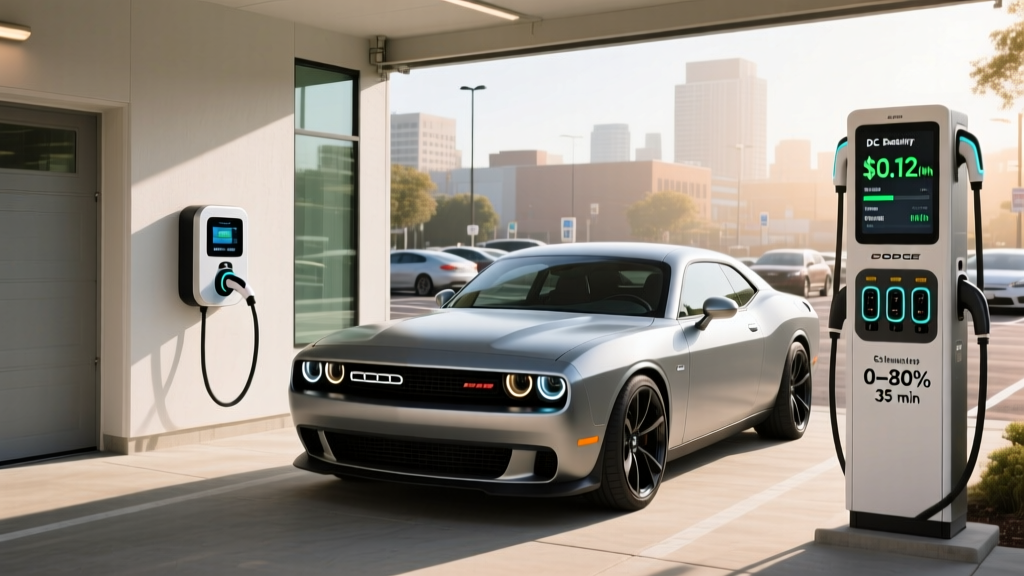
Real-world context for the Charger Daytona: On a 48-amp Level 2 home charger (11.5 kW), you'll add roughly 35–40 miles of range per hour. A full 10–80% charge at home takes approximately 7–8 hours. On a 350 kW DC fast charger, Stellantis quotes a 10–80% time of roughly 27 minutes, though real-world charging curves taper significantly above 80% — expect the final 20% to take nearly as long as the first 70%.
Home Charger Installation: Electrical Requirements and Costs
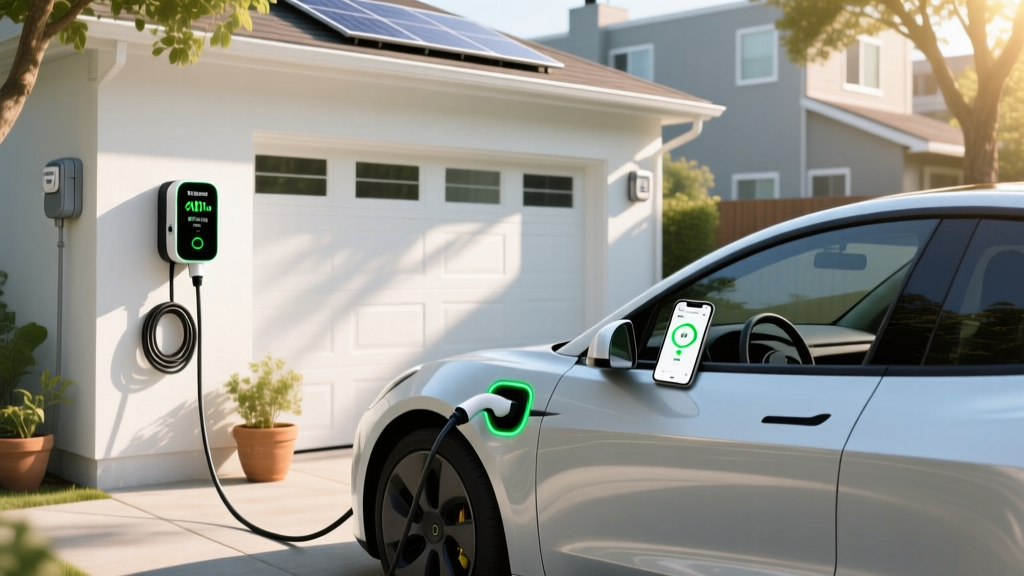
Installing a Level 2 home charger is the single biggest ownership upgrade you can make. Here's what's involved electrically and financially for a Charger Daytona owner.
Electrical Requirements
The Charger Daytona's onboard charger accepts up to 11.5 kW on Level 2 (48 amps continuous). To deliver that, you need a 240V circuit rated for at least 60 amps (NEC code requires circuits to be rated at 125% of continuous load, so 48A × 1.25 = 60A). If your electrical panel doesn't have spare capacity, you'll face a panel upgrade.
- Ideal setup: 240V / 60A dedicated circuit with a NEMA 14-60 outlet or hardwired connection
- Minimum viable: 240V / 40A circuit (delivers ~9.6 kW, ~30 mi/hr — still adequate for overnight charging)
- Panel capacity: Most modern 200-amp panels can accommodate a 60A EV circuit. Older 100-amp panels often cannot and may require a $1,500–$3,500 upgrade to 200 amps.
Permitting and Code
Most jurisdictions require an electrical permit for a new 240V circuit. Your licensed electrician will pull this. Key code requirements include a GFCI breaker if you're using a receptacle (NEMA outlet) rather than hardwiring, and an outdoor-rated enclosure and cable if the charger is mounted outside. Always defer final specifications to a licensed electrician familiar with your local code.
| Item | Typical Cost Range | Notes |
|---|---|---|
| Level 2 charger (hardware) | $350–$700 | 48A smart charger, 25-ft cable |
| Electrician labor (standard install) | $500–$1,500 | Run from panel to garage, ~20–40 ft |
| Electrical permit | $50–$250 | Varies by municipality |
| Panel upgrade (if needed) | $1,500–$3,500 | 100A → 200A service upgrade |
| Total (standard, no panel upgrade) | $900–$2,450 | Most homes with 200A panel |
| Total (with panel upgrade) | $2,400–$5,950 | Older homes with 100A service |
The IRS §30D tax credit does not cover charger installation directly, but the separate §30C Alternative Fuel Vehicle Refueling Property Credit can cover up to 30% of home charger hardware and installation costs (capped at $1,000), subject to census-tract eligibility. Check your eligibility on the IRS website or with a tax professional.
Connector Compatibility: NACS, CCS1, and the Charger Daytona
Stellantis has committed to adopting the NACS (North American Charging Standard) connector — the Tesla-originated plug now being standardized across the industry — for its EVs. For the 2024–2026 model-year Charger Daytona, the vehicle ships with a CCS1 (Combined Charging System) port. Here's what that means in practice:
| Connector | Compatibility | Notes |
|---|---|---|
| CCS1 | ✅ Native | Works at Electrify America, EVgo, ChargePoint, and most non-Tesla DC networks |
| NACS (Tesla Supercharger) | ⚠️ Adapter required | Stellantis has announced Supercharger access; a CCS-to-NACS adapter is needed for current models |
| CHAdeMO | ❌ Not compatible | Legacy standard; largely phased out in North America |
| J1772 (Level 2) | ✅ Native (via CCS inlet) | All Level 2 public chargers use J1772, which mates with the upper portion of the CCS port |
Adapter note: If you plan to use Tesla Superchargers (the largest DC fast-charging network in North America), you'll need a CCS-to-NACS adapter. Tesla sells one for ~$250, and third-party options from Lectron and A2Z are available for $150–$200. Verify adapter compatibility with your specific model year before purchasing. Future Charger Daytona model years may ship with a native NACS port.
Cost to Charge: Per-Mile Comparison vs. Gas
The Charger Daytona Scat Pack's efficiency is rated at approximately 2.0–2.2 kWh per mile (roughly 97 MPGe combined, per fueleconomy.gov). Let's translate that into real dollars.
| Scenario | $/kWh | Cost Per Mile | Cost for 300-Mile Trip |
|---|---|---|---|
| Home (off-peak utility rate) | $0.08–$0.12 | $0.16–$0.26 | $48–$78 |
| Home (average US rate ~$0.16) | $0.16 | $0.32–$0.35 | $96–$105 |
| Public Level 2 (ChargePoint, etc.) | $0.25–$0.40 | $0.50–$0.88 | $150–$264 |
| DC Fast Charge (Electrify America) | $0.35–$0.55 | $0.70–$1.21 | $210–$363 |
Gas comparison: A gas Dodge Challenger R/T Scat Pack (6.4L V8, ~18 MPG combined) running on $3.40/gallon fuel costs roughly $0.19 per mile. That means home-charged EV driving at off-peak rates can undercut gas on cost per mile. But DC fast charging on road trips can actually exceed the per-mile cost of gas — a trade-off worth understanding before you plan a cross-country drive.
Over 12,000 miles per year, a Charger Daytona owner charging primarily at home (average $0.14/kWh) would spend roughly $3,360–$3,700 annually on electricity. A comparable gas Challenger at 18 MPG and $3.40/gal would spend about $2,267. However, the EV eliminates oil changes, spark plugs, and transmission fluid — and if you have access to cheap solar or time-of-use rates below $0.10/kWh, the math swings decisively in the EV's favor.
Charging Time Examples: How Long Does It Really Take?
With a 100.5 kWh battery (roughly 95 kWh usable), here are realistic charging times for the Charger Daytona at various power levels:
| Charger Type | Power (kW) | Estimated 10–80% Time | Notes |
|---|---|---|---|
| Standard 120V outlet | 1.2 kW | ~60+ hours | Emergency/trickle only; not practical for daily use |
| Level 2 (32A / 240V) | 7.7 kW | ~10–11 hours | Common portable charger or older install |
| Level 2 (48A / 240V) | 11.5 kW | ~7–8 hours | Recommended home setup; full overnight charge |
| DC Fast (150 kW) | 150 kW | ~35–40 minutes | Common at Electrify America, EVgo stations |
| DC Fast (350 kW) | 350 kW (peak) | ~27 minutes | Peak rate; sustained rate is lower due to charge curve taper |
Charge curve reality: Peak DC fast-charging rates (e.g., 200+ kW) are only sustained at low states of charge (typically 10–40%). As the battery fills, the rate tapers to protect cell health. A "27-minute 10–80%" spec means the average sustained rate is closer to 130–150 kW even on a 350 kW-capable station. Always plan road-trip stops around the 10–80% window — charging from 80–100% on DC fast is painfully slow and wasteful.
Recommended Home Chargers for the Charger Daytona
Here are proven Level 2 chargers that pair well with the Charger Daytona's 11.5 kW onboard charger. All use the J1772 connector (compatible with the CCS inlet) and support the amperage needed for overnight fills.
ChargePoint Home Flex
- Power: Up to 12 kW (50A), adjustable down to 16A
- Connector: J1772 (25-ft cable)
- Smart features: Wi-Fi, app scheduling, Alexa, energy tracking
- Price: ~$550–$650
- Why: Flexible amperage means it works on 40A or 60A circuits; excellent app
Emporia Vue Level 2 Charger
- Power: Up to 11.5 kW (48A)
- Connector: J1772 (24-ft cable)
- Smart features: Wi-Fi, solar integration, load management, scheduling
- Price: ~$400–$500
- Why: Best value smart charger; pairs with Emporia energy monitor for solar-aware charging
Grizzl-E Smart
- Power: Up to 10 kW (40A)
- Connector: J1772 (24-ft cable)
- Smart features: OCPP-compatible, app control, OTA updates
- Price: ~$450–$550
- Why: Built in Canada for extreme cold (-40°F rated); rugged outdoor enclosure
Wallbox Pulsar Plus
- Power: Up to 11.5 kW (48A)
- Connector: J1772 (25-ft cable)
- Smart features: Wi-Fi + Bluetooth, app scheduling, Power Sharing for multi-charger setups
- Price: ~$550–$650
- Why: Compact form factor; ideal for tight garages; power-sharing lets you run two chargers on one circuit
All of these chargers are NEMA 4 or NEMA 4X rated for outdoor use. If you're installing outdoors, confirm the unit's IP rating and use a weatherproof conduit connection. For indoor garage installs, a hardwired connection eliminates the need for a GFCI breaker (saving $50–$100 on the electrical bill).
Safety, Code, and the Panel-Upgrade Gotcha
EV charging draws sustained, high-current loads for hours — far more demanding than any other household appliance. Here's what you must get right:
- Dedicated circuit: Your Level 2 charger must have its own dedicated circuit. Never share a circuit with other high-draw appliances (dryer, oven, HVAC).
- GFCI protection: NEC 2020 and later require GFCI protection for 240V receptacles used for EV charging. Hardwired installations are exempt from this requirement in most jurisdictions.
- Outdoor rating: If your charger is exposed to weather, ensure the unit, cable, and connector are rated for outdoor use (NEMA 4 minimum). The J1772 connector itself is rain-rated but should not be submerged.
- Wire gauge: A 60A circuit requires 6 AWG copper wire (THHN in conduit) or 4 AWG for NM-B (Romex). Your electrician will specify based on run length and local code.
- Load calculation: Before installing, your electrician should perform a NEC Article 220 load calculation to verify your panel can handle the EV circuit alongside existing loads. If the calculation fails, a panel upgrade is mandatory — this is the single biggest surprise cost for older-home owners.
Public Charging Networks: Where to Charge a Charger Daytona
The Charger Daytona's CCS1 port gives you access to the major public DC fast-charging networks:
- Electrify America: Largest non-Tesla network; stations typically offer 150 kW and 350 kW chargers. Pricing averages $0.35–$0.55/kWh. Use the EA app or Plug & Charge (if supported by your model year).
- EVgo: Growing network with 100–350 kW stalls. Subscription plans reduce per-kWh cost. Many locations in urban retail centers.
- ChargePoint: Dominant in Level 2 public charging (workplaces, malls, parking garages). DC fast stations are less common but expanding.
- Tesla Supercharger (with adapter): Over 25,000 stalls in North America. CCS-to-NACS adapter required for current Charger Daytona models. Verify your vehicle's firmware supports Supercharger handshaking before relying on this network.
For road-trip planning, use PlugShare or the AFDC station locator to map your route. The Charger Daytona's built-in navigation can also route through compatible chargers and precondition the battery for faster charging on arrival.
Frequently Asked Questions
How much does it cost to install a home EV charger for a Dodge Charger Daytona?
A standard Level 2 installation (48A charger, 240V/60A circuit, 20–40 ft wire run) typically costs $900–$2,450 including hardware, electrician labor, and permit. If your home needs a 100A-to-200A panel upgrade, add $1,500–$3,500. The federal §30C credit may cover up to 30% of costs (max $1,000) depending on your census tract.
How fast will each charging level add range to the Charger Daytona?
Level 1 (120V) adds about 3–5 miles per hour — essentially unusable for a 100 kWh battery. Level 2 at 48A/11.5 kW adds roughly 35–40 miles per hour, filling 10–80% overnight in about 7–8 hours. DC fast charging at 150 kW can add 150+ miles in 15 minutes at peak rate.
Which connector does the Dodge Charger Daytona use?
The 2024–2026 Charger Daytona uses a CCS1 port for DC fast charging and accepts J1772 for Level 2. To use Tesla Superchargers, you'll need a CCS-to-NACS adapter. Future model years are expected to ship with a native NACS port.
How much does charging cost per mile compared to a gas Challenger?
At home off-peak rates ($0.08–$0.12/kWh), the Charger Daytona costs roughly $0.16–$0.26 per mile. A gas Challenger R/T at 18 MPG and $3.40/gallon costs about $0.19 per mile. DC fast charging on the road ($0.35–$0.55/kWh) costs $0.70–$1.21 per mile — more than gas.
What electrical upgrades might I need for a home charger?
If your home has a 200-amp panel with spare breaker slots and passing load calculation, you likely just need a new 60A circuit ($500–$1,500 in labor). If you have a 100-amp panel, expect a full service upgrade ($1,500–$3,500). Smart load-management devices can sometimes avoid the upgrade entirely.
Does the Charger Daytona support Plug & Charge?
Plug & Charge (ISO 15118) support varies by model year and network. Electrify America has been expanding Plug & Charge compatibility — check the EA app or Stellantis owner portal for your specific VIN's compatibility.
Should I hardwire my Level 2 charger or use a NEMA outlet?
Hardwiring eliminates the need for a GFCI breaker (saving $50–$100), is required for circuits above 50A in many jurisdictions, and provides a cleaner installation. A NEMA 14-60 outlet offers portability — useful if you may move the charger or sell the home. Both are code-compliant when installed correctly.