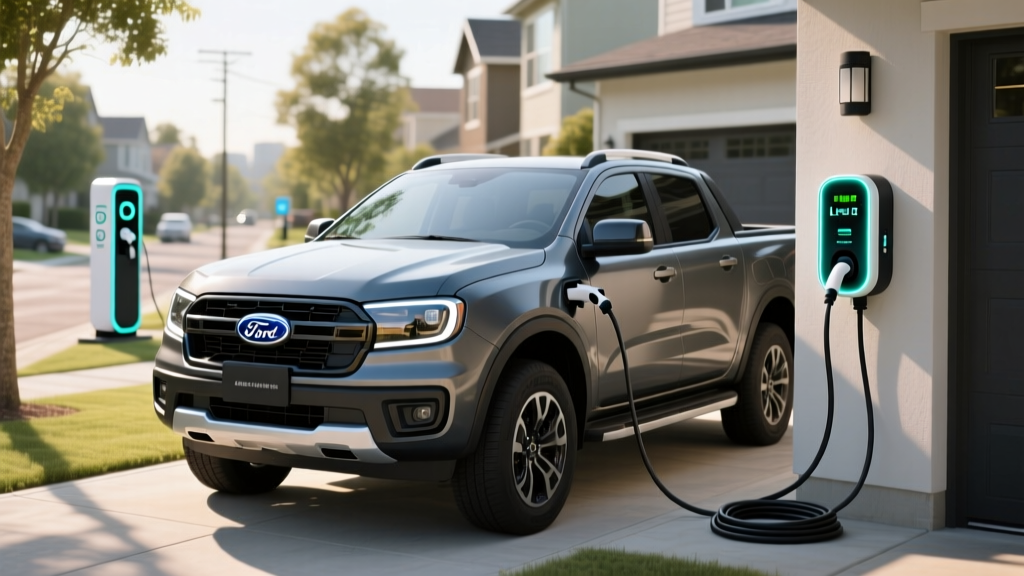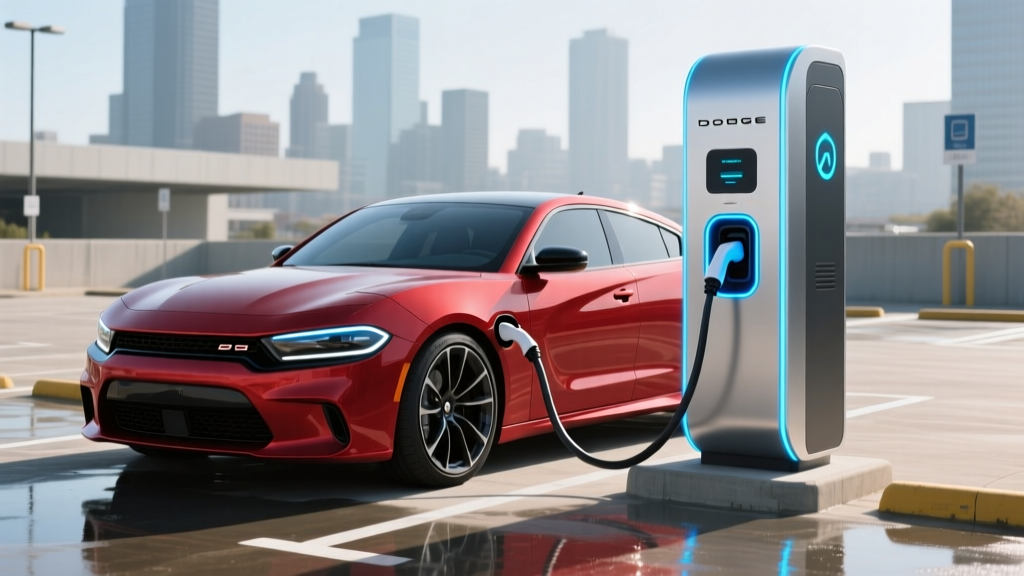
If you've spent any time cross-shopping a Dodge Challenger or Charger against your first electric vehicle, you've probably noticed the math looks different on paper. A 2024 Dodge Charger R/T with the 5.7L HEMI V8 gets around 19 MPG combined, while a comparably priced EV like the Hyundai Ioniq 6 or Tesla Model 3 posts efficiency numbers in the 130+ MPGe range. But the real question isn't just sticker price — it's what happens after you drive off the lot.
This guide breaks down the charging infrastructure you'd actually need if you're trading a Challenger or Charger for an EV: what Level 1, Level 2, and DC fast charging mean in real-world miles per hour, what a home charger installation actually costs (including the panel upgrade that catches many older-home buyers off guard), which connector your next EV will use, and exactly how much you'll spend per mile compared to filling up a HEMI.
The Three Charging Levels: Speed, Cost, and When Each Makes Sense
EV charging is measured in kilowatts (kW), which is the rate of energy delivery — not to be confused with kilowatt-hours (kWh), which is the total energy stored in your battery. Think of kW as how fast water flows from a hose, and kWh as the size of the bucket you're filling.
| Level | Voltage | Power (kW) | Miles Added per Hour | Best For |
|---|---|---|---|---|
| Level 1 (120V) | 120V / 12A | 1.4 kW | 3–5 mi/hr | Overnight top-ups, PHEVs, low-mileage drivers |
| Level 2 (240V) | 240V / 32–48A | 7.7–11.5 kW | 25–44 mi/hr | Daily home charging, most EV owners |
| DC Fast Charge | 400–800V DC | 50–350 kW | 150–1,200+ mi/hr (peak) | Road trips, quick stops, commercial fleets |
Level 1 charging from a standard 120V household outlet is painfully slow for a full-size EV with an 80+ kWh battery — expect 20+ hours to go from 10% to 80%. It works fine for plug-in hybrids like the Chrysler Pacifica PHEV (which has only a 16 kWh battery) or for EV owners who drive under 30 miles daily and can top up overnight.
Level 2 is where the vast majority of home charging happens. A 48-amp, 240-volt circuit delivers up to 11.5 kW, adding roughly 40 miles of range per hour of charging. An 82 kWh battery (like in the Ford Mustang Mach-E Extended Range) can go from 10% to 80% in about 6–7 hours on Level 2 — plug in when you get home, and you're full by morning.
DC fast charging is strictly for public stations. Peak speeds vary enormously: a Tesla Model 3 on a V4 Supercharger can peak at 250 kW (10–80% in roughly 18 minutes), while a Hyundai Ioniq 5 on a 350 kW Electrify America station can hit 240 kW and do 10–80% in about 18 minutes as well. But remember: peak kW is not sustained kW. Charge curves taper significantly above 80% SoC to protect battery health, so the last 20% can take as long as the first 60%.
Home Charger Installation: Real Costs, Electrical Requirements, and the Panel Upgrade Trap
A Level 2 home charger requires a dedicated 240-volt circuit, typically rated for 40 to 60 amps. The national average for a full installation — equipment, licensed electrician, and permit — runs between $500 and $2,500, but that range hides some important variables.
| Component | Low End | High End | Notes |
|---|---|---|---|
| Level 2 Charger (hardware) | $300 | $700 | 40A–48A smart chargers from ChargePoint, Emporia, Wallbox |
| Electrician labor | $200 | $1,200 | Depends on run length from panel to garage/carport |
| Electrical permit | $50 | $200 | Required in most jurisdictions; varies by municipality |
| Panel upgrade (if needed) | $1,500 | $4,000 | 200A service upgrade for older homes with 100A panels |
| Total (no panel upgrade) | $550 | $2,100 | Most newer homes with 200A service |
| Total (with panel upgrade) | $2,050 | $6,100 | Homes built before ~2000 with 100A or 150A panels |
The panel upgrade is the cost that blindsides people. If your home has a 100-amp electrical service (common in homes built before the 1990s), adding a 40-amp dedicated EV circuit may push you over capacity — especially if you also run electric heat, a dryer, and an oven. An electrician will perform a load calculation per NEC Article 220 to determine whether your panel can handle the additional draw. If not, a 200-amp service upgrade runs $1,500 to $4,000 depending on your utility's requirements and local labor rates.
Some utilities and states offer rebates that offset installation costs. Check with your local utility before scheduling work — some require pre-approval to qualify. The federal Residential Clean Energy Credit (IRS Form 5695) previously covered 30% of charger hardware and installation up to $1,000, but this credit expired for most taxpayers after 2023 unless Congress extends it. Always verify current-year rules with a tax professional.
Safety and Code Requirements
Your installation must comply with NEC Article 625 (Electric Vehicle Charging System Equipment). Key requirements:
- Dedicated circuit: Your Level 2 charger needs its own breaker — not shared with other appliances.
- GFCI protection: Required for outdoor installations and in garages per the 2020 NEC and later. Most modern hardwired chargers have built-in GFCI, but plug-in units on NEMA 14-50 outlets require a GFCI breaker (which adds $50–$100 to the bill).
- Outdoor rating: If your charger is mounted outside, it must carry at least a NEMA 4 (weatherproof) rating. All major brands rate their outdoor units for this.
- Cable management: NEC requires that charging cables not create a trip hazard. Wall-mounted cord reels or cable organizers are strongly recommended.
Connector Compatibility: NACS, CCS1, and CHAdeMO in 2026
The North American charging connector landscape has consolidated dramatically. Tesla's NACS (North American Charging Standard) is now the dominant plug for new EVs sold in North America, with nearly every major automaker adopting it starting with 2025 model-year vehicles. Here's where things stand:
| Connector | Brands Using It (Native) | Adapter Needed For |
|---|---|---|
| NACS (Tesla) | Tesla, Ford, GM, Rivian, Volvo, Polestar, Mercedes-Benz, BMW, Hyundai/Kia (2025+), Subaru, Lucid, Fisker | Legacy CCS1 vehicles need a NACS-to-CCS adapter (~$200–$250) to use Superchargers |
| CCS1 | VW ID.4 (pre-2025), older Hyundai/Kia/BMW, Chevrolet Bolt (discontinued), legacy fleet | CCS-to-NACS adapter needed for Supercharger access |
| CHAdeMO | Nissan Leaf (legacy only — discontinued in US after 2024), Mitsubishi Outlander PHEV | Effectively a dead standard in North America; no adapter to NACS exists for DC charging |
If you're buying a new EV in 2026, it will almost certainly have a NACS port unless you're purchasing remaining stock of a CCS1-equipped 2024 model. For home Level 2 charging, all EVs use the same J1772 connector (or NACS, which includes J1772 signaling), so any Level 2 home charger will work with any EV — the connector split only matters at public DC fast chargers.
According to the Alternative Fuels Data Center, there are over 70,000 public charging ports in the US, with Tesla Superchargers representing the largest and most reliable network. Non-Tesla networks (Electrify America, EVgo, ChargePoint) are rapidly adding NACS connectors, but CCS1 ports still outnumber NACS at non-Tesla stations as of early 2026. If you own a CCS1 vehicle, an adapter is a practical necessity.
Cost Per Mile: EV Charging vs. Filling Up a Challenger or Charger
This is where the Dodge comparison becomes stark. Let's run real numbers using a 2024 Dodge Charger R/T (5.7L HEMI, 19 MPG combined) against a 2025 Tesla Model 3 Long Range (3.5 miles per kWh efficiency, EPA-rated 132 MPGe).
| Scenario | Dodge Charger R/T (19 MPG) | Tesla Model 3 LR (3.5 mi/kWh) |
|---|---|---|
| Home charging (off-peak, $0.13/kWh) | — | $0.037/mile |
| Home charging (peak, $0.22/kWh) | — | $0.063/mile |
| Public Level 2 ($0.35/kWh avg) | — | $0.10/mile |
| DC Fast Charge ($0.48/kWh avg) | — | $0.137/mile |
| Gasoline ($3.45/gallon national avg) | $0.182/mile | — |
Gas prices based on fueleconomy.gov data and AAA national averages. The cheapest EV charging scenario (home off-peak) costs roughly one-fifth what the Charger costs in fuel per mile. Even the most expensive scenario (DC fast charging on a road trip) comes in about 25% cheaper than gasoline.
Over 15,000 miles of annual driving, that's the difference between $2,730 in gas for the Charger and as little as $555 in home-charged electricity for the Model 3 — a $2,175 annual savings. Over five years, that's over $10,000 in fuel savings alone, before factoring in the EV's lower maintenance costs (no oil changes, fewer brake replacements due to regenerative braking).
Charging Time Examples: What to Expect with Common Battery Sizes
Real-world charging times depend on your battery size, the charger's power output, and your vehicle's onboard charger capacity (for Level 2) or charge-curve profile (for DC fast). Here are representative examples:
| Battery Size | Example Vehicle | Level 2 (11.5 kW) | DC Fast (150 kW peak) | DC Fast (250 kW peak) |
|---|---|---|---|---|
| 60 kWh | Chevrolet Equinox EV | ~3.5 hours | ~25 min | ~20 min |
| 77 kWh | Ford Mustang Mach-E ER | ~4.6 hours | ~30 min | ~22 min |
| 82 kWh | Tesla Model 3 LR | ~4.9 hours | ~32 min | ~18 min |
| 100 kWh | GMC Sierra EV / Rivian R1T Max | ~6.0 hours | ~38 min | ~25 min |
Important caveat: these DC fast times assume optimal conditions — battery preconditioned to ideal temperature, starting at low SoC, and a charger capable of delivering the vehicle's peak rate. In cold weather (below 40°F), expect DC fast charging to take 20–40% longer unless your vehicle has active battery preconditioning (Tesla, Hyundai/Kia E-GMP, and GM Ultium vehicles all include this).
Recommended Home Level 2 Chargers: Specific Models for 2026
Based on reliability, smart features, and value, here are the chargers we recommend for most EV owners:
Emporia Vue Level 2 EV Charger
- Power output: 48A / 11.5 kW (hardwired) or 40A / 9.6 kW (NEMA 14-50 plug)
- Connector: J1772 (works with all EVs; NACS vehicles use included Tesla adapter)
- Cable length: 24 feet
- Smart features: Wi-Fi, energy monitoring via Emporia app, solar integration, scheduled charging
- Price: ~$399 (hardwired) / ~$449 (plug-in)
- Verdict: Best value for a smart charger with energy monitoring. The solar integration is unique at this price point.
ChargePoint Home Flex
- Power output: Up to 50A / 12 kW (adjustable down to match your circuit)
- Connector: J1772 with integrated NACS adapter holster
- Cable length: 23 feet
- Smart features: Wi-Fi, Alexa/Google Home integration, ChargePoint app scheduling, flexible amperage
- Price: ~$599
- Verdict: The adjustable amperage (16A–50A) is a standout feature — you can match it precisely to your available circuit without buying a different unit.
Tesla Wall Connector
- Power output: 48A / 11.5 kW (hardwired, 60A circuit required)
- Connector: NACS native (J1772 adapter included for non-Tesla EVs)
- Cable length: 24 feet
- Smart features: Wi-Fi, power sharing (link up to 6 units on one circuit for multi-EV garages), OTA updates
- Price: ~$475
- Verdict: Best pick if your EV has a NACS port. The power-sharing feature is ideal for two-EV households that don't want to upgrade to a 100A+ subpanel.
Making the Switch: A Decision Framework for Challenger/Charger Owners
Choose an EV (and install a home charger) if:
- You drive under 300 miles per day and can charge at home overnight
- Your home has 200A electrical service (or you're willing to invest in a panel upgrade)
- You want to cut fuel costs by 60–80% annually
- You're ready for the instant torque that makes EVs genuinely quick — a Tesla Model 3 Performance does 0–60 in 2.9 seconds, which is firmly in Hellcat territory
Stick with the Challenger/Charger (for now) if:
- You regularly tow heavy loads (EVs lose 30–50% range when towing at capacity)
- You live in an apartment or condo without charging access and your area has sparse public infrastructure
- The sound, feel, and culture of a V8 muscle car are the primary reason you own the car — EVs can match the speed but not the character
- Your daily commute is under 15 miles and a PHEV or hybrid could bridge the gap more cheaply
Frequently Asked Questions
How much does it cost to install a home EV charger?
Expect $550–$2,100 for a standard Level 2 installation in a home with adequate 240V panel capacity. If your home needs a 200A service upgrade (common in homes built before 2000 with 100A panels), add $1,500–$4,000, bringing the total to $2,050–$6,100. Always get a load calculation from a licensed electrician before committing.
How fast will each charging level add range?
Level 1 (120V) adds 3–5 miles per hour. Level 2 (240V, 48A) adds 25–44 miles per hour depending on vehicle efficiency. DC fast charging adds 150–1,200+ miles per hour at peak, but sustained rates taper above 80% SoC. For daily driving, Level 2 at home covers virtually all needs.
Which connector/charger is compatible with my EV?
All EVs charge at home on Level 2 using either a J1772 or NACS connector — both are interoperable with adapters. For DC fast charging, 2025–2026 models overwhelmingly use NACS. Older CCS1 vehicles need a ~$200 adapter for Supercharger access. CHAdeMO (Nissan Leaf) is effectively discontinued in North America.
How much does charging cost per mile vs gas?
Home charging at off-peak rates ($0.13/kWh) costs roughly $0.04/mile for an efficient EV — about one-fifth the $0.18/mile cost of fueling a 19 MPG muscle car at $3.45/gallon. Even DC fast charging at $0.48/kWh costs around $0.14/mile, still 25% less than gasoline.
What electrical upgrades might I need?
The most common upgrade is a 200A panel replacement for older homes with 100A service, costing $1,500–$4,000. You may also need a new 240V circuit run from the panel to your garage (adds $200–$800 depending on distance), a GFCI breaker for plug-in installations ($50–$100), and potentially a utility meter upgrade if your provider requires it for a 200A service.