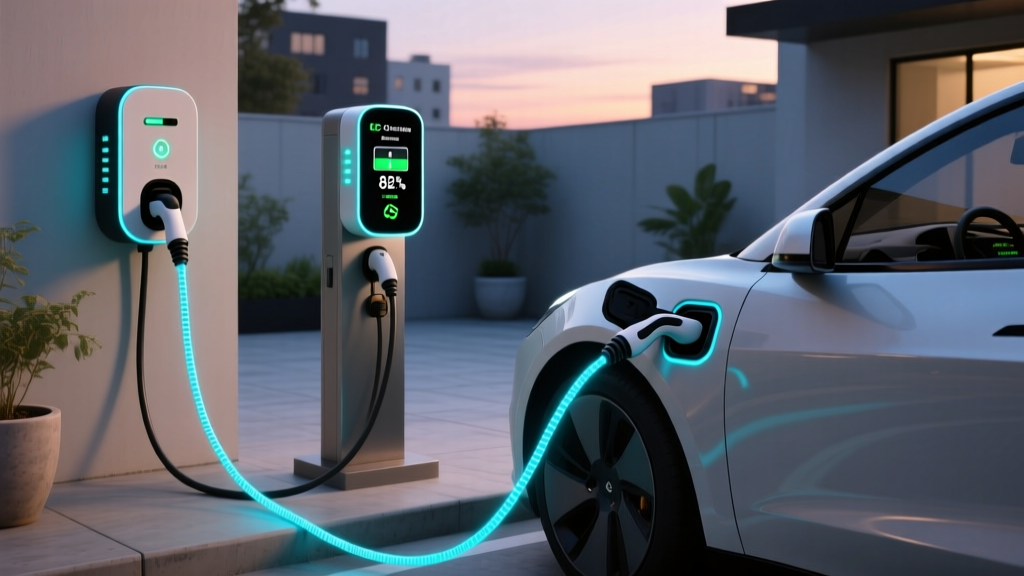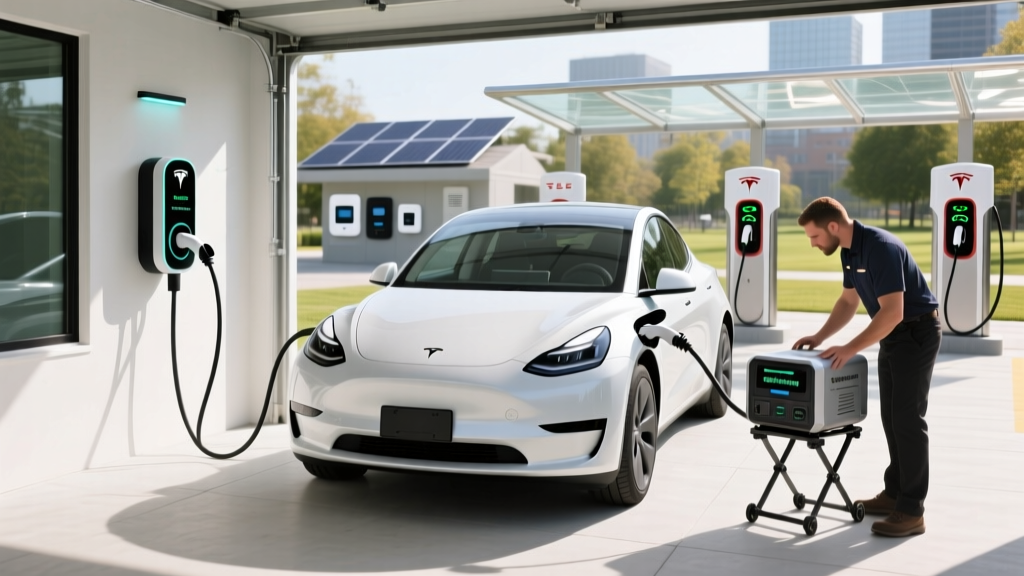
If you're considering a Tesla—or any electric vehicle—one of the first questions that comes up is: do you have to pay for Tesla charging stations? The short answer is yes, almost always. Tesla's Supercharger network charges per kilowatt-hour (kWh) in most markets, and while some legacy vehicles still carry free unlimited Supercharging credits, those are increasingly rare. But understanding the full picture of EV charging costs—home, public, and DC fast charging—requires a deeper look at the numbers.
This guide breaks down exactly what you'll pay to charge a Tesla (or any EV) in 2026, how much a home charger installation really costs, which connectors you need, and how charging expenses compare to filling up a gas car.
Tesla Supercharger Pricing: What You Actually Pay
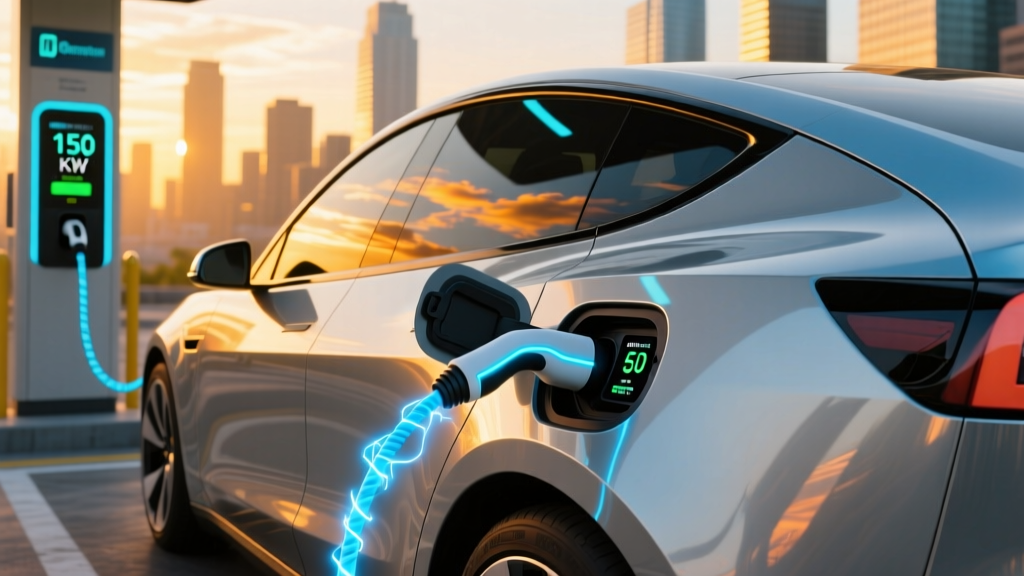
Tesla Superchargers are DC fast chargers (Level 3) that deliver peak power between 150 kW (V2 stalls) and 250 kW (V3 stalls), with the newest V4 posts capable of up to 350 kW for compatible vehicles. Pricing is typically structured per kWh consumed, though some locations bill per minute.
As of early 2026, typical Supercharger rates in the U.S. range from $0.28 to $0.48 per kWh, depending on location, time of day, and local utility rates. Urban Superchargers in California and New York tend to sit at the higher end, while Midwest and Southern stations often fall in the $0.30–$0.35 range.
Do Any Teslas Still Get Free Supercharging?
Some Model S and Model X vehicles purchased before 2017 retain transferable free unlimited Supercharging. However, this benefit is tied to the original vehicle—not the owner—and is increasingly rare on the used market. Tesla occasionally runs promotional referral credits (e.g., 1,000 free Supercharger miles), but these are time-limited. For the vast majority of Tesla owners buying in 2026, every Supercharger session costs money.
Tesla has also opened its Supercharger network to non-Tesla EVs via the built-in CCS adapter (for vehicles with CCS1 ports) or native NACS (North American Charging Standard) ports on newer Ford, GM, Rivian, and Volvo models. Non-Tesla drivers typically pay a slightly higher per-kWh rate unless they subscribe to Tesla's $12.99/month membership plan, which matches Tesla-owner pricing.
Charging Levels Explained: Speed, Power, and Range Added
Before comparing costs, it's essential to understand the three charging levels and what each delivers. Remember: kW (kilowatts) measures power—how fast energy flows into your battery. kWh (kilowatt-hours) measures energy—the total capacity of your battery, like gallons in a fuel tank.
| Level | Voltage | Power (kW) | Miles of Range Added Per Hour | Typical Use Case |
|---|---|---|---|---|
| Level 1 | 120V AC | 1.0–1.4 kW | 3–5 miles | Overnight trickle; emergency top-ups |
| Level 2 | 240V AC | 3.3–19.2 kW | 12–75 miles | Home daily charging; workplace; public AC |
| DC Fast Charge | 400–800V DC | 50–350 kW | 150–1,200+ miles (equivalent) | Road trips; rapid top-ups; 10–80% in 15–40 min |
Charging Time Examples for Common Battery Sizes
Charge time depends on battery capacity (kWh), the charger's peak power (kW), and the vehicle's charge curve—most EVs taper charging speed significantly above 80% State of Charge to protect battery health.
- Tesla Model 3 RWD (57.5 kWh LFP battery): 10–80% at a 170 kW V3 Supercharger in ~25 minutes; Level 2 at 11.5 kW in ~4.5 hours.
- Tesla Model Y Long Range (75 kWh NMC): 10–80% at 250 kW in ~27 minutes; Level 2 at 11.5 kW in ~5.8 hours.
- Ford F-150 Lightning Extended Range (131 kWh NMC): 10–80% at 150 kW in ~55 minutes; Level 2 at 19.2 kW in ~6.5 hours.
- Hyundai Ioniq 5 (77.4 kWh NMC, 800V architecture): 10–80% at a 350 kW charger in ~18 minutes; Level 2 at 10.9 kW in ~6.5 hours.
Home EV Charger Installation: Costs, Requirements, and Upgrades
Charging at home is where EV ownership economics shine. Most EV drivers do 80–90% of their charging at home on a Level 2 charger, waking up to a full battery every morning. But installation costs vary widely based on your home's electrical infrastructure.
Electrical Requirements for Level 2 Home Charging
A typical Level 2 home charger requires a 240-volt dedicated circuit, similar to what powers an electric dryer or oven. The most common setup is a 40-amp or 48-amp circuit, which supports continuous charging at 32 amps or 40 amps respectively (the National Electrical Code requires circuits rated at 125% of continuous load).
- 40A circuit / 32A continuous: Delivers ~7.7 kW — sufficient for most EVs overnight.
- 48A circuit / 40A continuous: Delivers ~9.6 kW — faster charging, ideal for larger batteries.
- 60A circuit / 48A continuous: Delivers ~11.5 kW — Tesla Wall Connector maximum; fastest residential AC option short of 80A.
Do You Need a Panel Upgrade?
This is the biggest wildcard in home charger installation. If your home has a 100-amp electrical panel (common in homes built before the 1990s), adding a 40–60 amp EV circuit may exceed your panel's capacity, especially if you already run electric heating, a dryer, and an electric range. In that case, you'll need a panel upgrade to 200 amps, which typically costs $1,500–$3,500 before the charger circuit is even installed.
Homes with existing 200-amp panels usually have enough headroom for a 40–60 amp EV circuit without an upgrade. A licensed electrician will perform a load calculation per NEC Article 220 to determine your available capacity.
| Component | Cost Range | Notes |
|---|---|---|
| Level 2 Charger (hardwired or NEMA 14-50 plug) | $250–$700 | Varies by brand, power output, smart features |
| Electrician Labor (circuit run + outlet/hardwire) | $500–$2,000 | Depends on distance from panel, wall material, conduit needs |
| Electrical Permit | $50–$300 | Required in most jurisdictions; varies by municipality |
| Panel Upgrade (if needed) | $1,500–$3,500 | 200A upgrade; not always required |
| Utility Rebate / Federal Credit | -$300 to -$1,000 | IRS §30D Alternative Fuel Vehicle Refueling Property Credit covers 30% up to $1,000 (irs.gov) |
| Total (no panel upgrade) | $800–$3,000 | Typical range for most homes |
| Total (with panel upgrade) | $2,300–$6,500 | Older homes with 100A service |
Level 2 Charger Equipment Picks for 2026
Not all Level 2 chargers are created equal. Here are top picks based on power output, reliability, connector type, cable length, and smart features.
Tesla Wall Connector (Gen 4)
- Power Output: Up to 11.5 kW (48A on 60A circuit)
- Connector: NACS (Tesla native); includes J1772 adapter for non-Tesla EVs
- Cable Length: 24 feet
- Smart Features: Wi-Fi, OTA updates, load sharing (pair two units on one circuit), Tesla app integration
- Price: ~$475
- Best For: Tesla owners wanting seamless integration; excellent value for the power output
ChargePoint Home Flex
- Power Output: Up to 12 kW (50A on 60A circuit); configurable from 16A–50A
- Connector: J1772 (standard for non-Tesla EVs); NACS adapter available separately
- Cable Length: 23 feet
- Smart Features: Wi-Fi, ChargePoint app scheduling, Alexa integration, amperage dial adjustment
- Price: ~$550–$650
- Best For: Multi-EV households; adjustable amperage accommodates different circuit sizes
Emporia Level 2 EV Charger
- Power Output: Up to 11.5 kW (48A)
- Connector: J1772 (NACS adapter available)
- Cable Length: 24 feet
- Smart Features: Wi-Fi, Emporia energy monitoring integration, solar-aware scheduling
- Price: ~$350–$400
- Best For: Budget-conscious buyers who want smart features; excellent solar-home integration
Connector Compatibility: NACS, CCS1, and CHAdeMO
The connector landscape shifted dramatically in 2024–2025 when Ford, GM, Rivian, Volvo, Mercedes-Benz, and most major automakers adopted Tesla's NACS (North American Charging Standard) as their primary charging port. As of 2026, NACS is the dominant DC fast-charging connector in North America, though CCS1 remains on many 2022–2024 model-year vehicles still on the road.
| Connector | Vehicles Using It (2026) | Adapter Needed? |
|---|---|---|
| NACS (Tesla) | All Teslas; 2025+ Ford, GM, Rivian, Volvo, Mercedes, Honda, Nissan | None for Superchargers; CCS adapter needed for legacy CCS stations |
| CCS1 | 2022–2024 Hyundai, Kia, BMW, VW, Stellantis; older Ford/GM EVs | NACS-to-CCS adapter (~$200–$250) for Tesla Superchargers |
| CHAdeMO | Nissan Leaf (discontinued 2025); Mitsubishi Outlander PHEV | Limited network; no viable adapter to NACS/CCS for DCFC |
| J1772 (AC only) | All non-Tesla EVs for Level 1/Level 2 AC charging | Tesla Mobile Connector includes J1772 adapter; NACS vehicles may need J1772-to-NACS adapter |
If you own a CCS1-equipped EV from the 2022–2024 era, you'll likely need a NACS-to-CCS adapter (sold by Tesla and third parties like Lectron for $200–$250) to access Tesla Superchargers, which now represent the largest and most reliable DC fast-charging network in the U.S.
Cost to Charge Per Mile: EV vs. Gas
The strongest economic argument for EV ownership is the per-mile fuel cost. Let's compare real scenarios using 2026 average energy prices and a gas baseline of $3.45/gallon (national average, per EIA).
| Charging Scenario | Cost per kWh / Gallon | Vehicle Efficiency | Cost Per Mile |
|---|---|---|---|
| Home Level 2 (national avg. electricity, ~$0.16/kWh) | $0.16/kWh | 3.5 miles/kWh (Tesla Model Y) | $0.046 |
| Home Level 2 (off-peak TOU rate, ~$0.09/kWh) | $0.09/kWh | 3.5 miles/kWh | $0.026 |
| Tesla Supercharger (avg. $0.35/kWh) | $0.35/kWh | 3.5 miles/kWh | $0.100 |
| Electrify America / Public DCFC (avg. $0.43/kWh) | $0.43/kWh | 3.5 miles/kWh | $0.123 |
| Gas Car (30 MPG combined, $3.45/gal) | $3.45/gallon | 30 miles/gallon | $0.115 |
| Gas Car (22 MPG combined, $3.45/gal — truck/SUV) | $3.45/gallon | 22 miles/gallon | $0.157 |
Even exclusive Supercharger use ($0.10/mile) remains cheaper than most gas vehicles on a per-mile basis. However, relying entirely on DC fast charging accelerates battery degradation and costs significantly more than home charging—reinforcing why a Level 2 home installation is the single best investment an EV owner can make.
Federal Tax Credit for Home Charger Installation
The IRS Alternative Fuel Vehicle Refueling Property Credit (§30C) covers 30% of the cost of home EV charging equipment and installation, up to $1,000. This credit applies to both the charger hardware and the electrician labor, provided the installation is at your primary residence.
Key eligibility details for 2026:
- The credit is non-refundable—it can reduce your federal tax liability to zero but won't generate a refund beyond that.
- The equipment must be placed in service during the tax year.
- Certain census tracts designated as "low-income" or "non-urban" may qualify for enhanced benefits—check the IRS eligibility tool.
- Consult a tax professional for your specific situation; incentive rules are subject to legislative change.
Additionally, many utilities offer rebates of $200–$500 for Level 2 charger purchases or time-of-use rate enrollment. Check your local utility's EV program page before buying equipment.
Public Charging Networks Beyond Tesla
While Tesla's Supercharger network consistently ranks highest in reliability (typically 95%+ uptime), non-Tesla EV drivers—or Tesla drivers using CCS stations—should understand the broader public charging landscape.
- Electrify America: Largest non-Tesla DCFC network; peak 350 kW; pricing $0.36–$0.56/kWh depending on state. Reliability has improved but still trails Tesla.
- EVgo: Urban-focused network; 100–350 kW stalls; subscription plans available ($4.99–$7.99/month for reduced rates).
- ChargePoint: Primarily Level 2 destination charging (workplaces, retail); some DCFC locations. Pricing set by site host, often $0.20–$0.49/kWh.
- Free Charging: Some retailers (e.g., certain shopping centers, hotels, workplaces) offer complimentary Level 2 charging as an amenity. Apps like PlugShare and ChargePoint map free stations. These are typically slow (6.6–7.2 kW) and not viable as a primary charging strategy.
Per fueleconomy.gov, the efficiency of modern EVs ranges from roughly 2.5 to 4.5 miles per kWh, making even the most expensive public DCFC cheaper per mile than a gas vehicle with under 30 MPG.
Frequently Asked Questions
How much does it cost to install a home EV charger?
A typical Level 2 home charger installation costs $800–$3,000 when no panel upgrade is needed. This includes the charger unit ($250–$700), electrician labor ($500–$2,000), and a permit ($50–$300). If your home has an older 100-amp panel and requires an upgrade to 200 amps, add $1,500–$3,500. The IRS §30C credit can offset 30% of costs up to $1,000.
How fast will each charging level add range?
Level 1 (120V) adds 3–5 miles per hour—suitable only for overnight trickle charging. Level 2 (240V) at 48 amps adds roughly 35–44 miles per hour for a typical EV, fully replenishing most batteries overnight. DC fast charging at 150–250 kW can add 150–250 miles in 15–25 minutes, though speeds taper above 80% State of Charge to protect battery longevity.
Which connector or charger is compatible with my EV?
All 2025–2026 model-year EVs from Tesla, Ford, GM, Rivian, Volvo, Honda, and others use the NACS connector natively. Vehicles from 2022–2024 with CCS1 ports need a NACS-to-CCS adapter (~$200–$250) to access Tesla Superchargers. For Level 2 home charging, J1772 is the universal standard for non-Tesla EVs; Tesla includes a J1772 adapter with its Wall Connector.
How much does charging cost per mile compared to gas?
Home charging at the national average electricity rate ($0.16/kWh) costs approximately $0.046 per mile in a Tesla Model Y—roughly 70% cheaper than a 25 MPG gas SUV at $3.45/gallon ($0.157/mile). Even public DC fast charging at $0.35–$0.43/kWh ($0.10–$0.12/mile) undercuts most gas vehicles.
What electrical upgrades might I need for a home charger?
The most common upgrade is running a new 240V dedicated circuit (40–60 amps) from your panel to your garage or driveway. If your panel is already at 200 amps with available capacity, this is straightforward. Homes with 100-amp panels, knob-and-tube wiring, or panels near capacity will likely need a full service upgrade to 200 amps ($1,500–$3,500). A licensed electrician's load calculation will determine your exact needs.
Do you have to pay for Tesla charging stations if you own a Tesla?
Yes. Nearly all Tesla owners pay per kWh at Superchargers. Only a small number of pre-2017 Model S and Model X vehicles retain free unlimited Supercharging credits. Tesla occasionally offers limited promotional credits through referral programs, but standard Supercharging is a paid service. Membership pricing ($12.99/month for non-Tesla EVs) provides access to Tesla-owner rates.