The Short Answer: Superchargers Don't Boost MPGe — Here's What They Actually Do
If you've searched "do Superchargers increase fuel economy," you're likely trying to understand whether using Tesla's Supercharger network (or any DC fast-charging network) makes your electric vehicle more efficient. The direct answer is no. DC fast chargers — whether Tesla Superchargers, Electrify America, or EVgo stations — deliver electricity to your battery faster, but they do not change your vehicle's energy consumption per mile.
Fuel economy in an EV is measured in MPGe (miles per gallon equivalent) or kWh/100 miles, and it's determined by your vehicle's weight, aerodynamics, drivetrain efficiency, tire choice, and driving conditions — not by how quickly electrons enter the battery pack. A Tesla Model 3 Long Range achieves an EPA-rated 132 MPGe combined whether you charge it on a 120V wall outlet or a 250 kW Supercharger.
However, charging speed does affect your ownership economics, your battery's long-term health, and your real-world road-trip efficiency. Let's unpack exactly how each charging level works, what it costs, and where actual efficiency gains can be found.
Charging Levels Explained: Speeds, Range Added, and Real-World Times
Every EV owner interacts with three charging tiers. Understanding the exact power delivery and range-recovery rates is essential for trip planning and daily ownership.
| Level | Voltage / Amperage | Power (kW) | Miles of Range / Hour | 10–80% Time (75 kWh battery) |
|---|---|---|---|---|
| Level 1 (120V household) | 120V / 12A | 1.4 kW | 3–5 mi/hr | ~35–40 hours |
| Level 2 (240V home/public) | 240V / 32–48A | 7.7–11.5 kW | 25–44 mi/hr | ~5–7 hours |
| DC Fast (Supercharger/CCS) | 400–800V DC | 50–350 kW peak | 150–300+ mi/hr (peak) | ~15–30 minutes |
Why Peak kW Is Not Sustained kW
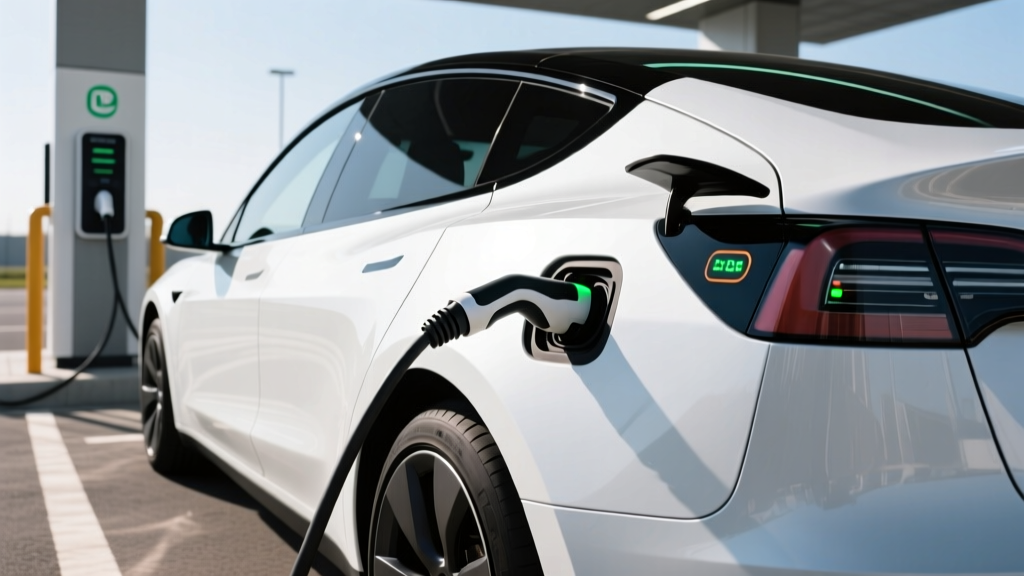
DC fast chargers advertise peak power — a Tesla V4 Supercharger may deliver 250 kW, and an Electrify America station might hit 350 kW. But batteries cannot accept peak power for the entire session. As the state of charge (SoC) climbs past roughly 50–60%, the battery management system reduces the charge rate to protect cell health. This is the charge curve taper.
Real-world example: A Hyundai Ioniq 5 (84 kWh usable, NMC chemistry) on a 350 kW charger will peak near 240 kW at low SoC, taper to ~150 kW by 60%, and drop below 50 kW past 80%. The 10–80% charge takes approximately 18 minutes under ideal thermal conditions. That 18-minute figure is meaningful; the 350 kW headline number is not sustained for the full session.
This taper is why most EV road-trippers charge from 10–80% and then move on rather than waiting for a full 100% top-off, which can take as long as a Level 2 session for that final 20%.
Connector Compatibility: NACS, CCS, and CHAdeMO in 2026
The North American charging connector landscape has consolidated significantly. As of 2026, nearly all new EVs sold in the U.S. use the NACS (North American Charging Standard) connector — Tesla's design, now adopted by Ford, GM, Rivian, Hyundai/Kia, BMW, and most other major automakers. CCS1 remains on some older models and a handful of new vehicles, while CHAdeMO is effectively legacy (Nissan Leaf being the primary holdout).
| Connector | Brands Using It (2026) | Adapter Needed? |
|---|---|---|
| NACS | Tesla, Ford, GM, Rivian, Hyundai, Kia, BMW, Mercedes, Volvo, Polestar, most new EVs | None for Tesla Superchargers; CCS-to-NACS adapter for older CCS stations |
| CCS1 | Legacy models (pre-2025 VW ID.4, some Stellantis), select new models | NACS-to-CCS adapter needed for Tesla Superchargers |
| CHAdeMO | Nissan Leaf (legacy); no new U.S. models since ~2024 | CHAdeMO-to-NACS adapters limited; use CHAdeMO stations |
Adapter reality check: If you drive a CCS-equipped EV and want Supercharger access, Tesla sells a CCS-to-NACS adapter (~$250). Ford and GM provide these adapters to early adopters. Third-party options from Lectron and A2Z exist at lower prices (~$150–$200), but verify UL certification before purchasing. Adapters typically add 1–2 inches to the connector length and may slightly reduce peak charge rate due to added resistance.
Home Charger Installation: Costs, Electrical Requirements, and Panel Upgrades
Installing a Level 2 home charger is the single highest-impact upgrade an EV owner can make. It eliminates daily public-charging dependence and delivers the lowest cost per mile. But the total cost varies enormously based on your home's electrical infrastructure.
Electrical Requirements
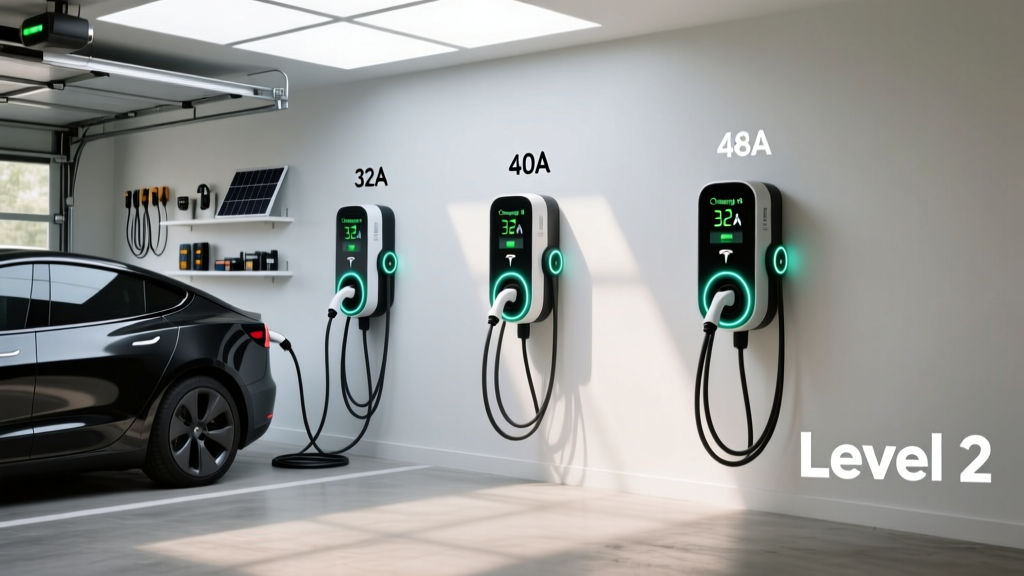
A typical Level 2 home charger requires a 240V dedicated circuit — the same voltage as your electric dryer or oven. Common amperage configurations:
- 32A circuit (40A breaker): Delivers 7.7 kW — sufficient for most EVs with smaller batteries (under 70 kWh)
- 40A circuit (50A breaker): Delivers 9.6 kW — the sweet spot for most homes, handles 75–100 kWh batteries overnight
- 48A circuit (60A breaker): Delivers 11.5 kW — maximum for most onboard chargers; requires robust panel capacity
National Electrical Code (NEC) requires that continuous loads (including EV charging) not exceed 80% of the circuit breaker rating. So a 50A breaker supports a 40A continuous draw (9.6 kW).
Installation Cost Breakdown
| Component | Simple Install (panel nearby) | Complex Install (long run / panel upgrade) |
|---|---|---|
| Level 2 charger equipment | $300–$650 | $300–$650 |
| Electrician labor (2–4 hrs simple / 6–12 hrs complex) | $300–$800 | $1,200–$3,000 |
| Electrical permit | $50–$150 | $100–$300 |
| Conduit, wiring (6 AWG copper), mounting hardware | $50–$150 | $300–$800 |
| Panel upgrade (100A → 200A, if needed) | N/A | $1,500–$4,000 |
| Total estimated cost | $700–$1,750 | $3,400–$8,750 |
Safety and Code Considerations
- Dedicated circuit: Your EV charger must be on its own dedicated breaker — never shared with other appliances.
- GFCI protection: NEC 2023 (Article 625.54) requires GFCI protection for all receptacles used for EV charging, including 240V outlets. Hardwired installations may have different GFCI requirements depending on jurisdiction.
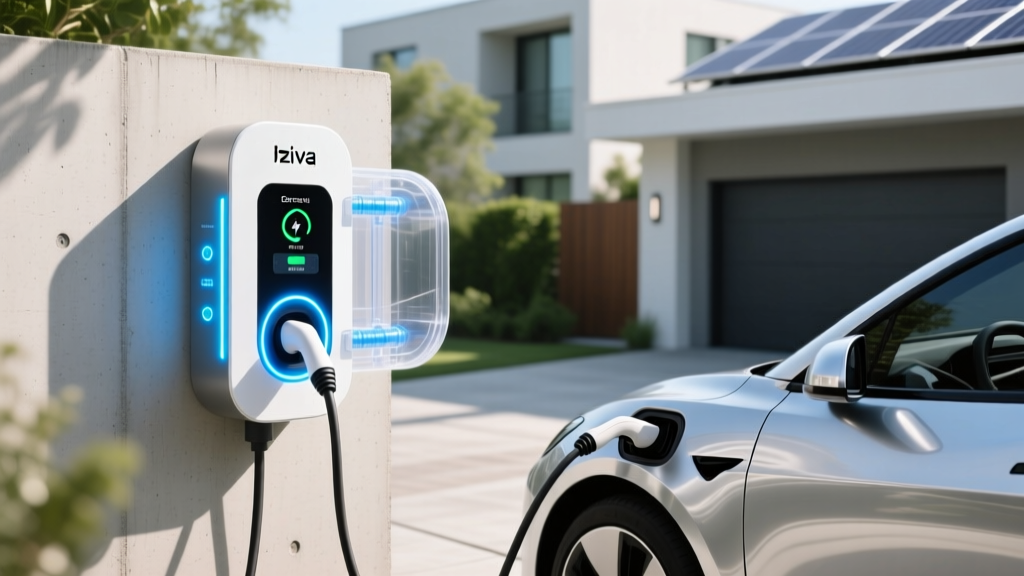
- Outdoor rating: If mounting outdoors, ensure the charger carries a NEMA 4 or NEMA 4X rating for weather resistance. Most premium chargers (ChargePoint Home Flex, Tesla Wall Connector) are outdoor-rated.
- Permit required: Virtually all jurisdictions require an electrical permit for EV charger installation. Skipping the permit risks insurance claim denial if an electrical fire occurs.
Charging Cost Per Mile: Home vs. Public vs. Gas
This is where real "fuel economy" economics play out. While Superchargers don't change your vehicle's MPGe, where and when you charge dramatically affects your cost per mile.
| Scenario | Cost per kWh | Cost per Mile (at 3.5 mi/kWh) | Annual Cost (12,000 mi) |
|---|---|---|---|
| Home Level 2 (national avg. $0.16/kWh) | $0.16 | $0.046 | $549 |
| Home off-peak TOU rate ($0.08/kWh) | $0.08 | $0.023 | $274 |
| Tesla Supercharger (avg. $0.35/kWh) | $0.35 | $0.10 | $1,200 |
| Electrify America / EVgo ($0.48/kWh) | $0.48 | $0.137 | $1,646 |
| Gas car (28 MPG avg, $3.40/gal) | — | $0.121 | $1,457 |
The takeaway: Home charging on off-peak rates costs roughly 5× less per mile than gasoline. Exclusive DC fast charging at public rates can approach or exceed gasoline costs — which is why home Level 2 installation is the highest-value EV ownership decision you can make.
According to fueleconomy.gov, the average 2026 EV achieves 100–140 MPGe combined (roughly 3.0–4.0 miles per kWh). That figure stays constant regardless of charging method.
Recommended Home Level 2 Chargers: 2026 Picks
These chargers represent the best value, reliability, and feature sets available. All are UL-listed and support the amperage configurations most homes can accommodate.
Tesla Wall Connector (Gen 4)
- Power: Up to 11.5 kW (48A)
- Connector: NACS native
- Cable length: 24 ft
- Smart features: Wi-Fi, OTA updates, load sharing, Tesla app integration
- Price: ~$420
- Best for: Tesla owners; NACS-equipped Ford/GM/Rivian owners
ChargePoint Home Flex
- Power: Up to 12 kW (50A, configurable down to 16A)
- Connector: NACS or CCS1 (J1772 with adapter)
- Cable length: 23 ft
- Smart features: Wi-Fi, ChargePoint app, Alexa, scheduling, energy tracking
- Price: ~$550–$650
- Best for: Multi-EV households, flexible amperage needs
Emporia Vue Level 2 Charger
- Power: Up to 11.5 kW (48A)
- Connector: NACS or J1772
- Cable length: 24 ft
- Smart features: Wi-Fi, energy monitoring, solar integration, load management
- Price: ~$350–$400
- Best for: Budget-conscious buyers, solar-panel homes
Grizzl-E Smart
- Power: Up to 10 kW (40A)
- Connector: NACS or J1772
- Cable length: 24 ft
- Smart features: Wi-Fi, OCPP-compatible, adjustable amperage (16–40A)
- Price: ~$450
- Best for: Extreme cold climates (rated to -40°F), Canadian-built durability
Does DC Fast Charging Harm Battery Health? The Efficiency Trade-Off
While Superchargers don't change your MPGe, frequent exclusive DC fast charging can accelerate battery degradation — which indirectly reduces your vehicle's range and usable energy over time. This is the closest link between fast charging and "fuel economy."
Lithium-ion cells (both NMC and LFP chemistries) experience stress from three factors during DC fast charging:
- Heat generation: High current flow raises cell temperatures. Without adequate thermal management (active liquid cooling), cells degrade faster.
- Lithium plating: At very high charge rates, lithium ions can deposit on the anode surface rather than intercalating properly, permanently reducing capacity.
- High SoC stress: Repeatedly charging to 100% on DC fast chargers keeps cells at high voltage for extended periods.
Modern EVs mitigate these risks with sophisticated thermal preconditioning — the car warms or cools the battery before you arrive at a Supercharger (when using the built-in navigation to route there). Still, industry fleet data from Geotab shows that vehicles charged primarily on DC fast charging degrade roughly 1–2% faster per year than those charged predominantly on Level 2.
Practical guidance: Use DC fast charging for road trips and occasional top-ups. For daily charging, Level 2 at home — ideally charging between 20–80% SoC — maximizes long-term battery health. For LFP batteries (found in standard-range Teslas, some Ford and BYD models), manufacturers recommend charging to 100% at least weekly to maintain cell balancing.
Where Real Efficiency Gains Actually Come From
If Superchargers don't improve fuel economy, what does? These factors have a measurable impact on your EV's MPGe and kWh/100mi:
- Tire pressure and type: Under-inflated tires increase rolling resistance by 2–5%. Low-rolling-resistance tires (e.g., Michelin e.Primacy, Hankook iON) can improve range by 3–7%.
- Speed: Aerodynamic drag increases with the square of velocity. Driving 75 mph vs. 65 mph on the highway typically reduces efficiency by 10–15%.
- Preconditioning: Warming the cabin and battery while plugged in (using grid power, not battery power) preserves 5–10% of range in cold weather.
- Regenerative braking settings: Maximum regen mode recovers more kinetic energy in stop-and-go driving, improving city MPGe by up to 8%.
- Heat pump usage: EVs equipped with heat pumps (standard on most 2024+ models) use 30–50% less energy for cabin heating than resistive heaters, significantly improving winter range.
Frequently Asked Questions
How much does it cost to install a home EV charger?
A straightforward Level 2 installation (panel nearby, no upgrade needed) typically costs $700–$1,750 including equipment, electrician labor, and permit. Complex installs requiring long wire runs or a 200A panel upgrade can reach $3,400–$8,750. Always get 2–3 quotes from licensed electricians and verify they pull permits.
How fast will each charging level add range?
Level 1 (120V) adds 3–5 miles of range per hour. Level 2 (240V) adds 25–44 miles per hour depending on amperage. DC fast charging can add 150–300+ miles per hour at peak power, though the charge curve tapers significantly above 60% SoC. A typical 10–80% DC fast charge takes 15–30 minutes for most modern EVs.
Which connector/charger is compatible with my EV?
If your EV is a 2025+ model from Tesla, Ford, GM, Rivian, Hyundai, Kia, or BMW, it almost certainly uses NACS. Older models (pre-2025) from VW, Stellantis, and others may use CCS1. The Nissan Leaf uses CHAdeMO. Check your vehicle's charge port or owner's manual. Adapters exist to cross-connect, but native compatibility is always preferable for reliability and peak charge speed.
How much does charging cost per mile vs gas?
Home charging at the national average ($0.16/kWh) costs roughly $0.046 per mile — about 2.6× cheaper than a 28 MPG gas car at $3.40/gallon ($0.121/mile). Off-peak home rates can drop to $0.023/mile. Exclusive public DC fast charging ($0.35–$0.48/kWh) costs $0.10–$0.14/mile, which approaches or exceeds gasoline costs.
What electrical upgrades might I need?
Homes with 100A electrical panels may need a panel upgrade to 200A ($1,500–$4,000) before adding a 40–48A EV circuit. Your electrician will perform a NEC Article 220 load calculation to determine if your existing panel has sufficient headroom. Homes with gas appliances (vs. all-electric) typically have more available capacity. Some utilities offer rebates for panel upgrades paired with EV charger installs.
Do Superchargers increase fuel economy or MPGe?
No. MPGe and kWh/100mi are determined by vehicle design and driving conditions, not by charge speed. Superchargers reduce charging time, not energy consumption. Your Tesla Model Y will achieve the same 122 MPGe combined (per the EPA) whether charged at home or on a Supercharger.
Can frequent Supercharging void my battery warranty?
No. Manufacturer battery warranties (typically 8 years/100,000 miles, covering degradation below 70% capacity) do not exclude DC fast charging. However, documented exclusive DC fast charging combined with abnormal degradation patterns could complicate warranty claims. Keep records of your charging habits and SoH readings.
The Bottom Line
Superchargers do not increase fuel economy. They reduce charging time — a convenience benefit, not an efficiency one. For the lowest cost per mile and best long-term battery health, install a Level 2 home charger and use DC fast charging primarily for road trips. Your vehicle's MPGe is fixed by its engineering; your cost per mile is determined by where you plug in.