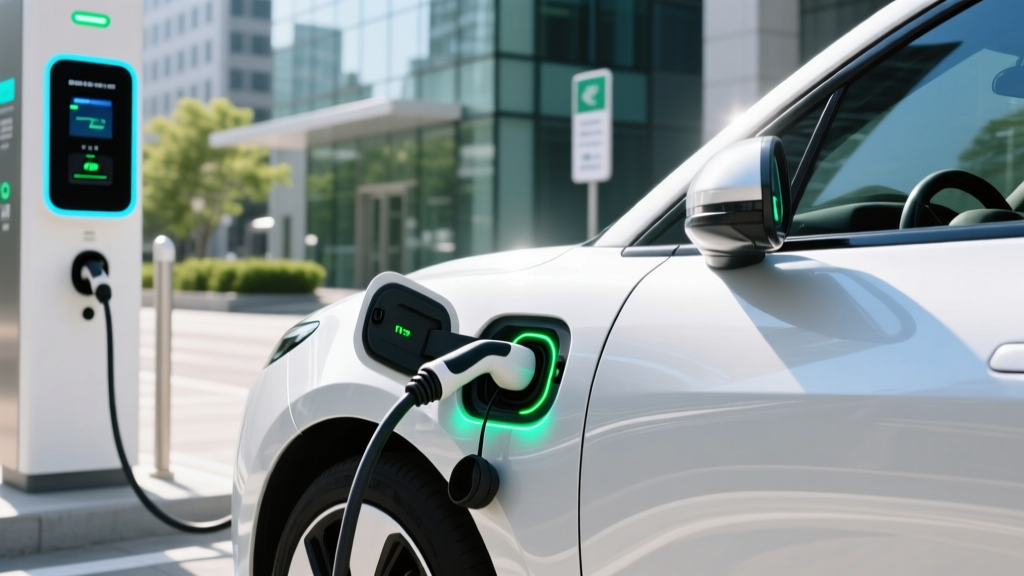
The Short Answer: Yes, But How Much Depends on Where You Plug In
If you've ever pulled up to a public EV charger and wondered whether it's free, the quick answer is: most charging stations cost money, but the price varies wildly depending on whether you're charging at home, at a public Level 2 station, or using a DC fast charger on the highway. In 2026, the average US residential electricity rate hovers around $0.16 per kWh, while public DC fast charging networks like Electrify America and EVgo typically charge between $0.35 and $0.55 per kWh — and sometimes more in peak-demand urban areas.
This guide breaks down exactly what you'll pay at every charging level, what a home charger installation actually costs (including the panel upgrade scenario most guides gloss over), and how EV charging stacks up against gasoline on a cost-per-mile basis. We'll also cover connector compatibility so you don't show up to a station with the wrong plug.
Charging Levels Explained: Speed, Cost, and Real-World Range Added
Before we talk dollars, we need to talk kilowatts. A critical distinction every EV owner must internalize: kW (kilowatts) measures power — the rate at which electricity flows into your car. kWh (kilowatt-hours) measures energy — the total amount stored in your battery. Think of kW as how fast the hose fills the pool; kWh is how big the pool is.
There are three charging levels available to EV drivers, each with different speeds, costs, and use cases:
| Level | Voltage | Power (kW) | Miles of Range Added/Hour | Typical Cost ($/kWh) | Best For |
|---|---|---|---|---|---|
| Level 1 | 120V (standard outlet) | 1.0–1.4 kW | 3–5 mi/hr | $0.12–$0.20 (home rate) | Overnight top-offs, PHEVs, low-mileage drivers |
| Level 2 | 240V (dryer-style outlet) | 7.2–19.2 kW | 25–70 mi/hr | $0.12–$0.20 home; $0.25–$0.49 public | Daily home charging, workplace, shopping centers |
| DC Fast Charge | 200–900V DC | 50–350 kW | 150–1,200+ mi/hr (peak) | $0.35–$0.55+ public | Road trips, highway travel, quick top-ups |
A few real-world caveats: DC fast charging speeds are peak rates, not sustained. Most EVs hit their peak charge rate between 10–40% state of charge, then the rate tapers significantly above 80% to protect battery health. A vehicle advertising "250 kW peak charging" may only sustain that rate for 5–8 minutes before dropping to 100 kW or lower. This is why manufacturers quote 10–80% charge times rather than 0–100%.
How Much Does Charging Cost Per Mile vs. Gas?
The most practical question for EV shoppers: will I actually save money? Let's run the numbers using a 2026 Hyundai Ioniq 5 (84 kWh usable battery, EPA 310 miles range, ~3.7 miles/kWh efficiency) as our benchmark, compared against a comparable gas crossover averaging 28 MPG combined.
| Scenario | Rate | Cost per kWh | Cost per Mile | Savings vs. Gas (per 1,000 mi) |
|---|---|---|---|---|
| Home Level 2 (off-peak utility rate) | $0.14/kWh | $0.14 | $0.038 | $102 |
| Home Level 2 (standard residential rate) | $0.17/kWh | $0.17 | $0.046 | $94 |
| Public Level 2 (ChargePoint, etc.) | $0.35/kWh | $0.35 | $0.095 | $45 |
| DC Fast Charging (Electrify America) | $0.48/kWh | $0.48 | $0.130 | $10 |
| DC Fast Charging (peak urban/Tesla Supercharger) | $0.55/kWh | $0.55 | $0.149 | –$9 (more expensive) |
| Gasoline (28 MPG @ $3.80/gal) | $3.80/gal | — | $0.136 | Baseline |
The takeaway is clear: home charging is where EVs deliver massive savings — typically 70–75% cheaper per mile than gasoline. Public Level 2 charging still saves money in most cases. DC fast charging approaches or occasionally exceeds gas costs depending on the network and location, which is why road-trippers should plan stops strategically and look for networks offering subscription discounts (Electrify America's Pass+ plan, for example, drops the per-kWh rate to around $0.36).
Many utilities offer time-of-use (TOU) plans where electricity drops to $0.08–$0.12/kWh overnight (typically 10 PM – 6 AM). If you can charge at home during off-peak hours, your cost per mile can drop below $0.03 — less than a quarter of what gasoline costs.
Home Charger Installation: What It Really Costs
Buying the charger itself is the easy part. The real expense — and the part most online guides understate — is the electrical work. Here's a realistic breakdown of what to budget for a Level 2 home charging setup in 2026.
Electrical Requirements for Level 2 Charging
A Level 2 charger requires a 240-volt circuit, identical in voltage to what your electric dryer or oven uses. Most EV owners install a 40-amp or 48-amp dedicated circuit, which supports charge rates of 7.7 kW to 11.5 kW respectively. The National Electrical Code (NEC) requires that continuous loads (like EV charging) use only 80% of a circuit's rated capacity, so a 40A circuit delivers a maximum continuous 32A (7.7 kW), and a 48A circuit delivers 38.4A (9.2 kW).
If your home's electrical panel is already near capacity — common in homes built before 2000 with 100-amp or 150-amp service — you may need a panel upgrade to 200 amps before adding a dedicated EV circuit. This is the single biggest variable in installation cost.
| Component | Simple Install (Panel Has Capacity) | Complex Install (Panel Upgrade Needed) |
|---|---|---|
| Level 2 Charger (hardware) | $400–$750 | $400–$750 |
| Electrician labor (2–4 hrs typical) | $400–$1,000 | $800–$1,500 |
| Electrical permit | $50–$200 | $100–$300 |
| Panel upgrade (if needed) | $0 | $1,500–$3,500 |
| Conduit/wiring (long runs >50 ft) | $0–$300 | $200–$600 |
| Total Estimated Cost | $850–$2,250 | $3,000–$6,650 |
According to data from the U.S. Department of Energy, most homeowners without panel issues spend between $1,000 and $2,000 for a complete Level 2 installation. Always get at least two quotes from licensed electricians and confirm they pull a permit — unpermitted work can void your homeowner's insurance and create a fire risk.
A permit and inspection ensure your charger installation meets NEC code requirements: proper wire gauge, dedicated circuit breaker, GFCI protection for outdoor installations, and correct grounding. The permit fee is typically $50–$200 and is non-negotiable for safety and insurance purposes.
What Electrical Upgrades Might I Need?
Before scheduling an electrician, check these items:
- Panel capacity: Open your main panel and add up the amperage of existing breakers. If the total approaches or exceeds your panel's rated amperage (e.g., 200A), you likely need an upgrade or a smart load-management system like the Span smart panel or a charger with built-in load sharing.
- Outlet vs. hardwired: A NEMA 14-50 outlet (50A) gives you flexibility to unplug and take the charger if you move. Hardwired installations support higher amperage (up to 48A/60A circuits) and eliminate the GFCI breaker requirement that some 14-50 setups need under the 2023 NEC update.
- Distance from panel to garage: Wire runs over 50 feet require thicker (more expensive) gauge wire to prevent voltage drop. This adds $200–$600 in materials and labor.
- Utility service upgrade: In rare cases, your utility may need to upgrade the service drop to your home, adding $500–$2,000+ and several weeks of wait time.
Which Connector Is Compatible With My EV?
The connector landscape in North America has consolidated significantly since 2024, when Ford, GM, Rivian, Volvo, and most major automakers adopted the North American Charging Standard (NACS), originally developed by Tesla. Here's where things stand for 2026 model-year vehicles:
| Connector | Brands Using It (Native) | Notes |
|---|---|---|
| NACS (Tesla/J3400) | Tesla, Ford, GM, Rivian, Volvo, Polestar, Mercedes, Nissan (2026+), Honda (2026+) | Now the dominant standard. Access to Tesla Supercharger network natively. |
| CCS1 (Combined Charging System) | Hyundai, Kia, BMW, VW, Stellantis/Jeep, Subaru, Lucid | Still widely used. CCS vehicles need a NACS adapter for Supercharger access. |
| CHAdeMO | Nissan Leaf (legacy only, discontinued) | Effectively deprecated. No new vehicles use it. Stations are declining. |
Adapter reality check: If you own a CCS-equipped vehicle (like a 2025 Hyundai Ioniq 5 or Kia EV6), you can purchase a CCS-to-NACS adapter for $150–$250 to access Tesla Superchargers. Ford and GM provide these adapters at no cost to owners of their 2024–2025 models. By 2026, most new EVs ship with NACS ports natively, making adapters unnecessary for new buyers.
For home Level 2 charging, all vehicles use the same J3400 (NACS) or J1772 connector — and any J1772 home charger works with every EV on the road using a simple adapter (included with most NACS-port vehicles).
Real-World Charging Times: How Long Does It Actually Take?
Charging time depends on three variables: your battery's usable capacity (kWh), the charger's power output (kW), and your vehicle's onboard charge acceptance curve. Here are realistic 10–80% charge times for popular 2026 EVs:
| Vehicle | Battery (kWh usable) | Level 2 (11.5 kW) | DC Fast (peak kW) | DC Fast 10–80% Time |
|---|---|---|---|---|
| Tesla Model Y Long Range | 75 kWh | ~5 hrs | 250 kW | ~22 min |
| Hyundai Ioniq 5 (Long Range) | 84 kWh | ~7 hrs | 240 kW (800V) | ~18 min |
| Ford F-150 Lightning (Extended) | 131 kWh | ~10 hrs | 150 kW | ~41 min |
| Chevrolet Equinox EV | 85 kWh | ~7 hrs | 150 kW | ~30 min |
| BMW i4 eDrive40 | 81 kWh | ~7 hrs | 205 kW | ~28 min |
Notice the Hyundai Ioniq 5's 800-volt architecture enables faster DC charging than vehicles with standard 400V systems, even when peak kW figures look similar. The Ioniq 5's 10–80% time of roughly 18 minutes is among the fastest in the industry, making it an excellent road-trip vehicle.
Cold weather caveat: Battery chemistry slows in cold temperatures. Expect 10–80% DC fast charge times to increase by 20–40% when ambient temperatures drop below 32°F unless your vehicle has active battery preconditioning (Tesla, Hyundai/Kia, and Ford all include this feature — activate it by setting the charger as your navigation destination).
Best Home EV Chargers for 2026: Equipment Picks
After testing and tracking reliability data across dozens of Level 2 chargers, here are our top picks for home installations based on power output, build quality, smart features, and value:
Emporia Level 2 Smart Charger
Power: 11.5 kW (48A) | Connector: J1772 (NACS adapter included) | Cable: 24 ft | Price: ~$400
Why: Best value for a 48A charger. Built-in energy monitoring pairs with the Emporia Vue home energy panel. Wi-Fi enabled with scheduling via app. Hardwired install recommended for 48A. UL-listed.
ChargePoint Home Flex
Power: Up to 12 kW (50A) | Connector: J1772 or NACS | Cable: 23 ft | Price: ~$550–$650
Why: Adjustable amperage (16A–50A) lets you match your circuit without buying a different unit. Excellent app with charging history and cost tracking. Available in both NACS and J1772 native connectors. NEMA 14-50 or hardwired.
Tesla Wall Connector
Power: 11.5 kW (48A) | Connector: NACS native | Cable: 24 ft | Price: ~$475
Why: The default choice for Tesla owners and any NACS-port vehicle. Sleek design, Wi-Fi updates, power-sharing between two units on one circuit. No adapter needed for NACS vehicles. Hardwired only.
Grizzl-E Smart
Power: 10 kW (40A) | Connector: J1772 or NACS | Cable: 24 ft | Price: ~$450–$550
Why: Built in Canada for extreme cold (-40°F rated). Rugged aluminum enclosure, IP67 outdoor rating. OCPP-compatible for utility demand-response programs. Best for harsh climates and outdoor installs.
Safety and Code Considerations
Regardless of which charger you choose, ensure your installation meets these safety requirements:
- Dedicated circuit: Your Level 2 charger must have its own breaker — never share a circuit with other high-draw appliances.
- GFCI protection: Required for outdoor receptacles (NEMA 14-50) under NEC 2023/2026. Hardwired chargers with built-in ground fault protection may not require a GFCI breaker, which avoids nuisance tripping issues some owners report with GFCI breakers on EV circuits.
- Outdoor rating: If your charger is installed outside or in an unenclosed carport, it must carry at least an IP54 rating (splash-proof). IP65 or IP67 is preferred for fully exposed locations.
- Cable management: Use a holster or cable organizer to keep the charging cable off the ground and prevent trip hazards and connector damage.
Frequently Asked Questions
Are any public charging stations free?
A small number of public Level 2 chargers remain free — typically at shopping centers, hotels, or workplaces that subsidize charging as a customer or employee amenity. However, free DC fast chargers are extremely rare. Apps like PlugShare and ChargeHub let you filter for free stations in your area. Note that even "free" chargers at retail locations may have time limits or require a purchase.
Do Tesla Superchargers cost money?
Yes. Tesla Superchargers charge per kWh in most US markets (typically $0.28–$0.55/kWh depending on location and time of day). Some older Tesla vehicles have "free unlimited Supercharging" that transfers with the original owner, but this is increasingly rare. Non-Tesla EVs with NACS ports can also access Superchargers at similar per-kWh rates via the Tesla app.
How much does it cost to fully charge an EV at home?
For a typical 75 kWh battery (Tesla Model Y) at the US average residential rate of $0.17/kWh, a full 0–100% charge costs about $12.75. For a larger 131 kWh battery (F-150 Lightning Extended Range), it's about $22.25. Most drivers don't charge from 0% — a typical daily top-up from 30% to 80% uses roughly 37 kWh, costing about $6.30 at home.
Is it cheaper to charge an EV at home or in public?
Home charging is almost always cheaper. Residential electricity rates ($0.12–$0.20/kWh) are typically 50–70% lower than public DC fast charging rates ($0.35–$0.55/kWh). The cost advantage of an EV over a gas car is primarily realized through home charging. If you lack home charging access and rely exclusively on public DC fast chargers, your per-mile fuel cost may equal or exceed that of an efficient gasoline car.
Can I use a regular household outlet to charge my EV?
Yes — this is Level 1 charging using a standard 120V outlet. It adds approximately 3–5 miles of range per hour and is adequate for plug-in hybrids (which have smaller batteries of 10–20 kWh) or EV drivers who travel fewer than 30 miles per day. A full charge of a 75 kWh battery from empty would take 55–70 hours on Level 1, making it impractical as a primary charging method for most BEV owners.
Do I need a permit to install a home EV charger?
Yes, in nearly all US jurisdictions, a hardwired Level 2 charger or new 240V outlet installation requires an electrical permit and inspection. The permit typically costs $50–$200 and ensures the work meets NEC safety standards. Skipping the permit risks voiding your homeowner's insurance coverage in the event of an electrical fire and may cause issues during a home sale inspection.