What Is a DC Fast Charger Trailer and Who Needs One?
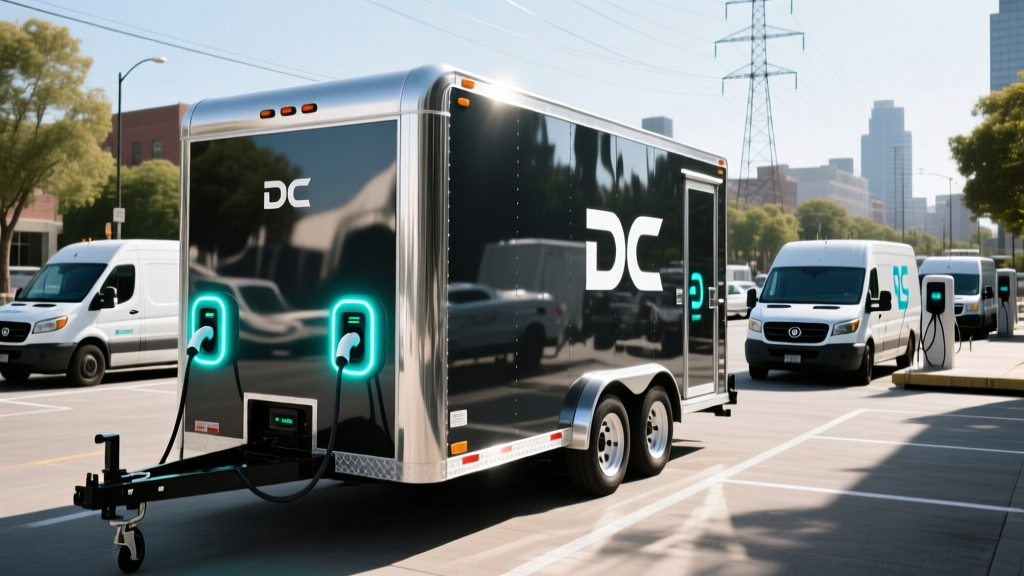
A DC fast charger trailer is a towable, self-contained mobile charging station that delivers Level 3 DC fast charging to locations without permanent infrastructure. These units typically house a 50 kW to 350 kW DC fast charger, an onboard diesel generator or battery buffer, cable management, and payment hardware — all mounted on a road-legal trailer chassis. They're deployed by fleet operators, event organizers, construction sites, emergency-response agencies, and roadside-assistance networks that need high-speed EV charging where the grid can't reach.
If you're researching a dc fast charger trailer, you're likely evaluating mobile charging as a supplement or alternative to fixed stations. This guide breaks down charging levels, real-world speeds, equipment options, connector compatibility, and the cost math you need to make an informed deployment decision in 2026.
Charging Levels Explained: Speeds, Power, and Range Added
Understanding the difference between kW (power — the rate of energy delivery) and kWh (energy — the battery's total capacity) is the single most important EV literacy concept. A 50 kW charger delivers energy at 50 kilowatts; a 75 kWh battery stores 75 kilowatt-hours. Here's how each level performs:
| Level | Voltage | Power (kW) | Miles of Range Added per Hour | Typical Use Case |
|---|---|---|---|---|
| Level 1 | 120V AC | 1.0–1.4 kW | 3–5 mi/hr | Overnight home trickle; emergency top-up |
| Level 2 | 240V AC | 3.3–19.2 kW | 12–75 mi/hr | Home, workplace, retail destination |
| DC Fast (Level 3) | 400–800V DC | 50–350 kW | 150–1,200+ mi/hr (peak) | Highway corridors, fleet depots, mobile trailers |
A DC fast charger trailer typically delivers 50–150 kW per connector, though premium units now push 180–350 kW using 800V architectures (found on the Hyundai Ioniq 5, Kia EV6, Porsche Taycan, and Lucid Air). Real-world charging speed depends on the vehicle's onboard charge acceptance curve — most EVs peak early in the session and taper significantly above 80% State of Charge (SoC).
- 60 kWh battery (Chevy Equinox EV): ~28 min at 50 kW; ~18 min at 150 kW
- 82 kWh battery (Tesla Model Y Long Range): ~38 min at 50 kW; ~22 min at 150 kW (via NACS)
- 77.4 kWh battery (Hyundai Ioniq 5, 800V): ~52 min at 50 kW; ~18 min at 233 kW peak
- 112 kWh battery (Ford F-150 Lightning Extended): ~85 min at 50 kW; ~41 min at 150 kW
Connector Compatibility: NACS, CCS1, and CHAdeMO
North America is mid-transition on connector standards. As of 2026, the North American Charging Standard (NACS) — originally Tesla's proprietary connector — has been adopted by Ford, GM, Rivian, Volvo, Polestar, Mercedes-Benz, BMW, Hyundai, and others. CCS1 remains on many 2022–2025 models, and CHAdeMO is effectively legacy (Nissan Leaf being the primary holdout). Any dc fast charger trailer deployed today should offer at minimum NACS and CCS1 connectors, with CHAdeMO as an optional add-on.
| Connector | Brands Using It (New Vehicles) | Adapter Availability |
|---|---|---|
| NACS (Tesla) | Tesla, Ford, GM, Rivian, Volvo, Polestar, Hyundai, Kia, BMW, Mercedes, Lucid | CCS-to-NACS adapters widely available ($150–$300); Tesla provides CCS adapter for older Superchargers |
| CCS1 | VW ID.4 (pre-2026), Stellantis, some Honda Prologue trims | NACS-to-CCS adapters available; Electrify America adding NACS cables to new stations |
| CHAdeMO | Nissan Leaf (legacy only) | Limited adapter options; most new DC stations dropping CHAdeMO |
For trailer-based mobile charging, dual-cable configurations (one NACS + one CCS1) are the standard deployment. Some trailer manufacturers offer swappable cable heads to future-proof against further standardization shifts.
Equipment Recommendations: DC Fast Charger Trailer Options
The mobile DC charging market has matured significantly. Here are representative categories and equipment configurations available in 2026:
Light-Duty Trailer (50 kW)
- Power Output: 50 kW DC (single connector)
- Generator: 75–100 kW diesel or natural gas
- Connectors: 1× CCS1 or 1× NACS (selectable)
- Cable Length: 20–25 ft
- Smart Features: RFID activation, cellular telemetry, remote monitoring
- Trailer Weight: ~4,500 lbs (towable by ¾-ton truck)
- Price Range: $65,000–$95,000
Mid-Range Trailer (120–150 kW)
- Power Output: 120–150 kW DC (dual connector)
- Generator: 200 kW diesel + optional battery buffer (50–100 kWh)
- Connectors: 1× NACS + 1× CCS1 (simultaneous or power-split)
- Cable Length: 25 ft
- Smart Features: Payment terminal, OCPP 2.0.1 compliance, load balancing, fleet API
- Trailer Weight: ~8,000–12,000 lbs
- Price Range: $120,000–$185,000
Heavy-Duty Trailer (180–350 kW)
- Power Output: 180–350 kW DC (dual connector, 800V capable)
- Generator: 400+ kW diesel or grid-tied with 200+ kWh battery buffer
- Connectors: 2× NACS, liquid-cooled cables for 350 kW
- Cable Length: 25–30 ft
- Smart Features: Full OCPP, plug-and-charge (ISO 15118), solar canopy add-on, V2X capable
- Trailer Weight: 15,000–22,000 lbs (requires semi or heavy-duty tow)
- Price Range: $220,000–$400,000+
Notable manufacturers in the mobile DC charging space include Blink Charging (mobile units), Lightning eMotors (fleet-grade mobile chargers), and various specialty fabricators integrating ABB, Tritium, or ChargePoint power electronics onto custom trailers. When evaluating equipment, verify that the charger supports OCPP 2.0.1 (Open Charge Point Protocol) for network interoperability and that the generator meets EPA Tier 4 emissions standards for the states where you'll operate.
Operating Costs: $/kWh and Cost Per Mile vs Gas
Running a dc fast charger trailer involves fuel (diesel for the generator), maintenance, and software/network fees. Here's how the economics break down across different charging scenarios:
| Scenario | $/kWh (National Avg) | Cost per Mile (EV at 3.5 mi/kWh) | Equivalent Gas Cost (at 25 MPG, $3.40/gal) |
|---|---|---|---|
| Home Level 2 (off-peak utility rate) | $0.06–$0.12 | $0.017–$0.034 | $0.136/mile |
| Public Level 2 (network pricing) | $0.20–$0.35 | $0.057–$0.10 | $0.136/mile |
| Fixed DC Fast (Electrify America, EA Pass) | $0.35–$0.55 | $0.10–$0.157 | $0.136/mile |
| Mobile DC Fast Trailer (diesel generator) | $0.55–$0.90 | $0.157–$0.257 | $0.136/mile |
The cost-per-mile math is straightforward: take the $/kWh rate and divide by your vehicle's efficiency in miles per kWh (most EVs average 3.0–4.0 mi/kWh; efficient sedans like the Tesla Model 3 or Lucid Air can hit 4.0+; heavy trucks like the F-150 Lightning average 2.0–2.5 mi/kWh).
Electrical and Site Requirements for Deployment
While a generator-based trailer needs no grid connection, a grid-tied dc fast charger trailer (which draws from a utility feed and uses a battery buffer to manage demand charges) requires serious electrical infrastructure:
| Charger Power | Service Required | Panel/Circuit | Estimated Grid Connect Cost |
|---|---|---|---|
| 50 kW | 480V 3-phase, 100A | Dedicated breaker, utility transformer upgrade likely | $15,000–$40,000 |
| 150 kW | 480V 3-phase, 250–400A | New switchgear, potential utility feeder upgrade | $40,000–$120,000 |
| 350 kW | 480V 3-phase, 600A+ | Pad-mount transformer, medium-voltage service | $80,000–$250,000+ |
For generator-only trailers, the primary site requirements are level ground, adequate ventilation (diesel exhaust), fuel delivery logistics, and compliance with local fire codes for fuel storage. Always check with the local AHJ (Authority Having Jurisdiction) for permits — many jurisdictions require temporary-use permits for mobile generators exceeding 50 kW, and noise ordinances may restrict operation in residential areas.
Safety and Code Considerations
- GFCI Protection: All outdoor EV charging equipment must have ground-fault circuit-interrupter protection per NEC Article 625 (2023/2026 editions).
- Dedicated Circuit: Grid-tied units require a dedicated circuit — no sharing with other loads.
- Outdoor Rating: All equipment must carry NEMA 3R or NEMA 4 enclosure ratings for weather resistance.
- Emergency Stop: Trailers should include a clearly marked E-stop button accessible without entering the vehicle.
- Cable Management: Retractors or holsters prevent cable drag and trip hazards — especially critical at public events.
Home Charging Alternative: When a Trailer Isn't the Answer
If your interest in a dc fast charger trailer stems from wanting faster home charging, a properly installed Level 2 home station is almost always the better solution. Here's what a home Level 2 install involves:
| Component | Low-End Estimate | High-End Estimate | Notes |
|---|---|---|---|
| Level 2 Charger Unit (240V, 32–48A) | $350 | $750 | Emporia Vue, ChargePoint Home Flex, Wallbox Pulsar Plus |
| Electrician Labor | $400 | $1,500 | Depends on run length, wall type, conduit needs |
| Electrical Permit | $50 | $250 | Varies by municipality |
| Panel Upgrade (if needed) | $1,500 | $4,500 | Required if panel is maxed at 100A; upgrading to 200A |
| Total (no panel upgrade) | $800 | $2,500 | Most common scenario |
| Total (with panel upgrade) | $2,300 | $7,000 | Older homes with 100A service |
A 48A Level 2 charger on a 60A dedicated 240V circuit adds roughly 30–40 miles of range per hour — enough to fully replenish any EV overnight. The IRS §30D credit does not cover home charging equipment directly, but the Alternative Fuel Vehicle Refueling Property Credit (§30C) may cover up to $1,000 of home charger installation costs, subject to census-tract eligibility and income limits. Consult a tax professional for your specific situation.
Frequently Asked Questions
How much does it cost to install a home EV charger?
A typical home Level 2 charger installation costs $800–$2,500 when no panel upgrade is needed. If your home has older 100A electrical service, a panel upgrade to 200A adds $1,500–$4,500, bringing the total to $2,300–$7,000. Equipment alone runs $350–$750 for a quality 32–48A smart charger. Always hire a licensed electrician and pull a permit — unpermitted work can void home insurance coverage.
How fast will each charging level add range?
Level 1 (120V) adds 3–5 miles per hour. Level 2 (240V, 32–48A) adds 20–40 miles per hour depending on amperage and vehicle acceptance. DC fast charging at 50 kW adds roughly 150 miles per hour at peak; at 150 kW, that jumps to ~500 miles per hour at peak. However, charge curves taper above 80% SoC, so real-world sessions are always slower than the peak kW rating suggests.
Which connector or charger is compatible with my EV?
Check your vehicle's charge port. Most 2025–2026 EVs from Tesla, Ford, GM, Rivian, Hyundai, Kia, and BMW use NACS. Volkswagen, some Stellantis, and older models use CCS1. The Nissan Leaf uses CHAdeMO. If your EV has CCS1 and you want to use Tesla Superchargers or NACS-equipped stations, a CCS-to-NACS adapter ($150–$300) bridges the gap. Verify adapter compatibility with your specific model year before purchasing.
How much does charging cost per mile compared to gas?
At the national average residential electricity rate of ~$0.16/kWh and an EV efficiency of 3.5 mi/kWh, home charging costs roughly $0.046/mile. Gasoline at $3.40/gallon in a 25 MPG vehicle costs $0.136/mile — nearly 3× more. Public DC fast charging at $0.48/kWh costs ~$0.137/mile, roughly equal to gas. Mobile DC trailer charging is more expensive due to diesel generator fuel costs, typically $0.16–$0.26/mile.
What electrical upgrades might I need for a DC fast charger trailer?
For a generator-based trailer, no electrical upgrades are needed — you supply diesel fuel. For a grid-tied trailer, a 50 kW unit requires 480V 3-phase service at 100A minimum, which may require a utility transformer upgrade ($15,000–$40,000). Higher-power 150–350 kW units need 250–600A+ 3-phase service with new switchgear and potentially medium-voltage utility connections costing $40,000–$250,000+. A battery buffer system (50–200 kWh) can reduce demand charges and lower the required service size, but adds $50,000–$200,000 to the system cost.
For authoritative data on EV efficiency ratings and MPGe figures, consult fueleconomy.gov. For charging equipment safety standards, reference NHTSA guidelines and your local building authority's adoption of NEC Article 625.