If you've pulled up to a public charging station and stared at a tangle of cables wondering which DC fast charger plug fits your EV, you're not alone. The connector landscape shifted dramatically between 2023 and 2026, with Ford, GM, Rivian, Volvo, and nearly every major automaker abandoning CCS1 in favor of Tesla's North American Charging Standard (NACS). Meanwhile, legacy CHAdeMO vehicles still need service, and adapters have become an essential part of every EV owner's kit.
This guide breaks down every DC fast charger plug type currently in use across North America, explains the three charging levels with exact speeds, walks through home installation requirements and costs, and gives you the per-mile economics of charging versus gasoline — all with real numbers, not marketing fluff.
The Three Charging Levels: Speed, Power, and Range Added
Before we get into plug shapes, you need to understand the three charging levels and what they actually deliver. A common mistake is confusing kW (kilowatts — the rate of power flow, like water pressure in a hose) with kWh (kilowatt-hours — the total energy stored in your battery, like gallons in a tank). A 150 kW charger doesn't put 150 kWh into your car; it delivers energy at a rate of 150 kilowatts, and the total energy transferred depends on time.
| Level | Voltage | Power (kW) | Miles of Range per Hour | Typical Use Case |
|---|---|---|---|---|
| Level 1 | 120V AC | 1.2–1.9 kW | 3–5 mi/hr | Overnight trickle; PHEV top-ups |
| Level 2 | 240V AC | 7.2–19.2 kW | 20–60 mi/hr | Home daily charging; workplace; shopping centers |
| DC Fast Charge | 400–900V DC | 50–350 kW | 130–1,000+ mi/hr | Road trips; highway corridors; quick top-ups |
Level 1 uses a standard household outlet and is painfully slow for a full BEV — expect roughly 40 hours to charge a 75 kWh battery from empty. It's fine for plug-in hybrids with smaller batteries (15–20 kWh) that can top up overnight. Level 2 is the workhorse of EV ownership: a 240V circuit (like your dryer outlet) that fully charges most EVs in 6–10 hours. DC fast charging bypasses the car's onboard charger entirely, sending direct current straight to the battery at high power — but it's designed for 10–80% top-ups on the road, not daily use.
Every DC Fast Charger Plug Type in North America (2026)
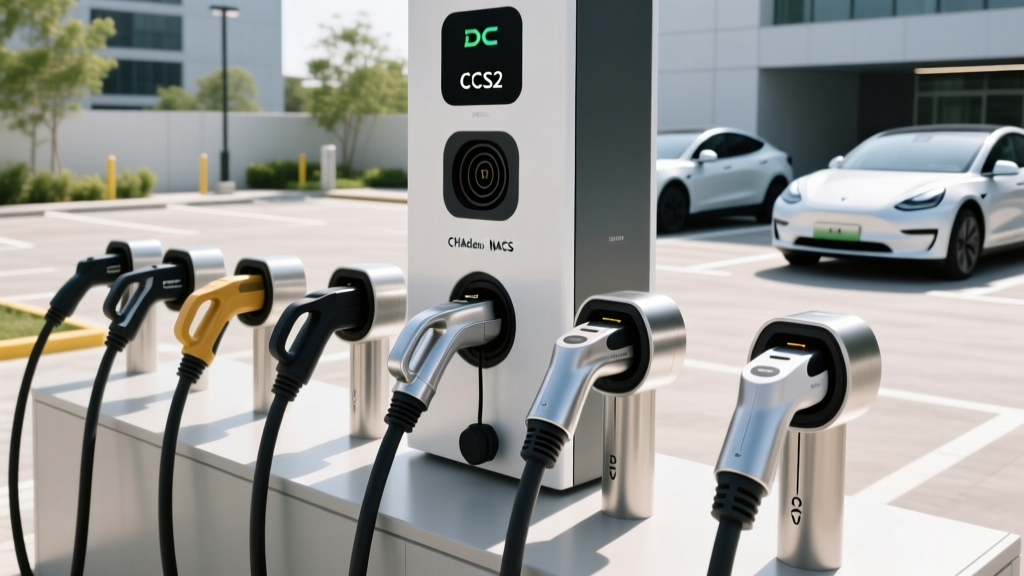
North America currently uses three DC fast charging connector standards. Here's which vehicles use which plug, and what you need to know about adapters.
| Connector | Max Power Available | Vehicle Brands (2026 Models) | Adapter Needed? |
|---|---|---|---|
| NACS (North American Charging Standard) | Up to 350 kW (V4 Superchargers) | Tesla (all), Ford (2025+), GM (2025+), Rivian (2025+), Volvo, Polestar, Mercedes, Fisker, Lucid (2026+) | CCS1-to-NACS adapter for non-Tesla vehicles at some CCS-only stations |
| CCS1 (Combined Charging System) | Up to 350 kW | Hyundai, Kia, BMW, VW, Audi, Porsche, Stellantis, legacy Ford/GM (2024 and earlier) | NACS-to-CCS adapter to use Tesla Superchargers |
| CHAdeMO | Up to 100 kW (most stations 50 kW) | Nissan Leaf (discontinued but still on roads), Mitsubishi Outlander PHEV (older models) | No adapter available; rely on remaining CHAdeMO stations |
The NACS Takeover
By 2026, NACS has become the dominant DC fast charger plug for new vehicles. Tesla opened its Supercharger network to non-Tesla EVs starting in 2024, and the combination of access to over 25,000 Supercharger stalls plus the smaller, more elegant connector design convinced the industry to switch. If you're buying a new EV in 2026, it almost certainly ships with a NACS port — with the notable exception of Hyundai/Kia, which has retained CCS1 on the Ioniq 5, Ioniq 6, and EV9 but provides an adapter for Supercharger access.
CCS1: Still Relevant, Shrinking Fast
Electrify America, EVgo, and ChargePoint stations built before 2025 still predominantly feature CCS1 connectors. Many of these networks are retrofitting stalls with NACS cables, but CCS1 remains widely available. If you drive a 2024 or earlier Ford Mustang Mach-E, GM Ultium vehicle, or any Hyundai/Kia EV, CCS1 is your native DC fast charger plug.
CHAdeMO: Legacy Only
CHAdeMO is effectively dead for new vehicles. The Nissan Leaf ended production, and no 2026 model uses this connector. Existing CHAdeMO stations still operate, but the network is shrinking as operators replace stalls with NACS/CCS dual-cable units. If you own a CHAdeMO vehicle, plan your road trips carefully using apps like PlugShare to confirm station availability.
Real-World Charging Times: 10–80% by Battery Size
Manufacturer claims about "charging in 18 minutes" always reference the 10–80% state of charge window — and for good reason. Above 80%, the battery management system dramatically reduces charging speed to protect cell health. This taper is why you'll almost never see a DC fast charging session go to 100% on a road trip; it's faster to stop at 80% and hit another charger down the road.
| Battery Size (kWh Usable) | Example Vehicles | At 150 kW Peak | At 250 kW Peak | At 350 kW Peak |
|---|---|---|---|---|
| 58 kWh | VW ID.4 Standard, base Leaf | ~28 min | ~22 min | N/A (vehicle-limited) |
| 75 kWh | Tesla Model Y LR, Ford Mach-E ER | ~32 min | ~24 min | N/A (vehicle-limited) |
| 84–100 kWh | Hyundai Ioniq 5, Kia EV9, Rivian R1T | ~38 min | ~26 min | ~18 min (Ioniq 5 800V) |
| 115–131 kWh | GMC Hummer EV, Silverado EV Max | ~55 min | ~40 min | ~30 min |
Real-world caveat: These times assume optimal battery temperature (preconditioned), a station capable of sustaining its peak rate, and a charge curve that doesn't taper early. In practice, a "250 kW" station might average 160–180 kW across the 10–80% session due to the charge curve taper, shared power cabinets, and ambient temperature. Cold weather (below 40°F) can add 30–50% to charging times unless the vehicle actively preconditioned its battery en route to the charger.
Home EV Charger Installation: Requirements and Costs
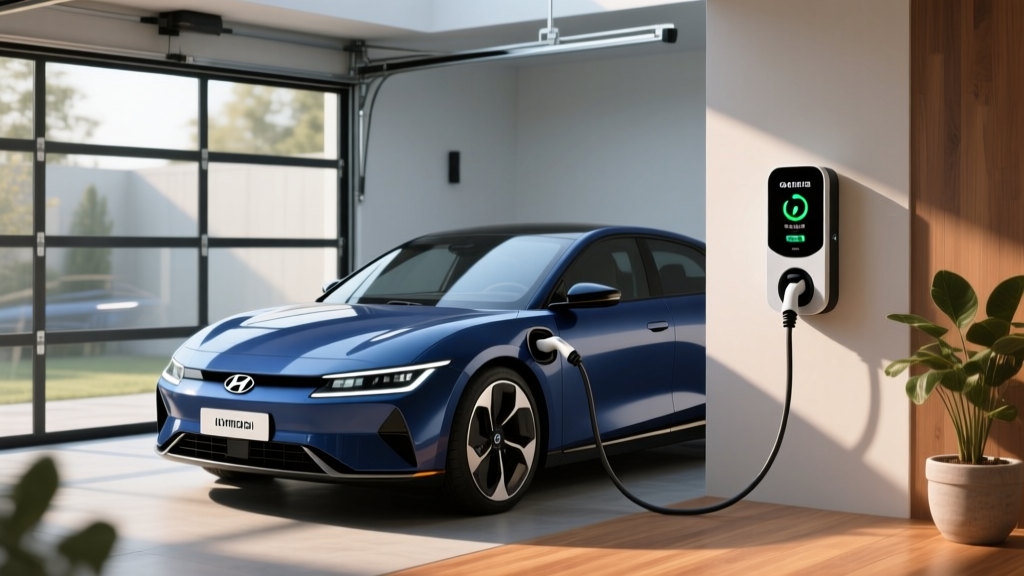
Most EV owners do 80–90% of their charging at home on a Level 2 circuit. Here's what a proper installation involves, what it costs, and where the budget surprises hide.
Electrical Requirements
A Level 2 home charger requires a dedicated 240V circuit, similar to what an electric dryer or oven uses. Common configurations:
- 40-amp circuit / 32-amp continuous charge (7.7 kW): The most common residential setup. Sufficient for overnight charging of any EV.
- 48-amp circuit / 40-amp continuous (9.6 kW): Faster charging; requires thicker wire and a 60-amp breaker.
- 60-amp circuit / 48-amp continuous (11.5 kW): Maximum for most residential chargers. Requires a 70-amp breaker and 4-gauge copper wire.
- 80-amp circuit / 64-amp continuous (15.4+ kW): Rare in homes; requires a 100-amp breaker. Only necessary for very large batteries (Hummer EV, F-150 Lightning extended range) if you need full charges in under 8 hours.
Per the National Electrical Code (NEC), continuous loads (like EV charging, which runs for 3+ hours) can only use 80% of a circuit's rated capacity. That's why a 40-amp breaker yields 32 amps of usable charging current.
Panel Upgrade Reality
Homes built before 1990 often have 100-amp main service panels. Adding a 40–60 amp EV circuit may exceed available capacity, requiring a panel upgrade to 200 amps. This is the single biggest variable in home charging cost.
| Component | Simple Install (Panel Has Capacity) | Complex Install (Panel Upgrade Needed) |
|---|---|---|
| Level 2 charger equipment | $350–$750 | $350–$750 |
| Electrician labor (run conduit, wire, mount) | $400–$1,200 | $800–$2,000 |
| Permit and inspection | $50–$250 | $100–$400 |
| Electrical panel upgrade (if needed) | $0 | $1,500–$4,000 |
| Utility service upgrade (rare, 100A to 200A at meter) | $0 | $2,000–$5,000 |
| Total estimated cost | $800–$2,200 | $3,750–$12,150 |
Get a load calculation from a licensed electrician before committing. Many utility companies offer free or discounted home energy assessments that include panel capacity evaluation. Some states and utilities also offer rebates of $250–$1,000 for Level 2 charger installation — check your local utility's EV program page.
Safety and Code Requirements
- Dedicated circuit: Your EV charger must be on its own breaker — never shared with other appliances.
- GFCI protection: The 2020 NEC requires GFCI (ground-fault circuit interrupter) protection for all EV charging outlets. Most hardwired chargers have built-in GFCI; if you use a NEMA 14-50 receptacle, your electrician must install a GFCI breaker.
- Outdoor rating: If your charger is mounted outside or in an unsealed garage, it must carry a NEMA 4 or NEMA 4X weather-resistance rating.
- Wire gauge: Must match the circuit amperage and run length. Longer runs require thicker wire to prevent voltage drop. Your electrician will calculate this.
- Permit: Nearly all jurisdictions require an electrical permit for EV charger installation. Skipping this can void your homeowner's insurance if a fire occurs.
Level 2 Home Charger Recommendations (2026)
These are proven units with the features that matter: reliable connectivity, appropriate power output, sufficient cable length, and UL/ETL safety certification.
ChargePoint Home Flex
- Power: Up to 12 kW (50A) on a 60A circuit; configurable down to 16A
- Connector: NACS (2025+ models) or J1772 with NACS adapter included
- Cable: 23 feet
- Smart features: Wi-Fi, app scheduling, utility integration, energy tracking
- Price: ~$599–$699
Tesla Wall Connector
- Power: Up to 11.5 kW (48A) on a 60A circuit
- Connector: NACS native
- Cable: 24 feet
- Smart features: Wi-Fi, OTA updates, power sharing (multiple units on one circuit), access control
- Price: ~$475
Emporia Vue Level 2 Charger
- Power: Up to 11.5 kW (48A) on a 60A circuit
- Connector: J1772 (NACS adapter available)
- Cable: 24 feet
- Smart features: Wi-Fi, app control, solar integration, energy monitoring with Emporia Vue panel
- Price: ~$399
Grizzl-E Smart
- Power: Up to 10 kW (40A) on a 50A circuit
- Connector: J1772 or NACS (choose at purchase)
- Cable: 24 feet
- Smart features: Wi-Fi, OCPP compatibility, adjustable amperage, extreme cold rating (-40°F)
- Price: ~$499–$549
Hardwired vs. plug-in: Chargers rated above 40 amps (continuous) should be hardwired by an electrician rather than plugged into a NEMA 14-50 receptacle. The 2020 NEC tightened requirements around receptacle-based EV charging, and many jurisdictions now mandate GFCI breakers for 14-50 outlets — which can cause nuisance tripping with some chargers. Hardwiring eliminates this issue and is generally the more reliable approach.
Charging Cost Per Mile: Home vs. Public vs. Gasoline
The economics of EV charging depend heavily on where and when you plug in. Here's how the numbers break down for a typical midsize EV getting 3.5 miles per kWh (roughly 286 Wh/mi — close to a Tesla Model Y or Hyundai Ioniq 5).
| Scenario | Rate ($/kWh) | Cost per Mile (at 3.5 mi/kWh) | Full 75 kWh Battery Fill-Up |
|---|---|---|---|
| Home (off-peak utility rate) | $0.08–$0.14 | $0.023–$0.040 | $6.00–$10.50 |
| Home (standard residential rate) | $0.14–$0.20 | $0.040–$0.057 | $10.50–$15.00 |
| Public Level 2 (workplace, shopping) | $0.20–$0.40 | $0.057–$0.114 | $15.00–$30.00 |
| DC Fast Charge (Electrify America, EVgo) | $0.35–$0.55 | $0.100–$0.157 | $26.25–$41.25 |
| Tesla Supercharger (varies by location/time) | $0.25–$0.45 | $0.071–$0.129 | $18.75–$33.75 |
| Gasoline (28 MPG avg, $3.40/gal) | — | $0.121 | ~$48 (equivalent range) |
At home with off-peak rates, an EV costs roughly 3–4 cents per mile to "fuel" — about a quarter of what a 28 MPG gas car costs at $3.40/gallon. Even at public DC fast charging rates of $0.45–$0.55/kWh, EVs are generally cost-competitive with gasoline on a per-mile basis, though the savings shrink significantly. The real financial advantage comes from consistent home charging.
According to fueleconomy.gov, the 2026 Hyundai Ioniq 5 achieves 114 MPGe combined, translating to roughly $550–$700 in annual electricity costs for 15,000 miles of driving at average residential rates — versus $1,600–$2,000 in gasoline for a comparable 28 MPG crossover.
Adapter Guide: Making Any DC Fast Charger Plug Work
The transition to NACS means adapters are now a critical accessory. Here's what you need based on your vehicle's native port:
- NACS vehicle at a CCS1 station: Most new NACS vehicles ship with a CCS1-to-NACS adapter (Ford, GM, Rivian include one). Aftermarket adapters from Lectron or A2Z cost $150–$250. Verify the adapter is rated for the station's maximum kW output.
- CCS1 vehicle at a Tesla Supercharger: Tesla sells an official CCS-to-NACS adapter (~$250) that enables non-Tesla CCS vehicles to use Superchargers that have been opened to other brands. Third-party adapters exist but check compatibility lists carefully.
- CHAdeMO vehicle: No adapter exists to convert CHAdeMO to NACS or CCS1. You must use stations with CHAdeMO connectors. Use PlugShare or A Better Routeplanner to filter for compatible stations.
- J1772 (Level 2) to NACS: If your home charger has a J1772 connector and your car has a NACS port, a J1772-to-NACS adapter ($80–$150) solves this for Level 2 charging only — these adapters do not work for DC fast charging.
Frequently Asked Questions
How much does it cost to install a home EV charger?
A straightforward Level 2 installation on an existing panel with available capacity typically runs $800–$2,200 including equipment, electrician labor, and permits. If your home needs a 200-amp panel upgrade, total costs can reach $3,750–$12,150. Always get a load calculation from a licensed electrician before budgeting.
How fast will each charging level add range?
Level 1 (120V) adds 3–5 miles of range per hour. Level 2 (240V) adds 20–60 miles per hour depending on amperage and your vehicle's onboard charger capacity. DC fast charging adds 130–1,000+ miles per hour in theory, but real-world 10–80% sessions take 18–40 minutes depending on battery size, peak kW acceptance, and the charge curve taper above 80%.
Which DC fast charger plug is compatible with my EV?
Check your vehicle's charge port or owner's manual. Most 2025–2026 models from Ford, GM, Rivian, Tesla, Volvo, and Polestar use NACS. Hyundai, Kia, BMW, and VW still use CCS1. Only older Nissan Leaf and Mitsubishi models use CHAdeMO. If your vehicle's native plug doesn't match the station, you'll need a certified adapter rated for the station's power output.
How much does EV charging cost per mile versus gas?
Home charging at off-peak rates costs roughly $0.03–$0.04 per mile — about 70–75% less than gasoline at $3.40/gallon and 28 MPG. Public DC fast charging at $0.40–$0.55/kWh costs $0.10–$0.16 per mile, which is comparable to or slightly cheaper than gasoline. The biggest savings come from consistent home charging with time-of-use utility rates.
What electrical upgrades might I need for a home charger?
You need a dedicated 240V circuit (40–60 amps for most homes). If your electrical panel lacks capacity — common in homes with 100-amp service built before 1990 — you may need a panel upgrade to 200 amps ($1,500–$4,000). In rare cases, the utility service from the street to your meter also needs upgrading ($2,000–$5,000). A licensed electrician can perform a load calculation to determine your exact needs. Per the IRS §30D guidelines, some home charging equipment may qualify for the Alternative Fuel Vehicle Refueling Property Credit (up to $1,000 for residential installations), though eligibility depends on census tract requirements — consult a tax professional.
Should I use DC fast charging every day?
Occasional DC fast charging won't meaningfully harm your battery, but relying on it daily accelerates degradation compared to Level 2 charging. Most manufacturers recommend keeping daily charging to Level 2 and limiting DC fast charging to road trips. Modern battery management systems mitigate much of the stress, but the data from NHTSA-monitored warranty claims and long-term fleet studies consistently show that frequent high-power DC charging correlates with slightly faster capacity loss over 5–8 years. For battery longevity, Level 2 at home is the gold standard.