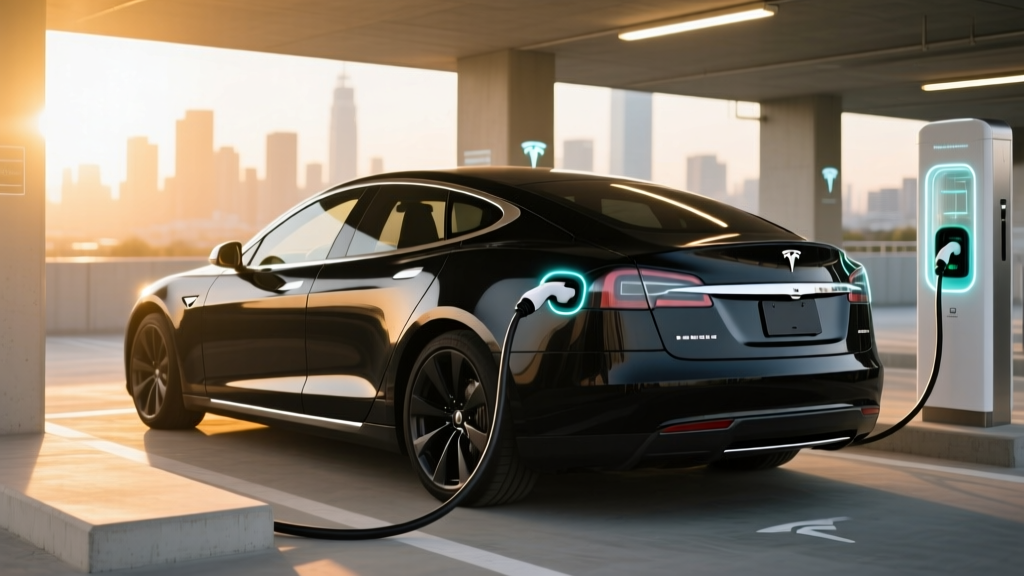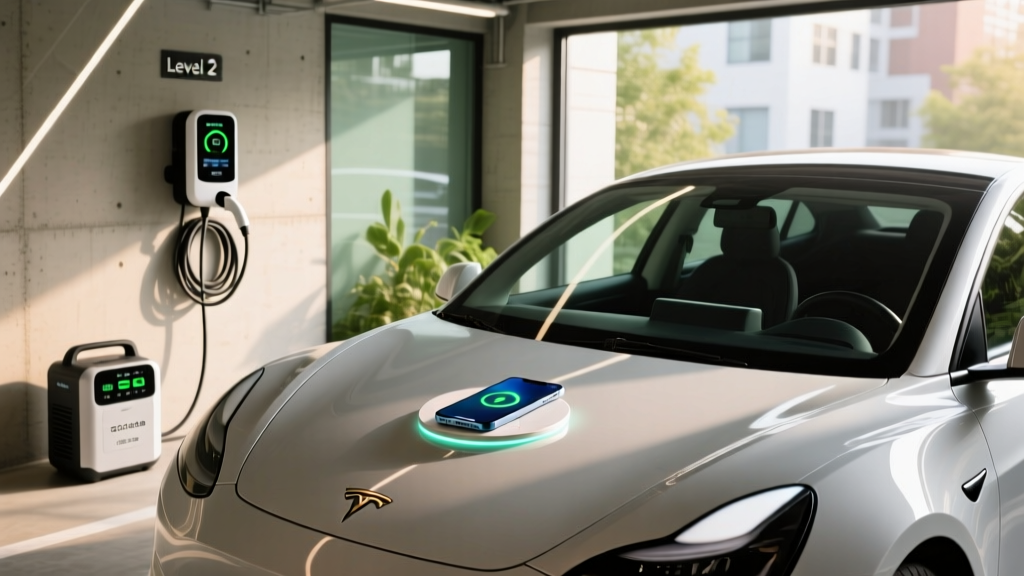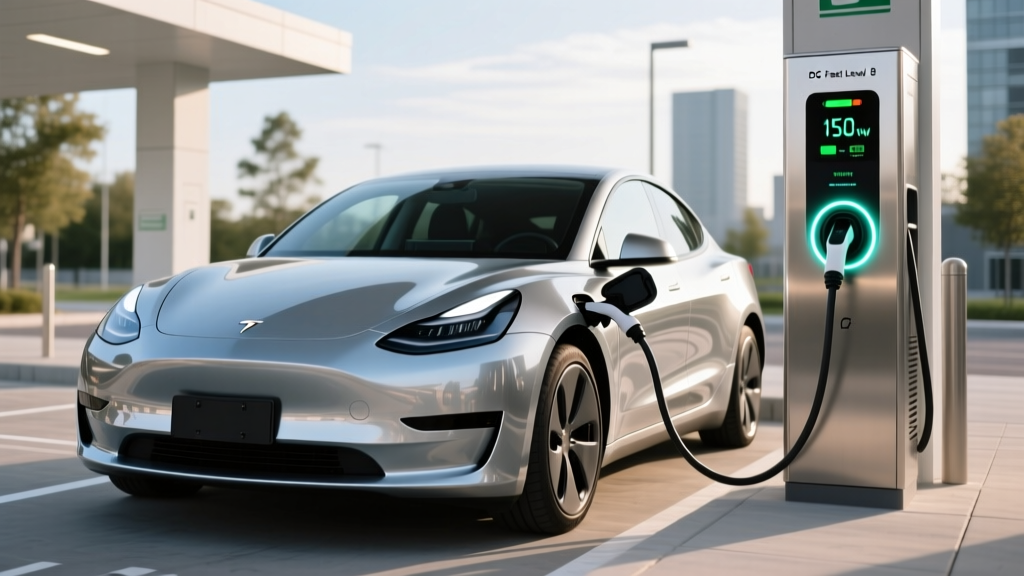
If you've searched for "dc fast charger level 3" hoping to install one at home, let's clear up a critical misconception immediately: Level 3 DC fast chargers are public infrastructure, not residential equipment. They pull 50 to 350+ kW of direct current — enough to require commercial-grade electrical service that no single-family home can support. What you can install at home is Level 2, which covers 95% of real-world EV charging needs. This guide breaks down all three charging levels with exact speeds, costs, connectors, and the equipment worth buying in 2026.
Charging Levels 1, 2, and 3: Speed, Power, and Where Each Belongs
EV charging is measured in kilowatts (kW), which represents power — the rate at which energy flows into your battery. Your battery capacity is measured in kilowatt-hours (kWh), which represents energy stored. Think of kW as how fast water flows from a hose, and kWh as how big the bucket is. Confusing these two is the most common EV literacy mistake; every charger spec below uses them correctly.
| Level | Power Source | Typical kW | Miles of Range Added per Hour | Where You'll Find It |
|---|---|---|---|---|
| Level 1 | 120V AC (standard outlet) | 1.2–1.4 kW | 3–5 mi/hr | Any household outlet; included with most EVs |
| Level 2 | 240V AC (dryer-style circuit) | 7.2–19.2 kW | 20–60 mi/hr | Home garage, workplace, shopping centers, hotels |
| Level 3 (DC Fast) | 480V+ DC (commercial service) | 50–350+ kW | 150–1,200+ mi/hr | Highway rest stops, dedicated fast-charging stations |
Level 1 is emergency trickle charging — fine for plug-in hybrids with small batteries (10–18 kWh) but impractical for full EVs with 60–100+ kWh packs. Level 2 is the home-charging workhorse: an overnight session replenishes virtually any EV battery. Level 3 (the "dc fast charger level 3" you searched for) is strictly for road trips and quick top-ups at public stations.
How Fast Will Each Charging Level Actually Add Range?
Charging speed depends on your vehicle's onboard charger capacity (for Level 1 and 2) and its DC fast-charge acceptance rate (for Level 3). Here are realistic charge times for two common battery sizes — a 65 kWh pack (e.g., Hyundai Ioniq 5 Standard Range, Volkswagen ID.4) and an 85 kWh pack (e.g., Tesla Model Y Long Range, Ford Mustang Mach-E Extended Range) — measured from 10% to 80% state of charge, the standard fast-charging benchmark.
| Charging Level | 65 kWh Battery | 85 kWh Battery | Notes |
|---|---|---|---|
| Level 1 (1.4 kW) | ~33 hours | ~42 hours | Not practical for full EVs; PHEV use only |
| Level 2 (11.5 kW / 48A) | ~4.5 hours | ~5.8 hours | Typical home wall connector on 60A circuit |
| Level 2 (7.7 kW / 32A) | ~6.3 hours | ~8.2 hours | Portable or lower-amperage home charger |
| DC Fast (150 kW peak) | ~22 min | ~28 min | Requires battery preconditioning; speed tapers above 80% |
| DC Fast (350 kW peak) | ~16 min* | ~18 min* | *Only if vehicle supports 800V+ architecture (Ioniq 5/6, Kia EV6/EV9, Porsche Taycan) |
Home Level 2 Installation: Electrical Requirements and Real Costs
Since you can't install a Level 3 DC fast charger at home, your residential investment centers on Level 2. Here's what a proper installation requires and what it actually costs in 2026.
Electrical Requirements
A Level 2 home charger requires a dedicated 240V circuit — the same voltage your electric dryer or oven uses. The most common setup is a 60-amp breaker feeding a hardwired wall connector rated for 48 amps of continuous draw (the National Electrical Code requires circuits to be rated 125% of continuous load). Some homeowners opt for a 50-amp breaker with a 40-amp charger, which still delivers 9.6 kW — enough to fully recharge most EVs overnight.
If you choose a NEMA 14-50 outlet instead of hardwiring (allowing you to unplug and take the charger when you move), the outlet must be installed with a commercial-grade receptacle — cheap residential 14-50 outlets have been linked to overheating and fires under continuous EV-charging loads. Several EV charger manufacturers now explicitly recommend hardwired installations for this reason.
Panel Upgrade: The Cost Surprise Older Homes Face
Homes built before 2000 often have 100-amp or 150-amp electrical panels. Adding a 60-amp EV circuit to an already-loaded panel may require upgrading to a 200-amp service — a significant expense. Signs you may need a panel upgrade: your panel is near capacity already (multiple electric appliances, central AC, hot tub), you have a Federal Pacific or Zinsco panel (known fire hazards that electricians won't add circuits to), or your utility drop is undersized. A panel upgrade typically costs $1,500–$4,000 on top of the charger installation.
Installation Cost Breakdown
| Item | Low Estimate | High Estimate | Details |
|---|---|---|---|
| Level 2 charger equipment | $350 | $750 | Quality smart chargers from ChargePoint, Emporia, Wallbox, Tesla |
| Electrician labor (standard install) | $500 | $1,500 | Running 6/2 or 4/2 NM-B cable 20–50 ft from panel to garage |
| Electrical permit | $50 | $200 | Required in most jurisdictions; varies by municipality |
| Panel upgrade (if needed) | $1,500 | $4,000 | 200A service upgrade; not required for most modern homes |
| Conduit/wiring for long runs | $200 | $800 | If panel is far from garage (100+ ft) or requires underground trenching |
| Total (no panel upgrade) | $900 | $2,450 | Typical scenario for homes with adequate panel capacity |
| Total (with panel upgrade) | $2,400 | $6,450 | Older homes needing full service upgrade |
Some utility companies offer rebates of $250–$1,000 for Level 2 charger installation, and certain states have additional incentives. Check your local utility's EV programs before scheduling work. The federal Alternative Fuel Vehicle Refueling Property Credit (30C) may cover up to 30% of home charging equipment and installation costs (capped at $1,000), but eligibility depends on your census tract meeting specific low-income or non-urban criteria — consult a tax professional.
Connector Compatibility: NACS, CCS1, CHAdeMO, and Adapters
The North American charging connector landscape has consolidated significantly. The Tesla-designed NACS (North American Charging Standard, formally SAE J3400) is now the dominant connector, adopted by Ford, GM, Rivian, Hyundai, Kia, BMW, and most other major automakers for 2025–2026 models. CCS1 (Combined Charging System) is still present on older vehicles and some current models. CHAdeMO is effectively discontinued for new vehicles (the Nissan Leaf was its last major holdout).
| Connector | Brands Using It (New Vehicles) | Home Level 2 | DC Fast Charging Networks |
|---|---|---|---|
| NACS (J3400) | Tesla, Ford, GM, Rivian, Hyundai, Kia, BMW, Volvo, Polestar, Mercedes, Lucid, Toyota (bZ models) | Native NACS wall connectors available | Tesla Supercharger (open to NACS vehicles), Electrify America, EVgo, ChargePoint |
| CCS1 | Volkswagen ID.4 (some trims), older EVs (2018–2024 models from most brands), Stellantis | CCS1 or J1772 chargers (with adapter) | Electrify America, EVgo, ChargePoint (most networks still support CCS1) |
| CHAdeMO | Discontinued (no new 2026 models) | Rare for home | Limited and declining; some Electrify America and EVgo locations |
If your EV has a CCS1 port and you want to access the Tesla Supercharger network (now the largest and most reliable DC fast-charging network in North America), you'll need a CCS-to-NACS adapter. Tesla sells an official adapter for ~$250, and third-party options from Lectron and A2Z are available for $120–$180. Conversely, NACS-equipped vehicles can use CCS1 stations with a NACS-to-CCS adapter. For home Level 2 charging, most chargers now ship with NACS connectors, and J1772-to-NACS adapters are widely available for under $100.
Charging Cost Per Mile: Home vs. Public DC Fast vs. Gas
One of the strongest EV ownership arguments is fuel cost savings — but only if you charge smartly. Public DC fast charging can be surprisingly expensive, sometimes approaching gas-car fuel costs per mile.
| Scenario | Rate | Cost per Mile* | Notes |
|---|---|---|---|
| Home Level 2 (off-peak utility rate) | $0.08–$0.12/kWh | $0.025–$0.04 | Cheapest option; use time-of-use plans |
| Home Level 2 (standard utility rate) | $0.13–$0.18/kWh | $0.04–$0.06 | National average residential electricity |
| Home solar (amortized) | $0.04–$0.07/kWh | $0.01–$0.02 | Lowest possible cost if you own solar panels |
| Public Level 2 (workplace/shopping) | $0.15–$0.30/kWh | $0.05–$0.09 | Often free at workplaces; varies at retail |
| Public DC Fast (Level 3) | $0.30–$0.55/kWh | $0.09–$0.17 | Electrify America, EVgo, Tesla Supercharger pricing |
| Gasoline (30 MPG combined @ $3.30/gal) | $3.30/gallon | $0.11 | EPA combined average for non-hybrid gas vehicles |
*Cost per mile calculated assuming 3.2–3.5 miles per kWh (typical EV efficiency for crossovers like Model Y, Ioniq 5, ID.4). Sedans like the Tesla Model 3 and Hyundai Ioniq 6 achieve 4+ mi/kWh and will cost proportionally less.
Best Home Level 2 Chargers for 2026: Equipment Recommendations
Since Level 3 DC fast chargers aren't residential equipment, here are the best Level 2 home chargers available in 2026 — selected for reliability, power output, smart features, and value based on real-world ownership.
Emporia Vue Level 2 EV Charger
- Power: 11.5 kW (48A) on 60A circuit
- Connector: NACS (J1772 adapter included)
- Cable length: 24 ft
- Smart features: Wi-Fi, app scheduling, solar integration with Emporia Vue energy monitor, load management
- Price: ~$399
- Best for: Solar panel owners; best value-to-power ratio
ChargePoint Home Flex (2nd Gen)
- Power: Up to 12 kW (50A) on 60A circuit, configurable 16–50A
- Connector: NACS or J1772 options
- Cable length: 23 ft
- Smart features: Wi-Fi, Alexa/Google Home, app with detailed session data, flexible amperage for older panels
- Price: ~$549
- Best for: Homes with limited panel capacity (adjustable amperage)
Tesla Wall Connector
- Power: 11.5 kW (48A) on 60A circuit
- Connector: NACS native
- Cable length: 24 ft
- Smart features: Wi-Fi, over-the-air updates, power sharing (link multiple units on one circuit), Tesla app integration
- Price: ~$475
- Best for: Tesla and NACS-equipped vehicle owners; cleanest integration
Wallbox Pulsar Max
- Power: 11.5 kW (48A) on 60A circuit
- Connector: NACS or J1772
- Cable length: 25 ft (longest in class)
- Smart features: Wi-Fi + Bluetooth, Eco-Smart solar mode, Power Boost dynamic load management, compact form factor
- Price: ~$599
- Best for: Tight garage spaces (smallest wall footprint); longest cable reach
Safety, Electrical Code, and Permit Requirements
EV charging is a continuous high-draw electrical load — your charger will run at full power for hours, which is fundamentally different from intermittent loads like a microwave. The National Electrical Code (NEC) treats it accordingly, and proper installation isn't optional.
- Dedicated circuit: Your EV charger must have its own dedicated breaker — it cannot share a circuit with other outlets or appliances.
- GFCI protection: NEC 2023 (and carried into 2026 adoptions) requires GFCI protection for all 125V and 250V receptacles rated 50A or less in garages. Hardwired chargers are exempt from this GFCI requirement, which is another reason many electricians now recommend hardwiring over plug-in installations.
- Outdoor rating: If your charger is installed outdoors (driveway or exterior wall), it must carry a NEMA 4 or NEMA 4X weather-resistance rating. All chargers recommended above are outdoor-rated.
- Permitting: Most jurisdictions require an electrical permit for EV charger installation. Your electrician typically pulls this; cost ranges from $50–$200. An inspector will verify wire gauge, breaker sizing, grounding, and GFCI compliance before signing off.
- Wire gauge: A 60A circuit requires 6 AWG copper wire (THHN in conduit) or 4 AWG aluminum. A 50A circuit requires 6 AWG copper (NM-B cable). Undersized wire creates a fire hazard — this is not an area to cut corners.
Never use an extension cord with an EV charger. Never plug a Level 2 charger into a standard 120V outlet with an adapter. And if your electrician suggests skipping the permit to save money, find a different electrician — unpermitted work can void your homeowner's insurance in the event of an electrical fire.
Frequently Asked Questions
Can I install a DC fast charger (Level 3) at home?
No. Level 3 DC fast chargers require 480V+ three-phase commercial electrical service, draw 50–350+ kW, and cost $20,000–$150,000+ per unit before electrical infrastructure. They are designed for commercial charging stations, not residences. Home charging maxes out at Level 2 (up to 19.2 kW), which fully recharges any EV overnight and covers daily driving needs.
How much does it cost to install a home EV charger?
A typical Level 2 home charger installation costs $900–$2,450 total (equipment + electrician + permit) if your electrical panel has sufficient capacity. If you need a 200-amp panel upgrade, expect $2,400–$6,450 all-in. Equipment alone runs $350–$750 for a quality smart charger.
How fast will each charging level add range?
Level 1 (120V) adds 3–5 miles per hour. Level 2 (240V) adds 20–60 miles per hour depending on amperage. Level 3 DC fast charging adds the equivalent of 150–1,200+ miles per hour, which translates to a 10–80% charge in 16–30 minutes for most modern EVs at a 150–350 kW station.
Which connector/charger is compatible with my EV?
For 2026 models, most new EVs use the NACS connector (Tesla, Ford, GM, Hyundai, Kia, Rivian, BMW, and others). Older EVs (pre-2025) typically use CCS1 or J1772. Check your vehicle's charge port — if it's the smaller NACS design, buy a NACS home charger. If it's the larger CCS1/J1772, buy a J1772 charger or use a NACS-to-J1772 adapter. For DC fast charging on road trips, adapters are available to cross between networks.
How much does charging cost per mile vs. gas?
Home Level 2 charging at average electricity rates costs $0.04–$0.06 per mile — roughly 50–65% less than gasoline at $3.30/gallon in a 30 MPG vehicle ($0.11/mile). However, public DC fast charging at $0.35–$0.55/kWh costs $0.09–$0.17 per mile, which can match or exceed gas costs. The economic advantage of EVs depends on consistent home or workplace charging access.
What electrical upgrades might I need?
The most common upgrade is a 200-amp electrical panel replacement ($1,500–$4,000) if your existing panel is at or near capacity. Homes with 200-amp service and room on the panel typically need no upgrade — just a new 60-amp breaker and wiring run to the garage. An electrician's load calculation will determine your specific needs before any work begins.
For authoritative data on EV efficiency ratings and range, consult fueleconomy.gov, the EPA's official source for MPGe and kWh/100mi figures across all current EV models. For the latest federal tax credit rules on home charging equipment, refer to the IRS 30C credit page.