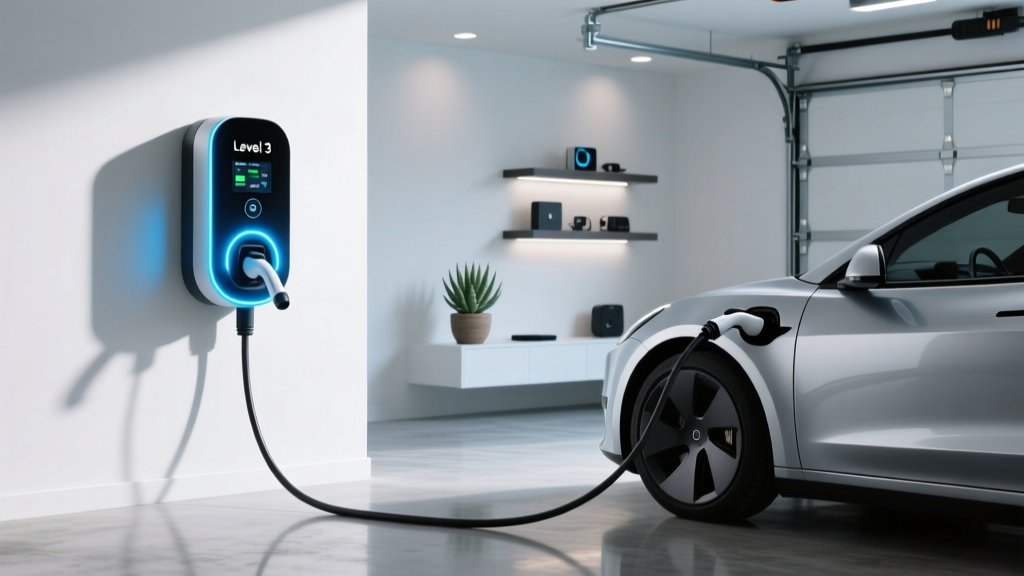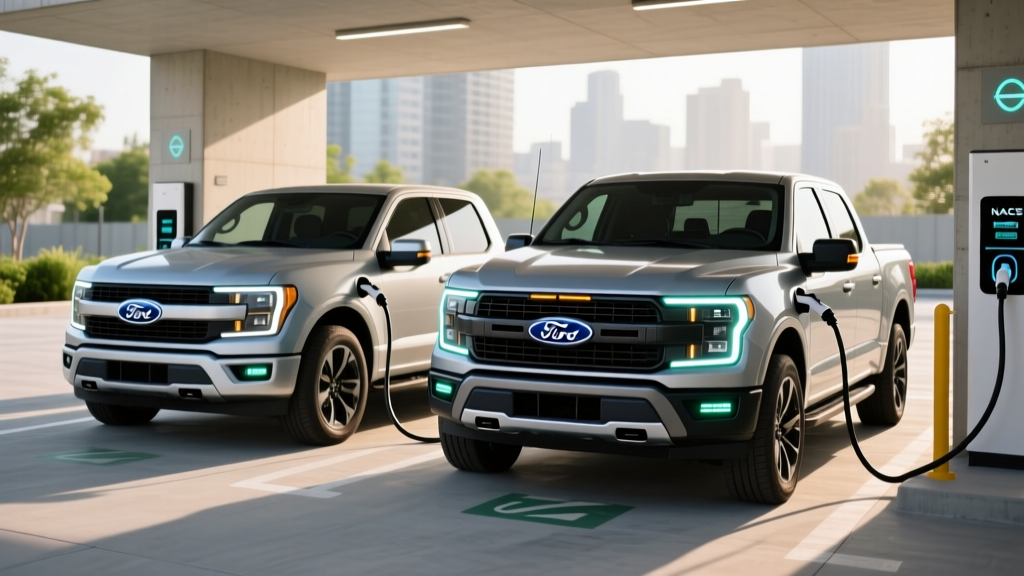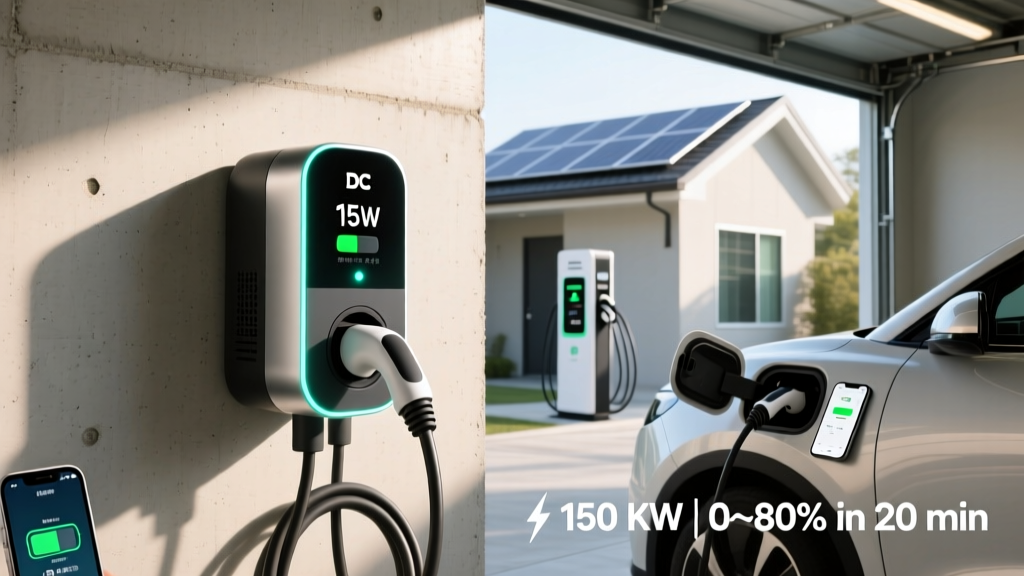
The Three Charging Levels: Speed, Power, and What They Mean for Your EV
Before evaluating any DC fast charger for electric vehicles, you need to understand the three tiers of EV charging and how they translate to real-world range recovery. The single most common mistake new EV owners make is confusing kW (kilowatts — the rate of power delivery, like water pressure) with kWh (kilowatt-hours — the total energy stored in your battery, like the size of the tank). A charger's kW rating tells you how fast it can push energy; your battery's kWh capacity tells you how much it can hold.
| Level | Voltage | Max Power (kW) | Miles of Range Per Hour | Typical Use Case |
|---|---|---|---|---|
| Level 1 (120V) | 120V AC | 1.0–1.4 kW | 3–5 mi/hr | Overnight trickle, PHEVs, emergency |
| Level 2 (240V) | 240V AC | 3.3–19.2 kW | 12–70 mi/hr | Daily home/workplace charging |
| DC Fast Charge | 200–900V DC | 50–400 kW | 150–1,200+ mi/hr | Road trips, rapid top-ups |
DC Fast Charging in Practice: 10–80% Times for Popular EVs
DC fast charging bypasses the vehicle's onboard AC-to-DC converter and pushes direct current straight into the battery pack at high voltage. This is why DC fast chargers can deliver 50–400 kW while Level 2 home chargers top out around 11.5–19.2 kW. Here's what that looks like for some of the most common EV battery sizes on the road in 2026:
| Vehicle (2025–2026 MY) | Battery (kWh usable) | Peak DC Rate | 10–80% Time | Notes |
|---|---|---|---|---|
| Tesla Model Y Long Range | 75 kWh (NMC) | 250 kW | ~25 min | NACS connector; V3 Supercharger |
| Hyundai Ioniq 5 (Long Range) | 77.4 kWh (NMC) | 240 kW | ~18 min | 800V architecture; CCS1 or NACS |
| Ford F-150 Lightning (Ext. Range) | 131 kWh (NMC) | 150 kW | ~41 min | Large pack extends charge time |
| Chevrolet Equinox EV 3RS | 85 kWh (NMC) | 150 kW | ~30 min | NACS standard for 2026 MY |
| BMW iX xDrive50 | 105.2 kWh (NMC) | 200 kW | ~34 min | CCS1 in North America |
Several factors compress or extend these times. Battery preconditioning — warming or cooling the pack to its optimal temperature before arrival at the charger — is critical. Without it, cold-soaked batteries can charge at half the peak rate. The Hyundai/Kia E-GMP platform and Tesla vehicles handle preconditioning automatically when you navigate to a charger. Ambient temperature matters enormously: expect 20–40% longer charge sessions below 32°F (0°C) unless the vehicle actively preconditions. State of charge dictates the curve: charging from 10–50% is dramatically faster than 50–80%.
Can You Install a DC Fast Charger at Home? (And What It Actually Costs)
This is the question that drives the most search traffic, and the honest answer requires separating fantasy from reality. A true DC fast charger for electric vehicles — the kind delivering 50–350 kW — is not a practical home installation for nearly all residential properties. Here's why:
- Electrical service requirements: A 50 kW DC fast charger draws roughly 125+ amps at 480V three-phase power. Most US homes have 200-amp, 240V single-phase service — insufficient by a wide margin.
- Utility upgrade costs: Upgrading to three-phase or 400-amp+ service can cost $10,000–$50,000+, subject to utility availability and transformer proximity.
- Equipment cost: Commercial-grade 50 kW DC fast chargers cost $20,000–$60,000 for the hardware alone.
- Demand charges: Commercial electricity rate structures impose demand charges based on peak kW draw, adding hundreds per month.
There are a handful of lower-power DC home chargers emerging — such as the Wallbox Quasar 2 (bidirectional, ~7.4 kW DC) — but these serve specific V2H (vehicle-to-home) use cases rather than replicating road-trip charging speeds.
What you actually want at home is a Level 2 charger. A 48-amp (11.5 kW) Level 2 station adds 35–45 miles of range per hour and fully replenishes most EV batteries overnight. Here's what a professional Level 2 installation costs in 2026:
| Component | Cost Range | Details |
|---|---|---|
| Level 2 charger hardware | $300–$700 | 32A–48A smart charger (ChargePoint, Emporia, Wallbox) |
| Electrician labor (standard install) | $500–$1,500 | Run 240V/50A circuit from panel to garage/carport, ~20–50 ft |
| Electrical permit | $50–$200 | Varies by municipality; required for code compliance |
| Panel upgrade (if needed) | $1,500–$4,000 | 200A→200A service upgrade or sub-panel; older homes with 100A service may need full upgrade ($3,000–$5,000+) |
| Total (no panel upgrade) | $850–$2,400 | Most common scenario for homes built after 1990 |
| Total (with panel upgrade) | $2,500–$6,500 | Homes with 100A service or maxed-out panels |
Home Installation Electrical Requirements
For a standard 48-amp Level 2 charger, the National Electrical Code (NEC) requires:
- Dedicated 240V circuit with a 60-amp breaker (EVSE must be derated to 80% of breaker capacity, so 60A breaker = 48A continuous draw)
- 6 AWG copper wire (or 4 AWG aluminum) for runs up to ~50 feet; longer runs may require thicker gauge to limit voltage drop
- GFCI protection — NEC 2020 and later require GFCI breakers for EV charging circuits in garages and outdoor locations (adds $50–$120 for a GFCI breaker)
- NEMA 14-50 outlet (for plug-in chargers) or hardwired connection (for wall-mounted units); hardwired is generally preferred for reliability and avoids the ~$80 outlet cost
- Outdoor-rated enclosure (NEMA 4 or 4X) if the charger is installed outside
Connector Compatibility: NACS, CCS1, and CHAdeMO in 2026
The connector landscape has shifted dramatically since Ford, GM, Rivian, and most major automakers adopted the North American Charging Standard (NACS) — originally Tesla's proprietary connector — beginning in 2024–2025. Here's where things stand for 2026 model-year vehicles:
| Connector | Brands Using It (Native) | DC Fast Charge Availability | Adapter Needed? |
|---|---|---|---|
| NACS (J3400) | Tesla, Ford, GM, Rivian, Hyundai/Kia (select 2026 MY), Volvo/Polestar, Mercedes-Benz (2026+) | Tesla Superchargers (20,000+ stalls), growing third-party NACS stations | Older CCS vehicles need CCS→NACS adapter (~$200–$300) |
| CCS1 (Combo) | BMW, VW/ID.4, some Stellantis, legacy Hyundai/Kia (2024 and earlier) | Electrify America, EVgo, ChargePoint DC stations | NACS→CCS adapter for Tesla Supercharger access (where enabled) |
| CHAdeMO | Nissan Leaf (discontinued 2025), Mitsubishi Outlander PHEV (legacy) | Declining network support; some EA and independent stations | No practical adapter; CHAdeMO is effectively sunset in North America |
Key takeaway for buyers: If you're purchasing a new EV in 2026, prioritize a NACS-equipped vehicle for the broadest fast-charging access. Tesla's Supercharger network remains the most reliable DC fast-charging infrastructure in North America, with over 25,000 stalls now open to non-Tesla NACS vehicles. If you own an older CCS1 vehicle, a CCS-to-NACS adapter (such as the Lectron or A2Z adapter, ~$200–$300) unlocks Supercharger access at participating locations.
Cost to Charge: Home vs. Public DC Fast Charging Per Mile
One of the strongest economic arguments for EV ownership is the per-mile fuel cost advantage — but the gap narrows considerably when you rely on public DC fast charging. Here's a realistic cost breakdown based on 2026 electricity rates and an average EV efficiency of 3.0 miles/kWh (roughly the EPA combined average for vehicles like the Tesla Model Y and Hyundai Ioniq 5):
| Charging Scenario | Rate ($/kWh) | Cost Per Mile | Annual Cost (12,000 mi) |
|---|---|---|---|
| Home Level 2 (off-peak utility rate) | $0.08–$0.14 | $0.027–$0.047 | $320–$560 |
| Home Level 2 (standard residential rate) | $0.14–$0.20 | $0.047–$0.067 | $560–$800 |
| Public Level 2 (workplace/shopping) | $0.20–$0.35 | $0.067–$0.117 | $800–$1,400 |
| Public DC fast charger (EA, EVgo) | $0.35–$0.55 | $0.117–$0.183 | $1,400–$2,200 |
| Tesla Supercharger (avg national) | $0.28–$0.36 | $0.093–$0.120 | $1,120–$1,440 |
| Gasoline comparison (30 MPG combined, $3.40/gal avg) | |||
| Gas vehicle (30 MPG) | $3.40/gallon | $0.113 | $1,360 |
| Gas vehicle (22 MPG — truck/SUV) | $3.40/gallon | $0.155 | $1,860 |
The data is clear: home charging is the economic sweet spot. At off-peak rates, charging an EV at home costs roughly one-quarter to one-third the per-mile cost of gasoline. Even at standard residential rates, you'll save $500–$1,000 annually vs. a 30 MPG gas car. However, if you rely exclusively on public DC fast charging at $0.45–$0.55/kWh, your per-mile cost can equal or exceed a fuel-efficient gas vehicle. This is why home Level 2 access is the single most important factor in EV ownership satisfaction and economics.
Recommended Home Level 2 Chargers (2026 Picks)
Since true DC fast chargers aren't viable for residential installation, here are the best Level 2 home EVSE (Electric Vehicle Supply Equipment) options currently available, evaluated on power output, connector options, smart features, build quality, and price:
Emporia Level 2 Smart Charger (48A)
- Power output: 11.5 kW (48A @ 240V)
- Connector: J1772 (NACS adapter included with select bundles)
- Cable length: 24 ft
- Smart features: Wi-Fi, Emporia app scheduling, solar integration, load management with Emporia Vue panel monitor
- Price: ~$350–$400
- Best for: Budget-conscious buyers who want smart scheduling and solar-aware charging
ChargePoint Home Flex (up to 50A)
- Power output: Up to 12 kW (50A @ 240V); configurable 16A–50A via DIP switch
- Connector: J1772 or NACS (select at purchase)
- Cable length: 23 ft
- Smart features: Wi-Fi, ChargePoint app, Alexa/Google Home, flexible amperage to match your circuit
- Price: ~$550–$650
- Best for: Flexibility — adjustable amperage lets you install on a 20A–60A breaker depending on your panel capacity
Wallbox Pulsar Plus (48A)
- Power output: 11.5 kW (48A @ 240V)
- Connector: J1772 or NACS
- Cable length: 25 ft
- Smart features: Wi-Fi + Bluetooth, myWallbox app, Power Sharing (two chargers on one circuit), Eco-Smart solar mode
- Price: ~$500–$600
- Best for: Multi-EV households needing two chargers on a shared 60A circuit
Tesla Wall Connector (48A)
- Power output: 11.5 kW (48A @ 240V)
- Connector: NACS native (J1772 adapter available)
- Cable length: 24 ft
- Smart features: Wi-Fi, OTA updates, Power Sharing, integrated cable management, glass faceplate
- Price: ~$425–$475
- Best for: Tesla and NACS-equipped vehicle owners wanting the cleanest native integration
All four chargers above are UL-listed, hardwired or NEMA 14-50 plug compatible, and rated for indoor/outdoor use (NEMA 4). The critical installation rule: match the charger's maximum amperage to your circuit breaker at 80% — a 48A charger needs a 60A breaker, a 40A charger needs a 50A breaker. Never install on an undersized circuit.
Public DC Fast Charging Networks: What to Expect in 2026
When you're on a road trip and need a DC fast charger for your electric vehicle, here's the current state of major public networks:
- Tesla Supercharger: ~25,000+ stalls in North America; 150 kW (V2) and 250 kW (V3) most common, with 350–500 kW V4 stalls rolling out at select locations. NACS connector. Now open to non-Tesla EVs with NACS ports via the Tesla app. Reliability consistently rated highest among networks.
- Electrify America: ~4,500+ DC fast chargers; peak rates of 150–350 kW. CCS1 and NACS connectors being added. Pricing: $0.36–$0.55/kWh depending on region and subscription (Pass+ plan: $0.31/kWh for $7/month).
- EVgo: ~3,500+ DC fast chargers; 50–350 kW. CCS1 and NACS. Pricing: $0.36–$0.48/kWh; subscription plans available.
- ChargePoint: Growing DC fast network; 50–400 kW stalls. CCS1 and NACS. Pricing varies by site host.
For real-time station availability, connector type, and live stall status, use PlugShare or A Better Route Planner (ABRP). These tools also calculate whether your current SoC will reach the next charger — essential for route planning in rural corridors.
Safety, Code, and Permitting Essentials
EV charging involves sustained high-current draw over many hours — a fundamentally different load profile than typical household appliances. Key safety and code requirements (NEC 2020/2023, adopted by most jurisdictions as of 2026):
- Dedicated circuit: Your EV charger must be on its own dedicated breaker — no shared circuits with other appliances.
- GFCI protection: Required for all 240V EV charging outlets in garages and outdoor locations. Hardwired installations may be exempt in some jurisdictions, but GFCI is recommended regardless.
- Permitting: Most municipalities require an electrical permit ($50–$200) and a post-installation inspection. Skipping the permit risks insurance claim denial in the event of an electrical fire.
- Outdoor rating: Any charger or outlet exposed to weather must be rated NEMA 4 (splash-resistant) or NEMA 4X (corrosion-resistant). Ensure your electrician installs an in-use cover for NEMA 14-50 outlets.
- Ventilation: Indoor charging in attached garages does not require special ventilation for EVs (no off-gassing like lead-acid batteries), but the NEC requires the charging area to be free of flammable material storage within 3 feet.
For detailed code requirements, consult the National Fire Protection Association's NEC guidelines and your local building department. Always hire a licensed electrician — DIY EV charger installation on a 240V/60A circuit carries serious arc-flash and fire risk.
Frequently Asked Questions
How much does it cost to install a home EV charger?
A typical Level 2 home charger installation (48A, 240V) costs $850–$2,400 including equipment ($300–$700), electrician labor ($500–$1,500), and permit ($50–$200) — assuming your electrical panel has sufficient capacity. If a panel upgrade is needed (common in homes with 100A service), add $1,500–$5,000+. True DC fast chargers are not feasible for residential installation due to three-phase power requirements and $20,000+ equipment costs.
How fast will each charging level add range?
Level 1 (120V) adds 3–5 miles per hour. Level 2 (240V, 48A) adds 35–45 miles per hour for most EVs. DC fast charging adds the equivalent of 150–1,200+ miles per hour at peak rate, but real-world sessions taper above 60–80% SoC — expect a 10–80% session to take 18–41 minutes depending on the vehicle's battery size and peak charge rate.
Which connector/charger is compatible with my EV?
For 2026 model-year vehicles: Tesla, Ford, GM, Rivian, and new Hyundai/Kia/Volvo models use NACS. BMW, VW, and most pre-2025 non-Tesla EVs use CCS1. CHAdeMO is effectively discontinued. Check your vehicle's charge port or owner's manual. CCS1-to-NACS adapters (~$200–$300) are available for older vehicles to access Tesla Superchargers.
How much does charging cost per mile vs gas?
Home Level 2 charging at off-peak rates costs approximately $0.03–$0.05 per mile — roughly one-quarter to one-third the cost of gasoline at $3.40/gallon in a 30 MPG vehicle ($0.11/mile). Public DC fast charging at $0.40–$0.55/kWh costs $0.12–$0.18 per mile, which can equal or exceed gas costs. Home charging access is the key to EV cost savings.
What electrical upgrades might I need?
If your home has a 100-amp electrical panel (common in homes built before 1990), you'll likely need a service upgrade to 200A ($3,000–$5,000) before adding a 60A EV circuit. Even with a 200A panel, if existing loads (electric range, dryer, HVAC) consume most of your capacity, you may need a smart load manager ($150–$300) that dynamically reduces charger amperage when other appliances are running. A licensed electrician can perform a NEC Article 220 load calculation to determine your exact situation.