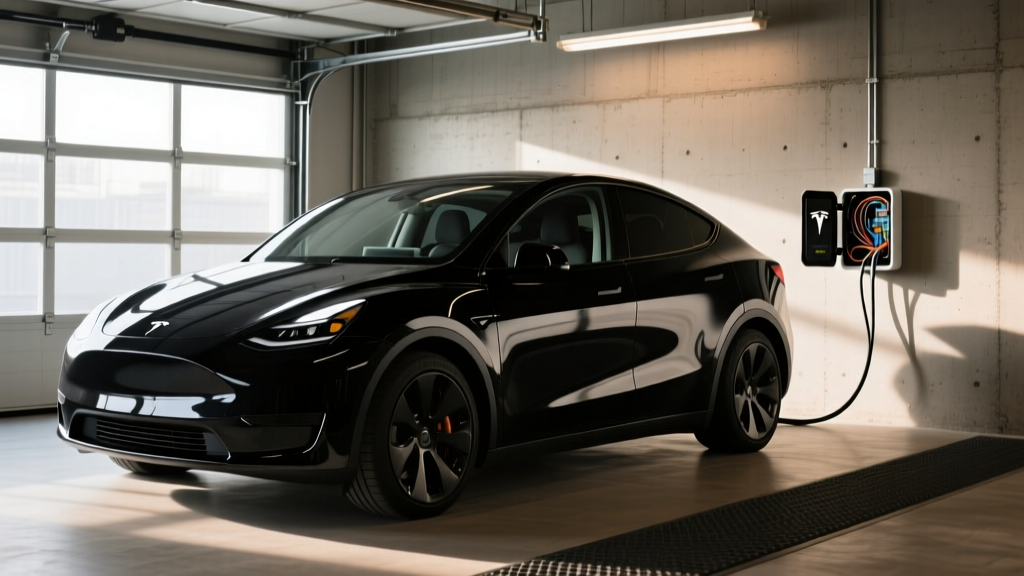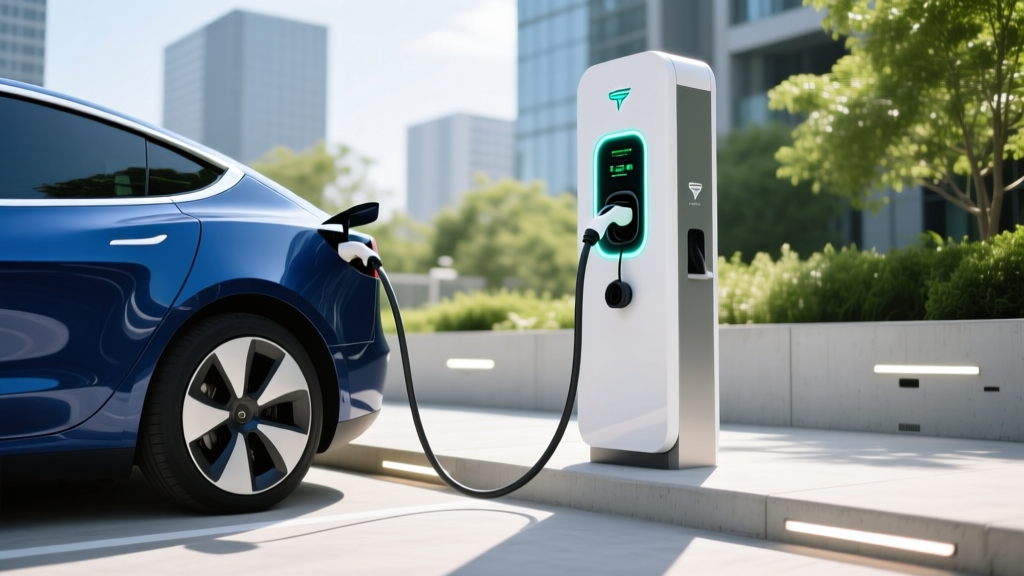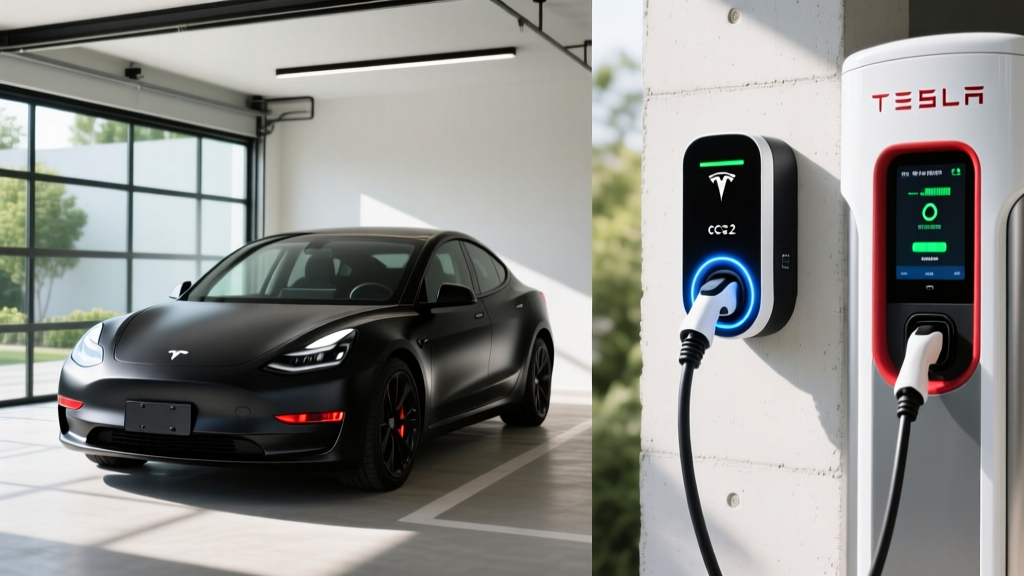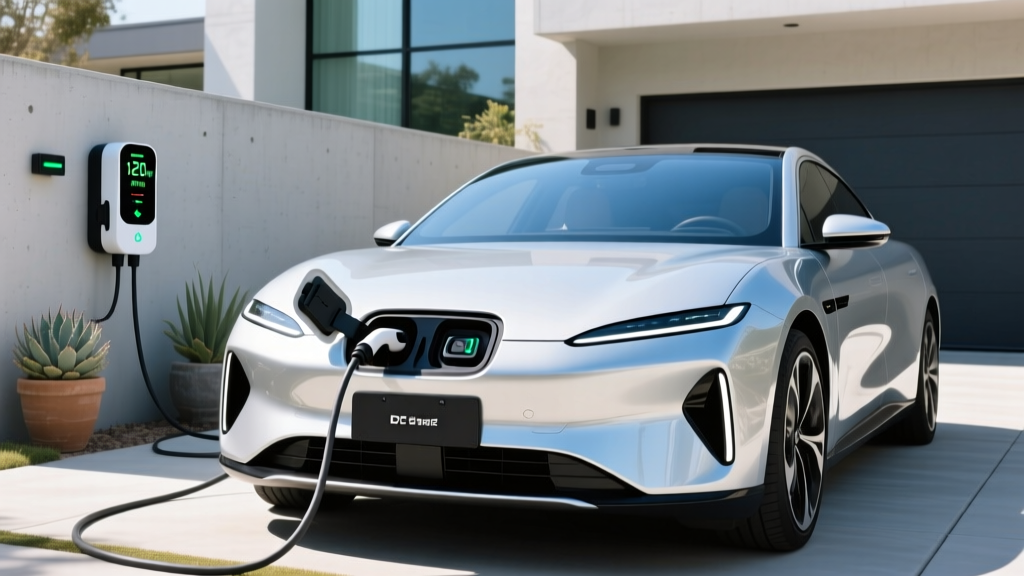
If you've spent any time at a public fast-charging station watching your battery climb from 10% to 80% in twenty minutes, you've probably wondered: could I just put one of these at home? The short answer to "can I DC fast charge at home?" is technically yes — but for the vast majority of EV owners, it's neither practical nor necessary. Here's the full breakdown of why, what it actually costs, and what you should install instead.
Understanding Charging Levels: Level 1, Level 2, and DC Fast
Before comparing equipment, you need to understand what each charging level actually delivers. Power is measured in kW (kilowatts), which is the rate of energy flow — think of it like the diameter of a hose. Energy is measured in kWh (kilowatt-hours), which is the total amount stored in your battery — like the size of the bucket you're filling.
| Level | Voltage | Power (kW) | Miles of Range/Hour | Typical Location |
|---|---|---|---|---|
| Level 1 | 120V AC | 1.0–1.9 kW | 3–5 mi/hr | Standard household outlet |
| Level 2 | 240V AC | 3.3–19.2 kW | 12–75 mi/hr | Home, workplace, public |
| DC Fast (Level 3) | 200–900V DC | 50–400 kW | 150–1,200+ mi/hr | Public stations, commercial |
A Level 2 home charger on a 48-amp circuit (11.5 kW) will add roughly 40–45 miles of range per hour. For an EV with a 300-mile EPA range and an 80 kWh battery, a full 10–80% charge takes about 5–6 hours — typically overnight while you sleep. That's why Level 2 is the standard for residential charging.
Why DC Fast Charge at Home Is Impractical for Most Owners
DC fast chargers bypass the vehicle's onboard charger and feed direct current straight into the battery at very high power. A 50 kW residential DC unit — the smallest commonly available — requires 480V three-phase power or a specialized transformer setup that most residential electrical panels simply cannot provide.
Here's what stands between you and home DC fast charging:
- Electrical service requirements: A 50 kW DC charger draws roughly 60–80 amps at 480V three-phase. Most US homes have 200-amp, 240V single-phase service. Upgrading to three-phase or adding a dedicated transformer can cost $10,000–$30,000+.
- Equipment cost: Residential-rated DC fast chargers start around $15,000–$30,000 for 25–50 kW units. By contrast, a quality Level 2 home charger costs $400–$800.
- Utility demand charges: Many utilities impose commercial demand charges on loads exceeding 10–20 kW, which can add $50–$200+ per month regardless of usage.
- Battery health: Frequent DC fast charging accelerates battery degradation. Most manufacturers recommend limiting DC fast charging to road trips, not daily use. Daily Level 2 charging at moderate power is actually better for long-term battery state of health (SoH).
Level 2 Home Charger Installation: Electrical Requirements and Costs
The realistic path to fast, convenient home charging is a hardwired or plug-in Level 2 charger on a dedicated 240V circuit. Here's what that involves.
Electrical Specifications
- Circuit: Dedicated 240V breaker — typically 40A, 50A, or 60A depending on charger amperage
- Charger amperage: Most residential units are 32A (7.7 kW), 40A (9.6 kW), or 48A (11.5 kW)
- Panel capacity: Your electrical panel must have enough spare capacity. A 48A charger on a 60A breaker represents a significant continuous load. Older homes with 100A service almost always need a panel upgrade to 200A.
- Wire gauge: 6 AWG copper for 50A circuits; 4 AWG for 60A circuits (per NEC Article 625)
- GFCI protection: NEC 2023/2026 requires GFCI protection for EV outlets; hardwired chargers with integrated ground-fault protection may satisfy this requirement — your licensed electrician will confirm
Installation Cost Breakdown
Home charger installation costs vary dramatically based on your panel capacity, the distance from panel to charger location, and whether conduit runs are needed. Based on 2025–2026 national averages:
| Component | Simple Install (Same wall as panel) | Standard Install (20–50 ft run) | Complex Install (Panel upgrade + long run) |
|---|---|---|---|
| Level 2 Charger (equipment) | $400–$800 | $400–$800 | $400–$800 |
| Electrician labor | $300–$600 | $600–$1,500 | $1,500–$3,000 |
| Permit and inspection | $50–$150 | $100–$300 | $150–$400 |
| Panel upgrade (if needed) | $0 | $0 | $1,500–$4,000 |
| Conduit/wiring materials | $50–$100 | $150–$400 | $300–$800 |
| Total estimated cost | $800–$1,650 | $1,250–$3,000 | $3,850–$9,000 |
Always get at least three quotes from licensed electricians. Some utilities offer rebates of $250–$1,000 for Level 2 charger installation — check with your provider before scheduling work. The IRS §30C alternative fuel vehicle refueling property credit may cover up to 30% of equipment and installation costs (capped at $1,000 for residential) if you live in an eligible census tract — consult a tax professional for eligibility.
Connector Compatibility: NACS, CCS1, and CHAdeMO
Your charger's connector must match your vehicle's inlet. As of the 2025–2026 model years, the North American market has consolidated heavily toward the NACS (North American Charging Standard, originally Tesla's proprietary connector), but CCS1 remains in use on many existing vehicles.
| Connector | Brands Using It (2026) | Notes |
|---|---|---|
| NACS (native) | Tesla (all), Ford (2025+), GM (2025+), Rivian (2025+), Hyundai/Kia (2025+), BMW, Mercedes, Volvo/Polestar | Industry standard going forward |
| CCS1 | Legacy models from VW, BMW, Hyundai/Kia (pre-2025), some Stellantis | Adapters available to NACS |
| CHAdeMO | Nissan Leaf (discontinued), Mitsubishi Outlander PHEV (legacy) | Effectively phased out for new vehicles |
If your EV has a CCS1 port but you want to use Tesla Superchargers or NACS-equipped home chargers, a CCS-to-NACS adapter ($150–$250 from Tesla or third-party brands like Lectron) enables compatibility. Most 2025+ EVs ship with NACS natively, making this a non-issue for new buyers.
For Level 2 home charging, nearly all chargers use a J1772 connector (which NACS vehicles accept via a small adapter included with most new Teslas and other NACS-equipped vehicles). Some newer Level 2 chargers now offer a native NACS plug.
Charging Cost: Home vs. Public DC Fast vs. Gas
One of the strongest arguments for home Level 2 charging is cost. Electricity rates vary by region, but home charging is consistently cheaper than public DC fast charging — and dramatically cheaper than gasoline on a per-mile basis.
| Scenario | Rate / Price | Vehicle Efficiency | Cost Per Mile |
|---|---|---|---|
| Home Level 2 (off-peak, national avg) | $0.13/kWh | 3.0 mi/kWh (100 MPGe) | $0.043 |
| Home Level 2 (California avg) | $0.28/kWh | 3.0 mi/kWh | $0.093 |
| Home Level 2 (off-peak TOU rate) | $0.07/kWh | 3.0 mi/kWh | $0.023 |
| Public DC fast (Electrify America) | $0.48/kWh | 3.0 mi/kWh | $0.16 |
| Public DC fast (Tesla Supercharger) | $0.32/kWh | 3.0 mi/kWh | $0.107 |
| Gasoline (national avg $3.40/gal) | $3.40/gallon | 28 MPG (avg ICE) | $0.121 |
At a national average electricity rate of $0.13/kWh, home Level 2 charging costs roughly $0.04 per mile — about one-third the cost of gasoline and one-quarter the cost of public DC fast charging. Even in high-cost states like California, time-of-use (TOU) plans that offer off-peak rates as low as $0.07/kWh make overnight home charging exceptionally cheap.
For a driver covering 12,000 miles per year, home charging at $0.13/kWh costs about $520 annually. The equivalent gasoline cost at 28 MPG and $3.40/gal is $1,457 — a savings of nearly $940 per year with home EV charging.
Recommended Home Level 2 Chargers (2026)
Since DC fast charging at home isn't practical for most owners, here are the Level 2 chargers that deliver the fastest, most reliable home charging available. All units below are UL-listed and support the J1772 or NACS connector.
ChargePoint Home Flex
- Power: Up to 12 kW (50A) on a 60A breaker; adjustable down to 16A
- Connector: J1772 (NACS adapter included or available)
- Cable length: 23 feet
- Smart features: Wi-Fi, app scheduling, TOU optimization, Alexa integration, Energy Star certified
- Price: ~$550–$650
- Best for: Most EV owners wanting flexible amperage and smart scheduling
Tesla Wall Connector
- Power: Up to 11.5 kW (48A) on a 60A breaker
- Connector: Native NACS (no adapter needed for Tesla or NACS-equipped vehicles)
- Cable length: 24 feet
- Smart features: Wi-Fi, OTA updates, power sharing (link multiple units on one circuit), load management
- Price: ~$450–$500
- Best for: Tesla owners and households with multiple NACS vehicles
Grizzl-E Smart
- Power: Up to 10 kW (40A) on a 50A breaker
- Connector: J1772 or NACS (select at purchase)
- Cable length: 24 feet
- Smart features: OCPP-compatible, app control, adjustable amperage, built-in GFCI, outdoor-rated (NEMA 4)
- Price: ~$450–$550
- Best for: Outdoor installations and extreme cold climates (-40°F rated)
Emporia Level 2 Smart Charger
- Power: Up to 11.5 kW (48A) on a 60A breaker
- Connector: J1772 (NACS adapter available)
- Cable length: 24 feet
- Smart features: Wi-Fi, app with real-time energy monitoring, solar integration, TOU scheduling, Energy Star
- Price: ~$350–$400
- Best for: Budget-conscious buyers who want full smart features and energy tracking
Charging Time Examples: 10–80% by Battery Size and Charger
Most EV owners charge between 10% and 80% state of charge (SoC) for daily use — charging above 80% slows dramatically due to the battery management system tapering current to protect cell longevity. Here's how long common battery sizes take on a home Level 2 charger versus a public DC fast charger:
| Battery Size (usable kWh) | Example Vehicles | Level 2 at 11.5 kW (48A) | DC Fast (peak rate) |
|---|---|---|---|
| 58 kWh | VW ID.4 Standard, base Leaf | ~3.5 hours | ~25–30 min (at 135 kW peak) |
| 75 kWh | Tesla Model 3 LR, Hyundai Ioniq 5 | ~4.5 hours | ~18–25 min (at 200–240 kW peak) |
| 82–85 kWh | Tesla Model Y LR, Ford Mustang Mach-E ER | ~5 hours | ~20–28 min (at 200–250 kW peak) |
| 100+ kWh | Tesla Model S, GMC Hummer EV, Rivian R1T Max | ~6–7 hours | ~25–40 min (at 200–350 kW peak) |
Note that DC fast charging times depend heavily on the vehicle's charge curve. A vehicle with a 240 kW peak rate may only sustain that peak between 10–30% SoC before tapering. Real-world DC fast charging from 10–80% is typically 20–35 minutes for modern 800V-architecture vehicles (Hyundai Ioniq 5, Kia EV6, Porsche Taycan) and 30–45 minutes for 400V vehicles.
Safety and Code Considerations
EV charging is governed by NEC Article 625 (National Electrical Code), with additional requirements in NEC 2023 and 2026 editions. Key safety requirements include:
- Dedicated circuit: Your EV charger must be on its own dedicated breaker — it cannot share a circuit with other appliances or outlets.
- Continuous load derating: EV charging is classified as a continuous load (3+ hours). A 48A charger requires a breaker rated for at least 60A (125% of continuous load).
- GFCI protection: NEC 2023 and later requires ground-fault circuit interrupter protection for receptacle-based EV chargers. Hardwired units with integrated GFCI may comply — your electrician will determine the appropriate method.
- Outdoor rating: If your charger is installed outdoors or in an unenclosed carport, it must carry a NEMA 4 (or better) rating for weather resistance.
- Permit and inspection: Virtually all jurisdictions require an electrical permit and post-installation inspection for EV charger circuits. Skipping this step can void homeowner's insurance coverage for electrical fires.
- Load management: If your panel is near capacity, consider a smart charger with load management or a panel-level monitor (like the Emporia Vue) that dynamically reduces charger amperage when other household loads spike.
Never use extension cords with EV chargers. If the charger cable doesn't reach your vehicle's charge port, relocate the charger or have an electrician extend the circuit with proper conduit and wiring.
Frequently Asked Questions
How much does it cost to install a home EV charger?
A Level 2 home charger installation typically costs $1,200–$3,000 total (equipment + electrician + permit) for a standard setup. If your home requires an electrical panel upgrade from 100A to 200A service, total costs can reach $5,000–$9,000. Always get quotes from licensed electricians and check for utility rebates before starting work.
How fast will each charging level add range?
Level 1 (120V) adds 3–5 miles per hour. Level 2 (240V) adds 12–75 miles per hour depending on amperage — a 48A/11.5 kW charger adds roughly 40–45 miles per hour. DC fast charging at 150+ kW adds 150–1,200+ miles per hour, but is not practical for home installation.
Which connector or charger is compatible with my EV?
For 2025–2026 model-year vehicles, most manufacturers have adopted NACS. Older EVs may have CCS1 or (rarely) CHAdeMO. For Level 2 home charging, nearly all chargers use J1772, which NACS vehicles accept via a small adapter. Check your vehicle's charge port or consult the manufacturer's spec sheet to confirm.
How much does charging cost per mile vs gas?
Home Level 2 charging at the national average rate of $0.13/kWh costs approximately $0.04 per mile for an EV averaging 3 mi/kWh. Gasoline at $3.40/gallon in a 28 MPG vehicle costs about $0.12 per mile. Home EV charging saves roughly $0.08 per mile, or about $960 per year at 12,000 miles driven.
What electrical upgrades might I need?
Homes with 100-amp electrical service typically need a panel upgrade to 200A to support a Level 2 charger — this costs $1,500–$4,000. Homes with 200A service usually have sufficient capacity, but your electrician will perform a load calculation to confirm. Older wiring, insufficient breaker spaces, or long conduit runs (50+ feet from panel to garage) can add cost.
Can I DC fast charge at home if I have three-phase power?
If your home has three-phase electrical service (rare in US residential but possible in some rural or commercial-residential properties), a 25–50 kW DC fast charger can technically be installed. Expect $15,000–$40,000+ in total equipment and installation costs, plus potential utility demand charges. For nearly all residential users, a Level 2 charger delivering a full overnight charge is the more practical and cost-effective solution.
Sources: fueleconomy.gov (EV efficiency data), IRS §30C refueling property credit, NFPA NEC Article 625. Installation costs are 2025–2026 national estimates; obtain local quotes for accurate pricing. Tax credit eligibility varies by location and income — consult a tax professional.