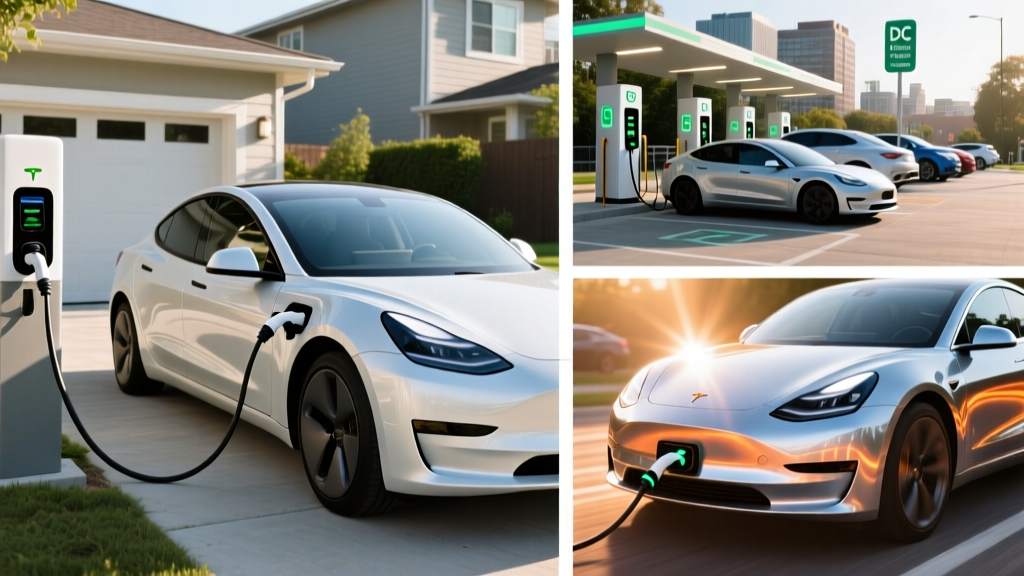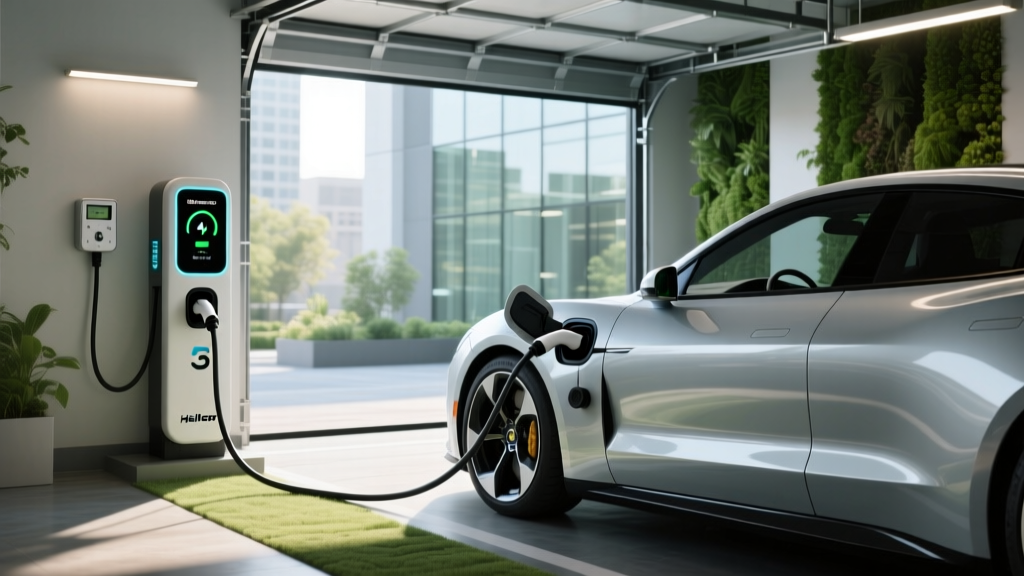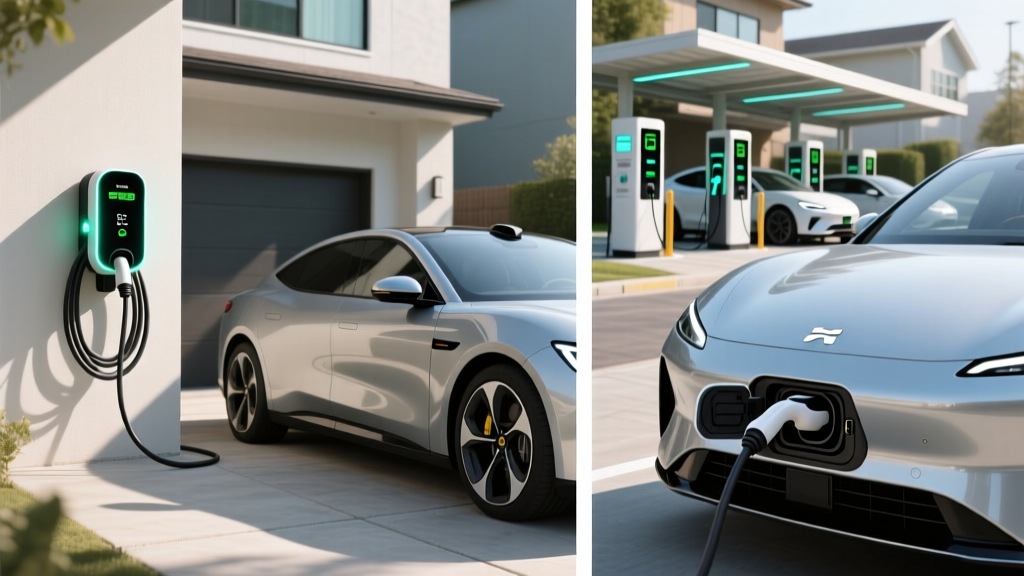
If you've searched for a DC charger for car use, you've probably hit a wall of conflicting specs, vague pricing, and connector confusion. The reality of EV charging is straightforward once you separate three variables: power (measured in kilowatts, kW), energy (measured in kilowatt-hours, kWh), and time. This guide breaks down every charging level, what a home installation actually costs, which connectors fit which vehicles, and what you'll spend per mile compared to gasoline.
The Three Charging Levels Explained
Every EV sold in the US charges on one of three levels. The difference isn't marketing — it's physics. Higher power (kW) delivers energy (kWh) into your battery faster. Here's the critical distinction: kW is the rate of flow; kWh is the amount stored. Think of kW as the width of a hose and kWh as the bucket you're filling.
| Level | Voltage / Amps | Power (kW) | Miles of Range / Hour | Typical Use |
|---|---|---|---|---|
| Level 1 | 120V / 12A | ~1.4 kW | 3–5 mi/hr | Overnight trickle; PHEVs, low-mileage commutes |
| Level 2 (Home/Public AC) | 240V / 32–48A | 7.7–11.5 kW | 25–44 mi/hr | Daily home charging; workplace; destination |
| DC Fast Charging | 400V–900V DC | 50–350 kW | 150–1,200+ mi/hr (peak) | Road trips; quick top-ups; fleet turnaround |
Level 2 is the practical baseline for most EV owners. A 240V/48A circuit delivers up to 11.5 kW — enough to refill a 75 kWh battery (roughly 270 miles of range) from 10% to 90% overnight in about 7 hours. DC fast charging bypasses the car's onboard AC-to-DC converter and feeds DC power directly into the battery pack, which is why a DC charger for car use at public stations can add 200 miles in 15–25 minutes on modern 800V architectures like the Hyundai Ioniq 5 or Porsche Taycan.
Real-World Charging Times by Battery Size
Manufacturer claims of "10–80% in 18 minutes" assume peak conditions: a preconditioned battery, ambient temperatures around 70°F, and a station that can sustain its advertised peak kW. In practice, DC fast charging follows a charge curve — power peaks at low state-of-charge (SoC) and tapers sharply above 80% to protect battery cells.
| Battery Size (kWh usable) | Level 2 (11.5 kW) | 150 kW DCFC | 250 kW DCFC (400V) | 350 kW DCFC (800V) |
|---|---|---|---|---|
| ~40 kWh (Nissan Leaf, Mini Cooper SE) | ~2.5 hr | ~22 min | ~22 min (capped by car) | ~22 min (capped by car) |
| ~65 kWh (Chevy Equinox EV, base Tesla Model 3) | ~4 hr | ~30 min | ~22 min | ~22 min (if 800V) |
| ~77 kWh (Tesla Model Y LR, Ford Mustang Mach-E ER) | ~5 hr | ~35 min | ~25 min | N/A (400V arch) |
| ~84 kWh (Hyundai Ioniq 5, Kia EV6 — 800V) | ~5.5 hr | ~32 min | ~24 min | ~18 min |
| ~100 kWh (Rivian R1T, Lucid Air, GMC Sierra EV) | ~7 hr | ~45 min | ~30 min | ~20 min (if 800V) |
Home EV Charger Installation: Electrical Requirements and Costs
Installing a Level 2 home charger is the single biggest ownership advantage: you wake up every morning with a full battery at the lowest per-kWh rate available. But the installation cost varies enormously depending on your home's electrical panel.
Electrical Requirements
A standard Level 2 home charger requires a dedicated 240V circuit, typically 40A or 50A. A 40A circuit supports up to 32A continuous draw (9.6 kW), while a 50A circuit supports up to 40A continuous (11.5 kW). The National Electrical Code (NEC) requires that continuous loads not exceed 80% of the circuit breaker rating.
If your home's main panel is 100A and already near capacity — common in homes built before 1990 with electric dryers, ranges, and HVAC — you may need a panel upgrade to 200A. This is the single largest cost variable in a home charger installation.
| Component | Simple Install (Panel has capacity, short run) |
Moderate Install (Longer wire run, conduit) |
Complex Install (Panel upgrade needed) |
|---|---|---|---|
| Level 2 Charger (Equipment) | $400–$700 | $400–$700 | $400–$700 |
| Electrician Labor | $300–$600 | $600–$1,200 | $800–$1,500 |
| Wire, Conduit, Materials | $100–$250 | $250–$600 | $200–$500 |
| Electrical Permit | $50–$150 | $50–$150 | $50–$150 |
| Panel Upgrade (200A) | — | — | $1,500–$3,500 |
| Total Estimated Cost | $850–$1,700 | $1,300–$2,650 | $2,950–$6,350 |
What Electrical Upgrades Might I Need?
Before calling an electrician, check your main panel for these indicators:
- Panel amperage: 200A panels usually have room for a 50A EV circuit. 100A panels often need a load calculation.
- Available breaker slots: You need two adjacent slots for a 240V double-pole breaker.
- Existing loads: Electric range, dryer, heat pump, and water heater all draw heavily. A licensed electrician will perform a NEC Article 220 load calculation to determine if your panel can handle the added draw.
If a full panel upgrade isn't feasible, ask your electrician about a smart load-management device (such as the Emporia Load Management Kit or Span panel integration), which dynamically limits charger draw when other appliances are running — potentially avoiding a panel upgrade entirely.
Connector Compatibility: NACS, CCS1, and CHAdeMO
The connector landscape has consolidated dramatically. As of 2026, the North American Charging Standard (NACS), developed by Tesla, is the dominant connector for new vehicles. Most legacy CCS1 vehicles can access Tesla Superchargers via a manufacturer-approved adapter.
| Connector | Brands Using It (Native) | DC Fast-Charge Availability | Adapter Needed? |
|---|---|---|---|
| NACS (Tesla) | Tesla, Ford, GM, Rivian, Volvo, Polestar, Hyundai, Kia (2025+), Mercedes-Benz | Tesla Supercharger network + growing third-party NACS stations | CCS1→NACS adapter for non-Tesla CCS1 vehicles at Superchargers |
| CCS1 | VW ID.4 (pre-2025), older BMW i4/iX, legacy Hyundai/Kia, Stellantis | Electrify America, EVgo, ChargePoint, Ionity (EU) | NACS→CCS1 adapter for Tesla Superchargers (where supported) |
| CHAdeMO | Nissan Leaf (all years), Mitsubishi Outlander PHEV | Declining; limited new installations | No adapter available for DCFC; CHAdeMO stations only |
Cost to Charge: Per-Mile Breakdown vs. Gasoline
Electricity pricing varies by time of day, utility rate plan, and whether you're charging at home or on a public DC fast charger. Here's a realistic comparison using a 2026 Tesla Model Y Long Range (EPA combined efficiency: 28 kWh/100mi, per fueleconomy.gov) and a comparable gas SUV averaging 26 MPG combined.
| Scenario | Rate | Cost / 100 Miles | Cost / Mile |
|---|---|---|---|
| Home Level 2 (Off-Peak TOU Rate) | $0.09/kWh | $2.52 | $0.025 |
| Home Level 2 (Standard Residential) | $0.16/kWh | $4.48 | $0.045 |
| Public Level 2 (ChargePoint, EVgo) | $0.25–$0.39/kWh | $7.00–$10.92 | $0.07–$0.11 |
| DC Fast Charging (Electrify America, Tesla) | $0.35–$0.56/kWh | $9.80–$15.68 | $0.10–$0.16 |
| Gasoline SUV (26 MPG, $3.40/gal) | $3.40/gallon | $13.08 | $0.13 |
The takeaway: Home off-peak charging is roughly one-fifth the per-mile cost of gasoline. Even public DC fast charging at premium rates is competitive with or cheaper than gas — but only if you use it for road trips, not daily fill-ups. The economics of EV ownership depend heavily on having reliable home or workplace Level 2 access.
Top Home Level 2 Charger Picks (2026)
For home installations, you're choosing a Level 2 AC charger — not a DC charger for car use at home. Residential DC fast chargers exist (like the Wallbox Quasar) but cost $5,000–$15,000 and are impractical for most homeowners. Here are the best Level 2 units for 2026, selected for reliability, smart features, and value.
ChargePoint Home Flex (NACS or CCS1)
- Power Output: Up to 11.5 kW (48A on a 60A circuit) or 9.6 kW (40A on 50A circuit) — adjustable via DIP switch
- Connector: Available in NACS or CCS1/J1772 variants
- Cable Length: 23 feet
- Smart Features: Wi-Fi, scheduling, energy tracking, Alexa integration, load sharing between two units
- Price: ~$599 (NACS) / ~$549 (J1772)
Wallbox Pulsar Plus (48A)
- Power Output: Up to 11.5 kW (48A)
- Connector: J1772 (CCS1-compatible) or NACS (new variant)
- Cable Length: 25 feet
- Smart Features: Wi-Fi + Bluetooth, Power Sharing, Eco-Smart (solar integration), compact form factor
- Price: ~$449–$499
Emporia Level 2 EV Charger
- Power Output: Up to 11.5 kW (48A)
- Connector: J1772 (CCS1-compatible)
- Cable Length: 24 feet
- Smart Features: Wi-Fi, integration with Emporia Vue energy monitor, real-time household energy dashboard, solar-aware scheduling
- Price: ~$399
Tesla Wall Connector (NACS)
- Power Output: Up to 11.5 kW (48A)
- Connector: NACS (native Tesla; works with Ford/GM/Rivian NACS vehicles)
- Cable Length: 24 feet
- Smart Features: Wi-Fi, OTA updates, Power Sharing, load management with multiple units, glass-face design
- Price: ~$450
Safety and Electrical Code Considerations
EV charging involves sustained high-current draw for hours — a fundamentally different electrical load than a dryer or oven that cycles on and off. Follow these non-negotiable safety requirements:
- Dedicated circuit: Your Level 2 charger must be on its own dedicated 240V breaker — never shared with other appliances.
- GFCI protection: NEC 2023 (Article 625.54) requires GFCI protection for all EV receptacles rated 150V to ground or less. If you install a NEMA 14-50 receptacle (rather than hardwiring), the breaker must be GFCI-rated. Note: many EV charger manufacturers recommend hardwiring to avoid nuisance GFCI trips and eliminate a common failure point.
- Outdoor rating: If your charger is mounted outdoors (driveway, carport), verify it carries a NEMA 4 or IP55+ rating for water and dust resistance. All units listed above meet outdoor-use standards.
- Permit and inspection: Virtually all jurisdictions require an electrical permit for a new 240V circuit. The permit ensures a city or county inspector verifies the work — this protects you and is often required for insurance claims related to electrical fires.
- Wire gauge: A 50A circuit requires minimum 6 AWG copper wire; a 60A circuit requires 4 AWG. Your electrician will size wire based on run length, applying NEC ampacity derating for longer runs.
Understanding Public DC Fast Charging Networks
When you need a DC charger for car use on the road, the major networks in 2026 offer varying reliability and pricing:
- Tesla Supercharger: Over 28,000 stalls in North America. Now open to NACS-equipped Ford, GM, Rivian, and other vehicles. Typically $0.35–$0.48/kWh. Consistently highest uptime (~97%+ per industry reports).
- Electrify America: ~4,500 stalls, CCS1 and NACS connectors. Pricing varies by location ($0.36–$0.56/kWh). Has invested heavily in reliability improvements since 2024.
- EVgo: ~4,000+ stalls, mix of CCS1 and NACS. Subscription plan (eVgo Plus) offers reduced per-kWh rates. Common in urban areas and shopping centers.
- ChargePoint: Primarily Level 2 destination charging; limited DCFC footprint. Useful for workplace and retail top-ups.
For long road trips, plan your route using A Better Routeplanner (ABRP) or your vehicle's native navigation. These tools account for elevation, temperature, and charge-curve taper to predict realistic arrival SoC.
Frequently Asked Questions
How much does it cost to install a home EV charger?
A simple Level 2 installation (adequate panel capacity, short wire run) typically costs $850–$1,700 including equipment, electrician labor, materials, and permit. If your panel needs upgrading from 100A to 200A, total costs can reach $3,000–$6,350. Always get at least two quotes from licensed electricians and verify they include the permit fee.
How fast will each charging level add range?
Level 1 (120V) adds 3–5 miles of range per hour. Level 2 (240V, 48A) adds 25–44 miles per hour depending on vehicle efficiency. DC fast charging at 150 kW can add roughly 150–200 miles in 15 minutes for efficient vehicles; 350 kW chargers on 800V-architecture vehicles (like the Hyundai Ioniq 5 or Kia EV6) can add over 200 miles in under 20 minutes at peak rate.
Which connector/charger is compatible with my EV?
Check your vehicle's charge port: if it's a 2025+ model from Ford, GM, Rivian, Tesla, Volvo, Polestar, Hyundai, or Kia, it almost certainly uses NACS. Older or pre-2025 models from VW, BMW, and Stellantis typically use CCS1. The Nissan Leaf uses CHAdeMO exclusively. For home Level 2 charging, buy a charger matching your car's native connector — or use a J1772-to-NACS adapter (included with most new NACS vehicles).
How much does charging cost per mile vs gas?
At home off-peak rates (~$0.09/kWh), an average EV costs about $0.025 per mile — roughly 80% cheaper than a 26 MPG gas SUV at $3.40/gallon ($0.13/mile). Even public DC fast charging at $0.48/kWh works out to ~$0.13/mile, making it comparable to gas but with far lower maintenance costs over time.
What electrical upgrades might I need?
The most common upgrade is a 200A panel replacement for older homes with 100A service ($1,500–$3,500). You may also need additional breaker slots, a new conduit run from the panel to your garage or driveway, or a smart load-management device if your panel is near capacity. A licensed electrician's load calculation will determine exactly what's required per NEC standards.
Can I install a DC fast charger at home?
Technically yes, but it's impractical for nearly all residential applications. A 50 kW DC fast charger requires 480V three-phase power (not available in residential service), costs $10,000–$30,000+ for the unit alone, and would need a commercial-grade electrical service upgrade costing $10,000–$50,000+. Level 2 home charging at 11.5 kW refills any EV battery overnight — making DC fast charging unnecessary at home.
Does the federal tax credit cover home charger installation?
The IRS §30D credit covers vehicle purchases, not charging equipment. However, the separate §30C Alternative Fuel Vehicle Refueling Property Credit covers up to 30% of home charger equipment and installation costs (capped at $1,000) — but only if you live in an eligible census tract (generally low-income or rural areas, per IRS guidelines). Check your eligibility before assuming you qualify.