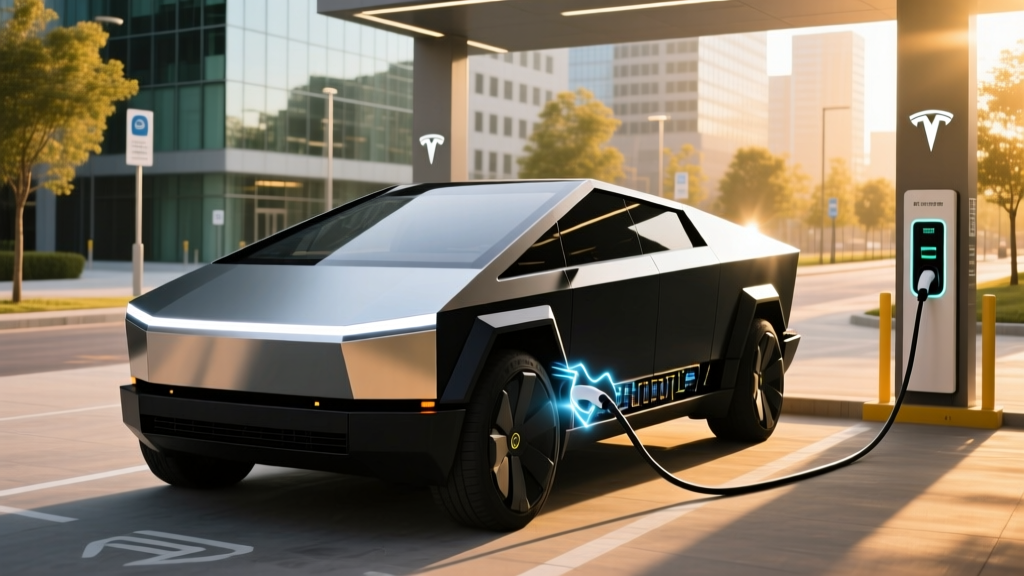
The Tesla Cybertruck's angular stainless-steel body dominates headlines, but for prospective owners, the most practical question is grounded in physics: how many Cybertruck range miles will you actually get, and what does it take to keep its massive battery charged? With a battery pack hovering around 123 kWh (usable) and an EPA-rated efficiency that surprises some truck buyers, the Cybertruck demands a charging strategy that accounts for its sheer energy appetite.
This guide covers the real-world range you can expect, the charging infrastructure required to support it — from home Level 2 installations to DC fast charging on road trips — and the exact costs involved. Whether you own a Dual Motor, Cyberbeast, or are evaluating the upcoming RWD trim, the numbers below will shape your daily ownership experience.
Real-World Cybertruck Range Miles: EPA vs. Highway vs. Cold Weather
The EPA posts official range estimates under controlled conditions, but real-world driving rarely mirrors the lab. The Cybertruck's aerodynamic profile — improved by the tonneau cover but still a large, tall vehicle — and its 6,600+ lb curb weight work against highway efficiency.
- EPA Combined: 340 miles (AWD), 320 miles (Cyberbeast)
- Highway (70–80 mph, moderate temps): ~270–295 miles
- Cold weather (below 32°F, highway): ~220–255 miles
- Towing (5,000+ lb trailer): ~150–180 miles
Source: fueleconomy.gov. Real-world figures based on owner-reported data and independent testing. Range extenders (if equipped) can add ~130+ miles to EPA estimates.
The Cybertruck uses an NMC (nickel manganese cobalt) battery chemistry optimized for energy density. Tesla's thermal management system, including a heat pump, helps mitigate cold-weather losses compared to resistive-heating EVs, but you should still plan for a 20–30% range reduction in freezing temperatures — a critical factor for northern-climate owners.
Charging Levels Explained: How Fast Will Each Level Add Range?
Understanding the three charging levels is essential for any EV owner, but especially Cybertruck drivers who need to move a lot of electrons into a very large battery. Here's the critical distinction: kW (kilowatts) measures the rate of power delivery — like water pressure from a hose — while kWh (kilowatt-hours) measures total energy stored, like gallons in a tank. Charging speed is always in kW; battery size is always in kWh.
| Level | Power (kW) | Miles of Range Added/Hour | Full Charge Time (0–100%) | Best Use Case |
|---|---|---|---|---|
| Level 1 (120V) | 1.4–1.9 kW | 3–5 miles | 60–80+ hours | Emergency/overnight trickle |
| Level 2 (240V) | 7.2–19.2 kW | 18–52 miles | 7–18 hours | Daily home charging |
| DC Fast Charge | 50–350+ kW | 150–800+ miles | 10–80% in ~15–25 min | Road trips, quick top-ups |
For the Cybertruck specifically, Level 1 charging is essentially useless for daily needs — plugging into a standard 120V outlet adds roughly 4 miles per hour, meaning a full charge would take over 3 days. Level 2 at home is the workhorse, and DC fast charging is your road-trip lifeline.
Cybertruck DC Fast Charging: The Charge Curve Reality
Tesla rates the Cybertruck at a peak DC fast-charge rate of 250 kW at V3 Superchargers and up to 350 kW at V4 Supercharger posts (availability expanding through 2026). However, peak rate is not sustained rate. The charge curve tapers significantly as the battery fills:
- 10–80% at a V3 Supercharger (250 kW peak): ~25–30 minutes
- 10–80% at a V4 Supercharger (350 kW capable): ~18–22 minutes
- 80–100%: Adds another 20–30 minutes due to taper — avoid unless necessary
Tesla's navigation system automatically preconditions the battery when you route to a Supercharger, warming it to optimal temperature for maximum charge acceptance. Without preconditioning — for example, arriving at a third-party charger without navigation routing — you may see significantly reduced charge speeds, especially in cold weather. Always precondition.
Home Charger Installation: Electrical Requirements, Costs & Panel Upgrades
The Cybertruck's onboard charger accepts up to 17 kW on Level 2 (at 240V/72A), though Tesla's Wall Connector is typically configured for 48A (11.5 kW) on a 60A circuit. To unlock the full 17 kW, you need a hardwired 80A/100A circuit — a significant electrical undertaking.
Electrical Requirements at a Glance
- Minimum recommended circuit: 60A breaker, 240V, hardwired or NEMA 14-50 outlet
- Optimal circuit for 17 kW: 100A breaker, 240V, hardwired (2 AWG copper wire)
- Wire gauge: 6 AWG copper for 48A; 2 AWG copper for 80A
- Dedicated circuit required: Yes — EV chargers cannot share circuits per NEC Article 625
- GFCI protection: Required for outdoor outlets (NEC 2023+); hardwired units typically exempt
Installation Cost Breakdown
| Component | Simple Install (Near Panel) | Complex Install (Long Run/Upgrade) |
|---|---|---|
| EV Charger Equipment (48A) | $400–$600 | $400–$600 |
| Electrician Labor | $500–$1,200 | $2,000–$5,000 |
| Permit & Inspection | $100–$300 | $200–$500 |
| Electrical Panel Upgrade (if needed) | $0 (200A panel sufficient) | $2,000–$4,500 |
| TOTAL RANGE | $1,000–$2,100 | $4,600–$10,600 |
Which Connector and Charger Is Compatible with the Cybertruck?
The Cybertruck uses the NACS (North American Charging Standard) connector natively — Tesla's proprietary design that has been adopted by Ford, GM, Rivian, Hyundai, and most major automakers for 2025+ models. This gives the Cybertruck direct access to Tesla's Supercharger network without adapters.
| Connector Type | Cybertruck Compatible? | Adapter Needed? | Notes |
|---|---|---|---|
| NACS (Tesla) | ✅ Native | No | Superchargers, Tesla Wall Connector, destination chargers |
| CCS1 | ⚠️ With Adapter | Tesla CCS Adapter (~$250) | Electrify America, EVgo, ChargePoint DC stations |
| CHAdeMO | ❌ Not Supported | No reliable adapter exists | Legacy Nissan Leaf standard; network declining |
| J1772 (Level 2) | ⚠️ With Adapter | J1772-to-NACS (included with Cybertruck) | Public Level 2 stations, non-Tesla home chargers |
Tesla includes a J1772-to-NACS adapter with the Cybertruck, which covers most public Level 2 chargers. For DC fast charging on non-Tesla networks (Electrify America, EVgo), you'll need to purchase the CCS adapter separately. Plan ahead for road trips through areas with limited Supercharger coverage.
Recommended Home Chargers for the Cybertruck
With the Cybertruck's 17 kW onboard charger capability, investing in a high-amperage Level 2 unit pays dividends in charging speed. Here are top picks across budgets:
Tesla Wall Connector (Best Match)
- Power Output: Up to 11.5 kW (48A) on 60A circuit; up to 17 kW (72A) on 90A circuit
- Connector: NACS native
- Cable Length: 24 ft
- Smart Features: Wi-Fi updates, load sharing (pair two units on one circuit), Tesla app integration, access control
- Price: ~$450
- Why it wins: Native NACS, seamless Tesla integration, highest power output for Cybertruck's onboard charger
ChargePoint Home Flex (Versatile Pick)
- Power Output: Up to 12 kW (50A) on hardwired 60A circuit; adjustable down to 16A
- Connector: NACS or J1772 (select at purchase)
- Cable Length: 23 ft
- Smart Features: Wi-Fi, Alexa/Google integration, scheduling, energy tracking, flexible amperage
- Price: ~$550–$700
- Why consider: Adjustable amperage works with any panel capacity; excellent app
Emporia Vue Level 2 (Budget Smart)
- Power Output: Up to 11.5 kW (48A) on 60A circuit
- Connector: J1772 (use included Tesla adapter) or NACS version
- Cable Length: 24 ft
- Smart Features: Wi-Fi, energy monitoring, solar integration, scheduling, load management
- Price: ~$350–$400
- Why consider: Best value for a smart 48A charger; pairs well with home solar/battery systems
Grizzl-E Smart (Rugged Outdoor)
- Power Output: Up to 10 kW (40A) on 50A circuit
- Connector: J1772 or NACS
- Cable Length: 24 ft
- Smart Features: OCPP compatibility, adjustable amperage, extreme-temp rated (-40°F to 122°F)
- Price: ~$450–$550
- Why consider: Built for harsh climates; Canadian-made; simple, reliable hardware
Cost to Charge: Cybertruck $/Mile vs. Gas Truck Comparison
The Cybertruck's efficiency is rated at approximately 2.0–2.2 kWh/mile (combined), making it one of the less efficient EVs per mile due to its weight and frontal area. However, electricity costs remain dramatically lower than gasoline on a per-mile basis in most markets.
| Charging Scenario | Cost per kWh | Cost per Mile (Cybertruck) | Cost to Add 200 Miles |
|---|---|---|---|
| Home Off-Peak (utility rate) | $0.08–$0.14 | $0.17–$0.30 | $34–$60 |
| Home Standard Rate | $0.14–$0.22 | $0.30–$0.46 | $60–$92 |
| Public Level 2 (ChargePoint, etc.) | $0.25–$0.49 | $0.52–$1.03 | $104–$206 |
| Tesla Supercharger V3/V4 | $0.28–$0.48 | $0.58–$1.01 | $116–$202 |
| Electrify America DC | $0.36–$0.56 | $0.75–$1.17 | $150–$234 |
Gas truck comparison: A comparable Ford F-150 4WD (3.5L EcoBoost) averaging 19 MPG combined at $3.50/gallon costs approximately $0.184/mile — or $36.80 per 200 miles. The Cybertruck charged at home off-peak is competitive or cheaper; on public DC fast chargers, it can cost 3–6x more per mile than a gas truck. The economics overwhelmingly favor home charging.
Safety, Code Compliance & Outdoor Installation Considerations
EV charger installation isn't just about running a wire — the National Electrical Code (NEC) has specific requirements that protect you, your home, and your vehicle:
- Dedicated circuit: NEC Article 625 requires EV charging equipment to be on its own dedicated circuit — no sharing with other outlets or appliances
- GFCI protection: Required for all outdoor receptacles (NEC 2023 edition onward). Hardwired installations typically do not require GFCI breakers, which are also known to nuisance-trip with some EV chargers
- Outdoor rating: If mounting outside, choose a charger rated NEMA 4 (weatherproof). The Tesla Wall Connector and Grizzl-E both carry this rating
- Cable management: NEC prohibits charging cables from running across walkways or driveways where they create a trip hazard. Wall-mount with a cable holster or use a retractable reel
- Permit & inspection: Most jurisdictions require an electrical permit and final inspection for EV charger installations. Unpermitted work can void home insurance claims and create liability
- Surge protection: While not universally required, a whole-panel surge protective device (SPD, ~$150–$300 installed) protects your charger and vehicle from grid voltage spikes
Cybertruck Charging & Range FAQ
How much does it cost to install a home EV charger for the Cybertruck?
A standard 48A/240V Level 2 installation near your electrical panel typically runs $1,000–$2,100 (equipment, electrician, and permit). If your panel needs upgrading from 100A to 200A, or the charger is far from the panel requiring long wire runs, costs can reach $4,600–$10,600. Always get a load calculation from a licensed electrician first.
How fast will each charging level add range to the Cybertruck?
Level 1 (120V) adds roughly 3–5 miles per hour — impractical for daily use. Level 2 (240V at 48A) adds approximately 30–35 miles per hour. DC fast charging at a V4 Supercharger can add 200+ miles in about 15 minutes, though the charge curve tapers significantly above 80% state of charge.
Can I charge the Cybertruck at non-Tesla charging stations?
Yes, with adapters. The Cybertruck includes a J1772-to-NACS adapter for public Level 2 stations. For DC fast charging on Electrify America or EVgo, you'll need Tesla's CCS1-to-NACS adapter (~$250). CHAdeMO stations are not compatible.
How much does charging the Cybertruck cost per mile compared to a gas truck?
At home off-peak rates ($0.10/kWh), the Cybertruck costs roughly $0.21/mile — comparable to or cheaper than a gas F-150 at ~$0.18/mile. However, at public DC fast chargers ($0.35–$0.50/kWh), costs rise to $0.74–$1.05/mile, making road-trip charging significantly more expensive than gas. Home charging is where the savings live.
What electrical upgrades might I need for a Cybertruck home charger?
The most common upgrade is a panel capacity increase. If your home has a 100A or 150A main panel and is already running central AC, an electric dryer, and an electric range, adding a 60A EV circuit may exceed your panel's capacity. A 200A panel upgrade costs $2,000–$4,500. Some utilities offer rebates for panel upgrades that support EV adoption — check with your local provider.
Does the Cybertruck support vehicle-to-home (V2H) or vehicle-to-load (V2L)?
As of the 2026 model year, the Cybertruck supports Powershare (V2L and V2H), allowing it to supply up to 11.5 kW of power to external devices or your home during outages via the Tesla Powershare connector. This effectively turns the Cybertruck's 123 kWh battery into a backup power source capable of running essential home circuits for multiple days.
What is the Cybertruck's battery warranty?
Tesla covers the Cybertruck battery and drive unit for 8 years or 150,000 miles (whichever comes first), with a minimum 70% capacity retention guarantee. Based on historical Tesla NMC battery degradation data, most packs retain 88–92% capacity at 100,000 miles under normal charging habits (avoiding routine 100% charges and deep discharges).
Bottom Line for Cybertruck Owners
The Cybertruck's real-world range of 250–300 highway miles is adequate for most daily driving and moderate road trips when Superchargers are available. The economics strongly favor home charging — budget $1,000–$2,100 for a basic Level 2 installation and expect to pay $0.17–$0.30 per mile on home electricity. Plan for panel upgrades if your home is older, and always carry the CCS adapter for non-Tesla DC fast charging on road trips.