When Tesla has quietly cancelled the Cybertruck range extender—the promised auxiliary battery pack that would have pushed the truck's range from an EPA-estimated 340 miles to over 470 miles—it left a lot of reservation holders recalculating. The range extender, originally teased as an under-bed battery module, was supposed to be a game-changer for towing and long-haul truck duty. As of early 2026, Tesla has removed all references to it from the Cybertruck configurator and spec pages, with no official announcement.
For current and prospective Cybertruck owners, this cancellation shifts the burden entirely onto your charging infrastructure strategy. Without a bolt-on battery to lean on for extended trips, optimizing your home and public charging setup becomes the single most impactful ownership decision you can make. This guide covers everything you need to know about charging a Cybertruck—or any modern EV—when you can't rely on extra onboard capacity.
Why the Cybertruck Range Extender Cancellation Changes Your Charging Math
The Cybertruck AWD comes with a ~123 kWh usable battery pack (NMC chemistry), delivering an EPA-estimated 340 miles of range. The rear-wheel-drive model, announced at a lower price point, targets around 250 miles. In real-world conditions—especially highway driving at 75 mph, towing, or cold weather—expect 250–280 miles from the AWD and closer to 190–210 from the RWD.
- EPA sticker (AWD): 340 miles
- Highway (75 mph, mild weather): ~270–290 miles
- Cold weather (below 30°F): ~220–250 miles
- Towing (5,000+ lb trailer): ~170–200 miles
Without the range extender, these real-world numbers mean strategic route planning and reliable DC fast charging access are essential for trips over 200 miles.
With the range extender off the table, your charging strategy has three pillars: fast and reliable home Level 2 charging, knowledge of DC fast-charging networks along your routes, and understanding how to minimize charging downtime. Let's break each down.
Charging Levels Explained: Speeds, Power, and What Each Delivers
Before investing in equipment, you need to understand the three charging levels and what they mean in practical terms. The critical distinction: kW (kilowatts) measures power—how fast energy flows into your battery. kWh (kilowatt-hours) measures energy—the total capacity stored. Think of kW as the width of a hose and kWh as the size of the bucket.
| Level | Voltage | Power (kW) | Miles of Range Added per Hour | Best For |
|---|---|---|---|---|
| Level 1 | 120V AC | 1.0–1.4 kW | 3–5 mi/hr | Emergency / overnight trickle (PHEVs) |
| Level 2 | 240V AC | 3.3–19.2 kW | 12–75 mi/hr | Daily home charging |
| DC Fast Charge | 400–800V DC | 50–350+ kW | 150–1,000+ mi/hr (peak) | Road trips, rapid top-ups |
For the Cybertruck AWD with its ~123 kWh battery, a full Level 1 charge would take over 100 hours—essentially useless. A 48-amp (11.5 kW) Level 2 home charger adds roughly 35–40 miles per hour of charging, replenishing the pack from empty in about 11–12 hours. On a Tesla Supercharger V4 (up to 250 kW), the Cybertruck can charge from 10–80% in approximately 25–30 minutes, though the charge curve tapers significantly above 80% to protect battery health.
Home Charger Installation: Electrical Requirements, Costs, and Gotchas
A proper home Level 2 installation is the backbone of hassle-free EV ownership. Here's what's involved:
Electrical Requirements
Most Level 2 chargers run on a 240V dedicated circuit. The Cybertruck's onboard charger accepts up to 11.5 kW (48 amps), which requires a 60-amp breaker (NEC code requires circuits rated at 125% of continuous load, so 48A × 1.25 = 60A). If you opt for a lower-amperage charger—say 32 amps (7.7 kW)—a 40-amp breaker suffices.
Panel Upgrade Considerations
Many older homes have 100-amp electrical panels that simply don't have the headroom for a 60-amp EV circuit alongside existing loads (HVAC, electric oven, dryer). A panel upgrade to 200 amps typically costs $1,500–$3,000 before the charger circuit is even added. Have a licensed electrician perform a load calculation before committing. Some utilities offer rebates for panel upgrades tied to EV adoption.
Permits and Code Compliance
Most jurisdictions require an electrical permit for EV charger installation ($50–$200 depending on locality). The installation must comply with NEC Article 625, including GFCI protection for outdoor outlets and proper conduit routing. Skipping permits risks insurance complications and code violations that surface during home resale.
| Item | Low End | High End | Notes |
|---|---|---|---|
| Level 2 Charger Equipment | $400 | $750 | Hardwired 48A smart charger |
| Electrician Labor | $500 | $2,000 | Depends on run length, wall type |
| Electrical Permit | $50 | $200 | Varies by jurisdiction |
| Panel Upgrade (if needed) | $1,500 | $3,000 | 100A → 200A service |
| Conduit & Wiring Materials | $100 | $500 | Longer runs cost more |
| Total (no panel upgrade) | $1,050 | $3,450 | |
| Total (with panel upgrade) | $2,550 | $6,450 |
Connector Compatibility: NACS, CCS, and What You Need to Know
The connector landscape has consolidated significantly by 2026. Tesla's North American Charging Standard (NACS) has been adopted by Ford, GM, Rivian, Hyundai, and most major automakers. The Cybertruck ships with a native NACS port.
| Connector | Native Vehicles | Adapter Required For |
|---|---|---|
| NACS (Tesla) | Tesla (all), Ford, GM, Rivian, Hyundai/Kia (2025+), Volvo, Polestar | CCS vehicles via CCS-to-NACS adapter (~$200–$250) |
| CCS1 | VW ID.4 (pre-2025), BMW iX, older non-Tesla EVs | NACS vehicles via NACS-to-CCS adapter (~$200) |
| CHAdeMO | Nissan Leaf (legacy) | Essentially deprecated; no adapter path to NACS |
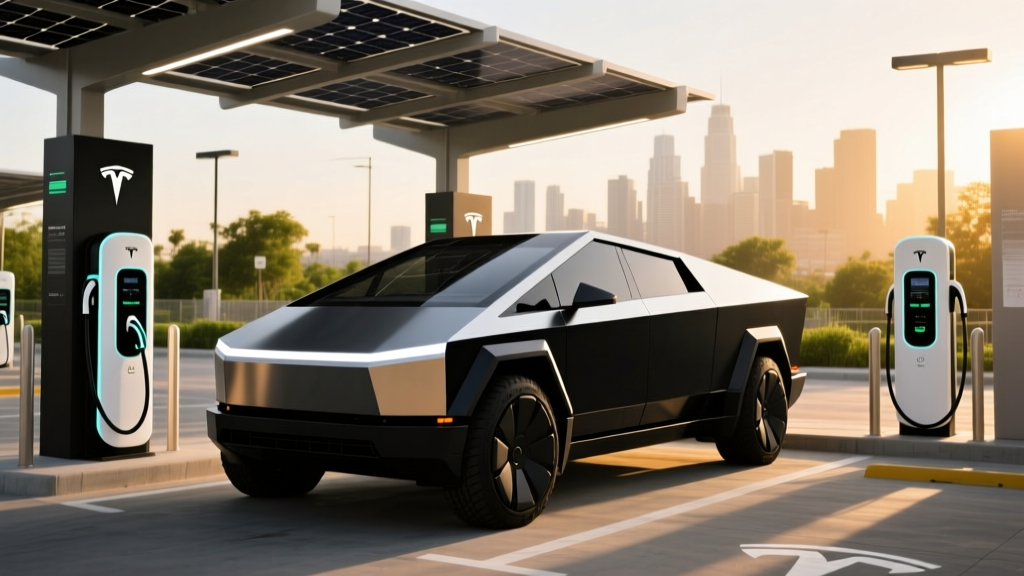
For Cybertruck owners, the NACS port means seamless access to the Tesla Supercharger network—over 25,000 stalls across North America as of 2026, including V4 cabinets capable of 250+ kW. If you need to use a non-Tesla DC fast-charger (Electrify America, EVgo), you'll need a NACS-to-CCS adapter from Tesla's shop, typically priced around $200.
For Level 2 home charging, most chargers now ship with a NACS connector or offer it as a configurable option. If you buy a J1772-terminated charger (still common for universal compatibility), Tesla includes a J1772-to-NACS adapter with every vehicle.
Cost to Charge: Home vs. Public vs. Gas Comparison
One of the strongest ownership arguments for the Cybertruck—especially without the range extender adding weight and cost—is the per-mile energy cost advantage over gasoline trucks. Here's the breakdown:
| Scenario | Rate | Cost per kWh | Cost per Mile (Cybertruck AWD ~2.8 mi/kWh) |
|---|---|---|---|
| Home (off-peak utility rate) | Time-of-use | $0.08–$0.14 | $0.03–$0.05 |
| Home (standard residential) | Flat rate | $0.13–$0.18 | $0.05–$0.06 |
| Tesla Supercharger (V3/V4) | Per kWh | $0.25–$0.35 | $0.09–$0.13 |
| Electrify America / EVgo DC | Per kWh | $0.30–$0.48 | $0.11–$0.17 |
| Gas truck (Ford F-150, 20 MPG) | $3.40/gal | — | $0.17 |
At national average electricity rates, home charging the Cybertruck costs roughly $0.04–$0.06 per mile—about a third of what a comparable gas truck costs at $3.40/gallon. Even on public DC fast chargers, you're typically paying less per mile than gasoline, though the gap narrows significantly on expensive networks like Electrify America during peak hours. The key insight: home charging is where the economics work best. Public DC fast charging is a convenience for road trips, not a daily strategy.
According to fueleconomy.gov, the Cybertruck AWD achieves approximately 87 MPGe combined, translating to roughly 2.8 miles per kWh. Use that figure for your own cost calculations based on local utility rates.
Recommended Home Chargers for the Cybertruck (2026 Picks)
With the Cybertruck's 11.5 kW onboard charger, you want a Level 2 unit that can deliver at least 48 amps to maximize charging speed. Here are three proven options:
Tesla Wall Connector (Gen 4)
- Power: Up to 48A / 11.5 kW (240V)
- Connector: Native NACS
- Cable length: 24 ft
- Smart features: Wi-Fi, OTA updates, Power-Share (load balancing between two units), Tesla app integration
- Price: ~$475
- Why it works: Seamless Tesla integration, fastest home charge for Cybertruck, cleanest install
ChargePoint Home Flex
- Power: Configurable 16A–50A (up to 12 kW at 50A)
- Connector: J1772 (use included Tesla adapter) or NACS pigtail option
- Cable length: 23 ft
- Smart features: Wi-Fi, Alexa, scheduling, ChargePoint app, Amazon Alexa integration
- Price: ~$550–$650
- Why it works: Flexible amperage lets you match your circuit capacity; great for multi-EV households with mixed connectors
Emporia Vue EV Charger
- Power: Up to 48A / 11.5 kW (240V)
- Connector: J1772 (Tesla adapter included) or NACS version available
- Cable length: 24 ft
- Smart features: Wi-Fi, energy monitoring via Emporia Vue panel integration, solar-aware scheduling
- Price: ~$400–$500
- Why it works: Budget-friendly with deep energy monitoring; ideal if you have solar panels and want to charge on excess production
Safety, Code Compliance, and Installation Best Practices
EV charging draws sustained high current for hours—unlike most household loads. This makes proper installation non-negotiable:
- Dedicated circuit: Your Level 2 charger must be on its own dedicated breaker. Never share a circuit with other appliances.
- GFCI protection: NEC 2023 and later require GFCI protection for outdoor receptacles used for EV charging. Hardwired installations may have different requirements—check local code.
- Outdoor rating: If your charger is mounted outside, ensure it carries a NEMA 4 (or IP65+) rating for weather resistance. The Tesla Wall Connector and ChargePoint Home Flex both qualify.
- Wire gauge: A 60-amp circuit requires 6 AWG copper wire (THHN in conduit) or 4 AWG for NM-B (Romex). Your electrician will specify based on run length and local code.
- Load management: If your panel is near capacity, consider a smart load-management system (e.g., Emporia's Smart Load Management or Tesla's Power-Sharing) that dynamically throttles charger amperage to prevent panel overload without requiring a full upgrade.
Always hire a licensed electrician familiar with NEC Article 625 (EV charging systems). Ask for references and verify they've completed EV charger installations before. The NHTSA recommends professional installation for all Level 2 and DC charging equipment.
Making Up for the Lost Range Extender: Practical Charging Strategies
Without the range extender, Cybertruck owners planning long trips or towing need to be deliberate:
- Precondition your battery before every DC fast-charge session. Navigate to a Supercharger using the truck's built-in navigation, and the thermal management system will warm the battery to optimal charging temperature, enabling peak charge rates of 250 kW. Skipping preconditioning can add 10–15 minutes to your stop.
- Charge to 80%, not 100%, at DC fast chargers. The Cybertruck's charge curve tapers sharply above 80%—the last 20% can take as long as the first 80%. For road trips, the 10–80% window (roughly 25–30 minutes) is your sweet spot.
- Plan Supercharger stops around 180–220 miles apart when towing or driving in cold weather. This gives you a comfortable buffer without running the pack dangerously low in areas with sparse charging infrastructure.
- Install a home charger capable of the full 11.5 kW. Starting every morning with a full 340-mile EPA range (~270 real-world) eliminates daily range concerns and reserves DC fast charging exclusively for road trips.
Frequently Asked Questions
How much does it cost to install a home EV charger?
A typical Level 2 home charger installation runs $1,050–$3,450 for equipment, labor, and permits if your electrical panel has sufficient capacity. If you need a panel upgrade from 100A to 200A service, add $1,500–$3,000, bringing the total to $2,550–$6,450. Always get a load calculation from a licensed electrician first.
How fast will each charging level add range?
Level 1 (120V) adds 3–5 miles per hour—essentially useless for the Cybertruck's 123 kWh battery. Level 2 (240V, 48A) adds approximately 35–40 miles per hour, fully recharging overnight. DC fast charging (250 kW Supercharger) adds up to 150+ miles in 15 minutes at peak rate, with a 10–80% charge taking roughly 25–30 minutes.
Which connector and charger is compatible with my Cybertruck?
The Cybertruck uses a native NACS (Tesla) connector for both AC and DC charging. At home, the Tesla Wall Connector (Gen 4) is the most seamless option. For public DC fast charging, the Tesla Supercharger network is natively compatible. To use CCS-based networks like Electrify America, you'll need a Tesla NACS-to-CCS adapter (~$200).
How much does charging cost per mile compared to gas?
Home charging costs approximately $0.04–$0.06 per mile at average residential electricity rates. Tesla Supercharging costs $0.09–$0.13 per mile. A comparable gas truck (Ford F-150 at 20 MPG, $3.40/gallon) costs $0.17 per mile. Home charging saves roughly 60–75% per mile versus gasoline.
What electrical upgrades might I need for a home charger?
The most common upgrade is a panel capacity increase from 100A to 200A service ($1,500–$3,000) if your existing panel can't handle a 60-amp dedicated circuit alongside other loads. You may also need new conduit runs if your garage is far from the panel, or a load-management device if you want to avoid a panel upgrade entirely. A licensed electrician's load calculation will determine your exact needs.
Was the Cybertruck range extender ever available?
No. Despite being announced during the Cybertruck's 2019 unveiling and referenced in early reservation materials, the range extender—a supplementary battery pack designed to mount in the truck bed—never entered production. As of 2026, Tesla has removed all references to it from official materials. For detailed reporting on Tesla's product decisions, Reuters auto coverage provides ongoing updates.
The cancellation of the Cybertruck range extender doesn't diminish the truck's viability—it just means your charging infrastructure matters more than ever. A well-executed 48-amp Level 2 home installation, combined with strategic use of the Supercharger network, covers the vast majority of ownership scenarios. Start with a professional electrical assessment, choose a quality charger matched to your circuit capacity, and let the math do the convincing: at $0.05 per mile at home, the Cybertruck's operating costs leave every gas truck in the dust.