Cybertruck Range: EPA Stickers vs Real-World Reality
If you're asking what is the range on a Cybertruck, the honest answer depends on which trim you buy, how you drive, and whether you're towing. The 2026 Tesla Cybertruck lineup offers three distinct range profiles across its AWD, Cyberbeast, and the anticipated Long Range variant. But as with every EV, the EPA sticker is a starting point — not a guarantee.
Here's what Tesla publishes and what you should actually plan for.
2026 Tesla Cybertruck Range Estimates
| Trim | Battery (usable) | EPA Range | Real-World Highway (70 mph) | Cold Weather (20°F) | Towing (5,000 lb trailer) |
|---|---|---|---|---|---|
| AWD | ~123 kWh (NMC) | 340 mi | ~270–290 mi | ~220–250 mi | ~150–170 mi |
| Cyberbeast | ~123 kWh (NMC) | 320 mi | ~255–275 mi | ~200–230 mi | ~140–160 mi |
| Long Range (announced) | ~150+ kWh (est.) | 470+ mi (est.) | ~370–400 mi | ~300–340 mi | ~200–230 mi |
Real-world figures are estimates based on owner reports, independent testing, and the physics of a 6,600+ lb stainless-steel truck with a tall frontal area. Cold-weather estimates assume no preconditioning. Source: fueleconomy.gov, Tesla spec sheets.
The Cybertruck's angular stainless-steel exoskeleton looks futuristic, but it creates a drag coefficient (~0.38 Cd) that's worse than most modern sedans and even some competing electric trucks. At highway speeds, aerodynamic drag dominates energy consumption — expect efficiency around 48–52 kWh/100 mi on the AWD, which is thirstier than a Rivian R1T or a Ford F-150 Lightning on the open road.
The Long Range variant, which Tesla has announced but not yet delivered as of early 2026, adds a "range extender" battery pack that occupies the bed. This is a significant weight and payload trade-off, and the 470+ mile figure remains preliminary.
Cybertruck Charging Specs: Peak kW, Charge Curve, and 10–80% Times
The Cybertruck uses an NMC (nickel manganese cobalt) battery architecture with an 800-volt electrical system — the same high-voltage platform Tesla introduced to enable faster DC charging. Here's what that means at the plug.
| Charging Metric | AWD / Cyberbeast | Long Range (est.) |
|---|---|---|
| Max DC Fast Charge Rate | 250 kW (peak) | 250 kW (peak) |
| 10–80% DC Fast Charge Time | ~25–28 min | ~35–40 min (larger pack) |
| Peak Sustained Rate (10–50%) | ~200–230 kW | ~200–230 kW |
| Rate Above 80% (taper) | Drops to ~60–80 kW | Drops to ~60–80 kW |
| Max Level 2 (AC) Rate | 17.2 kW (72A onboard charger) | 17.2 kW (72A) |
| Level 2 Time (0–100%) | ~8–9 hours | ~10–12 hours |
| Level 1 (120V) Time | ~5+ days (0–100%) | ~6+ days |
| Connector | NACS (native) | NACS (native) |
Understanding the charge curve: The Cybertruck does not sustain 250 kW for the entire session. Peak rate occurs roughly between 10–40% State of Charge (SoC). After 50%, the rate tapers progressively. If you arrive at a Supercharger at 5% and charge to 80%, expect roughly 25–28 minutes. Charging from 80–100% adds another 25+ minutes — which is why Tesla's navigation system typically recommends charging to 80% on road trips.
Preconditioning matters. If you navigate to a Supercharger using the Tesla app or in-car nav, the battery will preheat or precool to optimal temperature before you arrive. Skipping preconditioning in cold weather can reduce your peak charge rate by 30–50%, adding 10–15 minutes to a session.
Charging Levels Explained: Level 1, Level 2, and DC Fast Charging
Whether you own a Cybertruck or are planning to buy one, understanding the three charging levels is essential. kW (kilowatts) measures the power flow rate — how fast energy is delivered. kWh (kilowatt-hours) measures energy capacity — the size of the "tank." Never confuse them.
| Level | Voltage / Amps | Max Power (kW) | Miles of Range Added per Hour | Best Use Case |
|---|---|---|---|---|
| Level 1 | 120V / 12–15A | 1.4–1.8 kW | ~3–4 mi/hr | Overnight trickle, emergencies, low-mileage commuters |
| Level 2 (Home) | 240V / 40–60A | 9.6–14.4 kW | ~20–35 mi/hr | Daily home charging — the standard for EV owners |
| Level 2 (High-power) | 240V / 72–80A | 17.2–19.2 kW | ~35–44 mi/hr | Cybertruck (17.2 kW onboard); large-battery EVs |
| DC Fast Charge | 400–800V DC | 50–350 kW | ~150–750 mi/hr (peak) | Road trips, commercial fleets, quick top-ups |
For the Cybertruck's ~123 kWh battery, a standard 40A Level 2 charger (9.6 kW) adds roughly 20 miles of range per hour and takes about 13 hours for a full 0–100% charge. To fully leverage the Cybertruck's 17.2 kW onboard charger, you'd need a 72A Level 2 circuit — which requires a dedicated 90A breaker. Most homeowners opt for a 60A charger (48A continuous / 11.5 kW) as a practical middle ground.
Home Charger Installation: Electrical Requirements, Costs, and Panel Upgrades
Installing a home Level 2 charger for a Cybertruck isn't plug-and-play. The truck's large battery and high onboard charge rate mean you'll want a robust circuit. Here's what's involved.
Electrical Requirements
- Circuit: A dedicated 60A breaker is the practical minimum for a Cybertruck. A 90A breaker supports the full 72A/17.2 kW charge rate.
- Wire gauge: 6 AWG copper for 60A; 3 AWG for 90A (runs over 50 feet may require upsizing).
- Voltage: 240V single-phase (standard residential split-phase).
- Panel capacity: Most homes built after 1990 have a 200A main panel. Adding a 60A EV circuit is usually feasible. Older homes with 100A or 150A panels may require an upgrade ($1,500–$3,500).
Installation Cost Breakdown
| Component | Cost Range | Notes |
|---|---|---|
| Level 2 Charger (hardware) | $400–$750 | 48A–80A Wi-Fi-enabled unit |
| Electrician labor | $600–$2,000 | Depends on run length, conduit, wall material |
| Electrical permit | $50–$250 | Varies by municipality; required by code |
| Panel upgrade (if needed) | $1,500–$3,500 | 100A → 200A service upgrade |
| Conduit/wiring materials | $100–$400 | Long runs or underground conduit cost more |
| Total (no panel upgrade) | $1,150–$3,400 | Typical suburban install, 20–40 ft run |
| Total (with panel upgrade) | $2,650–$6,900 | Older homes needing service upgrade |
Don't skip the permit. Unpermitted electrical work can void your homeowner's insurance and create fire hazards. A licensed electrician will pull the permit, schedule an inspection, and ensure your installation meets NEC Article 625 (Electric Vehicle Charging Equipment). Many utilities also require proof of permitted installation before offering rebates.
Which Connector Does the Cybertruck Use? Compatibility and Adapters
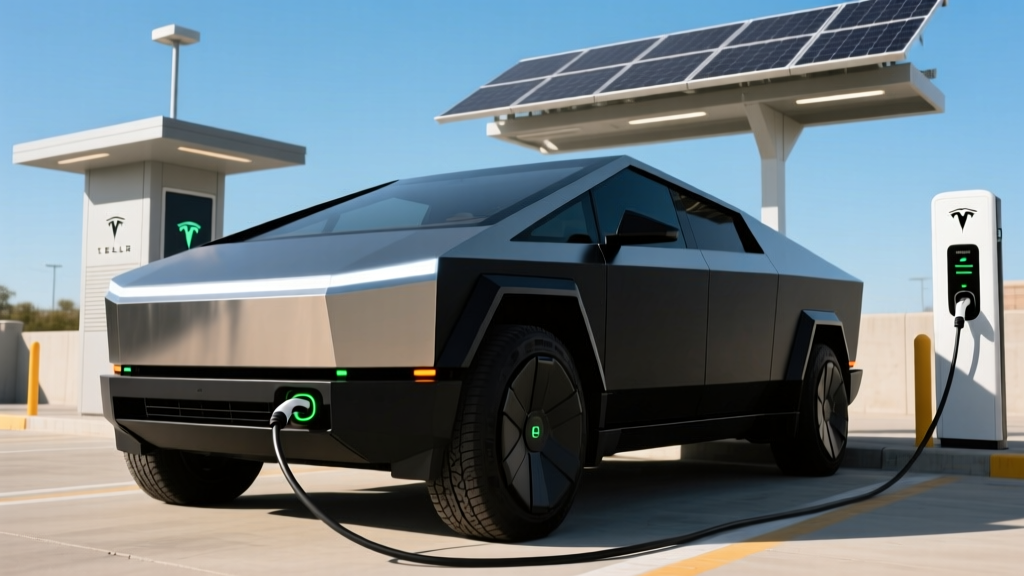
The 2026 Cybertruck ships with a native NACS (North American Charging Standard) port — Tesla's proprietary connector, now adopted by Ford, GM, Rivian, Hyundai, and most major automakers. This means direct access to Tesla's Supercharger network (20,000+ stalls in North America) with no adapter required.
| Connector | Cybertruck Compatible? | Adapter Needed? | Notes |
|---|---|---|---|
| NACS (Tesla) | Yes — native | No | Supercharger + Tesla Destination Chargers |
| CCS1 | Yes (with adapter) | Tesla CCS Adapter (~$175) | Electrify America, EVgo, ChargePoint DC stalls |
| CHAdeMO | Yes (with adapter) | Third-party CHAdeMO→NACS (~$300+) | Largely legacy; few new installations |
| J1772 (Level 2) | Yes (with adapter) | Tesla Mobile Connector J1772 adapter (included) | Public Level 2 stations, hotels, workplaces |
Tesla includes a J1772 adapter with every Cybertruck for Level 2 public charging. The CCS1 adapter is sold separately through Tesla's shop and is essential if you plan to use Electrify America or other non-Tesla DC fast-charging networks on road trips through areas with limited Supercharger coverage.
Charging Cost: Cybertruck $/kWh vs Gasoline Cost Per Mile
The Cybertruck's large battery and mediocre efficiency (48–52 kWh/100 mi) make charging costs a legitimate concern, especially compared to more aerodynamic EVs. Let's run the numbers.
| Charging Scenario | $/kWh | Cost for 123 kWh (full charge) | Cost per Mile (340 mi range) | Cost per 1,000 Miles |
|---|---|---|---|---|
| Home — off-peak utility rate | $0.09 | $11.07 | $0.033 | $32.60 |
| Home — average US rate | $0.16 | $19.68 | $0.058 | $57.90 |
| Public Level 2 (ChargePoint, etc.) | $0.25–$0.39 | $30.75–$47.97 | $0.090–$0.141 | $90–$141 |
| Tesla Supercharger (avg) | $0.28–$0.36 | $34.44–$44.28 | $0.101–$0.130 | $101–$130 |
| Electrify America DC Fast | $0.35–$0.52 | $43.05–$63.96 | $0.127–$0.188 | $127–$188 |
Gas comparison: A comparable gas truck (e.g., Ford F-150 3.5L EcoBoost, 20 MPG combined) at $3.40/gallon costs $0.170/mile or $170 per 1,000 miles. Home-charged Cybertruck owners save roughly $110–$140 per 1,000 miles. But if you rely exclusively on public DC fast charging at $0.40+/kWh, your per-mile cost can match or exceed gasoline — negating the fuel-cost advantage.
The takeaway: home charging is non-negotiable for Cybertruck economics. A 123 kWh battery charged at public DC rates is expensive. Install a Level 2 charger at home and charge overnight on off-peak rates to maximize savings.
Recommended Home Chargers for the Cybertruck
To take advantage of the Cybertruck's 17.2 kW onboard charger, you ideally want a 72A–80A Level 2 unit. However, a 48A unit on a 60A circuit is the most common and cost-effective setup. Here are specific recommendations.
Tesla Wall Connector (Best Overall)
- Power: Up to 48A / 11.5 kW (on 60A circuit) or 80A / 19.2 kW (on 100A circuit)
- Connector: Native NACS — no adapter needed
- Cable length: 24 ft
- Smart features: Wi-Fi, OTA updates, power sharing (link two units on one circuit), Tesla app integration
- Price: ~$475
- Why: Seamless integration with Cybertruck; power sharing is ideal for two-EV households
ChargePoint Home Flex (Best for Flexibility)
- Power: Adjustable 16A–50A / up to 12 kW (on 60A circuit)
- Connector: NACS (native) or J1772 (with adapter)
- Cable length: 23 ft
- Smart features: Wi-Fi, Alexa, scheduled charging, energy tracking via app
- Price: ~$599
- Why: Amperage is adjustable via DIP switches — future-proof if your panel changes
Emporia Vue EV Charger (Best Budget Smart Charger)
- Power: Up to 48A / 11.5 kW (on 60A circuit)
- Connector: NACS or J1772 versions available
- Cable length: 24 ft
- Smart features: Wi-Fi, energy monitoring, solar integration, scheduled charging
- Price: ~$399
- Why: Lowest-cost smart charger with robust energy monitoring
For maximum Cybertruck charge speed at home: The Tesla Wall Connector on a 100A circuit delivers 80A / 19.2 kW — faster than the Cybertruck's 17.2 kW onboard charger can accept. This setup costs more (100A breaker, 3 AWG wire, potentially a panel upgrade) but future-proofs your garage for next-generation EVs.
Safety, Code, and Installation Best Practices
EV charging draws sustained high current for hours — more like a hot tub than a typical appliance. Cutting corners is a fire risk. Follow these non-negotiables:
- Dedicated circuit: Your Level 2 charger must have its own breaker — never share a circuit with a dryer, oven, or HVAC unit.
- NEC 80% rule: Continuous loads (like EV charging) can only use 80% of a breaker's rated capacity. A 60A breaker supports 48A continuous charging. A 90A breaker supports 72A.
- GFCI protection: The 2023 NEC requires GFCI protection for all EV receptacles (NEMA 14-50 outlets). Hardwired chargers are exempt from this requirement, which is one reason hardwiring is preferred — it avoids nuisance GFCI trips.
- Outdoor rating: If your charger is outdoors, ensure it carries a NEMA 4 or IP65 rating. The Tesla Wall Connector and ChargePoint Home Flex are both rated for outdoor use.
- Permit and inspect: Every jurisdiction requires a permit for new 240V circuits. The inspection ensures proper wire gauge, breaker sizing, grounding, and torque on connections.
Cybertruck Range and Charging FAQ
What is the range on a Cybertruck AWD in real-world driving?
The EPA rates the 2026 Cybertruck AWD at 340 miles. In real-world highway driving at 70 mph, expect 270–290 miles. In cold weather (below 30°F), range drops to roughly 220–250 miles without preconditioning. Towing a 5,000-pound trailer cuts range to approximately 150–170 miles.
How long does it take to charge a Cybertruck at home?
On a 48A / 11.5 kW Level 2 charger (the most common home setup), a full 0–100% charge of the Cybertruck's ~123 kWh battery takes about 11 hours. On a 72A / 17.2 kW setup, it drops to roughly 8 hours. Most owners charge from 20–80% overnight, which takes 6–7 hours on a 48A circuit.
How much does it cost to install a home EV charger for a Cybertruck?
Expect $1,150–$3,400 for a standard installation (60A circuit, 20–40 ft wire run, no panel upgrade). If your home has an older 100A or 150A electrical panel, a service upgrade to 200A adds $1,500–$3,500, bringing the total to $2,650–$6,900. Always hire a licensed electrician and pull a permit.
Does the Cybertruck use CCS or NACS?
The Cybertruck uses NACS natively — Tesla's charging standard. You can plug directly into any Tesla Supercharger or Destination Charger. To use CCS1 stations (Electrify America, EVgo), you'll need the Tesla CCS Adapter, sold separately for ~$175.
Can I charge a Cybertruck on a regular 120V outlet?
Yes, but it's impractical for daily use. A standard 120V/15A outlet delivers roughly 1.4 kW — about 3 miles of range per hour. Fully charging the Cybertruck's 123 kWh battery from empty would take over 5 days. Level 1 is only viable for emergency top-ups or very low-mileage drivers.
Is the Cybertruck Long Range available to order in 2026?
The Cybertruck Long Range (estimated 470+ miles with a bed-mounted range extender pack) has been announced by Tesla but is not yet in production as of early 2026. Specs remain preliminary, and delivery timelines have shifted multiple times. Monitor Tesla's official Cybertruck page for updates.
Does the Cybertruck qualify for the federal EV tax credit?
Under IRS §30D rules, the Cybertruck AWD and Cyberbeast are classified as trucks, so the MSRP cap is $80,000. The Cyberbeast (base ~$99,990) exceeds this cap and does not qualify. The AWD trim (base ~$79,990) is borderline — eligibility depends on exact MSRP with destination and current battery-sourcing and critical-minerals requirements. Buyer income caps also apply ($150K single / $300K joint AGI). Consult IRS.gov §30D guidelines or a tax professional before relying on the credit.
Final Word: Plan Your Charging Before You Buy
The Cybertruck's range — 320 to 340 miles EPA for current trims — is adequate for most daily driving and manageable for road trips given Tesla's Supercharger network. But its large battery, high efficiency consumption, and 800V architecture demand a deliberate home charging strategy. Budget $1,500–$3,500 for a quality Level 2 installation on a 60A circuit, confirm your electrical panel has headroom, and charge primarily at home to keep per-mile costs well below gasoline. The Cybertruck rewards preparation — and punishes owners who rely solely on public DC fast charging.