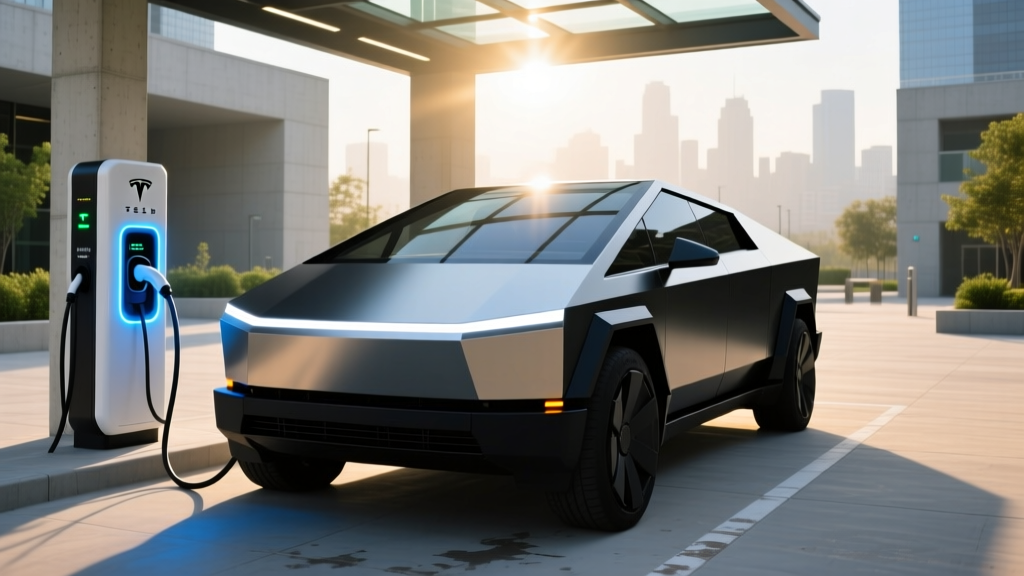
The Tesla Cybertruck's massive battery pack is one of the largest in any production consumer EV. Understanding how many kWh it stores, how fast you can replenish it, and what it actually costs to charge is critical before you plug in for the first time — or decide whether your home's electrical panel can handle it.
This guide breaks down the Cybertruck's battery capacity, every charging level available in 2026, real home-installation costs, and what you'll pay per mile compared to a gas truck. Whether you own a Dual Motor, Tri Motor, or the standard-range Cybertruck, the numbers below will help you plan your charging setup with precision.
Cybertruck Battery kWh: What You're Actually Working With
The 2025–2026 Tesla Cybertruck carries an estimated 123 kWh usable battery pack (approximately 150 kWh total capacity with buffer). Tesla uses an NMC (nickel manganese cobalt) chemistry in the Cybertruck, chosen for the energy density needed to push a 6,800+ lb stainless-steel vehicle over 300 miles.
| Specification | Value |
|---|---|
| Battery Chemistry | NMC (Nickel Manganese Cobalt) |
| Total Battery Capacity | ~150 kWh |
| Usable Battery Capacity | ~123 kWh |
| EPA Range (Dual Motor) | 340 miles |
| EPA Range (Tri Motor / Cyberbeast) | 320 miles |
| Real-World Highway Range (est.) | ~260–290 miles |
| Efficiency | ~48 MPGe / ~70 kWh/100mi |
| Battery Warranty | 8 years / 120,000 miles |
That ~70 kWh/100mi efficiency figure is significant: the Cybertruck is roughly 40–50% less efficient than a Tesla Model Y (~28 kWh/100mi). The angular stainless-steel body creates substantial aerodynamic drag, and the vehicle's weight compounds energy consumption. This matters directly for your charging costs and frequency.
Charging Levels Explained: Speeds, kW, and Miles Per Hour
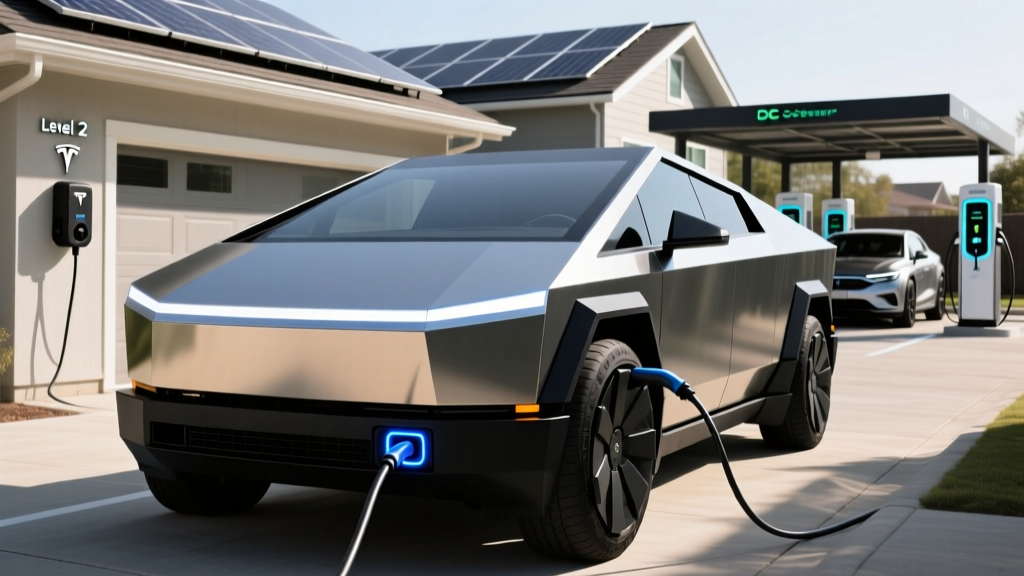
Every EV owner needs to understand the three charging tiers. Here's how each applies to the Cybertruck's large 123 kWh battery:
| Level | Power (kW) | Voltage / Amps | Miles of Range Per Hour | 10–80% Time (approx.) |
|---|---|---|---|---|
| Level 1 (Standard 120V outlet) | ~1.2–1.4 kW | 120V / 12A | ~2–3 miles/hr | Not practical (70+ hours) |
| Level 2 (Home / Destination) | 7.2–19.2 kW | 240V / 30–80A | ~14–35 miles/hr | ~5–10 hours |
| DC Fast Charging (Supercharger) | Up to 250 kW peak | 400V+ DC | ~200+ miles in 15 min | ~25–30 minutes |
Level 1 reality check: Plugging a Cybertruck into a standard 120V household outlet adds roughly 2–3 miles of range per hour. With a 123 kWh battery, a full charge from empty would take over 70 hours. Level 1 is only viable for overnight top-ups if you drive fewer than 30 miles daily — and even then, it's painfully slow for this vehicle.
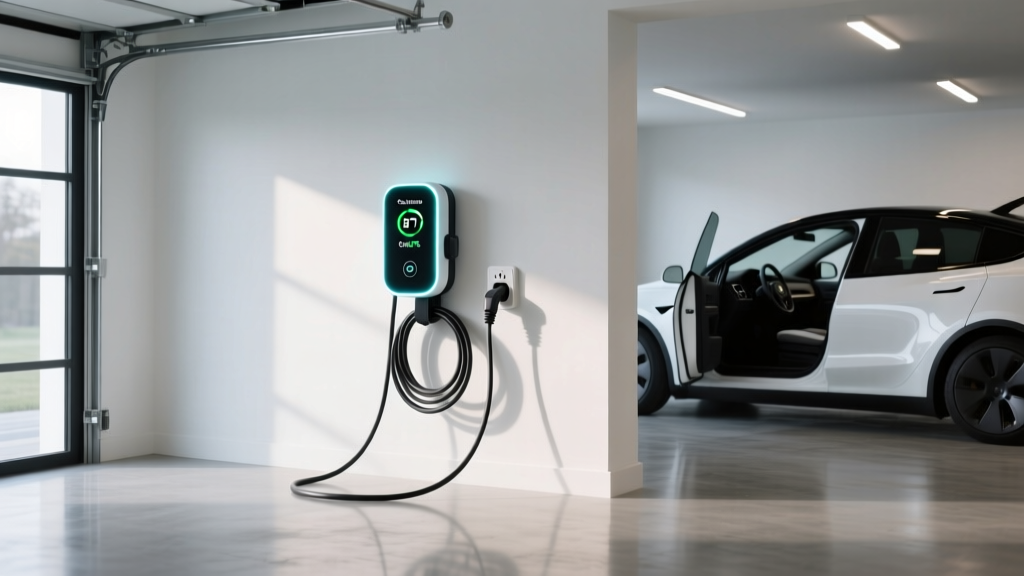
Level 2 is the home-charging standard: A 240V circuit (like your dryer outlet) delivers 7.2 to 19.2 kW depending on amperage. At 48A (11.5 kW), the Cybertruck gains roughly 20 miles of range per hour — enough to fully replenish overnight in about 10–11 hours. At 80A (19.2 kW), that drops to roughly 6 hours.
DC Fast Charging: Tesla Superchargers deliver up to 250 kW peak to the Cybertruck. However, peak rate is not sustained rate. The charge curve tapers significantly above 50–60% state of charge. Expect roughly 15 minutes to add ~200 miles from a low state of charge, but a full 10–80% session takes approximately 25–30 minutes. Above 80%, charging slows dramatically to protect battery health — plan your road trips around 80% stops.
Home Charger Installation: Electrical Requirements and Real Costs
Charging a 123 kWh battery at home requires a robust electrical setup. Here's what's involved:
Electrical Requirements
- Minimum viable circuit: 240V / 40A dedicated circuit (NEMA 14-50 outlet) — delivers ~9.6 kW
- Recommended circuit: 240V / 60A dedicated circuit — delivers ~11.5 kW (48A continuous)
- Optimal for Cybertruck: 240V / 100A circuit with Tesla Wall Connector hardwired — delivers up to 19.2 kW (80A continuous)
- Panel capacity: Your main electrical panel needs sufficient spare capacity. A 200-amp panel is typically required for a 60A+ EV circuit. Homes with 100-amp panels will likely need a panel upgrade.
Installation Cost Breakdown
| Component | Low Estimate | High Estimate | Notes |
|---|---|---|---|
| Level 2 Charger Equipment | $400 | $750 | Tesla Wall Connector, ChargePoint, Emporia |
| Electrician Labor | $500 | $2,000 | Depends on run length from panel to garage |
| Electrical Materials (wire, conduit, breaker) | $150 | $500 | Longer runs = more copper wire cost |
| Permit & Inspection | $50 | $300 | Varies by municipality |
| Panel Upgrade (if needed) | $1,500 | $4,000+ | 100A to 200A service upgrade |
| Total (no panel upgrade) | $1,100 | $3,550 | Typical suburban home with 200A panel |
| Total (with panel upgrade) | $2,600 | $7,550+ | Older homes with 100A service |
These ranges reflect national averages. Urban areas with higher labor costs (Bay Area, NYC, Seattle) trend toward the high end. Always get at least two quotes from licensed electricians and verify they pull the required permits — unpermitted work can void homeowner's insurance claims.
Safety and Code Considerations
- Dedicated circuit: Your EV charger must be on its own dedicated breaker — never share a circuit with other high-draw appliances.
- GFCI protection: The 2023 NEC (National Electrical Code) requires GFCI protection for EV charging outlets. Hardwired chargers (like the Tesla Wall Connector) may not require a separate GFCI breaker in all jurisdictions — check local code.
- Outdoor rating: If your charger is installed outdoors (carport, driveway), ensure the unit carries a NEMA 4 or IP65 weather-resistance rating. The Tesla Wall Connector is rated for outdoor use.
- Wire gauge: A 60A circuit requires 4 AWG copper wire minimum; an 80A circuit requires 2 AWG. Your electrician will size this correctly, but verify it during inspection.
Connector Compatibility: NACS, CCS, and the Cybertruck
The Tesla Cybertruck uses the NACS (North American Charging Standard) connector — Tesla's proprietary design, now adopted as an industry standard. This means native compatibility with Tesla's Supercharger network (over 25,000 stalls in North America as of 2026) and a growing number of third-party chargers offering NACS cables.
| Connector | Used By | Cybertruck Compatible? | Adapter Needed? |
|---|---|---|---|
| NACS (Tesla) | Tesla, Ford, GM, Rivian, Volvo, others (2025+) | Yes — native | No |
| CCS1 | Legacy non-Tesla EVs (Hyundai, VW, BMW pre-2025) | Yes with adapter | Tesla CCS Adapter (~$175) |
| CHAdeMO | Nissan Leaf, older Japanese EVs | Yes with adapter | Third-party CHAdeMO→NACS adapter |
| J1772 (Level 2) | All non-Tesla public Level 2 stations | Yes with adapter | Tesla J1772 Adapter (included with vehicle) |
Practical takeaway: The Cybertruck's NACS port gives you the best public-charging access of any EV in 2026. The included J1772 adapter handles non-Tesla Level 2 destination chargers. For CCS-equipped DC fast stations (some Electrify America and EVgo locations still use CCS1), the optional Tesla CCS Adapter unlocks access. The Supercharger network remains the most reliable DC fast-charging ecosystem in the U.S., and the Cybertruck uses it natively.
Charging Cost Per Mile: Cybertruck vs Gas Truck
The Cybertruck's ~70 kWh/100mi efficiency is poor by EV standards but still cheaper per mile than gasoline in most scenarios. Here's a realistic breakdown:
| Charging Scenario | Rate | Cost Per Mile (Cybertruck) | Notes |
|---|---|---|---|
| Home — Off-Peak TOU (0.08/kWh avg) | $0.08/kWh | $0.056/mile | Best case: overnight utility rates |
| Home — Standard Rate ($0.15/kWh avg) | $0.15/kWh | $0.105/mile | Typical residential rate |
| Home — Peak TOU ($0.28/kWh avg) | $0.28/kWh | $0.196/mile | Worst-case residential timing |
| Public Level 2 (ChargePoint, etc.) | $0.20–$0.35/kWh | $0.14–$0.25/mile | Varies by network and location |
| Tesla Supercharger (DC fast) | $0.28–$0.40/kWh | $0.20–$0.28/mile | Average $0.35/kWh in 2026 |
| Non-Tesla DC Fast (EA, EVgo) | $0.35–$0.55/kWh | $0.25–$0.39/mile | Most expensive public option |
Gas truck comparison: A comparable 2026 Ford F-150 4WD (gas, ~19 MPG combined) burning fuel at $3.60/gallon costs roughly $0.189 per mile. A Cybertruck charging at home off-peak ($0.056/mile) saves about $0.133 per mile — or roughly $1,995 per year at 15,000 miles driven. Even at standard residential rates ($0.105/mile), you save about $1,260 annually versus gas.
However, if you rely exclusively on DC fast charging at $0.35/kWh, your per-mile cost ($0.245) actually exceeds the gas truck. Home charging access is the economic linchpin of Cybertruck ownership. Without it, the efficiency penalty of this heavy, boxy vehicle erodes the EV cost advantage.
Recommended Home Chargers for the Cybertruck
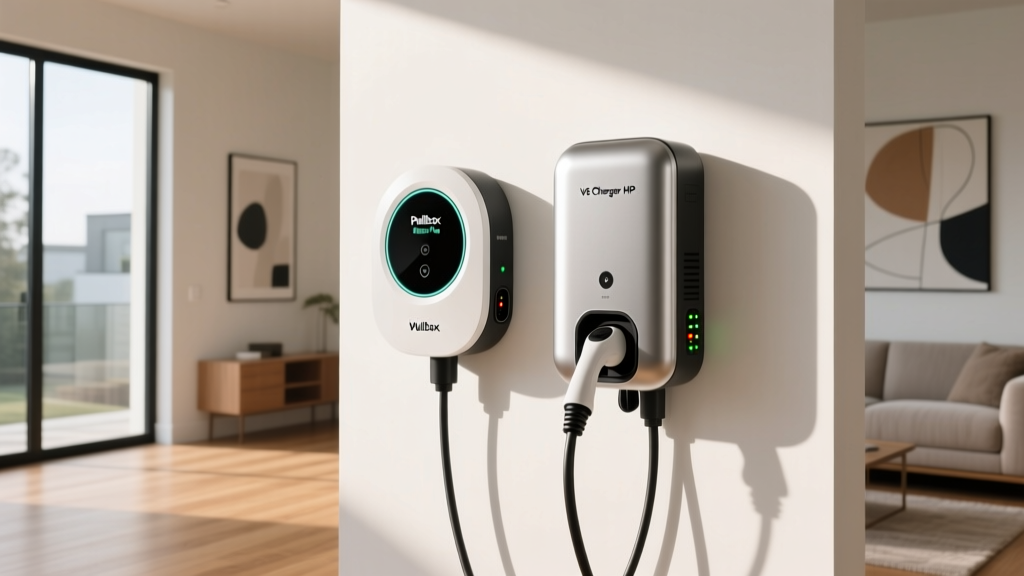
Given the Cybertruck's massive 123 kWh battery, maximizing your Level 2 charge rate is essential. Here are three chargers that meet the task:
Tesla Wall Connector
- Max Output: 11.5 kW (48A) on 60A circuit; up to 19.2 kW (80A) on 100A circuit
- Connector: NACS (native)
- Cable Length: 24 ft
- Smart Features: Wi-Fi, OTA updates, load sharing (pair two units on one circuit), access control
- Price: ~$475
- Best for: Tesla owners wanting maximum charge rate and seamless app integration
Emporia Vue Level 2 Charger
- Max Output: 11.5 kW (48A) on 60A circuit
- Connector: J1772 (use included Tesla adapter) or NACS version available
- Cable Length: 24 ft
- Smart Features: Wi-Fi, energy monitoring, solar integration, scheduled charging, load management
- Price: ~$399
- Best for: Budget-conscious buyers with solar panels or energy-monitoring needs
ChargePoint Home Flex
- Max Output: 12 kW (50A) on 60A circuit; configurable down to 16A
- Connector: J1772 (use Tesla adapter) or NACS pigtail version
- Cable Length: 23 ft
- Smart Features: Wi-Fi, Alexa integration, flexible amperage settings, scheduling
- Price: ~$549
- Best for: Multi-EV households with non-Tesla vehicles; flexible amperage for older panels
Our recommendation for Cybertruck owners: The Tesla Wall Connector is the clear pick. Native NACS compatibility eliminates adapter clutter, it supports up to 80A output on a 100A circuit (the fastest Level 2 charge the Cybertruck can accept), and Tesla's load-sharing feature lets you install two units on a single circuit. At $475, it's also the least expensive option.
Charging Time Examples: 10–80% for the Cybertruck
With a 123 kWh usable battery, a 10–80% charge means replenishing roughly 86 kWh. Here's how long that takes at various charge rates:
| Charging Method | Power Delivered | Estimated 10–80% Time | Practical Use Case |
|---|---|---|---|
| 120V Level 1 (wall outlet) | ~1.3 kW | ~66 hours | Emergency only — not viable for daily use |
| 240V / 32A Level 2 | ~7.7 kW | ~11.2 hours | Basic home setup — overnight full charge |
| 240V / 48A Level 2 (Wall Connector, 60A circuit) | ~11.5 kW | ~7.5 hours | Standard home install — overnight charge with margin |
| 240V / 80A Level 2 (Wall Connector, 100A circuit) | ~19.2 kW | ~4.5 hours | Optimal home setup — fast overnight, quick daytime top-up |
| Tesla Supercharger V3 (250 kW peak) | ~150 kW avg (curve-adjusted) | ~25–30 minutes | Road trips — plan stops at 80% for best speed |
Frequently Asked Questions
How much does it cost to install a home EV charger for the Cybertruck?
Expect $1,100–$3,550 for a standard Level 2 installation (equipment, electrician, materials, permit) if your home already has a 200-amp electrical panel. If you need a panel upgrade from 100A to 200A, add $1,500–$4,000+, bringing the total to $2,600–$7,550+. Always get itemized quotes from licensed electricians and verify permits are pulled.
How fast will each charging level add range to the Cybertruck?
Level 1 (120V) adds roughly 2–3 miles per hour. Level 2 at 48A (11.5 kW) adds approximately 20 miles per hour. Level 2 at 80A (19.2 kW) adds roughly 35 miles per hour. DC fast charging at a Tesla Supercharger can add 200+ miles in about 15 minutes at peak rate, though the charge curve tapers significantly above 50% state of charge.
Which connector and charger is compatible with the Cybertruck?
The Cybertruck uses the NACS (North American Charging Standard) connector natively. It charges at all Tesla Superchargers without an adapter. For non-Tesla Level 2 stations with J1772 connectors, use the J1772 adapter included with the vehicle. For CCS1 DC fast stations, the optional Tesla CCS Adapter (~$175) provides access. At home, the Tesla Wall Connector with NACS plug is the most seamless option.
How much does charging the Cybertruck cost per mile versus a gas truck?
At home off-peak rates ($0.08/kWh), the Cybertruck costs roughly $0.056 per mile — about 70% less than a gas F-150 at $0.189/mile (19 MPG, $3.60/gallon). At standard residential rates ($0.15/kWh), it costs $0.105/mile — still 44% cheaper. However, exclusive reliance on DC fast charging at $0.35/kWh brings the cost to ~$0.245/mile, which exceeds gasoline. Home charging access determines whether the Cybertruck saves you money.
What electrical upgrades might I need for a Cybertruck home charger?
Most Cybertruck owners installing a 60A dedicated circuit (for 48A continuous charging at 11.5 kW) need a 200-amp main electrical panel. If your home has a 100-amp panel — common in homes built before 1990 — you'll need a service upgrade to 200A, costing $1,500–$4,000+. Additionally, the circuit run from your panel to the charger location may require conduit, a new breaker, and appropriate-gauge wiring (4 AWG for 60A, 2 AWG for 80A+). A licensed electrician will assess your panel capacity and recommend the right circuit size.
Can I use a 240V dryer outlet to charge my Cybertruck?
Yes, if you have a NEMA 14-50 outlet (common for dryers and RVs), you can use the Tesla Mobile Connector with the NEMA 14-50 adapter. This delivers up to ~9.6 kW (40A), adding roughly 17 miles of range per hour. However, the outlet must be on a dedicated 50A breaker — sharing with a dryer is not code-compliant and is a fire risk. For daily charging, a hardwired Wall Connector on a dedicated circuit is safer and faster.
Does the Cybertruck qualify for the federal EV tax credit?
Under IRS §30D clean vehicle credit rules, the Cybertruck's eligibility depends on current-year battery sourcing, critical mineral requirements, MSRP caps (trucks: $80,000 cap), and buyer income limits ($300K joint / $150K single). As of 2026, eligibility varies by trim and production batch. Check the IRS qualified vehicle list or consult a tax professional before relying on the credit in your purchase decision. Point-of-sale transfer is available if eligible.
Sources: Tesla Cybertruck specifications via tesla.com/cybertruck; EPA efficiency data via fueleconomy.gov; IRS §30D credit rules via irs.gov.