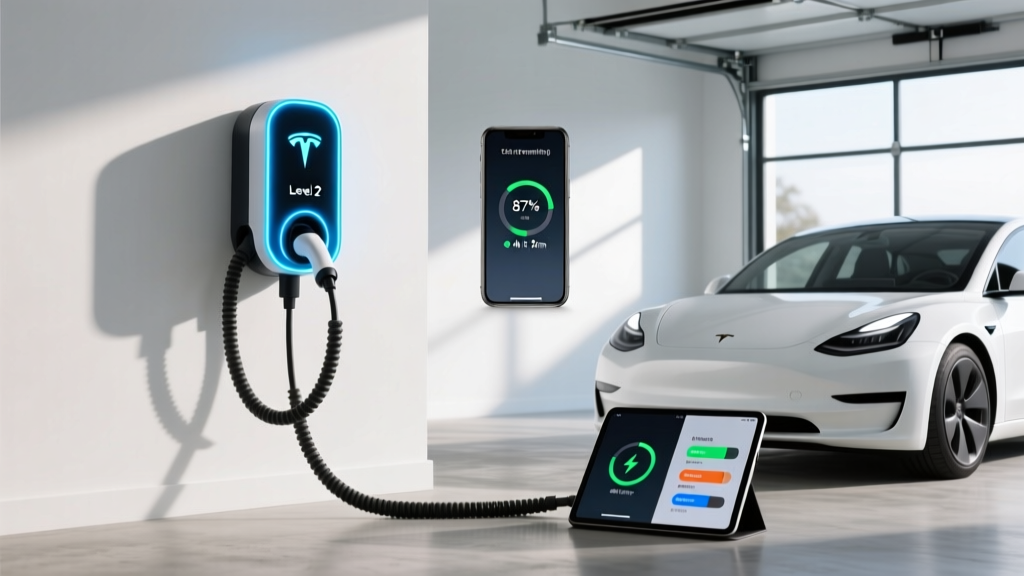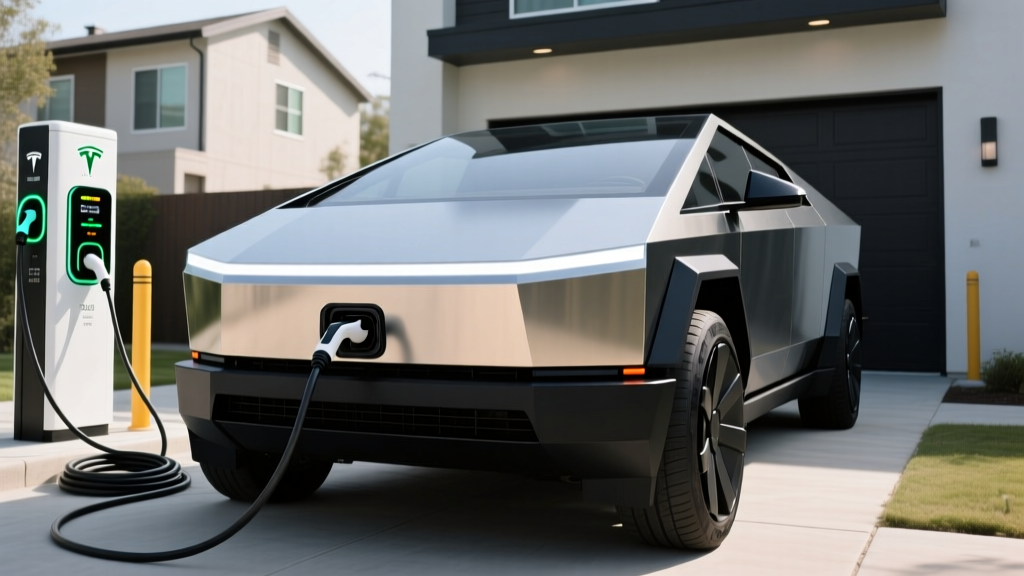
If you own or are shopping for a Tesla Cybertruck, understanding the vehicle's charging ecosystem starts with one critical component: the Cybertruck charging port. Located on the driver-side rear bed panel (left rear quarter), the port uses Tesla's North American Charging Standard (NACS) connector — the same plug now adopted by nearly every major automaker for 2025–2026 model-year EVs. This guide breaks down exactly how to charge a Cybertruck at home, on the road, and what equipment and electrical upgrades you will need, with real numbers for costs, speeds, and charging times.
Cybertruck Battery and Charging Specs at a Glance
Before examining charging infrastructure, here are the Cybertruck's core energy specifications that dictate how fast and how far you can go. These figures apply to the Dual Motor and Cyberbeast trims currently in production.
| Spec | Dual Motor AWD | Cyberbeast |
|---|---|---|
| Battery Capacity (usable) | ~123 kWh | ~123 kWh |
| Battery Chemistry | NMC (Nickel Manganese Cobalt) | NMC |
| EPA Range | 340 miles | 320 miles |
| Real-World Highway Range | ~270–290 mi | ~255–275 mi |
| Max DC Fast Charge Rate | 250 kW | 250 kW |
| 10–80% DC Fast Charge | ~28 minutes | ~28 minutes |
| Max Level 2 AC Charge Rate | 11.5 kW (48A) | 11.5 kW (48A) |
| Charging Port / Connector | NACS | NACS |
| Base MSRP (2025) | $79,990 | $99,990 |
Charging Levels: How Fast Will Each Add Range?
EV charging is categorized into three levels. The key distinction to remember: kW (kilowatts) measures power — the rate of energy flow — while kWh (kilowatt-hours) measures energy — the total capacity of the battery. Think of kW as the width of a hose and kWh as the size of the tank you are filling.
| Level | Voltage | Max Power (kW) | Miles of Range Added per Hour | Typical Use Case |
|---|---|---|---|---|
| Level 1 | 120V AC | 1.4 kW | ~3–4 mi/hr | Emergency / overnight trickle |
| Level 2 | 240V AC | 11.5 kW (48A) | ~28–34 mi/hr | Home daily charging |
| DC Fast Charging | 400V+ DC | Up to 250 kW | ~150–200 mi in 15 min | Road trips / public stations |
For the Cybertruck's ~123 kWh battery, Level 1 charging is impractical for daily use — a full charge would take over 85 hours. Level 2 is the workhorse for home charging, replenishing the battery from 20% to 80% in roughly 7–8 hours at the truck's maximum 11.5 kW onboard charger rate. DC fast charging at a Tesla Supercharger V3/V4 station can add roughly 200 miles in 15 minutes under ideal conditions, though the charge curve tapers significantly above 80% state of charge (SoC).
Home Charger Installation: Electrical Requirements and Costs
The Cybertruck's onboard charger accepts up to 11.5 kW on Level 2 AC power, which requires a 240V circuit rated for at least 60 amps (to deliver a continuous 48 amps to the vehicle, electrical code requires the circuit breaker to be rated 125% above the continuous load). This is a higher-draw setup than many older EVs required.
Electrical Requirements
- Circuit: Dedicated 60-amp, 240V breaker
- Wire gauge: 6 AWG copper (or 4 AWG aluminum) for runs up to ~100 feet; thicker wire for longer runs to prevent voltage drop
- Connector: NEMA 14-60 outlet (if using a plug-in charger) or hardwired connection (preferred for 48A+ continuous draw and often required by local code)
- GFCI protection: Required by NEC 2020+ for outdoor receptacles; hardwired units may bypass this requirement in some jurisdictions
- Outdoor rating: NEMA 4 enclosure required for any outdoor-mounted charger
Does Your Electrical Panel Need an Upgrade?
This is the most common surprise cost for new EV owners. Most homes built before 2000 have a 100-amp main service panel. Adding a 60-amp dedicated circuit for EV charging may exceed your panel's available capacity — especially if you already run electric HVAC, a dryer, an electric range, and a water heater. A licensed electrician will perform a load calculation per NEC Article 220 to determine whether your panel can handle the additional draw.
If you need a panel upgrade from 100A to 200A, expect to pay $1,500–$3,500. In rare cases, older homes with 60-amp service will need a full upgrade to 200A, which can cost $3,000–$5,000. Homes with existing 200A service and available breaker slots typically need no panel upgrade.
Installation Cost Breakdown
| Component | Low Estimate | High Estimate |
|---|---|---|
| Level 2 Charger (Equipment) | $400 | $750 |
| Electrician Labor (standard install, panel to garage, <50 ft run) | $500 | $1,500 |
| Permit & Inspection | $50 | $250 |
| Panel Upgrade (if needed: 100A → 200A) | $1,500 | $3,500 |
| Total (no panel upgrade) | $950 | $2,500 |
| Total (with panel upgrade) | $2,450 | $6,000 |
Connector Compatibility: NACS and the Adapter Landscape
The Cybertruck charging port uses the NACS connector natively. This gives you direct access to the Tesla Supercharger network — the largest and most reliable DC fast-charging network in North America, with over 30,000 stalls as of early 2026. But what about non-Tesla networks?
| Network / Connector | Native Compatibility? | Adapter Needed? | Notes |
|---|---|---|---|
| Tesla Supercharger (NACS) | Yes — native | No | Best experience; 150–250 kW stalls widely available |
| Electrify America (CCS1) | No | Tesla CCS Adapter (included with vehicle) | Works at up to 250 kW; use Tesla app to initiate session |
| EVgo (CCS1/NACS) | Partial (NACS stalls expanding) | CCS adapter for CCS1 stalls | EVgo adding NACS connectors through 2026 |
| ChargePoint (J1772 / CCS1) | No (Level 2: J1772) | Tesla J1772 Adapter (included) | Level 2 only; ~6–11 kW depending on station |
| CHAdeMO | No | Not available for NACS | CHAdeMO is being phased out in North America |
Tesla includes a CCS1 adapter and a J1772 adapter with every Cybertruck. The CCS1 adapter allows DC fast charging on Electrify America and other CCS-equipped networks, though charging speeds may be slightly lower than on Superchargers due to protocol overhead. The J1772 adapter handles Level 2 public stations at hotels, workplaces, and shopping centers. Note that CHAdeMO is effectively dead in North America — no adapter exists to connect a NACS vehicle to a CHAdeMO plug, and stations are being decommissioned or retrofitted.
Cost to Charge: Home vs. Public vs. Gas Comparison
Charging costs vary enormously depending on where and when you plug in. Here is a realistic breakdown for the Cybertruck's ~123 kWh battery.
| Scenario | Rate ($/kWh) | Cost for 10–80% (~86 kWh) | Cost per Mile (est.) |
|---|---|---|---|
| Home — Off-Peak TOU (utility rate) | $0.08–$0.12 | $6.88–$10.32 | $0.03–$0.04 |
| Home — Standard Residential Rate | $0.14–$0.18 | $12.04–$15.66 | $0.05–$0.06 |
| Tesla Supercharger (average US) | $0.28–$0.36 | $24.08–$30.96 | $0.10–$0.13 |
| Electrify America / Public DCFC | $0.32–$0.48 | $27.52–$41.28 | $0.12–$0.17 |
| Gasoline Equivalent (20 MPG truck, $3.40/gal) | — | — | $0.17 |
At home on an off-peak time-of-use (TOU) plan, the Cybertruck costs roughly $0.03–$0.04 per mile to fuel — about a quarter of the cost of a comparable gas truck getting 20 MPG. Even on public DC fast chargers, the per-mile cost is generally competitive with or slightly below gasoline. The key to maximizing savings is installing a home Level 2 charger and using TOU rates to charge overnight when electricity is cheapest.
Recommended Home Chargers for the Cybertruck
Since the Cybertruck accepts up to 11.5 kW (48 amps) on Level 2, you want a charger that can deliver at least that much power. Here are three proven options, all with the native NACS connector.
Tesla Wall Connector
- Power Output: 11.5 kW (48A)
- Connector: NACS (native)
- Cable Length: 24 feet
- Smart Features: Wi-Fi updates, load sharing with multiple units, Power Share for V2H (vehicle-to-home) integration with Tesla Powerwall
- Price: ~$475
- Best For: Tesla owners wanting seamless integration and future V2H capability
Emporia Vue Level 2 Charger
- Power Output: 11.5 kW (48A)
- Connector: NACS (2025+ model)
- Cable Length: 24 feet
- Smart Features: Energy monitoring, solar integration, scheduling via app, load management
- Price: ~$400
- Best For: Solar-equipped homes and energy-conscious owners
Grizzl-E Smart (NACS)
- Power Output: 11.5 kW (48A, adjustable down to 16A)
- Connector: NACS (2025+ model)
- Cable Length: 24 feet
- Smart Features: Adjustable amperage, OCPP compatibility, outdoor-rated (NEMA 4), extreme cold rated (-40°F)
- Price: ~$500
- Best For: Cold-climate garages and outdoor installations; adjustable amps for panel-limited homes
For Cybertruck owners, the Tesla Wall Connector is the default recommendation: it matches the truck's 11.5 kW maximum, integrates with the Tesla app, and supports future vehicle-to-home features. If your electrical panel has limited capacity, the Grizzl-E's adjustable amperage (down to 32A or 40A) lets you charge safely without a panel upgrade — you will just charge slightly slower.
DC Fast Charging: The Cybertruck Charging Curve Explained
The Cybertruck peaks at 250 kW on a compatible DC fast charger, but that peak rate is not sustained throughout the session. Like all lithium-ion batteries, the Cybertruck's NMC pack follows a charging curve: power ramps up quickly from low SoC, peaks in the 10–35% range, then progressively tapers as the battery fills.
Here is a realistic charging session at a 250 kW Tesla Supercharger V3/V4 stall:
- 10–35% SoC: Peak ~250 kW — adds roughly 100 miles in 8–10 minutes
- 35–60% SoC: ~150–180 kW — charging rate begins tapering
- 60–80% SoC: ~80–120 kW — significant taper to protect battery health
- 80–100% SoC: ~20–40 kW — slow trickle; avoid regular charging above 80% for battery longevity
The published 10–80% time of ~28 minutes reflects this taper. If you arrive at a Supercharger at 10% SoC, expect to be at 80% in roughly half an hour — enough time for a meal break. For battery health, Tesla recommends setting the daily charge limit to 80% and only charging to 100% for long trips. The navigation system will precondition the battery when you route to a Supercharger, warming the pack to optimal temperature for faster charging — this is automatic and critical in cold weather.
Safety, Code, and Best Practices
Home EV charging involves significant electrical loads running for hours at a time. Proper installation is not optional — it is a safety requirement.
- Dedicated circuit: Your EV charger must have its own dedicated breaker — never share a circuit with other appliances.
- Hardwired vs. plug-in: For 48A continuous draw, many jurisdictions require hardwired installation (no plug/receptacle). A hardwired connection also eliminates the failure point of a 14-60 receptacle overheating under sustained load.
- GFCI: The 2020 National Electrical Code (NEC 625.54) requires GFCI protection for outdoor EV receptacles. Hardwired chargers typically do not require GFCI since the unit has internal ground-fault protection.
- Outdoor rating: Any charger mounted outside must carry a NEMA 4 (or higher) enclosure rating to withstand rain, dust, and hose spray.
- Cable management: Use a wall-mounted holster or cable retractor to keep the 24-foot cable off the ground, preventing trip hazards and connector damage.
- Permit and inspection: Most jurisdictions require an electrical permit for a new 240V circuit. The inspection ensures the wire gauge, breaker size, and grounding meet code. Do not skip this — unpermitted work can void home insurance coverage.
Frequently Asked Questions
How much does it cost to install a home EV charger for a Cybertruck?
A standard Level 2 home charger installation (60A circuit, Tesla Wall Connector, <50-foot wire run, no panel upgrade) typically costs $950–$2,500 including equipment, electrician labor, and permit. If your home needs a panel upgrade from 100A to 200A service, add $1,500–$3,500. Always get at least two quotes from licensed electricians.
How fast will each charging level add range to the Cybertruck?
Level 1 (120V) adds roughly 3–4 miles per hour — essentially impractical for the Cybertruck's large battery. Level 2 (240V, 48A) adds approximately 28–34 miles per hour, fully replenishing an 80% discharge overnight. DC fast charging at a 250 kW Supercharger adds up to 200 miles in about 15 minutes under ideal conditions, though real-world speeds depend on SoC, battery temperature, and station load.
Which charger connectors are compatible with the Cybertruck?
The Cybertruck uses the NACS connector natively, giving direct access to Tesla Superchargers. For CCS1 stations (Electrify America, some EVgo locations), use the included Tesla CCS adapter. For J1772 Level 2 public stations, use the included J1772 adapter. No CHAdeMO adapter exists for NACS vehicles.
How much does charging a Cybertruck cost per mile compared to gas?
Charging at home on off-peak rates costs roughly $0.03–$0.04 per mile. Public DC fast charging costs $0.10–$0.17 per mile depending on the network. A comparable gas truck averaging 20 MPG at $3.40/gallon costs about $0.17 per mile. Home charging delivers the largest savings — typically 75–80% less fuel cost than gasoline.
What electrical upgrades might I need for a Cybertruck home charger?
The Cybertruck draws up to 48 amps continuous on Level 2, requiring a dedicated 60-amp, 240V circuit. Homes with 200-amp service and available panel slots usually need no upgrade. Homes with 100-amp service often require a panel upgrade ($1,500–$3,500). A licensed electrician must perform an NEC Article 220 load calculation to determine your specific situation. If a panel upgrade is not feasible, you can install a lower-amperage charger (32A or 40A) that draws less from your panel, at the cost of slower charging speeds.