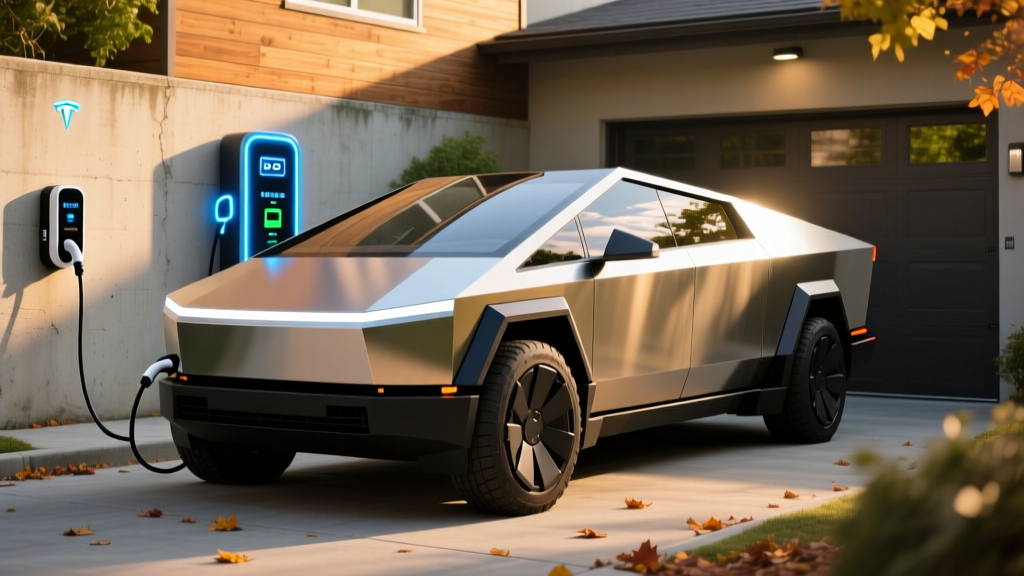
The Tesla Cybertruck's massive 123 kWh usable battery pack delivers class-leading range and towing capability, but that same enormous energy capacity means owners need a clear-eyed look at what charging actually looks like in practice. Whether you're plugging into a home Level 2 wall connector, topping up at a Supercharger, or relying on a standard 120V outlet in a pinch, understanding Cybertruck charge time across every scenario is essential before you take delivery.
This guide covers exact charge rates in kilowatts (kW — the power flowing into the truck), energy capacity in kilowatt-hours (kWh — the total energy the battery holds), real-world charging times from 10% to 80%, home installation requirements, equipment picks, and the true cost per mile compared to a gas truck. All figures reflect current 2026 production specs and Tesla's published data.
Cybertruck Battery and Charging Specs at a Glance
Before diving into charge times, here's the hardware you're working with. The Cybertruck uses an NMC (nickel manganese cobalt) lithium-ion architecture on an 800-volt-class platform, which enables faster DC charging than older 400V systems.
| Specification | AWD / Cyberbeast |
|---|---|
| Battery Capacity (usable) | ~123 kWh |
| Battery Chemistry | NMC (nickel manganese cobalt) |
| EPA Range (AWD) | 340 miles (est. with range extender) |
| EPA Range (base) | ~320 miles |
| Peak DC Fast Charge Rate | ~350 kW |
| Max Level 2 (AC) Charge Rate | 17.2 kW (48A onboard charger) |
| Charge Port / Connector | NACS (native Tesla) |
| Architecture Voltage | ~800V class |
Real-World Range Note: The EPA sticker says 320–340 miles depending on trim and the range-extender option. Expect roughly 260–290 miles in mixed highway driving at 70+ mph, and as low as 220–240 miles in cold weather (below 30°F) or while towing. The Cybertruck's large frontal area and weight (~6,600–6,800 lbs) hit efficiency hard at speed. Source: fueleconomy.gov.
Charging Levels Explained: kW, Miles Per Hour, and What They Mean
EV charging falls into three tiers. The critical distinction: kW (kilowatts) measures the rate of power delivery — how fast energy flows. kWh (kilowatt-hours) measures total energy stored — the size of the "tank." A higher kW number means faster charging, but the actual time depends on the battery's kWh capacity and the charge curve.
| Level | Voltage / Amps | Power (kW) | Miles of Range Added Per Hour | Best For |
|---|---|---|---|---|
| Level 1 (120V) | 120V / 12A | ~1.4 kW | ~3–4 mi/hr | Emergency / trickle |
| Level 2 (240V) | 240V / 40–48A | 9.6–11.5 kW | ~25–34 mi/hr | Daily home charging |
| Level 2 (240V max) | 240V / 48A (Cybertruck onboard) | Up to 17.2 kW* | ~44–50 mi/hr | Home with Wall Connector |
| DC Fast Charge | 400–800V DC | Up to ~350 kW (peak) | ~1,000+ mi/hr (at peak) | Road trips, rapid top-ups |
*The Cybertruck's onboard AC charger supports up to 17.2 kW, but only Tesla's Gen 3 Wall Connector on a 60A circuit delivers the full rate. Most home Level 2 setups on 40A or 48A circuits deliver 9.6–11.5 kW.
Cybertruck Charge Time: Level 1, Level 2, and DC Fast Scenarios
Here's where the Cybertruck's large battery cuts both ways. A 123 kWh pack gives you outstanding range but requires significantly more energy (and time) to refill than a smaller-battery EV like a Model 3 (57–75 kWh). These estimates assume a 10% to 80% state-of-charge (SoC) window, which is the practical charging range most owners use to preserve battery health.
Level 1 (120V / 1.4 kW)
At roughly 1.4 kW, adding 70% of the Cybertruck's battery (~86 kWh) takes approximately 61 hours. That's nearly three full days. Level 1 is only practical for maintaining charge or recovering a few miles overnight. If you drive 30 miles a day, Level 1 can barely keep up.
Level 2 (240V / 48A / 11.5 kW typical)
On a common 48-amp home circuit delivering 11.5 kW, a 10–80% charge takes roughly 7.5 hours. That's an overnight session — plug in at 10 PM, wake up at 6 AM with a full daily charge. This is the sweet spot for most Cybertruck owners.
Level 2 at Max Rate (240V / 60A circuit / 17.2 kW)
With a Tesla Wall Connector on a dedicated 60-amp breaker and the Cybertruck's full 17.2 kW onboard charger engaged, 10–80% drops to roughly 5 hours. This requires electrical panel headroom that many homes don't have (more on installation below).
DC Fast Charging (Supercharger V4, up to ~350 kW)
The Cybertruck's 800V-class architecture allows it to accept peak rates up to ~350 kW at compatible V4 Superchargers. However, peak rate is not sustained rate. The charge curve tapers significantly above 50–60% SoC to protect battery health.
- 10–80% DC fast charge: approximately 15–18 minutes at a V4 Supercharger
- 10–50% (peak rate window): approximately 8–10 minutes
- 15 minutes of charging can add roughly 185–200 miles of range under ideal conditions
At older V3 Superchargers (250 kW peak), expect 10–80% in roughly 20–25 minutes. The Cybertruck can also precondition its battery when you navigate to a Supercharger via the touchscreen, warming the pack to optimize charge acceptance — always use this feature for the fastest speeds.
Home Charger Installation: Electrical Requirements, Costs, and Panel Upgrades
Installing a Level 2 home charger for the Cybertruck isn't just about buying a wall unit — it's about whether your home's electrical panel can support the load. Here's the honest breakdown.
Electrical Requirements
- Circuit: Dedicated 240V circuit, 40A–60A depending on desired charge speed
- Breaker sizing: EV chargers are continuous loads under NEC code, meaning the breaker must be rated at 125% of the charger's max draw. A 48A charger requires a 60A breaker.
- Wire gauge: Typically 6 AWG copper for 40A circuits, 4 AWG for 60A (varies by run length and local code)
- Panel capacity: Your main panel must have enough spare amperage to add a 40–60A load. Many 100A panels in older homes cannot accommodate this without an upgrade.
Panel Upgrade: The Hidden Cost
If your home has a 100-amp main panel (common in homes built before the 1990s), adding a 60A EV circuit may require a panel upgrade to 200A. This is the single biggest variable in installation cost. A panel upgrade typically runs $1,500–$3,500 depending on your utility, local permitting, and whether a new meter or service drop is needed.
| Component | Cost Range | Notes |
|---|---|---|
| Level 2 Charger (Equipment) | $350–$700 | Tesla Wall Connector, ChargePoint, Emporia |
| Electrician Labor (standard install) | $500–$1,500 | Varies by run length, conduit, wall type |
| Electrical Permit | $50–$250 | Required in most jurisdictions |
| Panel Upgrade (if needed) | $1,500–$3,500 | 100A → 200A service upgrade |
| Total (no panel upgrade) | $900–$2,450 | Typical scenario for modern homes |
| Total (with panel upgrade) | $2,400–$5,950 | Older homes with 100A service |
Pro tip: Before hiring an electrician, check your panel's main breaker rating and count your existing breaker slots. Take a photo and send it to 2–3 licensed electricians for quotes. Many offer free estimates. Also check for utility rebates — some power companies offer $200–$500 toward smart charger installation or off-peak rate plans.
Connector Compatibility: NACS, CCS, and Adapters
The Cybertruck ships with a native NACS (North American Charging Standard) port — Tesla's proprietary connector, now adopted industry-wide. This means seamless access to Tesla's Supercharger network (17,000+ stalls in North America as of 2026) with no adapter needed.
| Connector Type | Cybertruck Compatibility | Notes |
|---|---|---|
| NACS (Tesla) | Native — no adapter | Superchargers, Tesla Wall Connector, destination chargers |
| CCS1 (Combined Charging System) | Adapter required | Tesla provides/sells a CCS adapter; needed for Electrify America, EVgo CCS stalls |
| CHAdeMO | Not supported | Largely deprecated in the US; no adapter available |
| J1772 (Level 2 AC) | Adapter required | Tesla includes a J1772-to-NACS adapter in most deliveries; needed for public Level 2 stations |
For home charging, the Tesla Wall Connector uses NACS natively. If you buy a third-party charger (ChargePoint, Emporia, Autel), it will likely have a J1772 connector — use the included J1772 adapter. Several manufacturers now offer NACS-terminated cables as well.
Cost to Charge: Cybertruck Per-Mile vs. Gas Truck
The Cybertruck's efficiency averages roughly 47–52 kWh per 100 miles (about 2.0–2.1 kWh/mi) in mixed driving, per fueleconomy.gov data. That's thirsty by EV standards — blame the 6,700-lb curb weight and brick-like aerodynamics — but electricity still costs far less per mile than gasoline.
| Charging Scenario | Rate ($/kWh) | Cost Per Mile | Full 0–100% Cost (~123 kWh) |
|---|---|---|---|
| Home (off-peak utility rate) | $0.10–$0.14 | $0.02–$0.03 | $12.30–$17.20 |
| Home (national avg. residential) | $0.17 | $0.034–$0.036 | $20.90 |
| Public Level 2 (ChargePoint, etc.) | $0.25–$0.40 | $0.05–$0.08 | $30.75–$49.20 |
| Tesla Supercharger (avg.) | $0.28–$0.36 | $0.056–$0.075 | $34.40–$44.30 |
| Gas truck (20 MPG, $3.50/gal) | — | $0.175 | $60.50 (equiv.) |
The takeaway: Charging at home on off-peak rates, the Cybertruck costs roughly $0.02–$0.035 per mile to fuel — about 5–6× cheaper than a comparable gas truck getting 17–20 MPG at $3.50/gallon. Even at Supercharger rates, you're paying roughly $0.06–$0.075/mi, still less than half the cost of gas. Over 15,000 miles/year, home charging saves $1,800–$2,200 annually versus gasoline.
Recommended Home Chargers for the Cybertruck
To unlock the Cybertruck's full 17.2 kW Level 2 capability, you need a charger that can deliver at least 48 amps on a 60A circuit. Here are three proven options:
Tesla Wall Connector (Gen 3)
- Power Output: Up to 11.5 kW (48A) on a 60A circuit
- Connector: NACS (native, no adapter needed)
- Cable Length: 24 ft
- Smart Features: Wi-Fi, OTA updates, load sharing with second unit, power-level adjustment via app
- Price: ~$475
- Why it works: The obvious first choice for any Tesla. Seamless integration, NACS-native, and reliable. Note: Gen 3 maxes at 48A/11.5 kW — it won't hit the Cybertruck's full 17.2 kW AC ceiling, but it covers overnight charging easily.
Emporia Vue / Emporia Level 2 EV Charger
- Power Output: Up to 11.5 kW (48A) on a 60A circuit
- Connector: J1772 (use Tesla's included adapter)
- Cable Length: 24 ft
- Smart Features: Energy monitoring, scheduling, solar integration, utility demand-response compatible
- Price: ~$399
- Why it works: Best value smart charger with excellent energy monitoring. Ideal if you have solar panels and want to charge only on excess production.
ChargePoint Home Flex (NACS version)
- Power Output: Up to 12 kW (50A) on a 60A circuit
- Connector: NACS (2025+ models available with native NACS cable)
- Cable Length: 23 ft
- Smart Features: App scheduling, Alexa integration, amperage adjustable via dip switch
- Price: ~$649
- Why it works: Flexible amperage settings (16A–50A) let you match your circuit exactly. Solid build quality and a NACS option means no adapter fumbling.
Safety, Code, and Installation Best Practices
A Level 2 EV charger is a continuous high-amperage load — it draws more sustained current than almost anything else in your home. Cutting corners here is a fire risk. Here's what proper installation requires:
- Dedicated circuit: The charger must be on its own breaker — no shared circuits with dryers, ovens, or HVAC.
- GFCI protection: NEC 2023 and later require GFCI protection for EV charging outlets. Hardwired installations (like the Tesla Wall Connector) may have different requirements depending on local code — your electrician will confirm.
- Outdoor rating: If installing outside, ensure the charger is NEMA 4 rated (weatherproof). The Tesla Wall Connector and ChargePoint Home Flex both carry outdoor ratings.
- Permit and inspection: Most jurisdictions require an electrical permit and post-installation inspection. Skipping this can void homeowner's insurance coverage for electrical fires.
- Wire sizing: Undersized wire causes voltage drop and heat. Your electrician must calculate wire gauge based on circuit amperage, run length, and ambient temperature.
- Load management: If your panel is near capacity, consider a smart load-management device (like the Emporia Vue with smart breaker panel integration) that throttles charger amperage when other high-draw appliances are running.
Frequently Asked Questions
How much does it cost to install a home EV charger for the Cybertruck?
A standard Level 2 installation (48A circuit, Tesla Wall Connector, no panel upgrade) typically costs $900–$2,450 including equipment, electrician labor, and permit. If your home needs a panel upgrade from 100A to 200A service, total costs can reach $2,400–$5,950. Always get 2–3 quotes from licensed electricians.
How fast will each charging level add range to the Cybertruck?
Level 1 (120V) adds roughly 3–4 miles per hour. Level 2 (240V / 48A) adds approximately 25–34 miles per hour. DC fast charging at a V4 Supercharger can add up to 200 miles in about 15 minutes at peak rate, though the charge curve tapers above 50–60% SoC.
Which connector and charger is compatible with the Cybertruck?
The Cybertruck uses a native NACS (Tesla) connector. It charges natively at all Tesla Superchargers and with the Tesla Wall Connector at home. For CCS-based public chargers (Electrify America, EVgo), you'll need Tesla's CCS adapter. For J1772 public Level 2 stations, use the J1772-to-NACS adapter included with most Cybertruck deliveries.
How much does charging the Cybertruck cost per mile vs. a gas truck?
At home off-peak rates ($0.10–$0.14/kWh), the Cybertruck costs roughly $0.02–$0.03 per mile. A comparable gas truck getting 18 MPG at $3.50/gallon costs about $0.175 per mile. That's a fuel savings of roughly $1,800–$2,200 per year at 15,000 miles driven. Even at Supercharger rates ($0.28–$0.36/kWh), the Cybertruck costs less than half what a gas truck does per mile.
What electrical upgrades might I need for a Cybertruck home charger?
You'll need a dedicated 240V circuit rated for 40–60 amps. Homes with 100A main panels often need a panel upgrade to 200A to accommodate this load safely — this is the single largest cost variable ($1,500–$3,500). Modern homes with 200A panels usually have sufficient headroom. A licensed electrician can perform a load calculation to determine your panel's spare capacity.
Does the Cybertruck charge faster than other large EVs?
The Cybertruck's ~350 kW peak DC rate and 800V-class architecture place it among the fastest-charging large EVs available. For comparison, the Ford F-150 Lightning peaks at ~150–190 kW (10–80% in roughly 40 minutes on older packs, ~25 minutes on extended-range models with newer hardware), and the Rivian R1T peaks around 220 kW. The Cybertruck's large battery means absolute charge time is still significant, but the rate per minute is competitive.
Should I charge to 100% regularly?
For daily use, Tesla recommends setting the charge limit to 80–90% to prolong NMC battery life. Charge to 100% only when you need the full range for a road trip. The Cybertruck's battery management system includes a top and bottom buffer to protect the cells, but habitual 100% charges accelerate long-term degradation. For long trips, time your 100% charge so you depart immediately rather than letting the truck sit at full SoC.