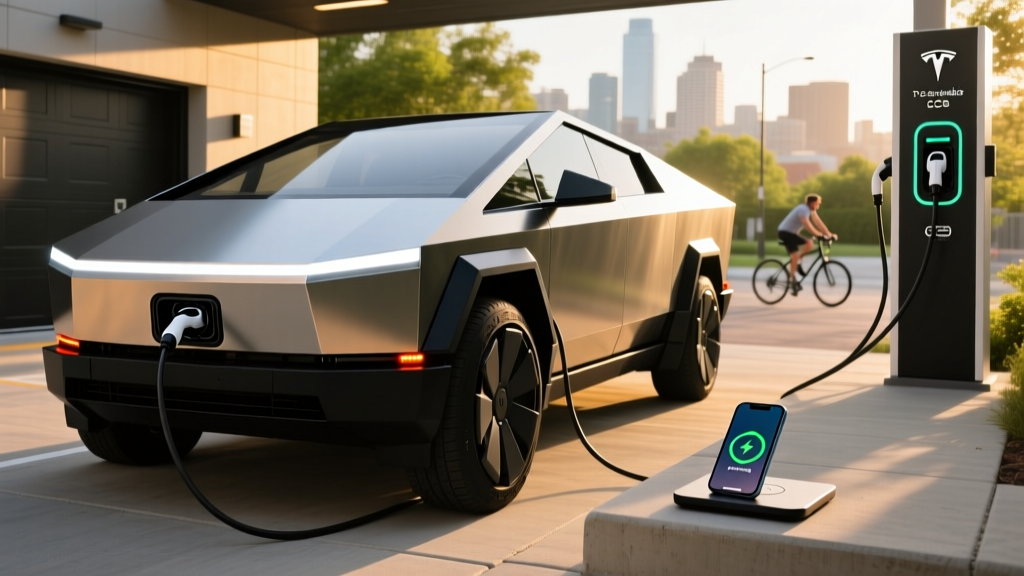
If you're reading this, there's a decent chance your Tesla Cybertruck is displaying an "AC charging unavailable" alert and you need answers fast. This error means the truck's onboard charger isn't accepting alternating current from a Level 1 (120V) or Level 2 (240V) source — whether that's your home wall connector, a destination charger, or a public Level 2 station. The good news: it's usually fixable without a service center visit.
Below, we'll walk through exactly what triggers this alert, how to resolve it, and then provide the full charging reference guide every Cybertruck owner needs — from home installation costs to real-world charging speeds and per-mile economics.
Why "AC Charging Unavailable" Appears on the Cybertruck
The Cybertruck uses a NACS (North American Charging Standard) connector and relies on an onboard AC-to-DC converter to accept Level 1 and Level 2 power. When the vehicle detects a fault in that pathway, it disables AC charging as a protective measure. Common triggers include:
- Software glitch after an OTA update — Tesla has acknowledged intermittent AC charging bugs in firmware builds throughout late 2025 and early 2026. A reboot often clears it.
- Charge port latch or sensor fault — debris, moisture, or a misaligned latch pin can prevent the truck from recognizing the cable.
- Ground fault or wiring issue at the charger — if the EVSE (Electric Vehicle Supply Equipment) reports a ground fault, the Cybertruck will refuse to accept current.
- Onboard charger hardware fault — rare, but the Cybertruck's dual onboard chargers (capable of accepting up to 19.2 kW combined on certain trims) can develop a fault requiring service.
Quick Fixes to Try First
- Perform a full vehicle reboot: Hold both scroll buttons on the steering wheel until the touchscreen goes black (~10 seconds). Wait for the Tesla logo to reappear, then retry charging.
- Inspect the charge port: Use your phone flashlight to check for debris, ice, or bent pins in the NACS inlet. Clean gently with compressed air.
- Try a different AC source: Plug into a known-working Level 2 station or a friend's Wall Connector. If AC charging works elsewhere, the fault is your home equipment — not the truck.
- Check your EVSE for error codes: Most smart chargers (Tesla Wall Connector, ChargePoint, Emporia) display LED patterns or app-based error codes. A ground-fault or over-temp code points to an electrical issue, not the vehicle.
- Reduce charge current in-app: In the Tesla app, slide the amperage down to 16A or 24A. If the Cybertruck begins charging at lower current, you likely have a wiring or breaker issue at the circuit.
If none of these steps resolve the alert, schedule service through the Tesla app. The Cybertruck's battery and drive unit carry an 8-year/120,000-mile warranty (with a minimum 70% capacity retention threshold), and onboard charger faults are typically covered.
Charging Levels Explained: Speeds, kW, and Miles Per Hour
Before you invest in home equipment or plan road trips, you need to understand the three charging levels and what each delivers to the Cybertruck's battery. The key distinction: kW (kilowatts) measures power — how fast energy flows into the battery. kWh (kilowatt-hours) measures energy — the battery's total capacity. Think of kW as the width of the hose and kWh as the size of the bucket.
The Cybertruck comes in multiple configurations. The AWD and Cyberbeast trims carry a ~123 kWh usable battery pack (estimated, based on EPA filings). Here's what each level delivers:
| Level | Voltage | Max Power (kW) | Miles of Range Added Per Hour | Best Use Case |
|---|---|---|---|---|
| Level 1 | 120V AC | ~1.4 kW | ~3–4 mi/hr | Overnight top-off, emergency |
| Level 2 | 240V AC | Up to 19.2 kW (dual onboard) | ~44–56 mi/hr at max rate | Home daily charging, workplaces |
| DC Fast Charge | 400V+ DC | Up to 250 kW (V3 Supercharger) | ~1,000+ mi/hr (peak) | Road trips, rapid top-ups |
Home Charger Installation: Electrical Requirements and Costs
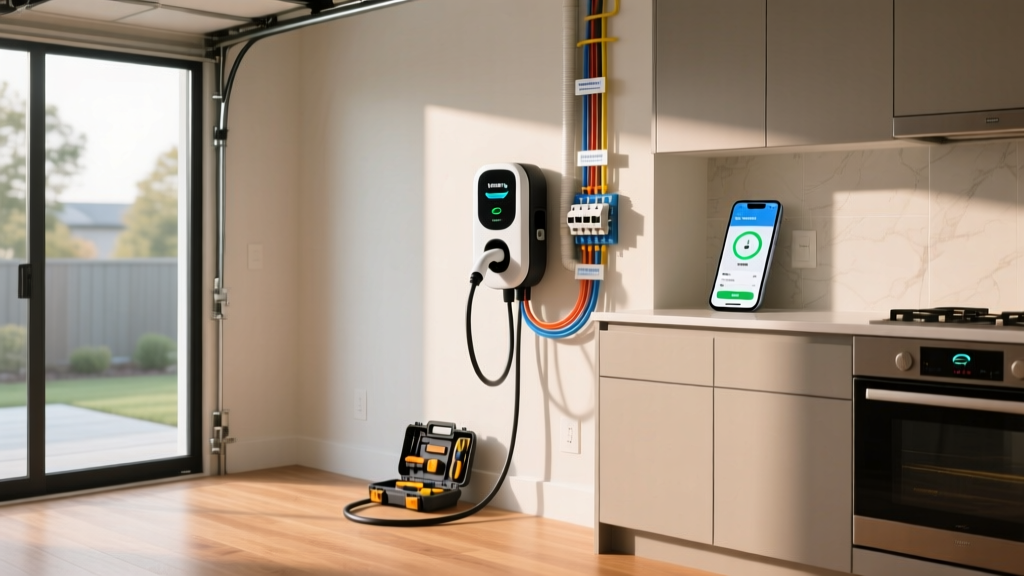
Charging a Cybertruck at home is the most cost-effective and convenient approach — but installation costs vary enormously depending on your home's electrical panel, the distance from the panel to your charging location, and local permit requirements.
Electrical Requirements
For a full-speed Level 2 home setup targeting the Cybertruck's 19.2 kW onboard charger capability, you need:
- Circuit: 100-amp dedicated breaker (for continuous 80A draw)
- Wire: 2 AWG copper or 1/0 AWG aluminum (varies by run length)
- Voltage: 240V split-phase (standard US residential)
- Alternative: A 60A circuit (48A continuous) delivering 11.5 kW is more common and sufficient for most Cybertruck owners who charge overnight. This requires a 60A breaker with 6 AWG copper wire.
Panel upgrade reality: Most homes built before 2000 have 100A or 150A main service panels. Adding an 80A EV circuit to a 150A panel that's already running central AC, an electric dryer, and an electric oven may exceed safe load calculations. An upgrade to a 200A panel costs $1,500–$3,000+ and is a common surprise cost. Always have a licensed electrician perform a load calculation before committing to a charger spec.
| Component | Cost Range | Notes |
|---|---|---|
| Level 2 EVSE equipment | $350–$750 | Smart chargers (Wi-Fi, scheduling) |
| Electrical labor (standard install) | $500–$1,500 | Short run, no panel upgrade |
| Electrical labor (long run/conduit) | $1,500–$3,500 | 50+ ft run, trenching, sub-panel |
| Panel upgrade (if needed) | $1,500–$3,000+ | 150A → 200A service upgrade |
| Permit and inspection | $100–$400 | Varies by municipality |
| Total (typical, no panel upgrade) | $950–$2,650 | Most common scenario |
| Total (with panel upgrade) | $2,450–$6,650 | Older homes with 100–150A panels |
The federal Alternative Fuel Vehicle Refueling Property Credit (IRS Form 8911) may cover up to 30% of home charging equipment and installation costs, capped at $1,000, subject to census-tract eligibility. Check irs.gov for current rules — eligibility depends on whether your home is in a qualifying non-urban or low-income census tract.
Connector Compatibility: NACS, CCS, and Adapters
The Cybertruck ships with a native NACS (J3400) charge port — the Tesla-designed connector now adopted as the industry standard by Ford, GM, Rivian, Hyundai, and most major automakers through 2025–2026. This means:
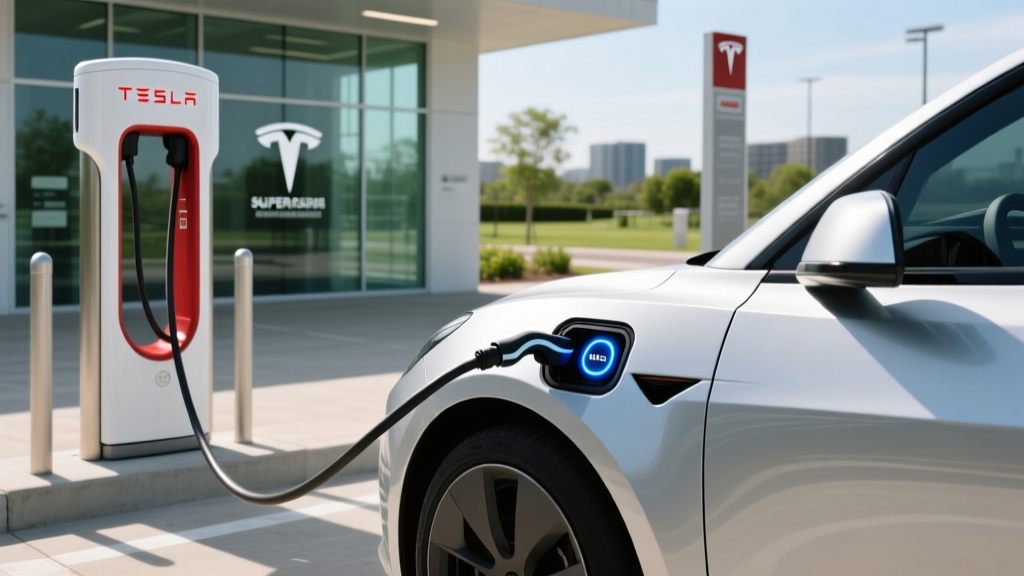
- Tesla Superchargers: Direct plug-in, no adapter needed. The Cybertruck accesses Tesla's full V3 (250 kW) and V4 Supercharger network.
- Non-Tesla DC fast chargers with NACS cables: Increasingly common as networks like Electrify America and EVgo add NACS connectors. Direct plug-in.
- CCS1 chargers: Require a NACS-to-CCS adapter. Tesla sells an official adapter (~$250). Essential for road-trip redundancy.
- CHAdeMO: Largely obsolete in North America. An adapter exists but is rarely worth the investment.
| Connector Standard | Native to Cybertruck? | Adapter Needed? | Network Examples |
|---|---|---|---|
| NACS (J3400) | Yes | No | Tesla Supercharger, Electrify America (NACS stalls) |
| CCS1 | No | Yes (NACS-to-CCS) | EVgo, Electrify America (legacy CCS stalls) |
| CHAdeMO | No | Yes (rare adapter) | Largely phased out |
| J1772 (Level 2 AC) | No | Yes (Tesla J1772 adapter, included) | Public Level 2, ChargePoint, workplaces |
Your Cybertruck ships with a J1772-to-NACS adapter in the glovebox or frunk. This allows you to use any public Level 2 charger with a J1772 connector — which still represents the majority of public Level 2 infrastructure in 2026. Keep it in the truck at all times.
Charging Cost Per Mile: Cybertruck vs. Gas Trucks
The Cybertruck's efficiency varies by trim and driving conditions. The AWD model achieves approximately 2.0–2.4 kWh/mile (roughly 58–70 MPGe combined per fueleconomy.gov). The heavier Cyberbeast, with its tri-motor setup and performance tires, sits closer to 2.3–2.6 kWh/mile. Real-world highway driving at 75+ mph and cold-weather conditions push consumption higher — plan for 2.5–2.8 kWh/mile in worst-case scenarios.
| Scenario | Cost per kWh / Gallon | Cybertruck Cost/Mile | Gas Truck (18 MPG) Cost/Mile |
|---|---|---|---|
| Home charging (off-peak utility rate) | $0.13/kWh | $0.29 | $0.20 (at $3.60/gal) |
| Home charging (peak/utility avg) | $0.22/kWh | $0.48 | $0.20 |
| Public Level 2 (network pricing) | $0.35/kWh | $0.77 | $0.20 |
| DC Fast Charge (Supercharger avg) | $0.38/kWh | $0.84 | $0.20 |
| DC Fast Charge (peak pricing) | $0.55/kWh | $1.21 | $0.20 |
Recommended Level 2 Chargers for the Cybertruck
Given the Cybertruck's large battery (~123 kWh usable), you want a Level 2 charger that delivers meaningful overnight range recovery. Here are top picks based on real-world reliability, smart features, and value:
Tesla Wall Connector (Gen 3)
Power: Up to 11.5 kW (48A on 60A circuit) or 19.2 kW (80A on 100A circuit, hardware-dependent)
Connector: Native NACS — no adapter needed
Cable: 24 ft
Smart features: Wi-Fi, OTA updates, load sharing between multiple units, power-sharing
Price: ~$475
Verdict: Best for Tesla-only households. Seamless integration, cleanest install.
Emporia Vue Smart EV Charger
Power: Up to 11.5 kW (48A)
Connector: J1772 (use included Tesla adapter) or NACS version available
Cable: 24 ft
Smart features: Energy monitoring, solar integration, time-of-use scheduling, load management
Price: ~$399
Verdict: Best value for solar homes. Excellent energy dashboard.
ChargePoint Home Flex
Power: Up to 12 kW (50A on 60A circuit), configurable down to 16A
Connector: J1772 (NACS adapter required)
Cable: 23 ft
Smart features: Alexa integration, scheduling, charging history, flexible amperage
Price: ~$699
Verdict: Best for multi-EV households with mixed connectors. Highly configurable.
Safety and Electrical Code Considerations
EV charging is a high-draw, continuous electrical load — the National Electrical Code (NEC) classifies it as a continuous load, meaning the circuit must be rated for 125% of the actual draw. A 48A charger requires a 60A breaker. An 80A charger requires a 100A breaker. Never undersize the circuit.
- Dedicated circuit: Your EV charger must have its own dedicated breaker — never share a circuit with other appliances.
- GFCI protection: NEC 2020 and later require GFCI (Ground Fault Circuit Interrupter) protection for outdoor receptacles used for EV charging. Hardwired EVSE units often have built-in GFCI, but outdoor NEMA 14-50 outlets require a GFCI breaker (~$50–$80 extra).
- Outdoor rating: If your charger is installed outside, both the EVSE and any conduit/wiring must carry a NEMA 4 or NEMA 4X rating for weather resistance.
- Permit required: Virtually all jurisdictions require an electrical permit for EV charger installation. The inspection ensures the work meets NEC code and protects your homeowner's insurance coverage. Unpermitted work can void claims in the event of an electrical fire.
- Hardwired vs. plug: Hardwired installations (directly connected to the panel, no outlet) are generally preferred for 60A+ circuits. NEMA 14-50 outlets are convenient for portability but are a known failure point if low-quality receptacles are used — specify a Hubbell or Bryant industrial-grade 14-50 receptacle if going the plug-in route.
Cybertruck Charging Times: What to Expect
Here are realistic charging times for the Cybertruck AWD (~123 kWh usable) across common scenarios:
| Charging Method | Power | 10–80% Time | Notes |
|---|---|---|---|
| 120V Level 1 (standard outlet) | 1.4 kW | ~52+ hours | Emergency/trickle only |
| 240V Level 2 (32A / 7.7 kW) | 7.7 kW | ~11 hours | Common dryer-outlet adapter |
| 240V Level 2 (48A / 11.5 kW) | 11.5 kW | ~7.5 hours | Standard Wall Connector on 60A circuit |
| 240V Level 2 (80A / 19.2 kW) | 19.2 kW | ~4.5 hours | Requires 100A circuit + dual onboard charger |
| Tesla V3 Supercharger (DC) | Up to 250 kW | ~35–40 min | Curve tapers significantly above 50% |
| Tesla V4 Supercharger (DC) | Up to 350 kW* | ~25–30 min* | *Cybertruck acceptance rate may be limited to 250 kW |
Frequently Asked Questions
How much does it cost to install a home EV charger for the Cybertruck?
A typical Level 2 home installation with no panel upgrade runs $950–$2,650, including the EVSE ($350–$750), electrician labor ($500–$1,500 for a standard short run), and permit fees ($100–$400). If your home needs a 200A panel upgrade, add $1,500–$3,000+. The IRS Alternative Fuel Refueling credit may offset up to $1,000 of this cost if your census tract qualifies.
How fast will each charging level add range to the Cybertruck?
Level 1 (120V) adds roughly 3–4 miles per hour. Level 2 (240V) at 11.5 kW adds approximately 30–35 miles per hour. DC fast charging at a V3 Supercharger can add up to ~200 miles in 15 minutes at peak rate, but the full 10–80% session takes 35–40 minutes due to charge-curve taper.
Which connector and charger is compatible with my Cybertruck?
The Cybertruck uses a native NACS connector. It plugs directly into Tesla Superchargers and any NACS-equipped Level 2 or DC fast charger. For CCS1 stations, you'll need a NACS-to-CCS adapter. For J1772 public Level 2 chargers, use the J1772-to-NACS adapter included with your truck.
How much does charging the Cybertruck cost per mile compared to a gas truck?
At home on off-peak electricity ($0.13/kWh), the Cybertruck costs roughly $0.29/mile — competitive with a gas truck getting 18 MPG at $3.60/gallon ($0.20/mile). However, DC fast charging at $0.38–$0.55/kWh pushes costs to $0.84–$1.21/mile, making home charging essential for cost savings.
What electrical upgrades might I need for a home charger?
Homes with 100A or 150A main panels may need a service upgrade to 200A ($1,500–$3,000+) to support a 60A or 100A dedicated EV circuit. Your electrician will perform a NEC Article 220 load calculation to determine if your existing panel can handle the additional draw. Older wiring, insufficient grounding, or aluminum service conductors may also require upgrades.
What do I do if my Cybertruck still says "AC charging unavailable" after trying fixes?
If reboots, port inspection, and testing alternate chargers don't resolve the alert, schedule a mobile service visit or service center appointment through the Tesla app. The issue may be a faulty onboard charger module or charge port assembly — both covered under the 8-year/120,000-mile battery and drive unit warranty. In the meantime, DC fast charging (Superchargers) typically remains functional since it bypasses the onboard AC charger entirely.