When a municipality issues a public solicitation for EV charging infrastructure — like the Crafton Boulevard streetscape and EV charger solicitation referenced on questcdn.com — it signals a community's commitment to electrified transportation. But whether you're a resident evaluating how new public chargers fit into your daily routine, a contractor bidding on the project, or a local business owner weighing the impact, understanding the technical and financial realities of EV charging is essential.
This guide breaks down everything you need to know about public and home EV charging in 2026: charging speeds, connector standards, installation costs, and the real per-mile economics compared to gasoline.
Understanding EV Charging Levels: Speeds That Matter
EV charging is measured in kW (kilowatts), which represents the rate of power delivery — think of it as the width of a hose. The energy stored in your battery is measured in kWh (kilowatt-hours) — the total volume of the tank. Confusing these two is the most common EV literacy mistake. A 10 kW charger delivers 10 kWh of energy in one hour under ideal conditions.
| Level | Voltage | Power (kW) | Miles of Range Added per Hour | Typical Use Case |
|---|---|---|---|---|
| Level 1 | 120V AC | 1.0–1.4 kW | 3–5 mi/hr | Overnight top-up, PHEVs, emergency |
| Level 2 | 240V AC | 3.3–19.2 kW | 12–75 mi/hr | Home daily charging, workplace, retail |
| DC Fast (Level 3) | 400–800V DC | 50–350 kW | 150–1,200+ mi/hr (peak) | Road trips, highway corridors, public hubs |
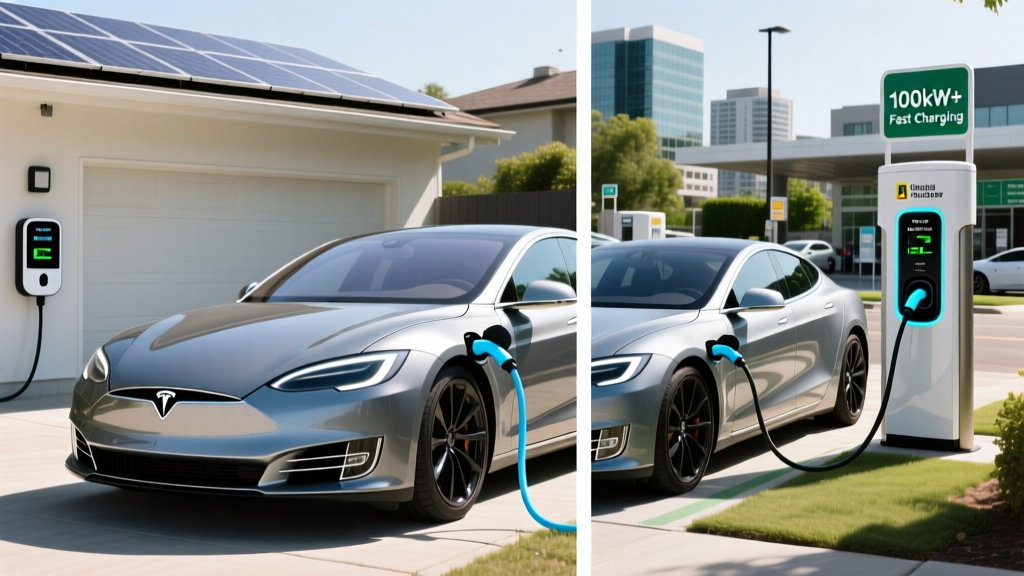
For context, a typical 75 kWh battery (like the one in a 2026 Tesla Model Y Long Range) charged on a Level 1 outlet would take roughly 60+ hours from empty. That same battery on a 48-amp Level 2 home charger (11.5 kW) fills in about 7 hours. On a 250 kW DC fast charger, you can go from 10–80% in roughly 20–25 minutes, depending on the vehicle's charge curve.
Public Charging Infrastructure: What the Crafton Boulevard Solicitation Means
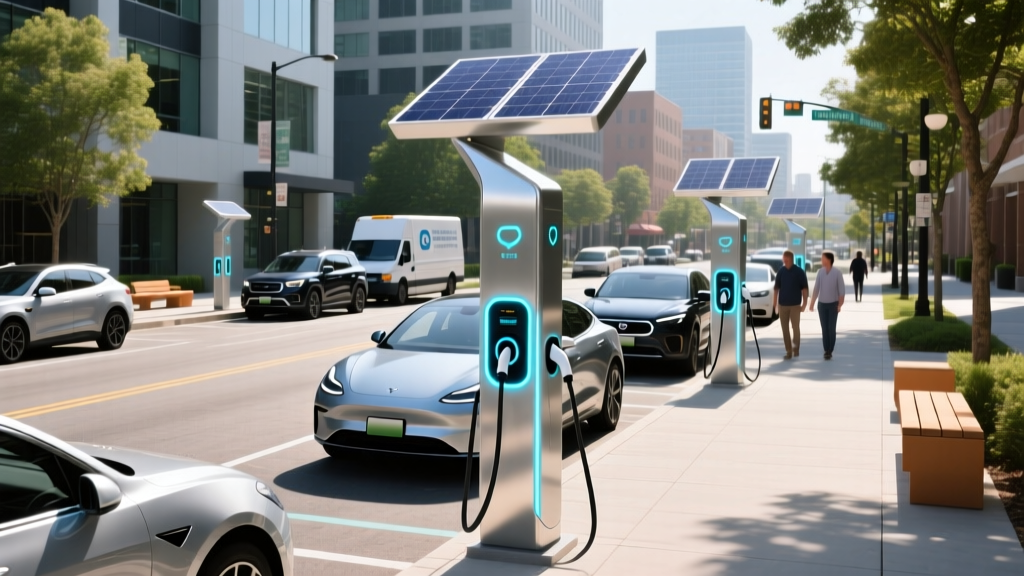
Municipal EV charger solicitations typically specify the number of ports, power levels, connector types, and site requirements. Projects listed on platforms like questcdn.com often involve a mix of Level 2 destination chargers (for streetscape parking) and DC fast chargers (for quick-turnover corridors).
For residents and visitors, a streetscape charging deployment means:
- Level 2 curbside chargers (7–19 kW): Ideal for 2–4 hour parking sessions, adding 25–75 miles of range. Well-suited for shopping, dining, or work commutes.
- DC fast chargers (50–150+ kW): Placed for 20–40 minute sessions, adding 100–250+ miles. These serve through-traffic and residents without home charging access.
- Networked vs. non-networked: Most public solicitations in 2026 require networked chargers (ChargePoint, EVgo, Electrify America, or Blink) for payment processing, uptime monitoring, and DOPE-compliant reporting if federal funds are involved.
Connector Compatibility: NACS, CCS1, and CHAdeMO in 2026
The connector landscape has consolidated significantly. As of 2026, the North American Charging Standard (NACS) — originally developed by Tesla — is the dominant connector for new EVs sold in North America. Most legacy CCS1 vehicles can access NACS chargers via adapter, and CHAdeMO is effectively legacy-only (primarily older Nissan Leaf models).
| Brand | Native Connector | Adapter Needed for NACS Superchargers? | Adapter Needed for CCS1? |
|---|---|---|---|
| Tesla (all models) | NACS | No | Yes (Tesla CCS adapter, ~$175) |
| Ford (F-150 Lightning, Mustang Mach-E) | NACS (2025+) | No | Legacy CCS adapter included |
| GM (Chevy Equinox EV, Blazer EV, Cadillac Lyriq) | NACS (2025+) | No | Aftermarket adapter available |
| Hyundai/Kia (Ioniq 5/6, EV6/9) | CCS1 | Yes (manufacturer adapter, often included) | No |
| Volkswagen (ID.4, ID.7) | CCS1 | Yes (VW NACS adapter available) | No |
| Rivian (R1T, R1S) | NACS | No | Yes (Rivian CCS adapter included) |
| Nissan (Leaf, Ariya) | CHAdeMO (Leaf) / CCS1 (Ariya) | Yes (for Ariya via adapter) | No (Ariya) |
| BMW (i4, i5, iX) | CCS1 | Yes (BMW NACS adapter) | No |
Key takeaway for public charger planning: Any 2026 streetscape solicitation should include dual-connector stations (NACS + CCS1) or NACS-only with clearly posted CCS1 adapter guidance. CHAdeMO is increasingly unnecessary for new deployments.
Home Level 2 Charger Installation: Costs and Electrical Requirements
Most EV owners do 80%+ of their charging at home. A Level 2 home charger is the single highest-impact upgrade for daily EV ownership. Here's what's involved:
Electrical Requirements
- Circuit: Dedicated 240V circuit, typically 40A or 60A breaker
- Charger amperage: A 48A charger requires a 60A breaker (NEC requires 125% headroom for continuous loads)
- Wire gauge: 6 AWG copper for 48A; 4 AWG for 60A circuits
- Panel capacity: Your main electrical panel must have sufficient spare capacity — typically 200A service for modern homes with a 48A EV charger
Do You Need a Panel Upgrade?
Homes with 100A service or older panels (common in pre-1990 construction) often need a panel upgrade to 200A before adding a high-amperage EV charger. This is the single biggest variable in installation cost. A panel upgrade alone can run $1,500–$4,000. Some homeowners opt for a lower-amperage charger (32A on a 40A breaker) to avoid the upgrade, which still delivers ~25 miles of range per hour — sufficient for most daily driving.
| Component | Cost Range | Notes |
|---|---|---|
| Level 2 Charger Equipment | $300–$750 | Smart Wi-Fi chargers (ChargePoint, Emporia, Wallbox) |
| Electrician Labor (standard install) | $500–$1,500 | Varies by run length, wall type, conduit needs |
| Permit & Inspection | $50–$300 | Required by most jurisdictions; varies by municipality |
| Electrical Panel Upgrade (if needed) | $1,500–$4,000 | 100A → 200A upgrade; not always required |
| Total (no panel upgrade) | $850–$2,550 | Typical for homes with 200A service |
| Total (with panel upgrade) | $2,350–$6,550 | Older homes or high-amperage setups |
Always hire a licensed electrician and pull a permit. Unpermitted EV charger installations can void homeowner's insurance and create fire-risk liability. The National Electrical Code (NEC) Article 625 governs EV charging equipment installation.
Real Charging Costs: Home vs. Public vs. Gasoline
The economic case for EV charging hinges on where you charge. Here's how the numbers work in 2026:
| Scenario | Rate | Cost per Mile (at 3.5 mi/kWh or 28 MPG) |
|---|---|---|
| Home Off-Peak (utility time-of-use) | $0.08–$0.12/kWh | $0.023–$0.034/mile |
| Home Standard Rate | $0.13–$0.18/kWh | $0.037–$0.051/mile |
| Public Level 2 (networked) | $0.25–$0.49/kWh | $0.071–$0.14/mile |
| DC Fast Charging (public) | $0.35–$0.69/kWh | $0.10–$0.20/mile |
| Gasoline (28 MPG avg sedan) | $3.20/gallon | $0.114/mile |
The bottom line: Home-charged EVs cost roughly one-third to one-half per mile compared to gasoline. Even DC fast charging is competitive with gas on a per-mile basis, though frequent DC fast charging accelerates battery degradation slightly and costs more than home charging.
For a driver covering 12,000 miles per year, home charging at $0.14/kWh costs approximately $480 annually. The equivalent gasoline cost at $3.20/gal and 28 MPG is $1,371 — a savings of roughly $891 per year with an EV.
Charging Time Examples: What to Expect with Common Battery Sizes
Charge times vary by battery size, charger power, and the vehicle's charge curve. EVs charge fastest between 10–80% State of Charge (SoC); above 80%, the battery management system throttles power to protect cell health — this is called the charge curve taper.
- 60 kWh battery (e.g., 2026 Chevy Equinox EV):
- Level 2 at 11.5 kW: ~5.2 hours (0–100%)
- DC fast at 150 kW peak: 10–80% in ~22 minutes
- 82 kWh battery (e.g., 2026 Tesla Model Y Long Range):
- Level 2 at 11.5 kW: ~7.1 hours (0–100%)
- DC fast at 250 kW peak: 10–80% in ~18 minutes
- 100 kWh battery (e.g., 2026 Ford F-150 Lightning Extended Range):
- Level 2 at 11.5 kW: ~8.7 hours (0–100%)
- DC fast at 150 kW peak: 10–80% in ~35 minutes
Peak kW ratings are not sustained rates. A charger rated at 250 kW may only deliver that rate for a narrow SoC window (typically 10–30%), then taper. Always evaluate charging by the 10–80% time, not the peak kW number.
Recommended Home Level 2 Chargers for 2026
Emporia Vue 2 + EV Charger
- Power: 48A (11.5 kW on 240V)
- Connector: NACS (J1772 adapter included)
- Cable Length: 24 ft
- Smart Features: Wi-Fi, solar integration, energy monitoring, scheduling via app
- Price: ~$399
- Best For: Solar-equipped homes, budget-conscious buyers
ChargePoint Home Flex
- Power: Up to 50A (12 kW, configurable 16–50A)
- Connector: NACS (J1772 version also available)
- Cable Length: 23 ft
- Smart Features: Wi-Fi, Alexa integration, amperage flexibility, ChargePoint network
- Price: ~$549
- Best For: Flexibility across panel capacities, network ecosystem
Tesla Wall Connector
- Power: 48A (11.5 kW on 240V)
- Connector: NACS native (J1772 adapter sold separately)
- Cable Length: 24 ft
- Smart Features: Wi-Fi, power sharing (multiple units on one circuit), OTA updates
- Price: ~$450
- Best For: Tesla owners, multi-EV households
Wallbox Pulsar Plus
- Power: 40A (9.6 kW on 240V)
- Connector: J1772 (NACS adapter available)
- Cable Length: 25 ft
- Smart Features: Wi-Fi + Bluetooth, load balancing, compact form factor
- Price: ~$449
- Best For: Tight spaces, CCS1-native vehicles
Safety, Code, and Installation Best Practices
EV chargers draw sustained high current — often for 6–8 hours straight. This is classified as a continuous load under the NEC, requiring specific safety measures:
- Dedicated circuit: Your EV charger must be on its own dedicated breaker — never shared with other appliances.
- GFCI protection: NEC 2023 (and carried into 2026 code cycles) requires GFCI protection for all 240V EV charging outlets rated 60A or less. Hardwired chargers with built-in ground-fault protection may satisfy this requirement.
- Outdoor rating: If mounted outdoors, the charger must carry a NEMA 4 (or higher) weatherproof rating. All recommended chargers above meet this standard.
- Conduit and wiring: Outdoor runs require proper conduit (typically EMT or PVC). Wire gauge must match the breaker rating with NEC-compliant derating for temperature and bundling.
- Smart load management: Some panels are near capacity. Smart chargers with load-balancing features (like the Emporia or Wallbox) can dynamically adjust charge rate to prevent panel overload — potentially avoiding a costly panel upgrade.
For public installations like a streetscape project, additional requirements apply: ADA accessibility, Americans with Disabilities Act compliance for cord management and payment interfaces, UL listing (UL 2594 for EVSE), and often Buy America compliance if federal infrastructure funds (NEVI program) are involved.
Frequently Asked Questions
How much does it cost to install a home EV charger?
A typical Level 2 home charger installation costs $850–$2,550 when no panel upgrade is needed (equipment + electrician + permit). If your home requires a 100A-to-200A panel upgrade, total costs range from $2,350–$6,550. The charger unit itself runs $300–$750 for quality smart models.
How fast will each charging level add range?
Level 1 (120V) adds 3–5 miles per hour. Level 2 (240V, 48A) adds roughly 35–45 miles per hour for most EVs. DC fast charging at 150+ kW can add 150–300+ miles in a 20–30 minute session, though the rate tapers significantly above 80% SoC.
Which connector/charger is compatible with my EV?
In 2026, most new EVs use NACS (Tesla, Ford, GM, Rivian). Hyundai, Kia, VW, and BMW still use CCS1 but offer NACS adapters. Check your vehicle's charge port — if it's the smaller Tesla-style connector, you need NACS-compatible equipment. If it's the larger oval CCS1 connector, you need CCS1 or a NACS-to-CCS adapter. Consult your owner's manual or the EPA's fueleconomy.gov EV database for your specific model.
How much does charging cost per mile vs. gas?
Home-charged EVs cost $0.02–$0.05 per mile (depending on your electricity rate and vehicle efficiency). Gasoline at $3.20/gallon and 28 MPG costs $0.114/mile. Even public DC fast charging at $0.50/kWh costs roughly $0.14/mile — competitive with gas and significantly cheaper when you charge at home.
What electrical upgrades might I need?
The most common upgrade is a panel capacity increase from 100A to 200A service ($1,500–$4,000). You may also need a new dedicated 240V circuit with appropriate breaker and wire gauge. Homes with modern 200A panels and spare breaker slots typically need no panel upgrade — just the new circuit run from panel to charger location. A licensed electrician can assess your panel's spare capacity during a site visit.