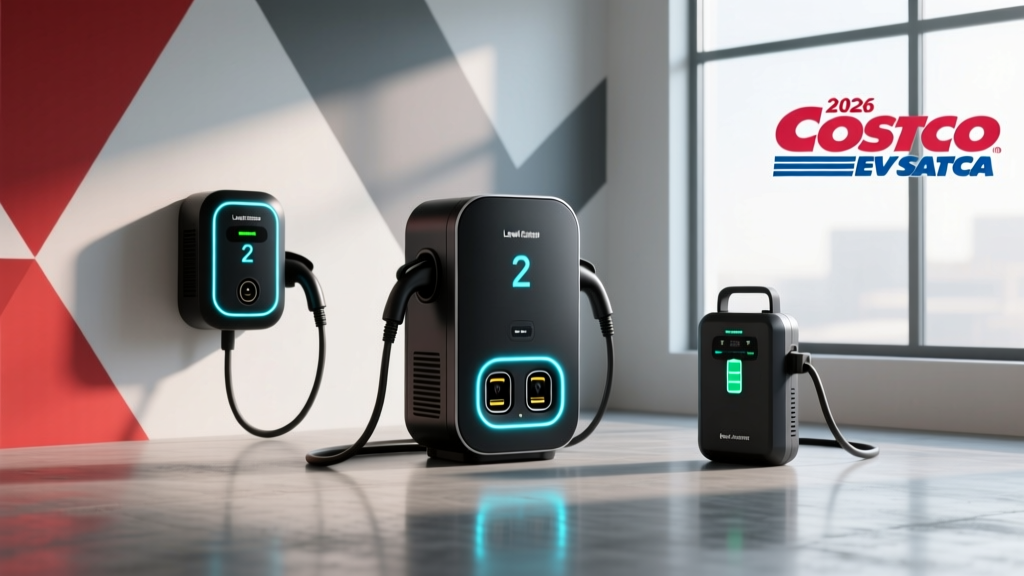
If you've wandered the automotive aisle at Costco or browsed Costco.com searching for a home EV charger, you've likely noticed the selection is curated rather than exhaustive. That's actually a feature, not a bug — Costco tends to stock proven, well-reviewed Level 2 chargers at competitive prices, often bundled with member-only perks like extended warranties or installation service discounts. But which Costco EV charger options actually make sense for your specific vehicle, electrical panel, and daily driving routine?
This guide dissects the Level 2 chargers you're most likely to find at Costco (in-warehouse and online), maps them to real-world charging speeds for popular 2026 EVs, and walks through the full cost of getting one installed at home — including the panel-upgrade scenarios that catch many buyers off guard.
Understanding Charging Levels: What You're Actually Buying
Before evaluating any specific charger, you need clarity on the three charging tiers. The single most common EV mistake is confusing kW (kilowatts — the rate of power delivery, like water pressure from a hose) with kWh (kilowatt-hours — the total energy stored in your battery, like gallons in a tank). A charger's kW rating tells you how fast it can push energy; your battery's kWh capacity tells you how much it holds.
| Level | Voltage | Max Power (kW) | Miles of Range Added Per Hour | Typical Use Case |
|---|---|---|---|---|
| Level 1 | 120V AC | 1.2–1.9 kW | 3–5 miles | Overnight trickle; PHEV top-ups |
| Level 2 | 240V AC | 7.2–19.2 kW | 20–60 miles | Daily home charging; workplace |
| DC Fast Charge | 400–800V DC | 50–350 kW | 150–300+ miles (in 20 min) | Road trips; highway corridors |
Every charger sold at Costco falls into the Level 2 category. These units require a dedicated 240V circuit — the same type of outlet your electric dryer or oven uses — and they're the sweet spot for overnight home charging. A typical 75 kWh battery (think Tesla Model Y or Hyundai Ioniq 5) will fully replenish from near-empty in 8–10 hours on a 7.2 kW Level 2 unit, or 4–5 hours on a 19.2 kW unit.
Costco EV Charger Options: What's on the Shelf
Costco's charger inventory rotates seasonally and varies between warehouse locations and Costco.com. Based on recurring stock through early 2026, here are the models you're most likely to encounter, with the exact specs that matter:
ChargePoint Home Flex (Costco.com recurring stock)
- Power output: Up to 12 kW (50A) on a 60A circuit; adjustable down to 16A (3.8 kW) for panel-limited homes
- Connector: J1772 (NACS adapter included with 2025+ shipments; Tesla vehicles plug in directly via NACS on newest units)
- Cable length: 23 feet
- Smart features: Wi-Fi, ChargePoint app scheduling, Alexa/Google Home integration, energy-use tracking
- Typical Costco price: $649–$699 (vs. $699–$749 MSRP elsewhere)
- Indoor/outdoor rating: NEMA 4 (weatherproof for outdoor mounting)
Emporia Level 2 EV Charger (Costco.com)
- Power output: Up to 11.5 kW (48A) on a 60A circuit
- Connector: J1772 (NACS adapter available separately; ~$99)
- Cable length: 24 feet
- Smart features: Wi-Fi, Emporia app, solar-integration capability (pairs with Emporia Vue energy monitor for solar-excess charging), time-of-use scheduling
- Typical Costco price: $349–$399
- Indoor/outdoor rating: NEMA 4
Wallbox Pulsar Plus (Periodic Costco.com availability)
- Power output: Up to 11.5 kW (48A)
- Connector: J1772 (NACS version available for 2026 shipments)
- Cable length: 25 feet
- Smart features: Wi-Fi + Bluetooth, Wallbox app, Power Sharing (load-balances with home panel), scheduled charging
- Typical Costco price: $549–$599
- Indoor/outdoor rating: NEMA 4
Important note on connectors: As of 2025, Tesla opened its Supercharger network to non-Tesla EVs via the North American Charging Standard (NACS). Most automakers — Ford, GM, Rivian, Volvo, Polestar, and others — have switched to NACS ports on 2025–2026 models. If your EV still has a CCS1 port (common on 2023–2024 Hyundai, Kia, and Volkswagen models), you'll need a CCS1-to-NACS adapter ($100–$250 depending on source) to use Tesla Superchargers. For home Level 2 charging, J1772 plugs work on all non-Tesla EVs; Tesla owners use the Tesla Mobile Connector or a J1772-to-Tesla adapter (usually included with the car).
| Brand | Charge Port | Home Level 2 Plug Needed | DC Fast Charging |
|---|---|---|---|
| Tesla (all models) | NACS | NACS or J1772 + adapter | NACS (Supercharger) |
| Ford (2025+ EVs) | NACS | NACS or J1772 + adapter | NACS + CCS via adapter |
| GM (2025+ EVs) | NACS | NACS or J1772 + adapter | NACS + CCS via adapter |
| Hyundai / Kia (2025+) | CCS1 (NACS on 2026+) | J1772 | CCS1 (NACS adapter avail.) |
| Volkswagen (ID.4) | CCS1 | J1772 | CCS1 |
| Rivian (2025+) | NACS | NACS or J1772 + adapter | NACS + CCS adapter |
| BMW / Mercedes / Toyota bZ | CCS1 | J1772 | CCS1 |
| Nissan LEAF | CHAdeMO | J1772 | CHAdeMO (declining network) |
How Much Does It Cost to Install a Home EV Charger?
The charger itself is only part of the equation. Professional installation by a licensed electrician is where costs diverge dramatically based on your home's age, panel capacity, and the distance between your electrical panel and the charger mounting location. Here's a realistic breakdown based on 2026 national averages:
| Component | Simple Install (panel near garage) | Moderate Install (50–80 ft run) | Complex Install (panel upgrade + long run) |
|---|---|---|---|
| Charger unit (Costco) | $350–$700 | $350–$700 | $350–$700 |
| Electrician labor (2–8 hrs @ $100–$175/hr) | $200–$400 | $500–$1,000 | $1,200–$2,500 |
| Materials (conduit, wire, breaker) | $50–$150 | $150–$400 | $300–$800 |
| Permit & inspection | $50–$150 | $50–$200 | $100–$300 |
| Electrical panel upgrade (100A → 200A, if needed) | $0 | $0 | $1,500–$3,500 |
| Total estimated cost | $650–$1,400 | $1,050–$2,300 | $3,450–$7,800 |
When Do You Need a Panel Upgrade?
This is the budget-wrecker that most online guides gloss over. Here's the rule: a Level 2 charger drawing 40–48 amps requires a dedicated 50–60 amp breaker. Electrical code (NEC Article 220) requires that your total calculated load — including the charger — must not exceed 80% of your panel's rated capacity. If you have a 100-amp panel (common in homes built before 1990), you're likely already near capacity with HVAC, water heater, kitchen appliances, and lighting. Adding a 48A EV circuit will push you over.
The practical test: Look at your panel's main breaker. If it says 100A, get a load calculation from an electrician before buying a charger. If it says 200A, you're almost certainly fine. If it says 150A, you're in the gray zone — an electrician's load calc will determine whether you can add 40A or need to step down to a 32A (7.7 kW) charger on a 40A breaker.
Costco has periodically offered panel-upgrade bundles through partnerships with electrical contractors (check Costco Services online), which can save $500–$1,000 vs. sourcing independently.
Real-World Charging Times: What to Expect
Manufacturer claims of "X hours to full charge" assume ideal conditions: a battery preconditioned to optimal temperature, a sustained peak charge rate, and charging from 0% to 100%. In practice, you'll mostly charge from 20–80% (the daily-use window that also preserves battery health), and charge rates taper significantly above 80% to protect the cells.
Here are realistic 10–80% home charging times for popular 2026 EVs on the chargers commonly available at Costco:
| Vehicle (Battery kWh) | 7.2 kW Charger (32A) | 11.5 kW Charger (48A) | 19.2 kW Charger (80A)* |
|---|---|---|---|
| Tesla Model Y (75 kWh usable) | ~7.3 hours | ~4.6 hours | ~2.7 hours |
| Ford Mustang Mach-E (91 kWh usable) | ~8.8 hours | ~5.5 hours | ~3.3 hours |
| Hyundai Ioniq 5 (77.4 kWh usable) | ~7.5 hours | ~4.7 hours | ~2.8 hours |
| Chevrolet Equinox EV (85 kWh usable) | ~8.2 hours | ~5.2 hours | ~3.1 hours |
| Toyota bZ4X (71.4 kWh usable) | ~6.9 hours | ~4.4 hours | ~2.6 hours |
*19.2 kW chargers require an 80A–100A dedicated circuit and are rarely available through Costco. They're typically commercial-grade units (e.g., ChargePoint CT4000 series or Tesla Wall Connector at max config) and demand a 200A+ panel.
The overnight reality: For 90%+ of EV owners, a 7.2–11.5 kW Level 2 charger is ideal. Plug in at 10 PM, wake up at 7 AM — that's 9 hours, enough to add 180–400 miles of range depending on the charger and vehicle. Unless you're driving 200+ miles daily, you'll never need more.
Charging Cost Per Mile: EV vs. Gas
One of the strongest financial arguments for home Level 2 charging is the per-mile energy cost. Electricity rates vary enormously by region and time of day, so let's model three common scenarios against a 30 MPG gasoline car at $3.40/gallon (2026 national average per EIA data):
| Scenario | Rate | Cost per Mile (250 Wh/mi EV) | Cost per Mile (30 MPG gas) |
|---|---|---|---|
| Home off-peak (utility TOU rate) | $0.09/kWh | $0.023 | $0.113 |
| Home standard rate | $0.16/kWh | $0.040 | $0.113 |
| Public Level 2 (ChargePoint, EVgo) | $0.35/kWh | $0.088 | $0.113 |
| DC fast charge (Electrify America) | $0.48/kWh | $0.120 | $0.113 |
The math is clear: home charging — especially on off-peak utility rates — delivers fuel savings of 70–80% compared to gasoline. Even standard-rate home charging costs roughly one-third what gas does per mile. The advantage erodes when you rely exclusively on DC fast charging (which can actually exceed gas cost per mile), which is why home Level 2 access is the single biggest predictor of EV satisfaction.
For a driver covering 12,000 miles/year, the annual fuel cost difference looks like this:
- Gas car (30 MPG, $3.40/gal): $1,360/year
- EV on home off-peak ($0.09/kWh): $270/year — saving $1,090/year
- EV on home standard ($0.16/kWh): $480/year — saving $880/year
According to fueleconomy.gov, the average 2026 EV achieves 110–130 MPGe combined, translating to roughly 250–300 Wh/mile in real-world mixed driving.
Which Costco Charger Should You Buy? A Decision Framework
Choose the Emporia Level 2 ($349–$399) if:
- You're budget-conscious and your panel is close to the garage (simple install)
- You have solar panels and want solar-excess charging integration
- Your EV charges at ≤48A (most current EVs max out at 48A onboard anyway)
- You don't need the longest cable run
Choose the ChargePoint Home Flex ($649–$699) if:
- You want maximum amperage flexibility (adjustable 16A–50A to match your panel capacity)
- You want the longest included cable (23 ft) and a proven app ecosystem
- Your EV supports >48A onboard charging (e.g., certain Tesla configurations)
- You value Costco's extended warranty bundle when offered
Choose the Wallbox Pulsar Plus ($549–$599) if:
- You want Power Sharing for dual-charger setups (two EVs on one circuit)
- You prefer the compact physical footprint
- Bluetooth connectivity matters (garages with poor Wi-Fi)
Safety, Permits, and Code Requirements
Every Level 2 installation must comply with the National Electrical Code (NEC Article 625) and your local jurisdiction's amendments. Here's what your electrician will address:
- Dedicated circuit: Your EV charger must have its own breaker — no sharing with other appliances. A 48A charger requires a 60A breaker; a 32A charger requires a 40A breaker.
- GFCI protection: NEC 2020 and later require ground-fault circuit interrupter protection for all EV charging outlets. Hardwired units with built-in GFCI satisfy this; plug-in units on NEMA 14-50 outlets need a GFCI breaker.
- Outdoor rating: If mounting outside, the unit must carry a NEMA 4 (or higher) rating. All three Costco chargers listed above meet this standard.
- Wire gauge: A 60A circuit requires 6 AWG copper wire (or 4 AWG aluminum) in conduit. Longer runs may need larger wire to prevent voltage drop.
- Permit: Nearly all jurisdictions require an electrical permit for EV charger installation ($50–$300 depending on locality). The inspection ensures code compliance and is required for insurance coverage in case of electrical fire.
Do not skip the permit. Unpermitted work can void your homeowner's insurance, cause issues at resale, and — more importantly — bypass the safety inspection that catches wiring errors. A licensed electrician will pull the permit as part of their service.
Federal Tax Credit for Home Charging Equipment
Under IRS §30C (Alternative Fuel Vehicle Refueling Property Credit), you may claim up to 30% of the cost of home EV charging equipment and installation, capped at $1,000. This applies to both the charger hardware and the electrician's labor — so a $1,800 total installation could yield a $540 credit.
Eligibility caveats for 2026:
- The credit applies to your primary residence only
- The property must be located in an eligible census tract (low-income or non-urban area, as defined by the IRS — check your address at the IRS eligibility tool)
- The credit is non-refundable (it reduces your tax liability to zero but won't generate a refund beyond that)
- Equipment must be new and placed in service during the tax year
Consult a tax professional to confirm eligibility — census tract designations and credit availability are subject to legislative updates.
Frequently Asked Questions
Does Costco install EV chargers?
Costco does not directly employ electricians, but it has periodically partnered with installation networks (such as Qmerit or Costco Services providers) to offer member-discounted installation quotes. Check Costco.com's automotive services section or ask at the Member Services desk. You're also free to hire any licensed electrician independently.
Can I plug a Level 2 charger into a regular outlet?
No. Level 2 chargers require a 240V outlet (typically NEMA 14-50 or NEMA 6-50) or a hardwired connection to a dedicated breaker. A standard household outlet is 120V and only supports Level 1 charging at 1.2–1.9 kW — far too slow for daily BEV use, though adequate for some PHEVs with smaller batteries.
Is hardwired better than plug-in (NEMA 14-50)?
Hardwired connections eliminate the outlet as a potential failure point and allow slightly higher amperage (50A hardwired vs. 40A on a NEMA 14-50, per NEC continuous-load rules). Plug-in offers portability — you can take the charger when you move. Both are safe when installed correctly. If you choose plug-in, use an industrial-grade NEMA 14-50 receptacle (Hubbell or Bryant brand — avoid cheap import outlets, which have been linked to overheating in EV forums and NHTSA reports).
Will a Costco charger work with my Tesla?
Yes, with a caveat. Chargers sold with J1772 connectors will charge Teslas using the J1772-to-Tesla adapter that comes with every Tesla. Newer Costco charger shipments (2025–2026) may include NACS connectors that plug directly into Teslas without an adapter. Check the product listing before purchasing.
How long does a Level 2 charger last?
Quality Level 2 chargers (ChargePoint, Wallbox, Emporia) carry 3-year warranties and are designed for 10+ years of daily use. The most common failure points are the cable (physical wear) and the connector latch — both are replaceable. Keep the unit out of direct sun when possible and avoid letting the cable sit in standing water.