Does Costco Have EV Chargers? The 2026 Landscape
If you've searched for Costco EV charger locations hoping to top off your battery while stocking up on bulk groceries, the answer in 2026 is: it depends heavily on your region. Costco has partnered with charging networks to install Level 2 and DC fast chargers at select warehouse locations across the United States, but availability remains inconsistent compared to dedicated charging networks like Tesla Supercharger or Electrify America.
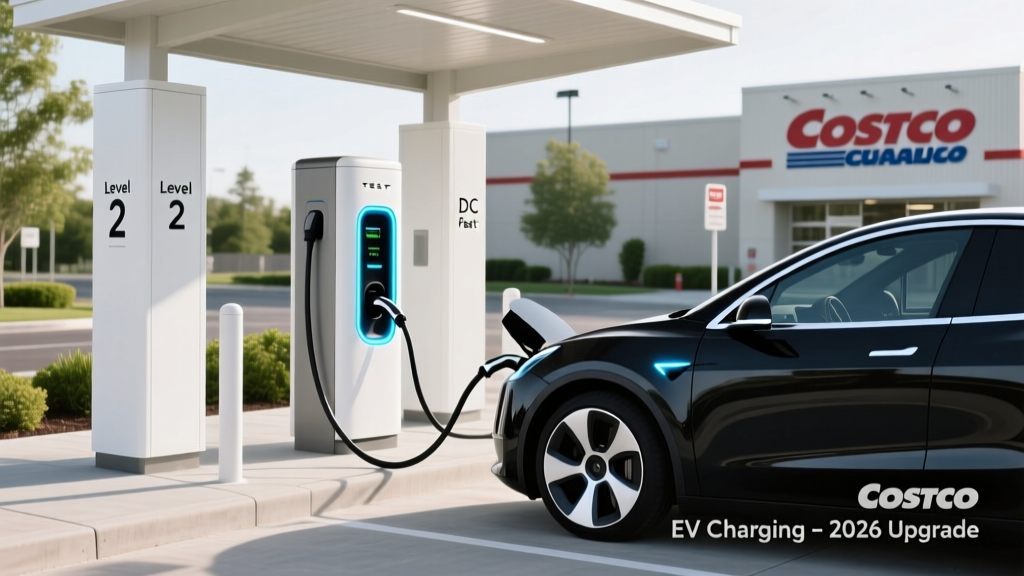
Most Costco locations that offer EV charging feature Level 2 stations (typically 7.2 kW to 19.2 kW) installed through partnerships with networks such as ChargePoint or EVgo. A smaller number of high-traffic warehouses—particularly in California, Washington, and the Northeast corridor—have added DC fast chargers capable of 50 kW to 150 kW. However, Costco does not maintain a centralized, publicly filterable map of all charger-equipped locations, which makes trip planning a challenge.
This guide covers what you'll find at Costco EV charger locations, how each charging level works, what connectors you'll need, and what charging actually costs per mile. We'll also walk through the economics and logistics of installing a home Level 2 charger—the single most impactful upgrade any EV owner can make.
Charging Levels Explained: Speeds, Power, and Range Added
Before pulling up to any Costco charger—or any public station—you need to understand the three charging levels and what they mean for your battery. The critical distinction: kW (kilowatts) measures power—the rate at which energy flows into your car. kWh (kilowatt-hours) measures energy—the total capacity of your battery. Think of kW as the width of a pipe and kWh as the size of the tank it's filling.
| Level | Power (kW) | Voltage | Miles of Range/Hour | Best Use Case |
|---|---|---|---|---|
| Level 1 | 1.4–1.9 kW | 120V AC | 3–5 mi/hr | Overnight top-ups, PHEVs, low-mileage drivers |
| Level 2 | 3.3–19.2 kW | 240V AC | 12–75 mi/hr | Home daily charging, workplace, retail (incl. Costco) |
| DC Fast Charging | 50–350 kW | 200–800V DC | 150–1,000+ mi/hr | Road trips, highway corridors, rapid top-ups |
Most Costco EV charger locations that feature Level 2 equipment deliver between 7.2 kW and 11.5 kW, which translates to roughly 25–40 miles of range per hour of charging for an average EV like the Tesla Model Y or Hyundai Ioniq 5. That's enough to recover 80–120 miles during a typical 2-hour shopping trip—useful for topping off, but not a full recharge from empty.
For DC fast chargers at select Costco locations, expect 50 kW units (older installations) or 150 kW units at newer sites. A 150 kW charger can take a 77.4 kWh battery (Hyundai Ioniq 5) from 10% to 80% in approximately 18–22 minutes, though the actual charge curve tapers significantly above 80% State of Charge (SoC). Peak kW ratings are never sustained across the full session.
Which Connectors Are at Costco EV Chargers?
Connector compatibility is the most common friction point at public chargers. In 2026, the North American market has largely consolidated around two connector standards, with a legacy option still in circulation:
| Connector | Type | Vehicles That Use It | Adapter Needed? |
|---|---|---|---|
| NACS (Tesla) | AC Level 2 + DC Fast | Tesla (all), Ford, GM, Rivian, Volvo, Polestar (2025+ models with native NACS) | CCS-to-NACS adapter for non-Tesla vehicles at older stations |
| CCS1 (Combo) | AC Level 2 + DC Fast | Hyundai, Kia, BMW, VW, most legacy non-Tesla EVs (pre-2025) | NACS-to-CCS adapter if station is NACS-only |
| CHAdeMO | DC Fast only | Nissan Leaf (legacy), Mitsubishi Outlander PHEV | No adapter available; requires native CHAdeMO station |
Most Costco Level 2 stations use J1772 connectors (the standard for AC Level 2 charging), which work with all non-Tesla EVs natively. Tesla owners need a J1772-to-NACS adapter (included with most Tesla vehicles). If the Costco location has DC fast chargers, they are more likely to feature CCS1 connectors, though newer installations may include NACS cables as networks adapt to the Tesla-standard shift.
How Much Does Charging at Costco Cost vs. Home and Gas?
Charging costs vary dramatically depending on where and when you plug in. Here's a realistic comparison across common scenarios, using a 2026 average EV efficiency of 3.5 miles per kWh (roughly the EPA combined figure for vehicles like the Tesla Model Y and Hyundai Ioniq 6):
| Scenario | $/kWh | Cost per 300 mi | Cost per Mile |
|---|---|---|---|
| Home (off-peak utility rate) | $0.09–$0.14 | $7.70–$12.00 | $0.026–$0.040 |
| Home (standard residential rate) | $0.14–$0.18 | $12.00–$15.40 | $0.040–$0.051 |
| Costco Level 2 (typical network pricing) | $0.18–$0.28 | $15.40–$24.00 | $0.051–$0.080 |
| Public DC Fast (Electrify America, EVgo) | $0.32–$0.48 | $27.40–$41.10 | $0.091–$0.137 |
| Gasoline (28 MPG at $3.40/gal) | — | $36.40 | $0.121 |
The takeaway: home charging on an off-peak rate is 3–5x cheaper per mile than gasoline. Costco Level 2 charging is a convenient supplement—more expensive than home but still cheaper than gas in most cases. DC fast charging on road trips can approach or exceed gas costs per mile, which is why it should be reserved for highway travel, not daily use.
Some Costco locations offer free Level 2 charging as a customer amenity, but this is increasingly rare in 2026 as networks have shifted to paid models. Always check the PlugShare or network app for current pricing before assuming free charging.
Home Level 2 Charger Installation: Costs, Electrical Requirements, and Upgrades
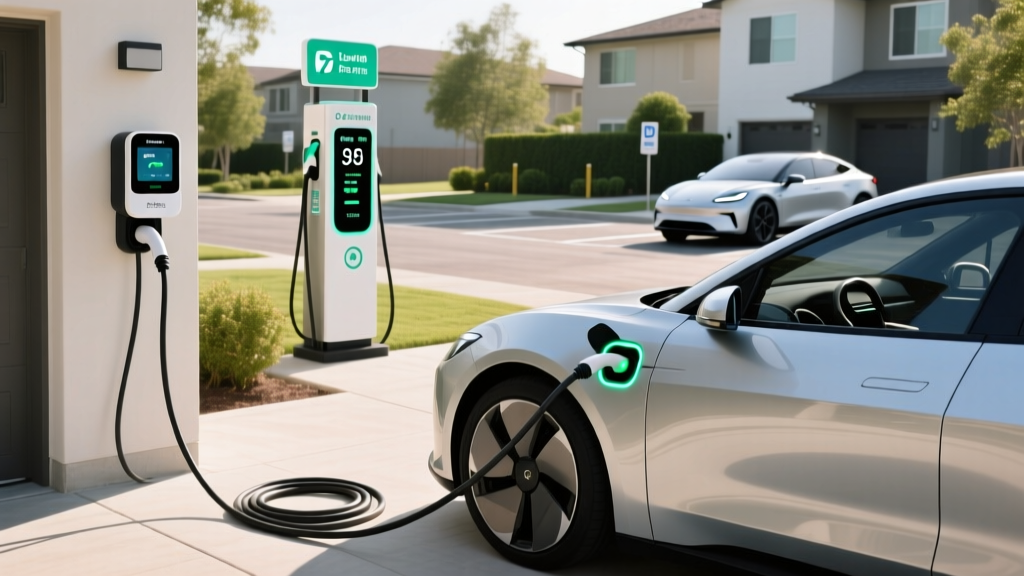
The most reliable "Costco EV charger" is the one in your garage. A home Level 2 installation eliminates range anxiety, lets you charge during off-peak utility hours, and adds 25–50 miles of range overnight—enough for 90% of daily driving. Here's what the installation actually involves and what it costs.
Electrical Requirements
A Level 2 home charger requires a dedicated 240V circuit, similar to what powers an electric dryer or oven. The most common configurations:
- 40-amp circuit (delivers 32A continuous / 7.7 kW) — sufficient for most EVs, requires a 50A breaker
- 48-amp circuit (delivers 40A continuous / 9.6 kW) — faster charging for larger batteries, requires a 60A breaker
- 60-amp circuit (delivers 48A continuous / 11.5 kW) — maximum Level 2 speed for vehicles like the Ford F-150 Lightning with dual onboard chargers
By the National Electrical Code (NEC), continuous loads like EV chargers can only use 80% of a circuit's rated capacity. So a 40A circuit delivers a maximum of 32A to the vehicle. This is a common source of confusion—your "40-amp charger" actually charges at 32 amps continuously.
Panel Upgrade Considerations
Many homes built before 2000 have 100A or 150A electrical panels. Adding a 40–60A dedicated EV circuit may exceed the panel's available capacity, especially if you already run electric heat, an electric dryer, and an electric oven. A licensed electrician will perform a load calculation to determine whether your panel can support the new circuit.
If a panel upgrade is needed—typically from 100A to 200A service—expect to add $1,500–$3,500 to your total installation cost. This is the single biggest variable that catches homeowners off guard. Homes with 200A or larger panels rarely need upgrades.
Installation Cost Breakdown
| Component | Simple Install (panel nearby) | Complex Install (long run, panel upgrade) |
|---|---|---|
| Level 2 charger equipment | $350–$700 | $500–$800 |
| Electrician labor (2–4 hrs simple / 6–10 hrs complex) | $300–$800 | $1,200–$2,500 |
| Permit and inspection | $50–$200 | $100–$300 |
| Panel upgrade (if needed) | $0 | $1,500–$3,500 |
| Conduit, wiring, misc. materials | $50–$200 | $300–$800 |
| TOTAL | $750–$1,900 | $3,600–$7,900 |
The federal Alternative Fuel Vehicle Refueling Property Credit (IRS Form 8911) may cover up to 30% of home charger equipment and installation costs (capped at $1,000), subject to income limits and census-tract eligibility. Check irs.gov for current-year qualification rules, as these change periodically.
Recommended Home EV Chargers for 2026
Based on real-world reliability, charge speed, smart features, and build quality, here are the top Level 2 home chargers for 2026:
ChargePoint Home Flex
Power: Up to 11.5 kW (48A) on a 60A circuit, configurable down to 16A
Connector: J1772 (NACS adapter included in 2025+ models)
Cable: 23 ft
Smart features: Wi-Fi, app scheduling, Alexa integration, energy reporting
Price: $599–$699
Best for: Most EV owners wanting flexible amperage and smart scheduling
Tesla Wall Connector
Power: Up to 11.5 kW (48A) on a 60A circuit
Connector: NACS native (J1772 adapter available separately)
Cable: 24 ft
Smart features: Wi-Fi, over-the-air updates, Power-Share (load balancing between two units), Tesla app integration
Price: $475
Best for: Tesla owners or households with NACS-equipped vehicles
Emporia Level 2 EV Charger
Power: Up to 11.5 kW (48A)
Connector: J1772
Cable: 24 ft
Smart features: Wi-Fi, app with real-time energy monitoring, solar integration, scheduled charging, works with Emporia Vue home energy monitor
Price: $399
Best for: Budget-conscious buyers who want energy monitoring and solar integration
Grizzl-E Smart
Power: Up to 10 kW (40A)
Connector: J1772 or NACS (select at purchase)
Cable: 24 ft
Smart features: Wi-Fi, OCPP protocol support, adjustable amperage, extreme-weather rated (-40°F to 122°F)
Price: $449–$549
Best for: Cold-climate owners and outdoor installations needing rugged build
Safety, Code, and Installation Best Practices
EV charger installation is not a DIY project. The National Electrical Code (NEC Article 625) governs EV charging equipment, and most jurisdictions require a permit and inspection. Here's what to expect and insist on:
- Dedicated circuit: Your EV charger must have its own dedicated breaker—never share a circuit with other appliances.
- GFCI protection: NEC 2020 and later requires Ground Fault Circuit Interrupter (GFCI) protection for all outdoor receptacles and many indoor EV installations. Some chargers have built-in GFCI; your electrician will determine if a GFCI breaker is needed at the panel.
- Outdoor rating: If installing outdoors (garage exterior, driveway, carport), ensure the charger carries a NEMA 4 or NEMA 4X rating for weather resistance.
- Wire gauge: A 48A continuous load requires 6 AWG copper wire (or 4 AWG aluminum) in most configurations. Your electrician will size wire based on run length and local code.
- Cable management: Wall-mount a cable organizer or retractor to prevent tripping hazards and cord damage. Never let the cable rest on the ground where vehicles can run over it.
Charging Time Examples: 10% to 80% by Battery Size
How long will you actually sit at a Costco charger or home station? Here are real-world 10–80% times for common EV battery sizes. Note that DC fast charging times assume optimal battery temperature (preconditioned) and peak charge rates; actual times vary with ambient temperature and SoC.
| Vehicle (Battery Size) | Home Level 2 (7.7 kW / 32A) | Home Level 2 (11.5 kW / 48A) | DC Fast (150 kW) | DC Fast (350 kW) |
|---|---|---|---|---|
| Tesla Model Y (75 kWh usable) | ~7.3 hrs | ~4.9 hrs | ~25 min | ~15 min |
| Hyundai Ioniq 5 (77.4 kWh, 800V) | ~7.5 hrs | ~5.0 hrs | ~22 min | ~18 min |
| Ford F-150 Lightning (131 kWh ext.) | ~12.8 hrs | ~8.5 hrs | ~42 min | ~30 min |
| Chevrolet Equinox EV (85 kWh usable) | ~8.3 hrs | ~5.5 hrs | ~28 min | ~20 min |
The charge curve matters: most EVs accept peak kW only between roughly 10–40% SoC, then taper progressively. A "25-minute" 10–80% session might become 40 minutes if you push to 95%. For daily driving, charging to 80% at home overnight is ideal for battery longevity—especially with NMC chemistry batteries. LFP (lithium iron phosphate) batteries, found in standard-range Teslas and some Rivians, tolerate regular 100% charges better.
Frequently Asked Questions
How much does it cost to install a home EV charger?
A straightforward Level 2 installation (short wire run, adequate panel capacity) typically costs $750–$1,900 including equipment, electrician labor, and permit. Complex installations requiring long conduit runs or a panel upgrade from 100A to 200A service can reach $3,600–$7,900. The federal Alternative Fuel Vehicle Refueling Property Credit may offset up to $1,000 of the cost if you qualify.
How fast will each charging level add range?
Level 1 (120V) adds 3–5 miles of range per hour. Level 2 (240V) adds 12–75 miles per hour depending on amperage and vehicle acceptance rate. DC fast charging adds 150–1,000+ miles per hour at peak rates, though real-world sessions average much less due to charge-curve taper above 50% SoC.
Which connector or charger is compatible with my EV?
All non-Tesla EVs use J1772 for Level 2 AC charging and CCS1 for DC fast charging. Tesla vehicles use the NACS connector natively. As of 2025, Ford, GM, Rivian, and others have adopted NACS on new vehicles. If you drive a 2025+ NACS-equipped non-Tesla, you'll need a CCS-to-NACS adapter ($150–$300) to use legacy CCS stations. CHAdeMO is limited to the Nissan Leaf and a few older models.
How much does charging cost per mile vs. gas?
Home charging at off-peak rates costs roughly $0.03–$0.04 per mile. Public Level 2 charging (including Costco locations where available) runs $0.05–$0.08 per mile. DC fast charging on road trips costs $0.09–$0.14 per mile. A comparable gas vehicle at 28 MPG with $3.40/gallon fuel costs about $0.12 per mile. Home charging delivers the strongest savings—3 to 4 cents per mile vs. 12 cents for gas.
What electrical upgrades might I need for a home charger?
The most common upgrade is a panel capacity increase from 100A to 200A service, needed when your existing panel lacks headroom for a new 40–60A dedicated circuit. This costs $1,500–$3,500. Other potential upgrades include replacing an outdated fuse box with a modern breaker panel, adding a sub-panel in an attached garage, or upgrading the service drop from the utility. A licensed electrician will perform a load calculation before recommending any upgrades.
Are Costco EV chargers free to use?
Most Costco EV charger locations in 2026 charge standard network rates through partners like ChargePoint or EVgo, typically $0.18–$0.28/kWh for Level 2. A small number of locations still offer complimentary charging as a customer amenity, but this is becoming rare. Always check the specific station listing on PlugShare or the network app for current pricing.
Can I charge my EV at Costco while I shop?
Yes—this is one of the best use cases for retail Level 2 chargers. A typical Costco shopping trip of 60–90 minutes on a 7.2 kW Level 2 charger will add roughly 25–40 miles of range, enough to supplement your home charging routine. Just be mindful of other EV drivers waiting for the spot; don't occupy a charger space once your vehicle is fully charged.
Finding reliable Costco EV charger locations in 2026 requires a bit of research—use PlugShare, ChargePoint, or the AFDC station locator to verify availability before you drive. But the bigger picture is clear: while public charging at retail locations is a useful supplement, a home Level 2 charger remains the foundation of practical EV ownership, delivering the lowest cost per mile and the most convenience by a wide margin.