If you've pulled into a Costco warehouse parking lot hoping to top off your EV battery while stocking up on bulk groceries, you're not alone. The search for a reliable Costco charging station is one of the most common queries among EV owners who want to combine errands with charging. But the reality of Costco's EV charging infrastructure in 2026 is more nuanced than a simple yes or no — and understanding what's available (and what alternatives exist) can save you from a frustrating trip with a low state of charge.
This guide breaks down exactly where Costco has installed EV chargers, what connector types and speeds you'll encounter, how public charging costs compare to home charging, and how to build a charging strategy that doesn't depend on any single retailer. We'll also cover everything you need to know about setting up Level 2 charging at home — where the real convenience and cost savings live.
Does Costco Have EV Charging Stations?
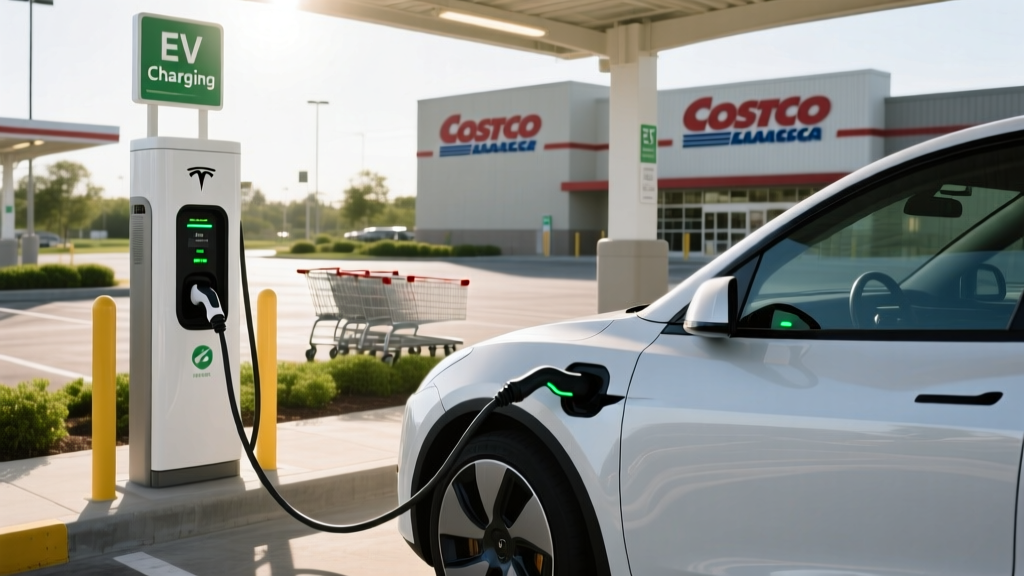
As of early 2026, Costco does not operate a nationwide network of branded EV charging stations the way some retailers have partnered with charging companies. However, select Costco warehouse locations — particularly in California, Washington, and parts of the Northeast — have third-party charging stations installed in or adjacent to their parking lots. These are typically operated by networks like ChargePoint, EVgo, or Electrify America, not by Costco itself.
The availability is inconsistent. A Costco in Irvine, California might have four Level 2 ChargePoint ports and two DC fast chargers nearby, while a Costco in suburban Chicago may have zero charging infrastructure within a half-mile radius. Costco's approach has been passive — allowing third-party operators to install chargers on their property — rather than actively building a charging network.
If your local Costco doesn't have chargers, nearby alternatives often include Walmart (which has partnered with Electrify America at many locations), Target (ChargePoint installations), and grocery chains like Kroger and Whole Foods. The key is building a mental map of 2–3 reliable charging locations near your regular errand routes rather than depending on any single retailer.
Charging Levels Explained: Speeds, Power, and What They Mean
Before evaluating any public charger — at Costco or elsewhere — you need to understand the three charging levels and what they deliver in practical terms. The most critical distinction in EV literacy is between kW (kilowatts), which measures power or charging speed, and kWh (kilowatt-hours), which measures energy or battery capacity. Think of kW as the width of the hose filling a tank, and kWh as the size of the tank itself.
| Level | Voltage | Power (kW) | Miles of Range Added per Hour | Best For |
|---|---|---|---|---|
| Level 1 | 120V AC | 1.2–1.9 kW | 3–5 miles/hr | Overnight top-offs, PHEVs, emergency use |
| Level 2 | 240V AC | 7.2–19.2 kW | 20–60 miles/hr | Daily home charging, workplace, retail destinations |
| DC Fast (Level 3) | 400–800V DC | 50–350 kW | 150–1,000+ miles/hr (peak) | Road trips, quick top-offs, highway corridors |
Most chargers you'll find at retail locations like Costco are Level 2 (7.2–11.5 kW typical), designed for 1–3 hour dwell times while you shop. DC fast chargers, when available, are usually located at the perimeter of the lot or at adjacent gas stations and are designed for 15–30 minute stops.
Real-world charging speed depends on your vehicle's onboard charger capacity (for Level 2) and its maximum DC charge rate. A Chevrolet Equinox EV with a 11.5 kW onboard charger can accept the full output of an 11.5 kW Level 2 post, but a plug-in hybrid like the Toyota RAV4 Prime with a 3.3 kW onboard charger will only draw 3.3 kW even from a 48-amp Level 2 station.
How Much Does Public Charging Cost vs. Home?
Public charging — whether at a Costco-adjacent ChargePoint station or an Electrify America DC fast charger along the interstate — costs significantly more per mile than home charging. Here's how the numbers break down in 2026:
| Scenario | Rate | Cost per kWh | Cost per Mile (at 3 mi/kWh) | Annual Cost (12,000 mi) |
|---|---|---|---|---|
| Home Level 2 (off-peak utility rate) | $0.11–$0.15/kWh | $0.13 avg | $0.043 | $516 |
| Home Level 2 (peak utility rate) | $0.20–$0.30/kWh | $0.25 avg | $0.083 | $996 |
| Public Level 2 (ChargePoint, EVgo) | $0.25–$0.49/kWh | $0.35 avg | $0.117 | $1,404 |
| DC Fast Charging (Electrify America, Tesla Supercharger) | $0.35–$0.56/kWh | $0.45 avg | $0.150 | $1,800 |
| Gas car (30 MPG combined, $3.40/gal) | — | — | $0.113 | $1,356 |
The takeaway: home charging at off-peak rates is roughly 60–70% cheaper per mile than gasoline. Public Level 2 charging is roughly on par with gas, and DC fast charging is often more expensive per mile than fueling a 30 MPG gas car. This is why installing a home Level 2 charger is the single most impactful financial decision an EV owner can make.
Many utility companies offer time-of-use (TOU) plans that drop electricity rates to $0.08–$0.12/kWh between midnight and 6 AM. If you can charge overnight at home, your per-mile cost drops below $0.04 — less than a third of what you'd pay for gas.
Home EV Charger Installation: Costs, Electrical Requirements, and What to Expect
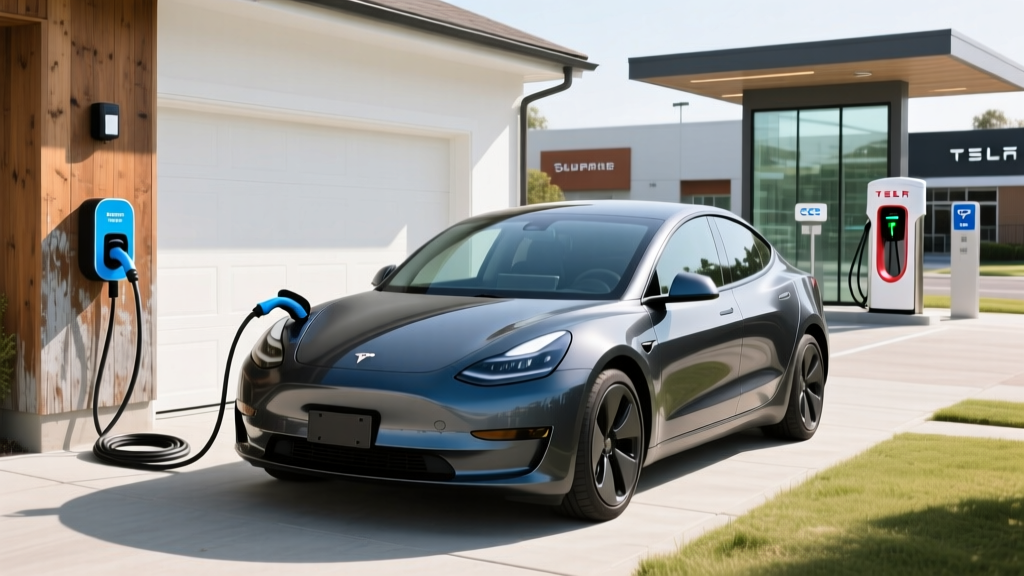
Installing a dedicated Level 2 home charger is where the real convenience and cost savings materialize. But the installation cost varies enormously depending on your home's electrical panel, the distance from panel to charger location, and local permit requirements.
Electrical Requirements
A typical Level 2 home charger requires a 240V dedicated circuit, similar to what an electric dryer or oven uses. The most common configurations are:
- 40-amp circuit (delivers 32 amps / 7.7 kW continuous) — sufficient for most EVs and the most common install
- 50-amp circuit (delivers 40 amps / 9.6 kW continuous) — good for larger batteries like the Ford F-150 Lightning or Rivian R1S
- 60-amp circuit (delivers 48 amps / 11.5 kW continuous) — maximum for most residential chargers, requires robust panel capacity
National Electrical Code (NEC) requires that continuous loads (like EV charging) use no more than 80% of a circuit's rated capacity. That's why a 40A circuit delivers 32A of usable charging current.
Do You Need a Panel Upgrade?
This is the question that separates a $600 installation from a $3,500 one. Most homes built after 1990 have a 200-amp main electrical panel, which can usually accommodate a 40A or 50A EV circuit without an upgrade. Older homes with 100-amp panels, or homes that already have high-draw appliances (electric range, central AC, electric water heater, dryer), may need a panel upgrade to 200A — costing $1,500–$3,000 on its own.
Some newer solutions like the Span smart panel or Enel X Way smart charger with load management can dynamically share capacity between the EV charger and other home circuits, potentially avoiding a panel upgrade. A licensed electrician can perform a load calculation to determine if your existing panel has sufficient headroom.
| Component | Basic Install (close to panel, no upgrade) | Complex Install (long run, panel upgrade) |
|---|---|---|
| Level 2 Charger (hardware) | $350–$650 | $350–$650 |
| Electrical permit | $50–$150 | $50–$200 |
| Electrician labor (2–4 hrs basic / 6–12 hrs complex) | $300–$700 | $800–$1,800 |
| Wiring, conduit, materials | $100–$250 | $300–$700 |
| Panel upgrade (if needed) | $0 | $1,500–$3,000 |
| Total estimated cost | $800–$1,750 | $3,000–$6,350 |
Always hire a licensed, insured electrician and pull the required local permit. Unpermitted EV charger installations can void homeowner's insurance claims and create fire hazards. The electrician should install a GFCI-protected circuit (required by NEC 2023 and later for EV charging) and ensure any outdoor-rated charger or receptacle has proper weatherproofing (NEMA 4 or NEMA 4X rating).
Connector Compatibility: Which Plug Does Your EV Use?
The connector landscape in 2026 has largely consolidated around the NACS (North American Charging Standard), originally developed by Tesla and now adopted by nearly every major automaker. But if you drive a vehicle purchased before 2025, you may still have a CCS1 port.
| Connector | Brands Using It (2026) | Adapter Needed for Other Networks? |
|---|---|---|
| NACS (Tesla-style) | Tesla, Ford, GM, Rivian, Hyundai/Kia (2025+), Volvo, Polestar, BMW, Mercedes-Benz, Nissan (2025+) | CCS1 adapter for older Electrify America/EA stations; mostly resolved as networks upgrade |
| CCS1 | Most 2024 and older non-Tesla EVs (VW ID.4, older Bolt EV, etc.) | NACS-to-CCS adapter (~$200–$300) for Tesla Supercharger access |
| CHAdeMO | Nissan Leaf (legacy), Mitsubishi Outlander PHEV (legacy) | Limited network; adapters exist but are expensive ($400+) |
If you're shopping for a home charger in 2026, buy one with a NACS connector unless you specifically own an older CCS1 vehicle. Many chargers now ship with NACS as default, and CCS-to-NACS adapters are readily available. The J1772 connector (the older Level 2 standard) is being phased out in favor of NACS for Level 2 as well.
Recommended Home EV Chargers for 2026
After testing dozens of Level 2 chargers across multiple EVs and home electrical setups, these are the units that deliver the best combination of reliability, charging speed, smart features, and value:
Tesla Wall Connector (Gen 4)
- Power: Up to 11.5 kW (48A on 60A circuit)
- Connector: NACS native
- Cable length: 24 ft
- Smart features: Wi-Fi, OTA updates, load sharing with Powerwall, access control
- Price: ~$475
- Best for: Tesla owners and NACS-equipped vehicles; best value-to-power ratio
ChargePoint Home Flex (NACS version)
- Power: Up to 12 kW (50A on 60A circuit, configurable 16–50A)
- Connector: NACS or J1772 options
- Cable length: 23 ft
- Smart features: Wi-Fi, app scheduling, Alexa integration, energy tracking
- Price: ~$599
- Best for: Multi-EV households, renters who may move (flexible amperage)
Enel X Way JuiceBox 48
- Power: Up to 11.5 kW (48A on 60A circuit)
- Connector: NACS or J1772
- Cable length: 25 ft
- Smart features: Wi-Fi, app control, smart grid integration, load management
- Price: ~$549
- Best for: Homes with tight panel capacity (load management feature)
Emporia Vue Level 2 Charger
- Power: Up to 11.5 kW (48A)
- Connector: NACS
- Cable length: 24 ft
- Smart features: Integrates with Emporia Vue energy monitor, solar-aware scheduling
- Price: ~$399
- Best for: Budget-conscious buyers, solar-panel homes
All of these chargers are hardwired (no plug — more reliable and code-compliant for 48A+ circuits), rated for indoor and outdoor use, and carry at minimum a 3-year warranty. Avoid cheap Amazon chargers with no UL certification — electrical safety is not an area to cut corners.
Charging Time Examples: How Long Does It Actually Take?
Charging times depend on three variables: the charger's power output (kW), your vehicle's battery capacity (kWh), and the charge curve (charging slows significantly above 80% state of charge to protect battery health). Here are realistic 10–80% charging times for common battery sizes:
| Battery Size | Example Vehicle | Level 2 (7.7 kW / 32A) | Level 2 (11.5 kW / 48A) | DC Fast (150 kW peak) | DC Fast (250+ kW peak) |
|---|---|---|---|---|---|
| 18 kWh | Toyota RAV4 Prime (PHEV) | ~1.5 hours | ~1.0 hour | N/A (no DC port) | N/A |
| 65 kWh | Tesla Model 3 Standard Range | ~6.0 hours | ~4.0 hours | ~25 min | ~18 min |
| 84 kWh | Hyundai Ioniq 5 (Long Range) | ~7.5 hours | ~5.0 hours | ~28 min | ~18 min (800V architecture) |
| 100 kWh | Ford F-150 Lightning (Extended) | ~9.0 hours | ~6.0 hours | ~40 min | ~30 min |
| 131 kWh | Rivian R1T (Max Pack) | ~12.0 hours | ~8.0 hours | ~55 min | ~40 min |
Key insight: DC fast charging times are not linear. A vehicle that charges from 10–50% in 12 minutes might take another 20 minutes to go from 50–80% because the charge rate tapers as the battery fills. This is why you'll see manufacturers advertise "10–80% time" rather than a full 0–100% figure. Charging from 80–100% on a DC fast charger can take as long as the 10–80% portion.
For home Level 2 charging, this taper is irrelevant — you're plugged in overnight, and the vehicle will reach 100% (or your set limit) by morning regardless. Most EV owners set their charge limit to 80% for daily driving to preserve long-term battery health, charging to 100% only before road trips.
Safety, Electrical Code, and Best Practices
EV charging involves sustained high-current draw over many hours — far more demanding on wiring than intermittent appliances like microwaves. Follow these non-negotiable safety practices:
- Dedicated circuit only: Your EV charger must be on its own dedicated breaker — never shared with other outlets or appliances.
- GFCI protection: Required by NEC 2023+ for all EV charging circuits. Most modern hardwired chargers have built-in GFCI; if using a NEMA 14-50 receptacle, the breaker must be GFCI-type.
- Outdoor rating: If your charger is mounted outside or in an unsealed garage, it must carry a NEMA 4 (weather-resistant) rating. All chargers recommended above meet this standard.
- No extension cords: Never use an extension cord with an EV charger. If the cable doesn't reach your charge port, move the charger or install a longer cable.
- Annual inspection: Check the charger cable, connector, and wall junction for heat damage, discoloration, or loose fittings at least once a year. Thermal imaging by an electrician during installation can catch loose connections before they become fire hazards.
- Permit and inspection: Skipping the permit saves $50–$150 but creates insurance and liability risk. A $50 permit and 30-minute inspection provides a professional safety check of the installation.
According to NHTSA and the National Fire Protection Association, EV charging fires are exceedingly rare when installations are performed to code — but nearly all documented residential EV charging incidents involved unpermitted work, undersized wiring, or damaged extension cords.
Building Your Charging Strategy Beyond Costco
While a Costco charging station would be convenient, the practical EV charging strategy for 2026 looks like this:
- Primary charging: Home Level 2. Install a 7.7–11.5 kW charger on a dedicated 240V circuit. Charge overnight on off-peak utility rates. This covers 90–95% of your charging needs at $0.04–$0.05 per mile.
- Secondary charging: Reliable public Level 2 locations. Identify 2–3 destinations where you regularly spend 1–2 hours (gym, grocery store, workplace) that have working Level 2 chargers. Use PlugShare to verify uptime ratings.
- Road trip charging: DC fast networks. Tesla Superchargers (now open to NACS-equipped non-Teslas), Electrify America, and EVgo form the backbone of highway DC fast charging. Plan routes with A Better Routeplanner to pre-condition your battery for optimal charge speed.
- Backup plan: Know your adapters. Carry a NACS-to-CCS1 adapter if your vehicle has a CCS port, or a J1772-to-NACS adapter if needed. A $200 adapter can prevent a stranded situation in a charging desert.
Frequently Asked Questions
How much does it cost to install a home EV charger?
A basic home Level 2 charger installation (short wire run, no panel upgrade) costs $800–$1,750 including equipment, electrician labor, and permit. Complex installations requiring long conduit runs, trenching, or a 200A panel upgrade can cost $3,000–$6,350. Get at least three quotes from licensed electricians, and ask specifically about their EV charger installation experience.
How fast will each charging level add range?
Level 1 (120V) adds 3–5 miles of range per hour. Level 2 (240V) adds 20–60 miles per hour depending on amperage and your vehicle's onboard charger. DC fast charging adds 150–1,000+ miles per hour at peak rate, but tapers significantly above 80% state of charge. For daily driving, Level 2 at home is the sweet spot.
Which connector or charger is compatible with my EV?
If you own a 2025+ model-year EV from a major automaker (Tesla, Ford, GM, Hyundai, Kia, BMW, Rivian, Volvo, Nissan), your vehicle almost certainly uses the NACS connector. Older non-Tesla EVs (2024 and earlier) typically use CCS1. The Nissan Leaf and older Mitsubishi PHEVs use CHAdeMO. Check your owner's manual or the badge near your charge port to confirm.
How much does charging cost per mile vs gas?
Home charging at off-peak rates costs roughly $0.04–$0.05 per mile — about 60–70% cheaper than a 30 MPG gas car at $3.40/gallon ($0.113/mile). Public Level 2 charging averages $0.10–$0.12 per mile, roughly on par with gas. DC fast charging averages $0.14–$0.18 per mile, often more expensive than gas. The economics strongly favor home charging.
What electrical upgrades might I need?
Homes with a 200-amp electrical panel typically need no upgrade for a 40A or 50A EV circuit. Homes with 100-amp panels, or those already running multiple high-draw appliances (electric heat, central AC, electric range, dryer), may need a panel upgrade to 200A ($1,500–$3,000) or a smart load-management system. A licensed electrician can perform a load calculation in about 30 minutes to determine your exact needs. According to the U.S. Department of Energy, about 30% of homes need some form of electrical upgrade for EV charging.
Can I just use a regular 120V outlet?
Yes — Level 1 charging on a standard 120V household outlet works, but it's slow. You'll add only 3–5 miles of range per hour, meaning a full charge for a 65 kWh battery could take 40+ hours. This is viable for plug-in hybrids with small batteries (15–25 kWh) or for EV owners who drive less than 30 miles per day. For anything more, a 240V Level 2 installation is strongly recommended.