The Short Answer: You Can't Install a Supercharger at Home
If you've searched for the cost to install a Tesla Supercharger at your house, you've likely hit a wall of conflicting information. Here's the reality: Tesla Superchargers are DC fast-charging stations that operate at 150 kW to 350 kW, require 480V three-phase commercial power, and cost between $70,000 and $150,000+ per stall to deploy. They are not residential products, and Tesla does not sell them to homeowners.
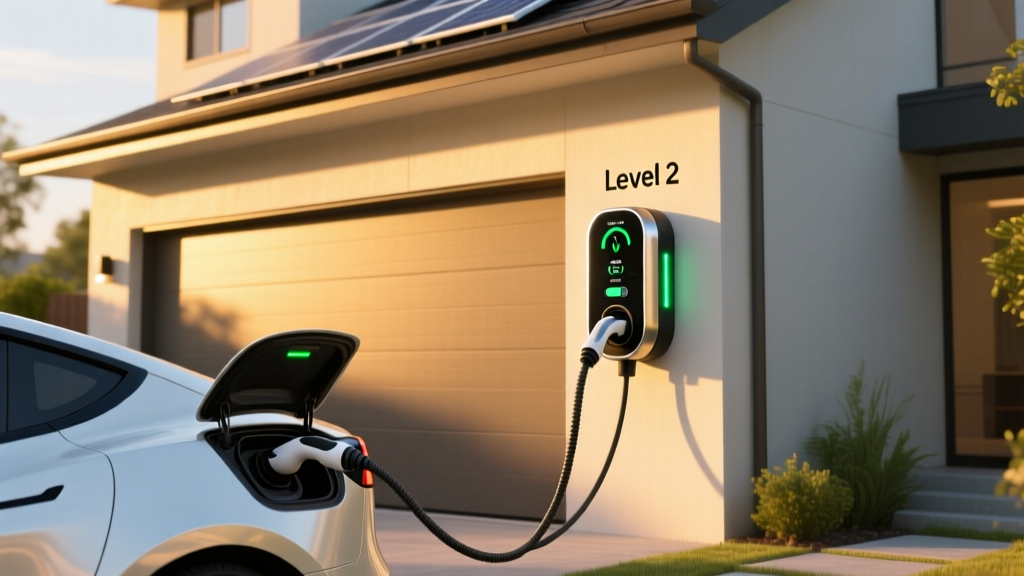
What most people actually need is a Level 2 home charger — including Tesla's own Wall Connector — which delivers 7 to 19 kW of power on a standard 240V residential circuit. This guide breaks down exactly what home EV charging costs, what electrical upgrades you might face, and how to pick the right equipment for your vehicle.
Understanding Charging Levels: What Actually Goes Into Your Home
Before budgeting for installation, you need to understand the three charging tiers available to EV owners. The critical distinction is between kW (kilowatts — the rate of power delivery, like water pressure) and kWh (kilowatt-hours — the total energy stored in your battery, like gallons in a tank). Charging speed is measured in kW; your battery capacity is measured in kWh.
| Level | Voltage | Max Power (kW) | Miles of Range Added Per Hour | Typical Use Case |
|---|---|---|---|---|
| Level 1 | 120V AC | 1.2–1.9 kW | 3–5 miles | Overnight trickle, PHEVs, emergencies |
| Level 2 | 240V AC | 3.3–19.2 kW | 12–75 miles | Primary home charging, workplace |
| DC Fast (Supercharger) | 400–800V DC | 50–350 kW | 150–1,000+ miles (theoretical) | Road trips, public highway corridors |
For a typical 75 kWh battery (like a Tesla Model Y Long Range), Level 2 charging at 11.5 kW adds roughly 44 miles of range per hour and fully recharges the pack in about 7–8 hours. A Supercharger at 250 kW can take a 75 kWh battery from 10% to 80% in roughly 15–20 minutes — but the charge curve tapers sharply above 80%, and sustained peak power is never maintained for the full session.
How Much Does It Cost to Install a Home EV Charger?
Installing a Level 2 home charger typically costs between $800 and $4,500 total, depending on your home's electrical infrastructure. Here's a realistic breakdown based on 2025–2026 electrician rates and equipment pricing:
| Component | Simple Install (Panel Nearby) | Complex Install (Panel Upgrade / Long Run) |
|---|---|---|
| Level 2 Charger Equipment | $400–$700 | $400–$700 |
| Electrician Labor (2–8 hrs @ $75–$150/hr) | $200–$500 | $600–$1,500 |
| Electrical Permit | $50–$200 | $50–$200 |
| Wiring & Conduit (materials) | $50–$150 | $200–$600 |
| Electrical Panel Upgrade (if needed) | $0 | $1,500–$4,000 |
| Total Estimated Cost | $700–$1,550 | $2,750–$7,000 |
What Electrical Upgrades Might Your Home Need?
Your home's electrical system determines the ceiling of your charging speed. Here are the key variables:
- Panel capacity: A 200-amp panel can typically support a 48-amp continuous charger (60-amp breaker). A 100-amp panel may only support 16–24 amps for EV charging without an upgrade.
- Dedicated circuit requirement: The National Electrical Code (NEC) requires EV chargers to have a dedicated circuit — you cannot share it with a dryer or oven.
- GFCI protection: NEC 2020 and later require Ground Fault Circuit Interrupter protection for EV outlets in garages. Hardwired chargers have GFCI built in; plug-in units need a GFCI breaker, which adds $40–$80.
- NEMA 14-50 vs. hardwired: A NEMA 14-50 outlet (240V/50A) gives you flexibility to unplug and move the charger but requires a GFCI breaker. Hardwired installations avoid the GFCI breaker cost and are required for circuits above 50 amps.
- Outdoor rating: If your charger lives outside, it needs a NEMA 4 or NEMA 4X weatherproof enclosure and outdoor-rated wiring.
Which Connector and Charger Is Compatible With Your EV?
The connector landscape has shifted dramatically. As of 2025–2026, the North American Charging Standard (NACS) — originally Tesla's proprietary plug — has become the dominant connector. Ford, GM, Rivian, Volvo, Hyundai, and most other manufacturers now equip vehicles with NACS ports or provide CCS-to-NACS adapters.
| Connector Type | Brands Using It (Native) | Home Charger Availability | Adapter Needed? |
|---|---|---|---|
| NACS (Tesla) | Tesla, Ford (2025+), GM (2025+), Rivian, Volvo, Polestar, Hyundai (2026+) | Tesla Wall Connector, Emporia, Lectron | CCS-to-NACS adapters available (~$200–$300) |
| CCS1 | VW, BMW, older Ford/GM/Hyundai models (pre-2025) | ChargePoint, Emporia, JuiceBox | NACS-to-CCS adapters available (~$200) |
| CHAdeMO | Nissan Leaf (legacy), Mitsubishi Outlander PHEV | Limited home options | Being phased out; no new vehicles use it |
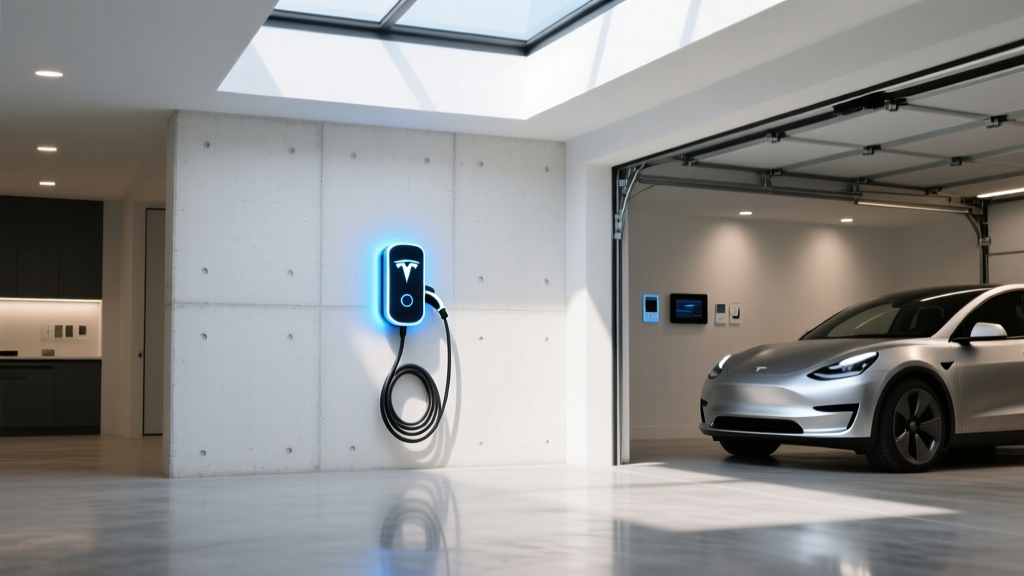
If you own a Tesla, the Tesla Wall Connector is the obvious choice — it natively uses the NACS plug and communicates seamlessly with your vehicle. If you own a non-Tesla EV with a CCS1 port, most Level 2 home chargers use a J1772 connector (the legacy AC standard) that physically fits CCS1 ports for Level 2 charging. For future-proofing, consider a charger with a NACS plug or one that offers swappable connector heads.
Best Home EV Chargers: Equipment Recommendations
Here are the top-performing Level 2 home chargers for 2025–2026, evaluated on power output, build quality, smart features, and value:
Tesla Wall Connector (Gen 3)
- Max Power: 11.5 kW (48 amps on a 60-amp breaker)
- Connector: NACS (native Tesla plug)
- Cable Length: 24 feet
- Smart Features: Wi-Fi, OTA updates, load sharing (pair two units on one circuit), Power Sharing
- Price: ~$475
- Best For: Tesla owners; also works with NACS-equipped Ford, GM, Rivian vehicles
Emporia Vue EV Charger
- Max Power: 11.5 kW (48 amps) or 9.6 kW (40 amps)
- Connector: J1772 (fits all CCS1 and NACS vehicles with adapter)
- Cable Length: 24 feet
- Smart Features: Energy monitoring via Emporia Vue panel integration, solar-aware charging, scheduling
- Price: ~$399
- Best For: Homes with solar panels or Emporia energy monitoring; budget-conscious buyers
ChargePoint Home Flex
- Max Power: 12 kW (50 amps, configurable down to 16 amps)
- Connector: J1772 (CCS1-compatible for AC charging)
- Cable Length: 23 feet
- Smart Features: Wi-Fi, Alexa integration, charge scheduling, detailed app analytics
- Price: ~$699
- Best For: Non-Tesla EV owners wanting a premium smart charger with flexible amperage
Lectron V-Box Pro (NACS)
- Max Power: 11.5 kW (48 amps)
- Connector: NACS
- Cable Length: 20 feet
- Smart Features: Wi-Fi, app control, scheduling
- Price: ~$349
- Best For: Budget NACS option for newer Ford/GM/Rivian owners
Charging Time Examples: How Long Does It Really Take?
Charging time depends on your battery size, the charger's kW output, and the vehicle's onboard charger limit. Most EVs cap Level 2 AC charging at 11.5 kW, even if the charger can deliver more. Here are real-world charging times for common models:
| Vehicle | Battery (kWh usable) | Onboard Charger Limit | Level 2 @ 7.7 kW (32A) | Level 2 @ 11.5 kW (48A) | DC Fast (10–80%) |
|---|---|---|---|---|---|
| Tesla Model Y LR | 75 kWh | 11.5 kW | ~6.5 hours | ~4.5 hours | ~18 min @ 250 kW |
| Ford Mustang Mach-E ER | 91 kWh | 10.5 kW | ~8 hours | ~6 hours | ~25 min @ 150 kW |
| Hyundai Ioniq 5 LR | 77.4 kWh | 10.9 kW | ~6.5 hours | ~5 hours | ~18 min @ 350 kW |
| Chevy Equinox EV | 85 kWh | 11.5 kW | ~7 hours | ~5 hours | ~22 min @ 150 kW |
| Toyota bZ4X | 64 kWh | 6.6 kW | ~6 hours | ~6 hours (capped) | ~30 min @ 150 kW |
Note that the Toyota bZ4X's 6.6 kW onboard charger bottleneck means even a 48-amp Wall Connector can't push power faster than 6.6 kW. This is a vehicle-side limitation, not a charger problem. Always check your EV's onboard charger spec before overspending on a high-amperage unit.
How Much Does Charging Cost Per Mile vs. Gas?
One of the strongest arguments for home EV charging is the per-mile cost advantage. Here's how common scenarios compare, using a vehicle averaging 3.5 miles per kWh (roughly 120 MPGe):
| Charging Scenario | Cost per kWh | Cost per Mile (at 3.5 mi/kWh) | Equivalent Gas Price (at 28 MPG) |
|---|---|---|---|
| Home (off-peak utility rate) | $0.08–$0.12 | $0.023–$0.034 | $0.64–$0.95/gal |
| Home (standard residential rate) | $0.14–$0.18 | $0.040–$0.051 | $1.12–$1.43/gal |
| Public Level 2 (ChargePoint, etc.) | $0.25–$0.49 | $0.071–$0.140 | $1.99–$3.92/gal |
| Tesla Supercharger / DC Fast | $0.28–$0.48 | $0.080–$0.137 | $2.24–$3.84/gal |
| Gasoline (national avg., 2026) | — | $0.115–$0.125 (at $3.20–$3.50/gal, 28 MPG) | $3.20–$3.50/gal |
Home charging on an off-peak rate is roughly one-quarter the cost of gasoline per mile. Even public DC fast charging at $0.40/kWh often undercuts gasoline on a per-mile basis. The economics strongly favor home charging — which is exactly why understanding installation cost matters.
Why Tesla Won't Sell You a Supercharger (and What That Means)
A Tesla Supercharger stall requires:
- 480V three-phase commercial power — not available in residential settings without a utility transformer upgrade costing $20,000–$100,000+
- Utility demand charges — commercial electricity billing includes peak-demand fees that can exceed $10,000/month for a multi-stall site
- Tesla network integration — Superchargers are managed as part of Tesla's proprietary network with load balancing, payment systems, and remote diagnostics
- Physical footprint — each V4 Supercharger cabinet and dispenser requires concrete pad work, bollards, and ADA-compliant layout
The Tesla Supercharger network is designed as public infrastructure, not home equipment. The $70,000–$150,000 per-stall cost you may see cited reflects the entire deployment including land, utility interconnection, and network hardware — not something transferable to a residential driveway.
Frequently Asked Questions
Can I install a Tesla Supercharger at my home?
No. Tesla Superchargers require 480V three-phase commercial power, utility demand-meter infrastructure, and Tesla's proprietary network integration. They are not sold to individual consumers for residential use. For home charging, Tesla sells the Wall Connector (Level 2, up to 11.5 kW), which costs around $475 plus installation.
How much does it cost to install a home Level 2 EV charger?
A straightforward Level 2 installation with an adequate electrical panel typically costs $700–$1,550 total (charger + electrician + permit). If your home needs a 200-amp panel upgrade, expect $2,750–$7,000. Get a load calculation from a licensed electrician before committing.
Do I need a permit to install an EV charger?
Yes, in virtually all US jurisdictions. A licensed electrician will pull the permit, which typically costs $50–$200. Unpermitted electrical work can void your homeowner's insurance and create a safety hazard.
What's the difference between a NACS and CCS1 connector?
NACS (North American Charging Standard) is Tesla's connector, now adopted by Ford, GM, Rivian, Hyundai, Volvo, and others for 2025–2026 models. CCS1 is the older combined standard still found on VW, BMW, and pre-2025 models from Ford/GM. For Level 2 home charging, NACS plugs fit NACS ports directly, while CCS1 vehicles typically use the J1772 connector (which plugs into the upper portion of the CCS port). Adapters are available in both directions for roughly $200–$300.
Is it cheaper to charge an EV at home or at a Supercharger?
Home charging is significantly cheaper. At the US average residential rate of ~$0.16/kWh, you'll pay about $0.046 per mile. At a Supercharger averaging $0.35/kWh, that jumps to ~$0.10 per mile — still often less than gasoline, but more than double the home rate. According to fueleconomy.gov, most EVs cost $500–$700 less per year to fuel than comparable gasoline vehicles when charged primarily at home.
Can my 100-amp electrical panel handle an EV charger?
It depends on your existing loads. A 100-amp panel might support a 16-amp or 24-amp EV circuit (3.8–5.8 kW) if you have gas appliances and low overall demand. However, if you run electric heat, an electric dryer, and an electric oven, a 100-amp panel likely cannot support meaningful EV charging without an upgrade to 200 amps. A licensed electrician can perform a NEC-compliant load calculation to determine your available capacity.
Does the federal tax credit cover home charger installation?
The IRS §30C Alternative Fuel Vehicle Refueling Property Credit covers up to 30% of home EV charger equipment and installation costs, capped at $1,000. However, eligibility is restricted to census tracts classified as low-income or non-urban under current IRS guidance. Check your census tract designation and consult a tax professional before assuming eligibility.