If you've ordered a Tesla or any EV with a NACS port, you're likely searching for the cost to install a Tesla charger in your house — and the answer is rarely a single number. Based on 2026 electrician rates, equipment prices, and permit fees, most homeowners spend between $500 and $2,500 for a professional Level 2 installation. If your electrical panel needs an upgrade to 200 amps, that figure can climb to $4,000 or more.
This guide breaks down every cost layer — from the Wall Connector itself to the circuit breaker, conduit, labor, and potential panel upgrades — so you can budget accurately before calling an electrician.
Charging Levels Explained: Speed, Power, and What You Actually Need
Before estimating cost, you need to understand what you're installing. Home charging falls into two categories: Level 1 (standard outlet) and Level 2 (dedicated 240V circuit). DC fast charging is public-only infrastructure and not part of a home install.
A critical distinction: kW (kilowatts) measures power — the rate of energy flow, like water pressure from a hose. kWh (kilowatt-hours) measures energy — the total amount stored in your battery, like gallons in a tank. A 11.5 kW charger delivers energy into an 82 kWh battery over time.
| Level | Voltage | Max Power (kW) | Miles of Range Added Per Hour | Typical Use |
|---|---|---|---|---|
| Level 1 | 120V | 1.4–1.9 kW | 3–5 mi/hr | Overnight trickle; PHEVs or low-mileage commuters |
| Level 2 (Home) | 240V | 7.2–19.2 kW | 25–65 mi/hr | Daily home charging; primary EV setup |
| DC Fast Charging | 400–800V DC | 50–350 kW | 150–1,000+ mi/hr | Public road-trip charging only |
For a Tesla Model Y with a ~75 kWh usable battery, a 11.5 kW Level 2 charger (48 amps) adds roughly 44 miles of range per hour — enough to replenish a full day of driving in about 2–3 hours. A full 10–80% charge takes approximately 6–7 hours at this rate, though your vehicle's onboard charger limits the actual draw.
How Much Does It Cost to Install a Tesla Charger at Home?
The total cost to install a Tesla charger in your house breaks into three components: the charging equipment, the electrical work, and local permits. Here's what that looks like in practice.
| Cost Component | Low-End Estimate | High-End Estimate | Notes |
|---|---|---|---|
| Tesla Wall Connector (48A, NACS) | $400 | $450 | Direct from Tesla; 24-ft cable included |
| Third-party NACS charger (e.g., ChargePoint Home Flex) | $550 | $700 | Variable amperage, app features |
| Electrician labor (simple install) | $300 | $800 | Short wire run, panel nearby, drywall |
| Electrician labor (complex install) | $800 | $2,000 | Long conduit run, outdoor mount, concrete cutting |
| Electrical permit | $50 | $300 | Varies by municipality |
| 60A breaker + wiring (copper) | $50 | $150 | #6 AWG copper for 48A continuous load |
| Panel upgrade (100A → 200A) | $1,500 | $3,500 | Only if current panel lacks capacity |
| Total (no panel upgrade) | $500 | $2,500 | Most homes with 200A panel |
| Total (with panel upgrade) | $2,000 | $5,500 | Older homes with 100A service |
What Drives the Labor Cost Up or Down?
The single biggest variable is the distance from your electrical panel to the charger location. A Wall Connector mounted on the garage wall directly beside a 200A panel with spare breaker slots might take an electrician two hours and $400 in labor. That same charger on an exterior wall 60 feet from a basement panel — requiring conduit runs through finished ceilings, attic crawls, or buried PVC — can easily exceed $1,500 in labor alone.
Other cost factors include:
- Conduit type: EMT (metal) conduit costs more than flexible Romex in open garage walls
- Outdoor installation: Requires a weatherproof enclosure, NEMA 4-rated connector, and potentially a GFCI breaker ($50–$100 more)
- Drywall repair: If wire runs require cutting into finished walls, add $100–$300 for patching
- Local labor rates: Electricians in metro areas (San Francisco, New York, Boston) charge $125–$200/hr versus $75–$125/hr in rural regions
What Electrical Upgrades Might You Need?
The Tesla Wall Connector at 48 amps requires a dedicated 60-amp, 240V circuit. This is a continuous load under the National Electrical Code (NEC), meaning the circuit must be rated for 125% of the actual draw — hence 60A for a 48A charger.
Before installation, an electrician will perform a load calculation on your existing panel to determine whether you have enough spare capacity. Here's the reality for common home electrical setups:
- 200A panel with spare slots: Most modern homes (built after ~2000) can accommodate a 60A EV circuit without upgrades. You're clear to install.
- 200A panel near capacity: If you run electric heat, an electric oven, electric dryer, and central A/C, your panel may be close to its limit. An electrician might recommend a smart load management device (like the Emporia VUE or Span panel) that throttles charger draw when other loads spike — avoiding a full panel upgrade.
- 100A panel: Common in homes built before the 1980s. You will almost certainly need a panel upgrade to 200A ($1,500–$3,500) or must downgrade to a 32A charger on a 40A circuit, which charges at roughly 7.7 kW instead of 11.5 kW.
One cost-saving option: if you don't need maximum charging speed, you can configure the Wall Connector to 32A on a 40A breaker, which requires lighter-gauge wire and puts less strain on an older panel. This still adds ~29 miles of range per hour — sufficient for most daily driving.
Which Charger Should You Buy? Equipment Compared
Tesla's Wall Connector is the default choice, but it's not the only option. Here's how the leading NACS-compatible home chargers stack up in 2026:
| Charger | Max Power | Connector | Cable Length | Smart Features | Price (MSRP) |
|---|---|---|---|---|---|
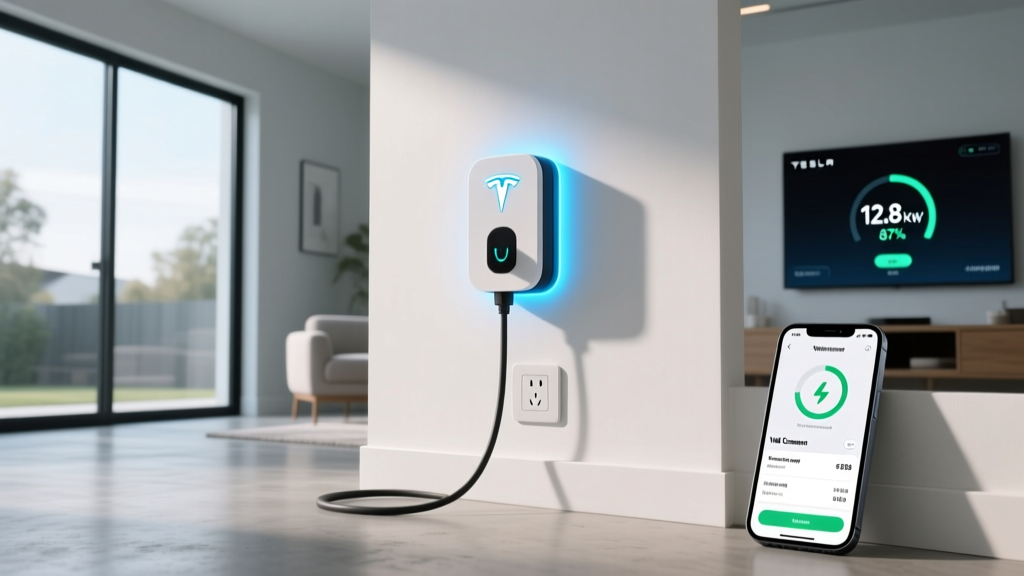
| Tesla Wall Connector (Gen 4) | 11.5 kW (48A) | NACS (native) | 24 ft | Wi-Fi, OTA updates, Power Sharing, access control | $400 |
| ChargePoint Home Flex (NACS) | 11.5 kW (48A) | NACS | 23 ft | App scheduling, Alexa, energy tracking | $599 |
| Emporia Level 2 EV Charger | 11.5 kW (48A) | NACS or J1772 | 24 ft | Energy monitoring, solar integration, load management | $399 |
| Grizzl-E Smart (NACS edition) | 10 kW (40A) | NACS | 24 ft | Smart app, OCPP, extreme-cold rated (-40°F) | $549 |
Our pick: The Tesla Wall Connector remains the best value for Tesla owners — it's the cheapest in this comparison, supports Power Sharing (two Wall Connectors on one 60A circuit), and receives over-the-air firmware updates. If you own multiple EV brands with NACS and CCS ports, or want detailed energy monitoring integrated with solar panels, the Emporia charger offers compelling smart-home integration at a similar price.
Connector Compatibility: NACS, CCS, and Adapter Realities
As of 2026, nearly every major automaker has adopted the NACS (North American Charging Standard) — Tesla's connector — as the primary EV plug in North America. Ford, GM, Rivian, Hyundai, and others now ship vehicles with native NACS ports.
| Connector | Brands Using It (Native) | Home Charging | Adapter Needed? |
|---|---|---|---|
| NACS (Tesla) | Tesla, Ford, GM, Rivian, Hyundai, Kia, Volvo, BMW, Mercedes | Tesla Wall Connector, ChargePoint NACS, Emporia NACS | None for NACS vehicles |
| CCS1 | Older VW ID.4, some Stellantis models, legacy EVs | ChargePoint, Emporia, Grizzl-E CCS versions | Tesla CCS adapter (~$175) for Supercharging |
| CHAdeMO | Nissan Leaf (discontinued), Mitsubishi Outlander PHEV (older) | Limited home options | Largely phased out in North America |
If you own a CCS-equipped EV but want a Tesla Wall Connector, Tesla sells a J1772 adapter (included with some vehicles) and third-party CCS-to-NACS adapters are available, though they add bulk and cost ($100–$200). For 2026, buying a NACS-native charger is the future-proof choice.
How Much Does Charging Cost Per Mile vs. Gas?
One of the strongest arguments for home charging is the per-mile fuel cost. Here's how electricity stacks up against gasoline in typical 2026 scenarios:
| Scenario | Energy Cost | Vehicle Efficiency | Cost Per Mile |
|---|---|---|---|
| Home charging (national avg, off-peak) | $0.14/kWh | 3.5 mi/kWh (Model Y) | $0.04/mi |
| Home charging (California, peak TOU) | $0.34/kWh | 3.5 mi/kWh | $0.10/mi |
| Public DC fast charging (Electrify America) | $0.48/kWh | 3.5 mi/kWh | $0.14/mi |
| Tesla Supercharger (avg) | $0.32/kWh | 3.5 mi/kWh | $0.09/mi |
| Gasoline (28 MPG combined, $3.40/gal) | $3.40/gallon | 28 MPG (RAV4 AWD) | $0.12/mi |
| Gasoline (22 MPG combined, $3.40/gal) | $3.40/gallon | 22 MPG (truck/SUV) | $0.15/mi |
At the national average off-peak residential rate of ~$0.14/kWh, home EV charging costs roughly $0.04 per mile — about one-third the cost of fueling a 28 MPG gas vehicle. Even in high-cost states like California during peak hours, home charging remains competitive with gasoline. The savings compound: at 12,000 miles per year, a Model Y owner charging at home saves roughly $960 annually versus a 28 MPG gas car, according to fueleconomy.gov data.
To maximize savings, many utilities offer time-of-use (TOU) plans that drop electricity rates to $0.06–$0.10/kWh during overnight hours (typically 10 PM – 6 AM). Scheduling your Wall Connector to charge during these windows via the Tesla app or your vehicle's built-in scheduler is the single most impactful cost-saving move.
Charging Time: What to Expect With a Home Level 2 Setup
Real-world charging time depends on your battery size, the charger's output, and your vehicle's onboard charger limit. The Tesla Model Y and Model 3 can accept up to 11.5 kW on Level 2, meaning they can fully utilize a 48A Wall Connector.
Here are approximate 10–80% charging times for popular EVs on an 11.5 kW home charger:
- Tesla Model Y Long Range (75 kWh usable): ~4.5 hours (10–80%)
- Tesla Model 3 Long Range (75 kWh usable): ~4.5 hours
- Ford F-150 Lightning Extended Range (131 kWh usable): ~8 hours (10–80%)
- Hyundai Ioniq 5 (77.4 kWh usable): ~4.7 hours (with NACS adapter or native NACS on 2026 models)
- Chevrolet Equinox EV (85 kWh usable): ~5.2 hours
Note that charging is not linear. Your vehicle's battery management system (BMS) reduces the charge rate as the battery approaches full capacity — this is called charge curve taper. The 10–80% window is the fastest portion; the final 80–100% can take nearly as long as the first 70%. For daily driving, charging to 80% is recommended to preserve long-term battery health, especially for NMC chemistry packs. Tesla recommends a daily charge limit of 80% for Long Range models and 100% for LFP-equipped Standard Range models.
Safety, Permits, and Code Compliance
A Level 2 EV charger is a significant electrical load — comparable to an electric oven or central A/C compressor. Proper installation isn't optional; it's a safety and insurance requirement.
Key NEC and Safety Requirements
- Dedicated circuit: The Wall Connector must be on its own breaker — you cannot share the circuit with other appliances
- GFCI protection: The 2023 NEC (adopted by most states by 2026) requires GFCI protection for outdoor EV charging outlets. Hardwired installations may be exempt in some jurisdictions — your electrician will confirm
- Wire gauge: 48A continuous load requires #6 AWG copper wire (or #4 aluminum). Undersized wire creates fire risk
- Outdoor rating: If mounting outside, the Wall Connector is rated NEMA 4 (weatherproof), but the junction box and conduit connections must also be rated for wet locations
- Permit and inspection: Nearly all US jurisdictions require an electrical permit for a new 240V circuit. The inspection ensures code compliance — skipping it can void homeowner's insurance coverage for electrical fires
According to NHTSA, properly installed home EV chargers carry minimal fire risk when code requirements are met. The primary danger comes from DIY installations using undersized wire, shared circuits, or unpermitted work. Always hire a licensed electrician — the labor cost is insurance against a $50,000+ electrical fire.
Frequently Asked Questions
Can I install a Tesla Wall Connector myself?
Tesla provides installation guides, and technically a homeowner can wire a Wall Connector in some jurisdictions. However, most localities require a licensed electrician to pull the permit, and DIY electrical work on a 60A/240V circuit carries significant safety and liability risk. We strongly recommend professional installation.
Does the Tesla Wall Connector work with non-Tesla EVs?
Yes — the Gen 4 Wall Connector uses the NACS connector, which is now the standard on Ford, GM, Rivian, Hyundai, and other 2025–2026 EVs. For CCS-equipped vehicles, you'll need a NACS-to-CCS adapter.
Will installing a Tesla charger increase my home's value?
Studies from Zillow and Redfin suggest homes with EV charging infrastructure sell for 1–2% more than comparable homes without. A professionally installed, permitted Level 2 charger is a tangible selling point for the growing EV-buyer demographic.
Can I use a NEMA 14-50 outlet instead of hardwiring?
Yes. A NEMA 14-50 outlet (50A, 240V) allows you to plug in the Wall Connector or use Tesla's Mobile Connector. This gives you portability but limits charging to 40A (9.6 kW) instead of 48A (11.5 kW). A 14-50 outlet also requires a GFCI breaker under current NEC, adding ~$80–$120 to the installation.
Is there a tax credit for installing a home EV charger?
The federal Alternative Fuel Vehicle Refueling Property Credit covers 30% of home charger hardware and installation costs, up to $1,000. However, eligibility depends on your census tract meeting certain income or rural criteria. Check the latest IRS guidance, as qualifying tracts are updated periodically.