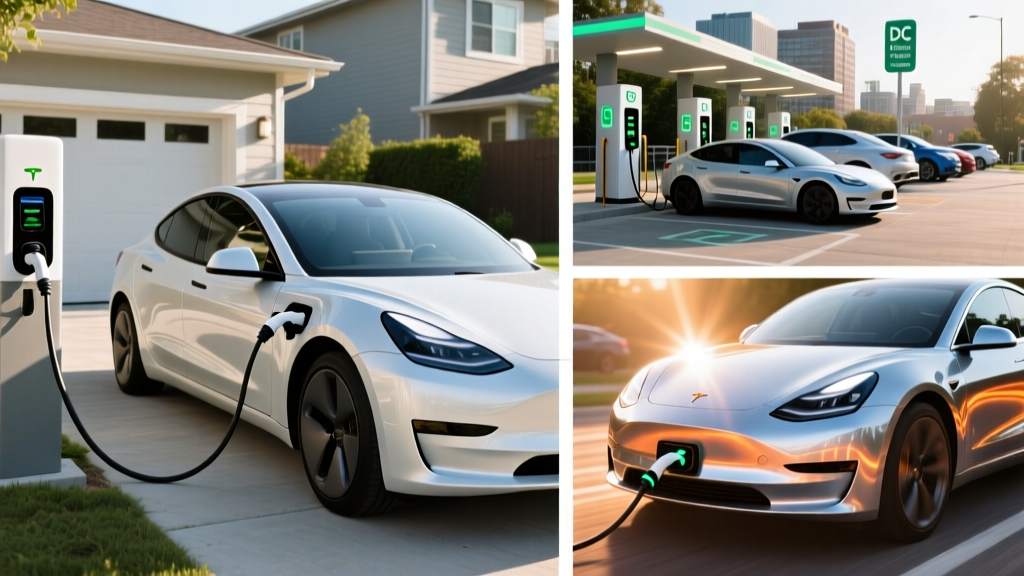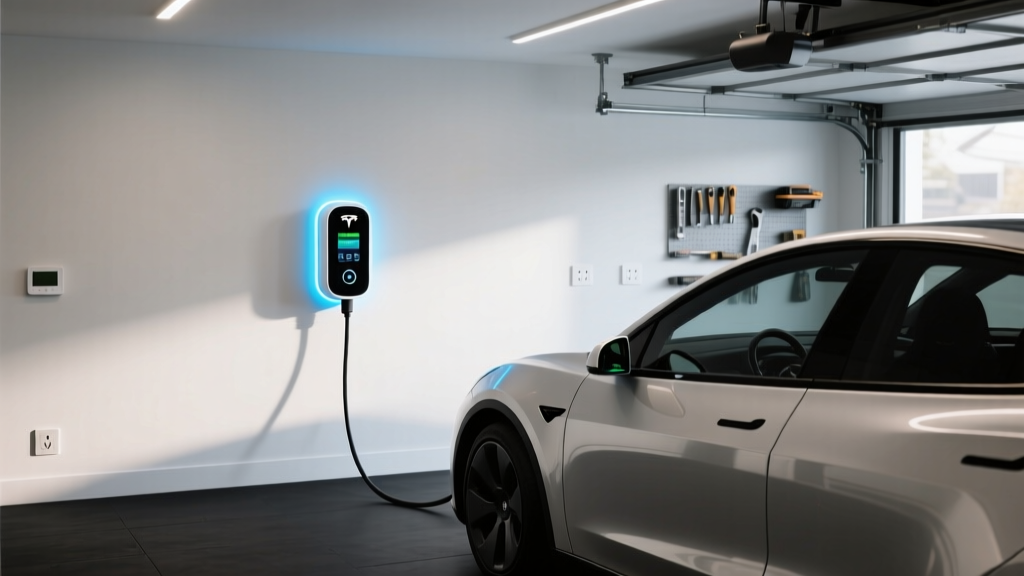
If you've ordered a Tesla or any EV with the North American Charging Standard (NACS) port, you're probably staring at an empty garage wall and a critical question: what does it actually cost to install a home charger? The sticker price of the charger itself is just the start. Electrical panel capacity, wire runs, permitting, and local labor rates all shape the final invoice. This guide walks through every line item so you can budget accurately before calling an electrician.
Understanding Charging Levels: Speed, Power, and What You Actually Need
Before pricing hardware, you need to understand what each charging level delivers. EV charging is measured in kilowatts (kW), which is the rate of power flow. The energy stored in your battery is measured in kilowatt-hours (kWh). Think of kW as how fast water flows from a hose, and kWh as the total gallons in your bucket. Confusing these two is the most common mistake new EV owners make.
| Level | Voltage | Power (kW) | Miles of Range Added Per Hour | Typical Use Case |
|---|---|---|---|---|
| Level 1 | 120V AC | 1.0–1.4 kW | 3–5 miles | Overnight trickle, emergency top-off |
| Level 2 | 240V AC | 7.2–19.2 kW | 25–70 miles | Daily home and workplace charging |
| DC Fast Charging | 400–800V DC | 50–350 kW | 150–1,000+ miles (equivalent) | Road trips, rapid top-ups on public networks |
For most Tesla owners, a Level 2 home charger is the practical choice. A Tesla Model Y Long Range with an 82 kWh (usable ~79 kWh) battery can recover from 20% to 80% in roughly 5–7 hours on a 48-amp (11.5 kW) Wall Connector, compared to nearly 3 days on a standard 120V outlet. DC fast charging is reserved for public stations — you can't install a 250 kW Supercharger in your garage, and your home's electrical service wouldn't support it anyway.
How Much Does It Cost to Install a Tesla Charger at Home?
The total cost to install a Tesla charger at home ranges from roughly $500 on the very low end to $5,000+ if your electrical panel needs an upgrade. Most homeowners with a modern 200-amp panel and a short wire run land between $1,200 and $2,500 all-in. Here's how that breaks down:
| Cost Component | Simple Install (panel nearby) | Moderate Install (longer run) | Complex Install (panel upgrade) |
|---|---|---|---|
| Tesla Wall Connector (hardware) | $420 | $420 | $420 |
| Electrician labor (2–8 hours @ $75–$150/hr) | $300–$600 | $600–$1,200 | $800–$1,500 |
| Electrical materials (wire, conduit, breaker) | $50–$150 | $200–$500 | $300–$600 |
| Permit fee | $50–$150 | $50–$200 | $50–$200 |
| Electrical panel upgrade (if needed) | — | — | $1,500–$3,500 |
| Estimated Total | $820–$1,320 | $1,270–$2,320 | $3,070–$6,220 |
The Tesla Wall Connector itself costs $420 directly from Tesla and includes a 24-foot cable, Wi-Fi connectivity, and up to 48 amps of output (11.5 kW on a 60-amp circuit). That hardware price is fixed; the variable is your home's electrical infrastructure.
What drives the cost up?
- Distance from panel to charger: Every additional foot of 6-gauge copper wire adds $5–$12 in materials plus labor. A 50-foot run through an unfinished basement is cheap; routing through finished walls or underground conduit to a detached garage gets expensive fast.
- Panel capacity: A Level 2 charger on a 60-amp breaker draws a continuous 48 amps. If your home has a 100-amp service panel that's already near capacity with HVAC, an electric range, and a dryer, the electrician may recommend a panel upgrade to 200 amps — the single biggest cost driver at $1,500–$3,500.
- Local permit requirements: Most jurisdictions require an electrical permit for a new 240V circuit. Fees typically run $50–$200, and the work must pass inspection. Skipping the permit risks insurance issues and code violations.
Federal and state incentives that reduce your cost
The IRS §30D credit applies to vehicle purchases, not charger hardware. However, the Alternative Fuel Vehicle Refueling Property Credit (IRS §30C) may cover up to 30% of home charger equipment and installation costs, capped at $1,000, if you live in an eligible census tract. Check current eligibility on irs.gov before assuming you qualify — the census-tract requirement disqualifies many suburban and urban addresses. Some utilities also offer rebates of $200–$500 for installing a smart Level 2 charger; check your local provider.
Electrical Requirements: What Your Home Needs to Support a Tesla Charger
The Tesla Wall Connector is configurable from 16 to 48 amps. The amp setting determines the circuit breaker size required (the NEC requires a breaker rated at 125% of continuous load):
- 48-amp charging (11.5 kW): Requires a 60-amp breaker and 6-gauge copper wire. This is the maximum output and the most common configuration for Tesla owners.
- 40-amp charging (9.6 kW): Requires a 50-amp breaker and 6-gauge wire. A good option if your panel has limited spare capacity.
- 32-amp charging (7.7 kW): Requires a 40-amp breaker and 8-gauge wire. Still adds roughly 30 miles of range per hour — sufficient for most daily driving.
- 16-amp charging (3.8 kW): Requires a 20-amp breaker and 12-gauge wire. A fallback for older panels or NEMA 5-15 circuits with adapters.
Do you need a panel upgrade?
An electrician will perform a load calculation per NEC Article 220 to determine whether your panel can handle the additional draw. Homes with 200-amp service and gas appliances (furnace, water heater, dryer, range) almost always have enough headroom. Homes with 100-amp service and all-electric appliances may not. A panel upgrade from 100A to 200A costs $1,500–$3,500 depending on your region, the utility's connection requirements, and whether new service conductors are needed.
Safety and code essentials
Your installation must comply with NEC Article 625 (Electric Vehicle Charging System Equipment). Key requirements include:
- Dedicated circuit: The charger must have its own breaker — no sharing with other outlets or appliances.
- GFCI protection: The 2023 NEC revision requires GFCI protection for all EV charging outlets. The Tesla Wall Connector hardwired model includes built-in ground fault protection, but if you use a NEMA 14-50 receptacle, a GFCI breaker is required.
- Outdoor rating: The Wall Connector is rated NEMA 3R for outdoor use. If mounting outside, ensure the conduit entry is sealed and the unit is positioned to avoid direct sprinkler spray.
- Cable management: The 24-foot cable should not drape across a driveway where it could be run over. Tesla sells a cable organizer, or plan your mount location to keep the cable off the ground.
Connector Compatibility: NACS, CCS, and What Adapters You Might Need
As of 2026, the North American Charging Standard (NACS) — originally Tesla's proprietary connector — has become the dominant EV charging connector in the United States. Ford, GM, Rivian, Volvo, BMW, Hyundai, and most other major automakers now ship vehicles with native NACS ports or provide CCS-to-NACS adapters.
| Connector | Native Vehicles (2026) | Home Charging | Public DC Fast Charging | Adapter Needed? |
|---|---|---|---|---|
| NACS (Tesla) | Tesla (all), Ford, GM, Rivian, Volvo, BMW, Hyundai, others | Tesla Wall Connector, ChargePoint Home Flex (NACS), Emporia | Tesla Superchargers, Electrify America (NACS stalls) | None for NACS-native vehicles |
| CCS1 | Older VW ID.4, some pre-2025 models still on road | CCS-equipped Level 2 stations | Electrify America, EVgo (legacy CCS stalls) | NACS-to-CCS adapter (~$150–$250) for Supercharger access |
| CHAdeMO | Nissan Leaf (legacy, discontinued new sales) | Rare for home | Declining availability | CHAdeMO-to-NACS adapters are rare and expensive |
If you own a Tesla, the Wall Connector is the obvious choice — native NACS, no adapter needed. If you own a non-Tesla EV with a NACS port (e.g., a 2025+ Ford F-150 Lightning or Hyundai Ioniq 5 NACS edition), the Tesla Wall Connector also works natively. If your EV still has a CCS1 port, you can either buy a CCS-compatible Level 2 charger like the ChargePoint Home Flex or use a manufacturer-supplied adapter to charge at home with a NACS-equipped station. For public DC fast charging, Tesla has opened select Supercharger stalls to non-Tesla NACS-equipped vehicles via the Tesla app.
How Much Does Charging Cost Per Mile vs. Gas?
One of the strongest arguments for home charging is cost. Electricity prices vary by region, but the math consistently favors EVs charged at home over gasoline vehicles. Here's a realistic comparison using national averages:
| Scenario | Rate | Cost per Mile (Tesla Model Y, ~3.5 mi/kWh) | Cost per Mile (Gas car, 28 MPG combined) |
|---|---|---|---|
| Home charging (national avg. $0.17/kWh) | $0.17/kWh | $0.049 | — |
| Home off-peak / TOU rate ($0.09/kWh) | $0.09/kWh | $0.026 | — |
| Public Level 2 ($0.30/kWh avg.) | $0.30/kWh | $0.086 | — |
| DC Fast Charging ($0.48/kWh avg.) | $0.48/kWh | $0.137 | — |
| Gasoline ($3.40/gallon national avg.) | $3.40/gal | — | $0.121 |
At home on a time-of-use (TOU) off-peak rate, a Tesla Model Y costs roughly $0.026 per mile to fuel — less than a quarter of what a 28-MPG gas car costs at $3.40/gallon. Even at public DC fast-charging rates, the per-mile cost is competitive with gasoline. The savings compound: driving 12,000 miles per year, home charging saves $900–$1,100 annually versus gasoline, according to data from fueleconomy.gov.
The key is charging at home as much as possible. Public DC fast charging is convenient for road trips, but relying on it exclusively erodes the cost advantage. If you can't install a home charger, a PHEV or hybrid may make more financial sense until charging access improves.
Charging Time Examples: What to Expect With Common Battery Sizes
Charging time depends on three variables: battery capacity (kWh), the charger's power output (kW), and the vehicle's onboard charger limit. Most Teslas accept up to 11.5 kW on Level 2 AC (48 amps), though the Cybertruck can accept up to 17.2 kW (80 amps) with a high-amperage Wall Connector.
Here are realistic 10–80% charging times for common configurations at home:
- Tesla Model 3 RWD (60 kWh battery, 11.5 kW charge rate): ~3.6 hours from 10% to 80%. Adds roughly 250 miles of range overnight.
- Tesla Model Y Long Range (82 kWh battery, 11.5 kW): ~5 hours from 10% to 80%. Plenty for a full overnight charge.
- Tesla Model S (100 kWh battery, 11.5 kW): ~6.1 hours from 10% to 80%.
- Ford F-150 Lightning Extended Range (131 kWh battery, 11.5 kW): ~8 hours from 10% to 80% — still fits in an overnight window.
On DC fast charging, a Tesla Model Y at a V3 Supercharger (250 kW peak) reaches 10–80% in approximately 25–30 minutes. However, peak charge rate is not sustained — the charge curve tapers significantly above 60% State of Charge (SoC) to protect battery health. Expect an average rate of roughly 100–130 kW across the full 10–80% session, not the advertised 250 kW peak.
Equipment Recommendations: Best Home Chargers for Tesla and NACS EVs
The Tesla Wall Connector is the default choice for Tesla owners, but it's not the only option. Here's how the leading NACS-compatible Level 2 chargers compare:
Tesla Wall Connector
- Power: Up to 48A / 11.5 kW (hardwired, 60A breaker)
- Connector: NACS (native)
- Cable length: 24 feet
- Smart features: Wi-Fi, over-the-air updates, power sharing (link up to 6 units on one circuit), Tesla app integration
- Price: $420
- Best for: Tesla owners who want the simplest, most integrated experience
ChargePoint Home Flex (NACS)
- Power: Up to 50A / 12 kW (hardwired) or 40A / 9.6 kW (NEMA 14-50 plug)
- Connector: NACS (2025+ model) or CCS1 (older model)
- Cable length: 23 feet
- Smart features: Wi-Fi, Alexa, scheduling, detailed energy tracking via ChargePoint app
- Price: ~$550–$650
- Best for: Multi-EV households with both NACS and CCS vehicles (with adapter)
Emporia Vue Level 2 Charger
- Power: Up to 48A / 11.5 kW (hardwired) or 40A / 9.6 kW (plug-in)
- Connector: NACS (2025+ model available) or J1772 with adapter
- Cable length: 24 feet
- Smart features: Wi-Fi, solar integration with Emporia Vue energy monitor, TOU scheduling
- Price: ~$400–$500
- Best for: Solar owners who want to charge from excess generation
For most Tesla owners, the $420 Wall Connector is hard to beat on value. Its power-sharing feature is uniquely useful if you have two Teslas and want to charge both on a single 60-amp circuit — the units automatically split available amperage. If you have non-Tesla EVs in the household or want more granular energy tracking, the ChargePoint Home Flex is a strong alternative.
Frequently Asked Questions
How much does it cost to install a home EV charger?
For a Tesla Wall Connector, expect $820–$1,320 for a simple install where the electrical panel is close to the garage. A moderate install with a longer wire run costs $1,270–$2,320. If your home needs a panel upgrade from 100A to 200A service, total costs can reach $3,000–$6,200. Always get at least two quotes from licensed electricians and confirm they include permitting in their estimate.
Can I install a Tesla charger myself?
Technically, yes — if you're experienced with electrical work. But the NEC requires a permit and inspection for new 240V circuits in most jurisdictions, and improper wiring creates a fire hazard and can void your homeowner's insurance coverage. Hiring a licensed electrician typically adds $300–$1,200 in labor but ensures code compliance and safety. Most EV owners find the professional install cost is worth the peace of mind.
Do I need a Tesla Wall Connector, or can I use a regular outlet?
You can charge a Tesla from a standard 120V household outlet using the Mobile Connector that comes with the vehicle, but Level 1 charging adds only 3–5 miles of range per hour. If you drive more than 30 miles per day, Level 1 won't keep up. A NEMA 14-50 outlet (240V, 50 amps) with the Tesla Mobile Connector delivers up to 30 miles per hour and is a lower-cost alternative to a hardwired Wall Connector — but it lacks smart features and power sharing.
Will charging at home increase my electric bill significantly?
Yes, but the cost is far less than gasoline. Charging a Tesla Model Y from 10% to 80% (~57 kWh) costs about $9.70 at the national average rate of $0.17/kWh, or $5.13 at an off-peak rate of $0.09/kWh. If you drive 12,000 miles per year, expect your electricity bill to increase by roughly $580–$680 annually — compared to $1,460+ in gasoline for a 28-MPG vehicle. Many utilities offer EV-specific time-of-use plans that further reduce cost by shifting charging to overnight hours.
How fast will each charging level add range?
Level 1 (120V) adds 3–5 miles per hour — fine for low-mileage drivers or overnight top-offs. Level 2 (240V, 48A) adds 40–44 miles per hour for a Tesla Model Y, fully replenishing a depleted battery overnight. DC fast charging at 250 kW can add up to 200 miles in 15 minutes, though real-world rates taper as the battery fills. For daily driving, Level 2 at home is the sweet spot: convenient, fast enough, and cheapest per mile.
What electrical upgrades might I need?
The most common upgrade is a panel replacement from 100-amp to 200-amp service, required when your existing panel lacks spare capacity for a 60-amp charger circuit. Other potential upgrades include replacing a Federal Pacific or Zinsco panel (known safety hazards that insurers may require you to replace), adding a sub-panel in a detached garage, or upgrading the utility service drop if your home's incoming supply is insufficient. Your electrician's load calculation will identify what's needed before work begins.
Sources: Tesla Wall Connector specifications via tesla.com/home-charging; EV efficiency and cost data via fueleconomy.gov; IRS §30C refueling property credit rules via irs.gov.