Plugging into a 120V outlet every night and waking up to 4 miles of added range works — until you need to drive 60 miles round-trip the next morning. A Level 2 home charger is the single biggest quality-of-life upgrade an EV owner can make, turning a 50-hour full charge into a 5-hour top-up while you sleep. But the price tag extends well beyond the $300–$700 wall unit itself.
This guide breaks down the real cost to install an EV charger at home in 2026, including the electrical panel upgrades, permitting, and labor that catch first-time buyers off guard. We will also cover charging speeds, connector compatibility, and how much you will actually save per mile versus gasoline.
The Three Charging Levels: Speeds That Matter
Before calculating installation costs, you need to understand what each level delivers. Power is measured in kW (kilowatts) — the rate of energy flow. Energy stored in your battery is measured in kWh (kilowatt-hours) — the total capacity. Confusing the two is the most common EV literacy mistake. Think of kW as the width of a hose, and kWh as the size of the bucket.
| Level | Voltage | Power (kW) | Miles of Range per Hour | Typical Use |
|---|---|---|---|---|
| Level 1 | 120V AC | 1.0–1.4 kW | 3–5 mi/hr | Overnight trickle; PHEVs; low-mileage drivers |
| Level 2 | 240V AC | 3.3–19.2 kW | 12–70 mi/hr | Primary home charging; workplace; public Level 2 |
| DC Fast Charge | 400–800V DC | 50–350 kW | 150–300+ mi in 20 min | Road trips; highway corridors; rapid top-ups |
A typical 75 kWh battery (like the one in a Tesla Model Y Long Range) charged from 10% to 80% takes roughly 11 hours on Level 1 (1.4 kW), about 5–6 hours on a 48-amp Level 2 (11.5 kW), and approximately 22–28 minutes on a 250 kW DC fast charger. Those DC fast numbers come with a major caveat: charging curves taper significantly above 80% State of Charge to protect battery chemistry, so the advertised peak kW is sustained only through roughly the 10–50% window.
How Much Does It Cost to Install a Home EV Charger?
The total cost to install an EV charger at home in 2026 ranges from roughly $400 on the very low end to over $3,500 if your electrical panel needs an upgrade. The wide spread reflects how much existing electrical infrastructure your home already has in place.
| Component | Low-End | Typical | High-End |
|---|---|---|---|
| Level 2 Charger Hardware (40–48A) | $300 | $450 | $700 |
| Electrician Labor (2–6 hours) | $300 | $600 | $1,200 |
| Wiring & Conduit Materials | $50 | $200 | $500 |
| Electrical Permit | $50 | $150 | $300 |
| Panel Upgrade (100A → 200A) if needed | $0 | $0 | $1,500–$3,000 |
| Total (no panel upgrade) | $700 | $1,400 | $2,700 |
| Total (with panel upgrade) | $2,200 | $2,900 | $4,700+ |
The most cost-effective scenario: your home already has a 200-amp service panel with spare breaker slots, and the charger mounts on a garage wall within 20 feet of that panel. In that case, expect to pay $1,000–$1,500 total. The expensive scenario involves older homes (pre-1990) with 100-amp service, long conduit runs through finished walls, or a detached garage requiring a sub-panel.
The Federal Tax Credit for Home Charging Equipment
The IRS Alternative Fuel Vehicle Refueling Property Credit (IRC §30C) covers 30% of the cost of home EV charging equipment and installation, up to a maximum of $1,000 per year. This applies to the hardware and the electrician labor, but eligibility depends on your property being located in a qualifying census tract (non-urbanized area or low-income community). The credit is non-refundable and subject to change — consult a tax professional and verify current-year rules on IRS.gov before assuming you qualify.
Electrical Requirements: What Your Panel Needs to Handle
A 48-amp Level 2 charger draws 11.5 kW at 240 volts. Per the National Electrical Code (NEC), continuous loads must be sized at 125% of the rated current, meaning a 48A charger requires a 60-amp dedicated circuit breaker. That circuit is in addition to everything else running in your home — HVAC, electric oven, dryer, water heater.
Here is how panel capacity works in practice. A 200-amp panel can theoretically deliver 48,000 watts (200A × 240V), but your existing loads may already consume 60–80% of that capacity during peak usage. A licensed electrician will perform a load calculation to determine whether adding a 60A EV circuit pushes you over the safe threshold. If it does, you have options:
- Install a lower-amperage charger: A 32-amp unit (7.7 kW, ~28 mi/hr) needs only a 40A breaker and adds range fast enough for most daily commutes.
- Use a smart load manager: Devices like the Emporia Smart Load Management system monitor real-time home consumption and throttle the charger when other heavy loads kick on, avoiding a panel upgrade entirely.
- Upgrade to 200A or 400A service: Costs $1,500–$3,000+ but future-proofs the home for additional electrification (heat pumps, induction ranges).
Connector Compatibility: NACS, CCS, and CHAdeMO in 2026
The North American Charging Standard (NACS), originally Tesla's proprietary connector, has become the dominant plug for new EVs sold in North America. By the 2026 model year, virtually every major automaker — Ford, GM, Rivian, Hyundai, Kia, BMW, and others — has adopted NACS on new vehicles. CCS1 (Combined Charging System) is still found on 2022–2025 models, and CHAdeMO remains on older Nissan Leafs and Mitsubishi Outlander PHEVs.
| Connector | AC Level 2 Charging | DC Fast Charging | 2026 Models Using It |
|---|---|---|---|
| NACS (Tesla/J3400) | Yes (native) | Yes (native) | Tesla (all), Ford (F-150 Lightning, Mustang Mach-E), GM (Equinox EV, Blazer EV, Silverado EV), Rivian, Hyundai (Ioniq 5/9), Kia (EV6/EV9) |
| CCS1 | Yes (with adapter on NACS cars) | Yes (legacy networks) | VW ID.4 (2024–25), BMW i4 (2024–25), older stock; fading from new models |
| CHAdeMO | No (separate J1772 inlet) | Yes (legacy) | Nissan Leaf (discontinued after 2025); essentially legacy-only |
| J1772 | Yes (all EVs) | No (AC only) | Universal AC standard; NACS cars use adapter or native |
For home Level 2 charging, the practical advice is straightforward: buy a charger with the connector that matches your current vehicle. If you own a 2026 Hyundai Ioniq 5 or a Tesla, get a NACS-terminated charger. If you own a 2024 VW ID.4, get a CCS1/J1772 unit. Adapters (CCS-to-NACS, J1772-to-NACS) cost $100–$250 and work well for occasional use, but a native connector avoids one more failure point in daily plugging.
Equipment Picks: Level 2 Chargers Worth Buying
Not all wall chargers are equal. Key differentiators include maximum amperage (which determines charge speed), cable length (critical if your charge port is far from the wall mount), Wi-Fi/smart scheduling for off-peak electricity rates, and outdoor/weather ratings for carport or driveway installations.
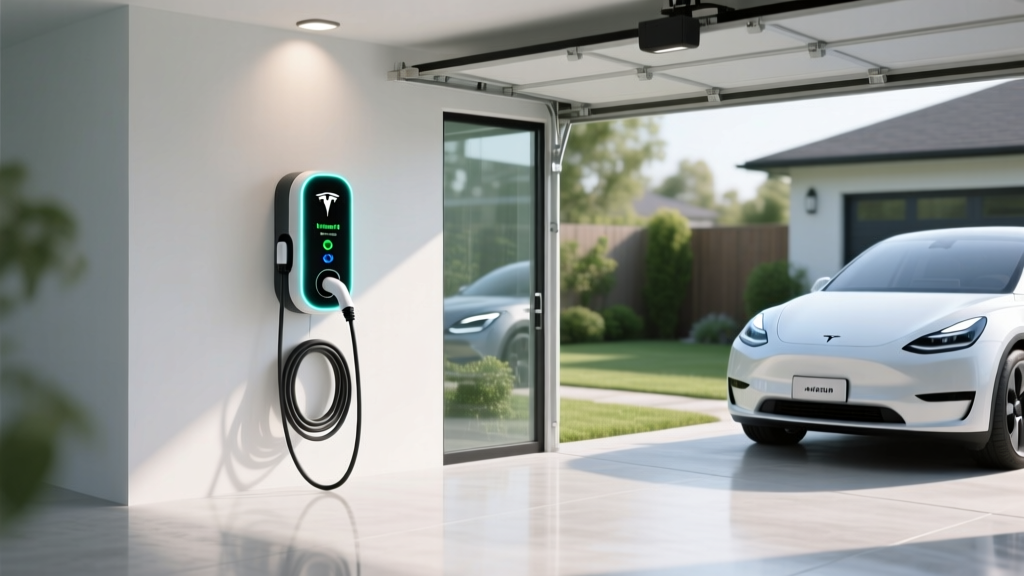
Best Overall: Tesla Wall Connector (J3400/NACS)
- Power Output: Up to 48A (11.5 kW) on a 60A circuit
- Connector: NACS native; J1772 adapter included in box
- Cable Length: 24 feet
- Smart Features: Wi-Fi, over-the-air updates, Tesla app power sharing between two units on one circuit
- Price: ~$420
- Best For: Tesla owners and NACS-equipped 2025–2026 EVs; cleanest integration with Tesla vehicles
Best for Non-Tesla EVs: ChargePoint Home Flex (2nd Gen)
- Power Output: Configurable up to 50A (12 kW) on a 60A circuit; adjustable down to 16A for limited panels
- Connector: J1772 native (CCS compatible); NACS adapter available
- Cable Length: 23 feet
- Smart Features: Wi-Fi, Alexa integration, utility demand-response programs, scheduled charging
- Price: ~$550
- Best For: Mixed-EV households; adjustable amperage avoids panel upgrades
Best Value: Emporia Level 2 EV Charger
- Power Output: Up to 48A (11.5 kW) on a 60A circuit
- Connector: J1772 native (NACS adapter sold separately)
- Cable Length: 24 feet
- Smart Features: Wi-Fi, real-time energy monitoring via Emporia app, solar integration for homes with PV systems
- Price: ~$350
- Best For: Budget-conscious buyers who want smart features without the premium
Best for Outdoor/Exposed Installations: EnelX Way Flex
- Power Output: Up to 40A (9.6 kW) on a 50A circuit
- Connector: J1772 native
- Cable Length: 25 feet
- Smart Features: Wi-Fi, JuiceNet app scheduling, utility integration
- Price: ~$500
- Best For: NEMA 4-rated weather resistance; robust outdoor enclosure
Cost to Charge: Home vs. Public vs. Gas Per Mile
The financial case for home charging rests on one number: the cost per mile. Home electricity rates vary widely, but most US residential customers pay between $0.10 and $0.25 per kWh. A 75 kWh battery charged from 10% to 80% requires roughly 52.5 kWh. At $0.15/kWh, that full session costs $7.88 and delivers approximately 220 real-world miles in a vehicle rated at 3.5 miles per kWh (like a Hyundai Ioniq 5 or Tesla Model Y). That works out to $0.036 per mile.
| Scenario | Rate | Cost for 52.5 kWh (10–80%) | Cost Per Mile (at 3.5 mi/kWh) |
|---|---|---|---|
| Home, off-peak TOU rate | $0.10/kWh | $5.25 | $0.024/mi |
| Home, standard flat rate | $0.15/kWh | $7.88 | $0.036/mi |
| Home, peak TOU rate | $0.25/kWh | $13.13 | $0.060/mi |
| Public Level 2 (ChargePoint, etc.) | $0.30/kWh | $15.75 | $0.071/mi |
| DC Fast Charge (Electrify America) | $0.48/kWh | $25.20 | $0.115/mi |
| Gasoline vehicle (28 MPG combined, $3.40/gal) | $3.40/gal | $26.71 (equiv. 220 mi) | $0.121/mi |
Even at peak residential rates, home charging undercuts gasoline on a per-mile basis. The savings compound dramatically over time: a driver covering 12,000 miles per year saves roughly $1,000–$1,200 annually charging at home versus fueling a 28 MPG gas car. At off-peak TOU (Time-of-Use) rates, savings exceed $1,400 per year. Public DC fast charging, however, approaches gas-car costs — which is exactly why home Level 2 installation pays for itself within 12–24 months for most drivers.
According to fueleconomy.gov, the most efficient EVs in 2026 achieve 3.5–4.5 miles per kWh, meaning real-world cost per mile can drop even lower than the table above suggests. Always check your specific vehicle's efficiency rating rather than assuming a universal number.
Safety, Code, and Installation Best Practices
EV charging is a high-draw, continuous electrical load — it runs at near-maximum capacity for hours at a time. That places demands on wiring and breakers that typical household circuits never experience. Follow these non-negotiable safety requirements:
- Dedicated circuit: Your Level 2 charger must have its own breaker — never shared with other outlets or appliances. A 48A charger needs a dedicated 60A breaker.
- Correct wire gauge: A 60A circuit requires 6 AWG copper wire (or 4 AWG aluminum) for runs up to 50 feet. Longer runs may need thicker wire to prevent voltage drop.
- GFCI protection: NEC 2020 and later require GFCI (Ground Fault Circuit Interrupter) protection for all EV charging outlets. Hardwired chargers may use GFCI breakers; plug-in units on NEMA 14-50 receptacles need GFCI-protected outlets.
- Outdoor rating: If mounting outside a garage, ensure the charger carries a NEMA 4 or IP65 weather rating. Indoor-rated units will degrade rapidly in rain, snow, or humidity.
- NEMA 14-50 vs. hardwired: A NEMA 14-50 receptacle offers portability (take the charger when you move), but hardwired installations eliminate the outlet as a potential failure point and often cost slightly less in materials.
Hire a licensed electrician who has installed EV chargers before. Ask specifically whether they will perform a load calculation and pull a permit. Electricians unfamiliar with EV charging sometimes undersize the circuit or skip the GFCI requirement — both create fire risk.
Charging Time Examples for Common 2026 EV Battery Sizes
How long a Level 2 session takes depends on your battery's usable capacity (in kWh) and your charger's output (in kW). Below are 10% to 80% charge times for popular 2026 models on a 48A (11.5 kW) Level 2 charger:
| Vehicle | Usable Battery (kWh) | 10–80% Charge Energy | Estimated Time |
|---|---|---|---|
| Tesla Model 3 Long Range | 75 kWh | 52.5 kWh | ~4 hrs 34 min |
| Hyundai Ioniq 5 (Long Range AWD) | 77.4 kWh | 54.2 kWh | ~4 hrs 43 min |
| Ford Mustang Mach-E Extended Range | 88 kWh | 61.6 kWh | ~5 hrs 21 min |
| Kia EV9 (Long Range AWD) | 99.8 kWh | 69.9 kWh | ~6 hrs 05 min |
| Chevrolet Equinox EV 3RS | 85 kWh | 59.5 kWh | ~5 hrs 10 min |
| Toyota bZ4X (2026 refresh) | 71.4 kWh | 50.0 kWh | ~4 hrs 21 min |
These times assume the charger sustains full output for the entire session, which is typical for Level 2 (unlike DC fast charging, where taper is significant). In practice, most EV owners charge from 20–80% rather than 10–80%, cutting these times by roughly 20%. Set your vehicle's charge limit to 80% for daily driving to preserve long-term battery health — reserve 100% charges for road trips.
Frequently Asked Questions
Can I install an EV charger myself?
Level 1 (120V) requires no installation — just plug into a standard outlet on a dedicated 15A or 20A circuit. Level 2 (240V) involves high-amperage wiring that carries lethal current and must meet NEC code. Unless you are a licensed electrician, hire a professional. DIY 240V work that fails inspection or causes a fire will not be covered by homeowner's insurance.
Do I need a panel upgrade for a Level 2 charger?
Not always. Homes built after 2000 typically have 200A service with sufficient spare capacity. Homes built before 1990 often have 100A panels that are already near capacity. An electrician's load calculation (usually $100–$200 if not included in the installation quote) will give you a definitive answer. If an upgrade is needed, budget $1,500–$3,000 for the panel work alone.
Should I get a hardwired charger or a NEMA 14-50 outlet?
Hardwired eliminates the receptacle as a wear component and may save $50–$100 on materials. A NEMA 14-50 outlet gives you portability — you can unplug the charger and take it when you move, or use the outlet for a welder or RV. For most homeowners planning to stay put, hardwired is marginally more reliable. For renters or those who may relocate, the outlet offers flexibility.
How fast will a Level 2 charger add range compared to Level 1?
Level 1 at 1.4 kW adds roughly 3–5 miles of range per hour — enough for a 40-mile daily commute if you plug in for 10+ hours. Level 2 at 11.5 kW adds roughly 30–40 miles per hour, meaning a full overnight session (8 hours) adds 240–320 miles of range. For any driver regularly exceeding 40 miles per day, Level 2 is the practical minimum.
Is off-peak (Time-of-Use) charging worth the effort?
If your utility offers TOU rates, scheduling charging between 10 PM and 6 AM can cut your per-kWh cost by 30–50%. Most smart chargers and EVs have built-in scheduling — you plug in when you get home, and the car or charger delays the session until off-peak hours begin. Over a year, this typically saves $200–$400 depending on local rates and driving volume.
Will a home charger increase my home's resale value?
Real estate data suggests a professionally installed, permitted Level 2 charger is a positive signal to EV-shopping buyers but does not typically appraise at full installation cost. Expect to recoup 30–50% of the installation investment at resale. The larger value proposition is convenience and daily cost savings during ownership, not return on investment at sale.
For authoritative guidance on EV efficiency ratings, consult fueleconomy.gov, and for electrical safety standards, reference the National Electrical Code (NFPA 70). Always verify tax credit eligibility directly with the IRS before claiming deductions.