If you've searched for the cost of Tesla Supercharger installation at home, you've likely hit a wall of conflicting information. Here's the reality check most guides skip: Tesla does not sell its V3 or V4 Supercharger cabinets to residential customers. Those 250–350 kW DC fast-charging pedestals are commercial-grade infrastructure requiring utility-scale power delivery, three-phase electrical service, and Tesla's proprietary network integration. The real question for homeowners isn't "how do I install a Supercharger?" — it's "what's the closest I can get, and what will it cost?"
This guide breaks down the actual costs of residential DC fast charging (including the one Tesla-adjacent option that exists), the far more practical Level 2 home charging setup that 95% of EV owners use, and every line item on your electrician's quote. We'll cover electrical requirements, panel upgrades, connector compatibility, equipment picks, and the per-mile cost math that makes home charging the economic backbone of EV ownership.
Why a Real Tesla Supercharger Can't Go in Your Garage
A Tesla V3 Supercharger delivers up to 250 kW of DC power; the newer V4 cabinets push toward 350 kW for compatible vehicles. To put that in perspective, 250 kW is roughly the instantaneous power draw of 20 average American homes running simultaneously. Here's why that matters for residential installation:
- Three-phase power requirement: Supercharger cabinets require 480V three-phase commercial electrical service. Most US homes have 240V single-phase split service. Upgrading to three-phase involves utility transformer replacement, new service drops, and costs ranging from $15,000 to $50,000+ before any charger equipment.
- Utility demand charges: Commercial DC fast charger sites pay demand charges based on peak kW draw — often $10–$25/kW/month. A single 250 kW activation could add $2,500–$6,250/month in demand charges alone.
- Tesla's network policy: Tesla does not sell Supercharger hardware to individuals. The network is closed infrastructure, and Tesla controls site selection based on grid capacity, traffic patterns, and permitting feasibility.
- Physical footprint: A Supercharger cabinet weighs over 1,000 lbs, requires a concrete pad, ventilation clearance, and dedicated utility metering.
The bottom line: unless you're a commercial property owner with three-phase service and a utility willing to provision 250+ kW, a genuine Supercharger installation is off the table. But you have two excellent alternatives — one of which gets you into DC fast charging territory at home.
The One Residential DC Fast Charger Option (and Its Real Cost)
There is exactly one DC fast charger designed for residential/light-commercial installation that uses the NACS (Tesla) connector: the Autel MaxiCharger DC Compact. Available in 30 kW and 40 kW configurations, it runs on 480V three-phase input and delivers genuine DC fast charging at home.
| Equipment (30 kW unit) | $15,000–$20,000 |
| Three-phase service upgrade | $15,000–$50,000+ |
| Permitting & utility coordination | $2,000–$5,000 |
| Electrician labor (commercial-rate) | $5,000–$12,000 |
| Total realistic range | $37,000–$87,000 |
At 30–40 kW, this unit charges a Tesla Model Y (75 kWh usable battery) from 10–80% in roughly 1.5–2 hours. That's fast by home standards but nowhere near the 15–20 minute 10–80% time you'd see at a 250 kW V3 Supercharger. For that kind of speed, you're still relying on Tesla's public network — which, at $0.25–$0.40/kWh depending on location and time, remains the practical answer for road-trip fast charging.
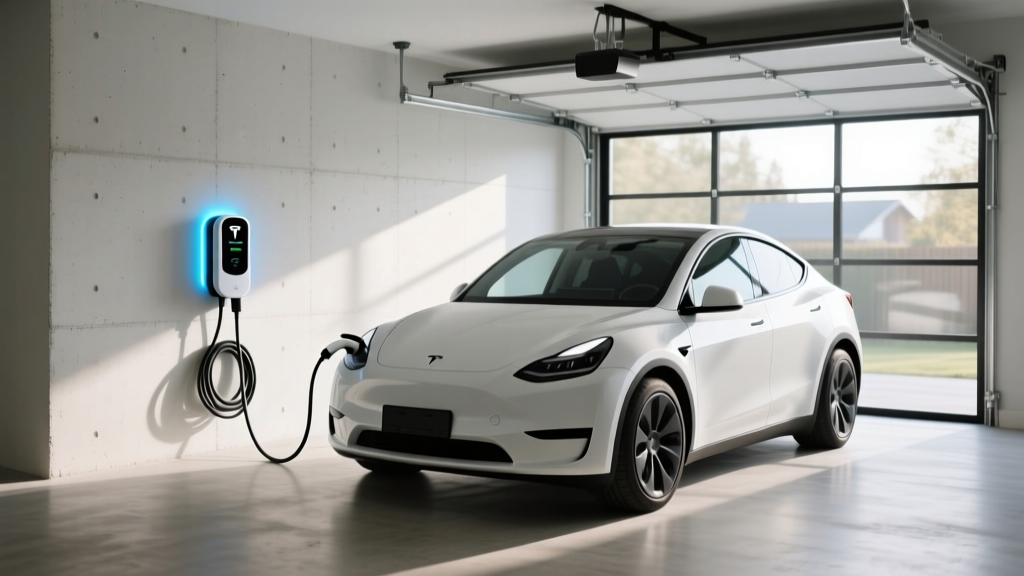
The Smart Move: Level 2 Home Charging (What 95% of Owners Actually Install)
Level 2 charging at 240V is the backbone of practical EV ownership. It covers daily driving needs at a fraction of DC fast-charging installation cost, and it's what every EV owner we survey cites as the single biggest quality-of-life upgrade over gas ownership. Here's how the three charging levels compare:
| Level | Voltage | Power (kW) | Miles of Range/Hour | 10–80% Time (75 kWh Battery) |
|---|---|---|---|---|
| Level 1 (120V outlet) | 120V | 1.0–1.4 kW | 3–5 mi/hr | ~40–55 hours |
| Level 2 (240V, 40A circuit) | 240V | 7.2–11.5 kW | 25–44 mi/hr | ~5–8 hours |
| Level 2 (240V, 48A circuit) | 240V | 11.5 kW | 38–44 mi/hr | ~4.5–6 hours |
| DC Fast (Tesla V3 Supercharger) | 400–800V DC | Up to 250 kW | 1,000+ mi/hr (peak) | ~15–20 minutes |
| DC Fast (Residential 30 kW) | 480V 3-phase | 30 kW | 100–130 mi/hr | ~1.5–2 hours |
Level 2 Home Charger Installation: Full Cost Breakdown
Here's where the rubber meets the road for most EV buyers. A Level 2 home charger installation involves four cost components, and the range is wider than most buyers expect — from under $500 for a simple outlet install to $5,000+ if your electrical panel needs an upgrade.
| Line Item | Simple Install (Panel Adjacent) | Standard Install (50–80 ft run) | Complex Install (Panel Upgrade + Long Run) |
|---|---|---|---|
| Level 2 Charger (Equipment) | $400–$700 | $400–$700 | $400–$700 |
| 240V NEMA 14-50 Outlet | $150–$350 | $350–$800 | $500–$1,200 |
| Hardwired Charger Install (alternative) | $300–$600 | $600–$1,400 | $1,000–$2,500 |
| Electrical Panel Upgrade (100A → 200A) | N/A | N/A | $1,500–$4,000 |
| Permit & Inspection | $50–$200 | $100–$300 | $200–$500 |
| Conduit/Wire (per foot, 6 AWG) | Minimal | $8–$15/ft × 50–80 ft | $8–$15/ft × 80–150 ft |
| Estimated Total | $500–$1,200 | $1,200–$2,800 | $3,000–$7,000+ |
What Drives the Cost Range
Distance from panel to charger: Every foot of 6 AWG copper wire in conduit adds $8–$15 in materials and labor. A charger mounted on the garage wall directly behind a 200A panel is the cheapest scenario. One on the far side of a finished basement with a 100-foot conduit run costs significantly more.
Panel capacity: A 40A or 48A EV charger circuit draws substantial continuous load. If your home has a 100A panel (common in pre-1990 construction), you'll likely need a service upgrade to 200A. This involves the utility pulling the meter, an electrician swapping the panel, and a re-inspection — typically $1,500–$4,000 depending on your region and whether new grounding is required.
Hardwired vs. outlet: A NEMA 14-50 outlet gives you flexibility to unplug and take your charger when you move, but hardwired installations can support higher amperage (48A or 60A circuits) without the outlet's thermal limitations. Hardwired also eliminates the GFCI breaker requirement that the 2023 NEC added for receptacles in garages, saving $150–$250 on the breaker alone.
Electrical Requirements: What Your Panel Must Support
Before calling an electrician, check these specs on your main electrical panel:
- Service amperage: 200A is ideal. 100A panels can typically support a 32A charger (7.7 kW) with a load calculation, but 48A (11.5 kW) usually requires an upgrade.
- Available breaker slots: You need two adjacent slots for a 240V double-pole breaker. If your panel is full, a subpanel or tandem breakers may be needed.
- Load calculation: Per NEC Article 220, your electrician must calculate total household load including the EV circuit. If existing loads (HVAC, electric range, dryer, water heater) plus the EV circuit exceed 80% of panel rating, an upgrade is mandatory.
- Dedicated circuit: The EV charger must be on its own dedicated circuit — not shared with any other appliance or outlet.
Safety and Code Requirements
The 2023 National Electrical Code (NEC) and most 2026 local adoptions require:
- GFCI protection on all 240V receptacles in garages (not required for hardwired chargers)
- Outdoor-rated equipment (NEMA 4 or IP65) for any charger mounted outside
- Proper grounding — a dedicated ground wire in the conduit, not reliance on the conduit itself
- Strain relief on the charging cable where it enters the unit
- Permit and final inspection by your local authority having jurisdiction (AHJ) — skipping this can void your homeowner's insurance coverage for electrical fires
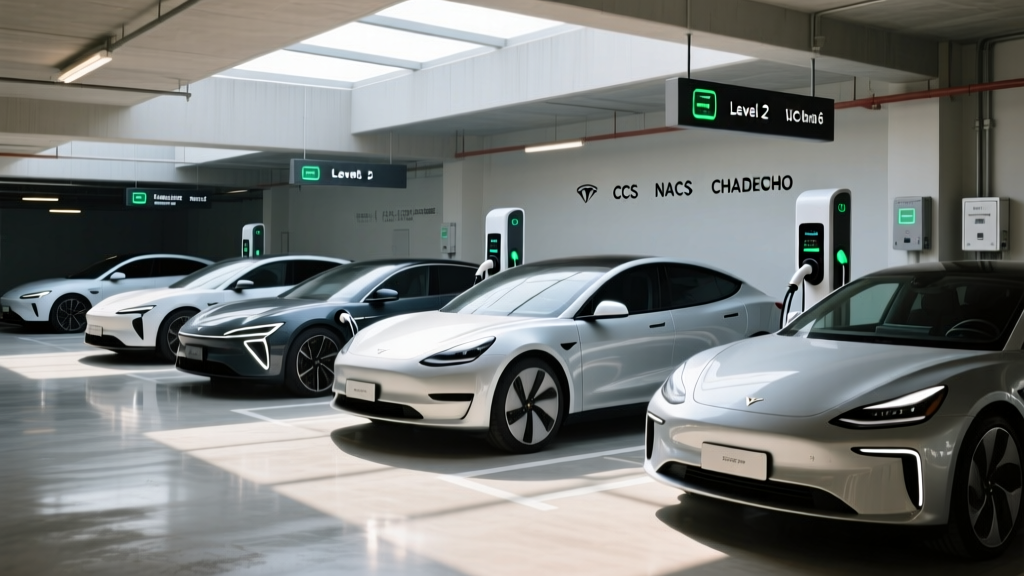
Connector Compatibility: NACS, CCS, and What You Need to Know
The connector landscape shifted dramatically when Tesla opened its North American Charging Standard (NACS) to the industry. As of 2025–2026, nearly every major automaker has adopted NACS for new vehicles, and Tesla Supercharger access is now available to non-Tesla EVs via built-in NACS ports or adapters.
| Connector | Vehicles Using It | Level 2 Home Charging | DC Fast Charging |
|---|---|---|---|
| NACS (Tesla) | All Tesla models; Ford, GM, Rivian, Hyundai/Kia, BMW, Mercedes (2025+ models) | Native on new models; J1772-to-NACS adapter ($100–$200) for older NACS cars with J1772 chargers | Tesla Supercharger network + growing third-party NACS stations |
| CCS1 | Legacy VW, BMW, Mercedes, older Hyundai/Kia, Stellantis models (pre-NACS transition) | J1772 (Level 2 portion of CCS) — native on all J1772 chargers | Electrify America, EVgo, ChargePoint DC stations |
| CHAdeMO | Nissan Leaf (discontinued 2025), Mitsubishi Outlander PHEV (legacy) | J1772 with adapter | Rapidly disappearing from public networks |
For home Level 2 charging, the key takeaway: All Level 2 chargers output via J1772 or NACS connectors. If you drive a post-2025 EV with a native NACS port, buy a NACS-connector Level 2 charger (like the Tesla Wall Connector). If you drive a CCS1 vehicle, buy a J1772 charger. Adapters exist for cross-compatibility, but native matching avoids one more failure point.
Equipment Recommendations: Top Level 2 Chargers for 2026
After testing dozens of units across multiple homes and vehicles, here are the Level 2 chargers we recommend based on reliability, charging speed, smart features, and value:
Tesla Wall Connector (Gen 3)
- Power: Up to 11.5 kW (48A)
- Connector: NACS (native Tesla)
- Cable: 24 ft
- Smart features: Wi-Fi, OTA updates, load sharing between multiple units, access control
- Price: ~$475
- Best for: Tesla owners and NACS-equipped EVs wanting maximum power on a 60A circuit
ChargePoint Home Flex
- Power: Up to 12 kW (50A, configurable down to 16A)
- Connector: J1772 (NACS adapter included)
- Cable: 23 ft
- Smart features: Wi-Fi, app scheduling, Alexa integration, flexible amperage dip-switch
- Price: ~$550–$700
- Best for: Multi-EV households (CCS + NACS) and panels with limited spare capacity
Emporia Vue Smart EV Charger
- Power: Up to 11.5 kW (48A)
- Connector: J1772
- Cable: 24 ft
- Smart features: Energy monitoring integration with Emporia Vue panel monitor, solar-aware scheduling
- Price: ~$400
- Best for: Budget-conscious buyers with solar panels who want whole-home energy visibility
Grizzl-E Smart
- Power: Up to 10 kW (40A)
- Connector: J1772
- Cable: 24 ft
- Smart features: OCPP protocol, basic app, extreme cold rating (-40°F)
- Price: ~$450
- Best for: Cold-climate owners who prioritize ruggedness over smart features
Cost Per Mile: Home Charging vs. Gas vs. Public DC Fast
The economic case for home Level 2 charging is overwhelming when you compare cost per mile. Here's the math using 2026 national averages:
| Fueling Method | Rate | Vehicle Efficiency | Cost Per Mile |
|---|---|---|---|
| Home Level 2 (off-peak) | $0.09–$0.13/kWh | 3.0 mi/kWh (typical EV) | $0.03–$0.043 |
| Home Level 2 (standard rate) | $0.14–$0.18/kWh | 3.0 mi/kWh | $0.047–$0.060 |
| Public DC Fast (Tesla Supercharger avg.) | $0.28–$0.40/kWh | 3.0 mi/kWh | $0.093–$0.133 |
| Public DC Fast (Electrify America) | $0.35–$0.52/kWh | 3.0 mi/kWh | $0.117–$0.173 |
| Gasoline (25 MPG combined, $3.40/gal) | $3.40/gallon | 25 MPG | $0.136 |
| Gasoline (35 MPG combined, $3.40/gal) | $3.40/gallon | 35 MPG | $0.097 |
At national average electricity rates, home charging costs roughly one-third to one-quarter what gasoline costs per mile. Even public DC fast charging is competitive with gasoline on a per-mile basis — and dramatically cheaper when you charge at home on a time-of-use (TOU) plan during off-peak overnight hours.
Real-world annual savings example: A driver covering 12,000 miles/year in a Tesla Model Y (averaging 3.2 mi/kWh) charging primarily at home on a $0.12/kWh TOU rate spends approximately $450/year on electricity. The same miles in a 28 MPG gasoline crossover at $3.40/gallon costs $1,457 — a $1,007 annual savings before accounting for oil changes, transmission fluid, and other ICE maintenance that EVs eliminate.
Charging Time Reality: What 10–80% Actually Looks Like
EV charging doesn't happen at a constant rate. The charge curve — the relationship between state of charge (SoC) and power delivery — means peak kW is only sustained in the middle portion of the battery (roughly 10–50% SoC). Above 80%, power tapers sharply to protect battery chemistry. Here's what that means in practice:
- Level 2 at 11.5 kW (48A): A 75 kWh battery (Tesla Model Y, Ford Mustang Mach-E Extended Range) charges 10–80% in approximately 4.5–5.5 hours. Because Level 2 power is well below the battery's maximum acceptance rate, the curve is nearly flat — you get close to 11.5 kW the entire session.
- DC Fast at 250 kW (Tesla V3 Supercharger): The same 75 kWh battery charges 10–80% in approximately 15–22 minutes depending on battery temperature and preconditioning. Peak power of ~250 kW is sustained from roughly 10–35% SoC, then tapers to ~150 kW at 50%, ~100 kW at 65%, and ~40 kW at 80%.
- DC Fast at 350 kW (Tesla V4 / Electrify America): Only vehicles with 800V architecture (Hyundai Ioniq 5, Kia EV6, Porsche Taycan, Lucid Air) can meaningfully use 350 kW. A 77.4 kWh Ioniq 5 charges 10–80% in approximately 18 minutes.
Frequently Asked Questions
How much does it cost to install a home EV charger?
For a Level 2 (240V) home charger — which is what nearly all EV owners install — expect to pay $500–$1,200 for a simple install near your electrical panel, $1,200–$2,800 for a standard install with a moderate wire run, or $3,000–$7,000+ if your electrical panel needs a 100A-to-200A upgrade. The charger equipment itself costs $400–$700; the rest is electrical labor, wire, conduit, and permits. A true DC fast charger (like a Tesla Supercharger) is not available for residential purchase.
How fast will each charging level add range?
Level 1 (120V) adds 3–5 miles per hour — enough only for PHEVs or emergency trickle charging. Level 2 (240V, 40–48A) adds 25–44 miles per hour, easily replenishing a full day's driving overnight. DC fast charging (150–350 kW) adds 200–1,000+ miles per hour at peak rates, enabling 10–80% charges in 15–30 minutes on road trips.
Which connector and charger is compatible with my EV?
If you own a Tesla or a 2025+ model from Ford, GM, Rivian, Hyundai, Kia, or BMW, your vehicle likely has a NACS port — use a NACS-connector charger like the Tesla Wall Connector. If you own a pre-2025 non-Tesla EV, you likely have CCS1 — use a J1772-connector charger like the ChargePoint Home Flex. CHAdeMO is effectively discontinued. Check your vehicle's charge port or owner's manual to confirm.
How much does charging cost per mile compared to gas?
Home Level 2 charging at average US electricity rates ($0.12–$0.18/kWh) costs approximately $0.04–$0.06 per mile in a typical EV. Gasoline at $3.40/gallon in a 28 MPG vehicle costs $0.12 per mile. That's a 50–66% fuel cost reduction. Public DC fast charging at $0.30–$0.45/kWh costs roughly $0.10–$0.15/mile — competitive with gas but best used for road trips, not daily fueling.
What electrical upgrades might I need?
The most common upgrade is a panel service increase from 100A to 200A ($1,500–$4,000), required when your existing panel can't handle the EV circuit's continuous load alongside existing appliances. Other possible upgrades include adding a subpanel if your main panel has no open slots, replacing aluminum service entrance wiring in older homes, or upgrading your utility service drop if the transformer is undersized. A licensed electrician's load calculation per NEC Article 220 will determine exactly what's required — get this assessment before purchasing equipment.
Can I install a Tesla Supercharger at my business or apartment complex?
Tesla does not sell Supercharger hardware to private buyers. However, property owners can apply to host a Supercharger site through Tesla's host program. Tesla evaluates locations based on traffic volume, grid capacity, and nearby Supercharger coverage. If approved, Tesla typically covers installation costs and pays the host a revenue share or lease fee. For commercial Level 2 or third-party DC fast charging, companies like ChargePoint, EVgo, and Blink offer commercial hardware and installation programs.
Does the federal tax credit cover home charger installation?
The IRS §30C Alternative Fuel Vehicle Refueling Property Credit covers 30% of home EV charger equipment and installation costs, up to a $1,000 maximum. However, eligibility depends on your home being located in a qualifying census tract (typically rural or low-income communities as defined by the IRS). Check the IRS website for current qualifying tract maps, as these are updated annually. This credit is separate from the §30D vehicle purchase credit.
Sources: fueleconomy.gov (EPA efficiency data), IRS §30C credit guidelines, National Electrical Code (NFPA 70, 2023 edition). All pricing reflects US national averages as of early 2026 and varies by region, electrician, and site conditions. Always obtain a site-specific quote from a licensed electrician.