The Real Cost of Installing a Tesla Charger at Home
If you own a Tesla — or any EV with a NACS port — home charging is the single biggest ownership upgrade you can make. But the cost of Tesla charger installation varies wildly depending on your home's electrical panel, the distance from panel to parking spot, and which charger you choose. In 2026, most homeowners spend between $800 and $3,500 for a complete Tesla Wall Connector installation, with the national average landing around $1,400 to $1,800 for a straightforward setup.
That range is wide for a reason. A simple install on a modern 200-amp panel with the charger mounted 10 feet away might cost under $1,000. A complex run requiring a panel upgrade, trenching, or a 60-foot conduit path can push past $4,000. This guide breaks down every cost component so you can budget accurately before calling an electrician.
Understanding Charging Levels: Speed, Power, and What You Actually Need
Before pricing an installation, it's essential to understand what each charging level delivers. The distinction between kW (kilowatts — the rate of power flow, like water pressure) and kWh (kilowatt-hours — the total energy delivered, like gallons of water) is the single most important concept in EV charging. Your charger's kW rating determines how fast it fills your battery's kWh capacity.
| Level | Voltage | Max Power (kW) | Miles of Range Per Hour | Typical Use |
|---|---|---|---|---|
| Level 1 | 120V AC | 1.0–1.4 kW | 3–5 mi/hr | Overnight trickle; PHEVs or low-mileage drivers |
| Level 2 | 240V AC | 3.3–19.2 kW | 12–75 mi/hr | Primary home charging; the standard setup |
| DC Fast Charge | 400–800V DC | 50–350+ kW | 150–1,000+ mi/hr | Road trips; public stations (not home-installable) |
For home installation, Level 2 is the standard. The Tesla Wall Connector delivers up to 11.5 kW (48 amps) on a 60-amp circuit, adding roughly 44 miles of range per hour to a Model 3 or Model Y. That's enough to fully replenish a 75 kWh battery overnight in about 7–8 hours. Level 1, by contrast, would take over 3 days for the same battery — impractical for most BEV owners.
DC fast charging is relevant for road trips (Tesla Superchargers peak at 250 kW for V3 stalls, adding up to 200 miles in 15 minutes), but you cannot install DC fast-charging equipment at a typical residence due to the extreme power requirements and cost.
Electrical Requirements for a Tesla Wall Connector
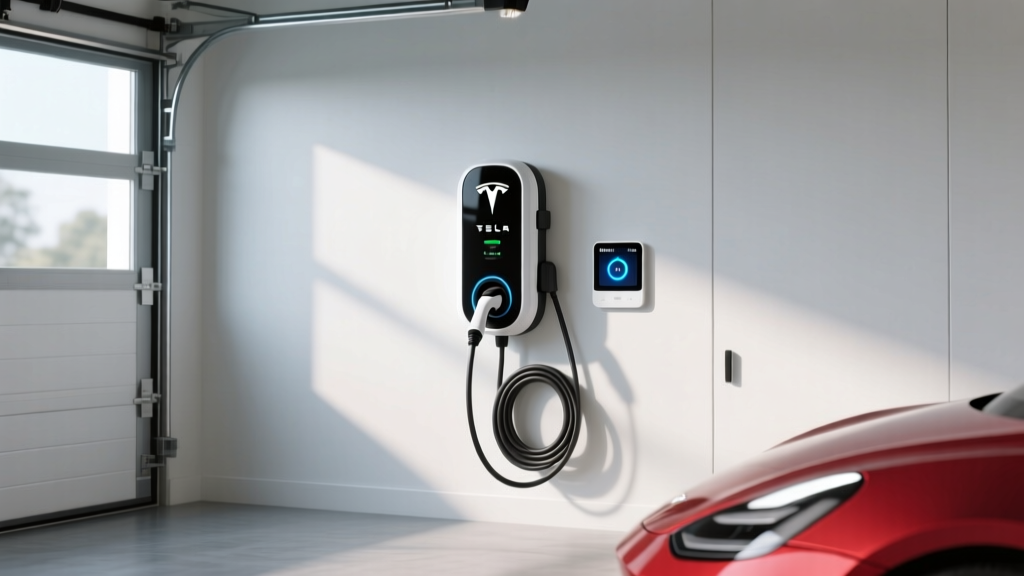
The Tesla Wall Connector is a hardwired Level 2 charger, meaning it connects directly to your electrical panel via a dedicated circuit — no plug. Here's what your electrician will assess:
Circuit and Amperage
- Recommended circuit: 60-amp breaker, delivering up to 48 amps continuous to the vehicle (NEC requires circuits be rated at 125% of continuous load, so 48A continuous = 60A breaker)
- Wire gauge: Typically 6 AWG copper (THHN in conduit) for runs up to ~100 feet; 4 AWG for longer runs to minimize voltage drop
- Alternative: The Wall Connector can be configured for lower amperage (16A, 24A, 32A, or 40A) if your panel can't support a 60A circuit — this is a common solution for older homes
Panel Capacity and Upgrade Needs
Your home's electrical panel has a maximum amperage rating — typically 100A, 150A, or 200A. Adding a 60A EV circuit to an already-loaded 100A panel is often impossible without an upgrade. Your electrician will perform a load calculation (per NEC Article 220) to determine available capacity.
Homes with 200A panels and gas appliances usually have enough headroom. All-electric homes with heat pumps, electric ranges, and electric dryers on a 150A panel may need to upgrade to 200A or use a lower-amperage charger configuration.
Permitting and Code
Most jurisdictions require an electrical permit for a new 240V circuit. Permit costs typically run $50 to $200, and the work must pass inspection. Your electrician handles this. Key code requirements include:
- Dedicated circuit (no sharing with other appliances)
- GFCI protection is generally not required for hardwired EV chargers per NEC 2023/2026, but local amendments vary
- Outdoor installations require a NEMA 4-rated enclosure (the Tesla Wall Connector is rated for indoor and outdoor use)
- Proper conduit and wire routing per NEC Article 625 (EV charging system installations)
Tesla Charger Installation Cost: Full Breakdown
Here's where the numbers come together. The total cost of Tesla charger installation has three main components: the charger hardware, electrical labor and materials, and permitting. Below is a realistic breakdown based on 2026 pricing data from licensed electricians and Tesla's own installer network.
| Component | Simple Install | Moderate Install | Complex Install |
|---|---|---|---|
| Tesla Wall Connector (hardware) | $450–$500 | $450–$500 | $450–$500 |
| Electrical labor (licensed electrician) | $300–$600 | $600–$1,200 | $1,200–$2,500 |
| Materials (wire, conduit, breaker, fittings) | $100–$200 | $200–$500 | $400–$800 |
| Permit fee | $50–$100 | $75–$150 | $100–$200 |
| Panel upgrade (if needed) | $0 | $0 | $1,500–$3,000+ |
| Total Estimated Cost | $900–$1,400 | $1,325–$2,350 | $3,650–$7,000 |
What Defines Each Scenario
- Simple install: 200A panel with available capacity, charger mounted within 10–15 feet of the panel on the same wall, no trenching or attic crawl required.
- Moderate install: 30–50 foot wire run through attic or crawlspace, surface-mounted conduit on a garage wall, panel has capacity but the route is longer.
- Complex install: Panel upgrade from 100A to 200A, wire runs exceeding 60 feet, trenching for a detached garage, or upgrading from aluminum to copper service wiring.
Charging Time Examples: How Long Does a Full Charge Take?
Charge time depends on your vehicle's battery capacity (in kWh) and the charger's power output (in kW). Here are real-world examples using the Tesla Wall Connector at its maximum 11.5 kW output:
| Vehicle | Battery Capacity (usable kWh) | 10–80% Time | 0–100% Time |
|---|---|---|---|
| Tesla Model 3 RWD (LFP) | 57.5 kWh | ~3.5 hours | ~5.0 hours |
| Tesla Model 3 Long Range | 75 kWh (NMC) | ~4.5 hours | ~6.5 hours |
| Tesla Model Y Long Range | 75 kWh (NMC) | ~4.5 hours | ~6.5 hours |
| Tesla Cybertruck AWD | 123 kWh (NMC) | ~7.5 hours | ~10.7 hours |
| Ford F-150 Lightning (Extended) | 131 kWh (NMC) | ~8.0 hours | ~11.4 hours |
For context, most EV owners charge from roughly 20% to 80% overnight — a window that takes 4–5 hours for most Tesla models on an 11.5 kW Wall Connector. Since the average American drives under 40 miles per day according to FHWA data, even a lower-power 7.7 kW (32A) setup easily replenishes daily use in a few hours.
Charging curve note: At Level 2, the charge rate stays relatively constant throughout the session. Unlike DC fast charging — where speeds taper sharply above 80% State of Charge — Level 2 charging delivers near-peak power until the battery is nearly full. This makes overnight Level 2 charging highly predictable.
Connector Compatibility: NACS, CCS, and Adapters
As of 2026, the North American Charging Standard (NACS) — originally Tesla's proprietary connector — has become the dominant EV charging connector. Most major automakers have adopted NACS for new vehicles, though many EVs on the road still use CCS1. Here's how compatibility breaks down:
| Connector | Vehicles Using It | Tesla Wall Connector Compatible? | Adapter Needed? |
|---|---|---|---|
| NACS (Tesla) | All Teslas; 2025+ Ford, GM, Rivian, Volvo, Polestar, BMW, Mercedes, Hyundai, Kia EVs | Yes — native fit | None |
| CCS1 | Pre-2025 non-Tesla EVs (VW ID.4, Hyundai Ioniq 5 pre-2025, Kia EV6 pre-2025, BMW i4) | No — NACS plug only | NACS-to-CCS adapter (~$150–$250) |
| CHAdeMO | Nissan Leaf (legacy) | No | No widely available adapter; use separate J1772 charger |
| J1772 | All non-Tesla EVs (for Level 1/2 AC charging) | No — NACS plug only | Tesla provides a J1772-to-NACS adapter with vehicle; or buy a J1772 charger |
The Tesla Wall Connector ships with a NACS plug. If you own a non-Tesla EV with a CCS1 port (common for 2022–2024 models), you can use a NACS-to-CCS adapter to charge from the Wall Connector. Brands like Tesla, Lectron, and A2Z sell these adapters for $150–$250. Alternatively, consider a universal Level 2 charger with a J1772 plug and use your vehicle's J1772-to-NACS adapter (included with most newer Teslas).
Cost to Charge: Home Electricity vs. Gas vs. Public Charging
One of the strongest arguments for home charging is cost. Let's compare the per-mile fuel cost of home electricity, public Level 2, DC fast charging, and gasoline using 2026 average rates:
| Fueling Method | Rate | Cost per Mile (3.5 mi/kWh EV) | Cost per Mile (28 MPG gas car) |
|---|---|---|---|
| Home (national avg electricity, 16¢/kWh) | $0.16/kWh | $0.046 | — |
| Home (off-peak TOU rate, 8¢/kWh) | $0.08/kWh | $0.023 | — |
| Public Level 2 (ChargePoint, EVgo) | $0.25–$0.40/kWh | $0.071–$0.114 | — |
| DC Fast Charging (Tesla Supercharger, EA) | $0.28–$0.48/kWh | $0.080–$0.137 | — |
| Gasoline (national avg $3.40/gal) | $3.40/gallon | — | $0.121 |
At the national average residential electricity rate of roughly $0.16/kWh (per EIA data), charging a Tesla Model 3 at home costs about 4.6 cents per mile. With a time-of-use (TOU) plan that offers off-peak rates around 8¢/kWh, that drops to just 2.3 cents per mile — roughly one-fifth the cost of gasoline.
Even DC fast charging at $0.35/kWh averages about 10 cents per mile, still below the gas car's 12 cents. The real savings come from consistent home charging. A driver covering 12,000 miles per year saves roughly $900–$1,200 annually by charging at home versus buying gas.
Recommended Home Chargers for Tesla and NACS Vehicles
The Tesla Wall Connector is the obvious default for Tesla owners, but several competitive options exist — especially if you need J1772 compatibility for a multi-EV household. Here's how the top picks compare:
Tesla Wall Connector (Gen 4)
- Power output: Up to 11.5 kW (48A) on a 60A circuit
- Connector: NACS (native Tesla plug)
- Cable length: 24 feet
- Smart features: Wi-Fi connectivity, OTA updates, power-sharing between multiple units, scheduled charging, Tesla app integration
- Price: ~$450–$500
- Best for: Tesla-only households wanting seamless integration
ChargePoint Home Flex (NACS version)
- Power output: Up to 12 kW (50A) on a 60A circuit; configurable down to 16A
- Connector: NACS (2025+ models) or J1772
- Cable length: 23 feet
- Smart features: Wi-Fi, ChargePoint app, Alexa integration, detailed energy tracking, flexible amperage configuration
- Price: ~$550–$650
- Best for: Multi-EV households, users wanting detailed energy data
Emporia Level 2 EV Charger
- Power output: Up to 11.5 kW (48A) on a 60A circuit
- Connector: J1772 (use adapter for NACS) or NACS (2025+ version)
- Cable length: 24 feet
- Smart features: Wi-Fi, Emporia app, integrates with Emporia home energy monitor, solar-aware charging, load management
- Price: ~$350–$400
- Best for: Budget-conscious buyers, solar-panel households
For a Tesla-only household, the Tesla Wall Connector remains the best value — it's competitively priced, delivers full 11.5 kW, and integrates directly with your vehicle's charging settings. If you have a non-Tesla EV with a J1772 port alongside a Tesla, the ChargePoint Home Flex offers the most flexibility with its configurable amperage and robust app.
Safety, Code Compliance, and Installation Best Practices
EV charger installation involves high-amperage, continuous-load electrical work. Cutting corners creates fire risk. Here's what to insist on:
- Use a licensed electrician: Not a handyman, not DIY. EV charging circuits draw sustained high current for hours — improper connections overheat. Verify your electrician is familiar with NEC Article 625.
- Dedicated circuit only: The Wall Connector must have its own breaker — never shared with an outlet, dryer, or HVAC system.
- Proper wire gauge: 6 AWG copper minimum for 48A continuous on a 60A breaker. Undersized wire is the most common code violation.
- Outdoor rating: If mounting outside, confirm the unit's NEMA 4 rating and that all conduit connections are weatherproofed. The Tesla Wall Connector is rated for both indoor and outdoor use.
- Load management: If your panel is near capacity, consider the Tesla Wall Connector's built-in load management feature (or a third-party load-management device) that dynamically reduces charge rate when other appliances activate.
- Permit and inspect: Always pull a permit. The inspection protects you — it verifies the work meets code and ensures your homeowner's insurance remains valid.
Federal Tax Credit for Home Charger Installation
The federal Alternative Fuel Vehicle Refueling Property Credit (IRS Form 8911) can offset up to 30% of home EV charger installation costs, capped at $1,000. However, eligibility is restricted:
- The charger must be installed at your primary residence
- The property must be located in an eligible census tract (non-urban or low-income community as defined by the IRS — many suburban and rural areas qualify, but most urban cores do not)
- The credit is non-refundable (you must have tax liability to claim it)
- Equipment and labor both count toward the $1,000 cap
Always consult a tax professional to confirm eligibility, as census tract qualifications and IRS guidance are subject to change. Check the IRS website for current-year rules before filing.
Frequently Asked Questions
How much does it cost to install a Tesla charger at home?
The total cost of Tesla charger installation ranges from $900 to $3,500 for most homes, with the national average around $1,400–$1,800. This includes the Tesla Wall Connector ($450–$500), electrician labor ($300–$2,500 depending on wire run complexity), materials ($100–$800), and permit fees ($50–$200). Homes requiring a 200A panel upgrade should add $1,500–$3,000+.
Can I install a Tesla charger myself?
Tesla's Wall Connector is hardwired and requires a dedicated 240V circuit installed by a licensed electrician. While technically possible for a skilled homeowner, most jurisdictions require a permit and inspection for new 240V circuits, and improper installation creates serious fire and insurance-liability risk. Professional installation is strongly recommended.
Do I need a 200-amp electrical panel for a Tesla charger?
Not necessarily. A 200A panel makes a 60A/48A charger installation straightforward, but many 100A and 150A panels can support a lower-amperage charger. The Tesla Wall Connector can be configured for 32A (7.7 kW) or 40A (9.6 kW) on smaller circuits, which still provides ample overnight charging for most drivers. Your electrician's load calculation determines what's safe.
How fast does a Tesla Wall Connector charge compared to a regular outlet?
A standard 120V outlet (Level 1) adds about 3–5 miles of range per hour — roughly 30–50 miles overnight. The Tesla Wall Connector at 11.5 kW adds approximately 44 miles per hour, fully charging most Tesla models in 5–7 hours. For daily driving under 50 miles, even Level 1 can work, but Level 2 is the practical standard for BEV owners.
Will a Tesla Wall Connector work with non-Tesla EVs?
The Tesla Wall Connector has a NACS plug, which fits all Tesla vehicles and 2025+ Ford, GM, Rivian, and other NACS-equipped EVs natively. For older non-Tesla EVs with CCS1 ports, a NACS-to-CCS adapter ($150–$250) enables compatibility. CHAdeMO vehicles like the Nissan Leaf cannot use the Wall Connector without a specialized adapter that is not widely available.
How much does it cost to charge a Tesla at home per month?
At the national average electricity rate of $0.16/kWh, driving 1,000 miles per month in a Model 3 (roughly 3.5 mi/kWh) costs about $46/month in electricity. With an off-peak TOU rate of $0.08/kWh, that drops to roughly $23/month. Compare that to $121/month in gasoline for a 28 MPG car at $3.40/gallon.