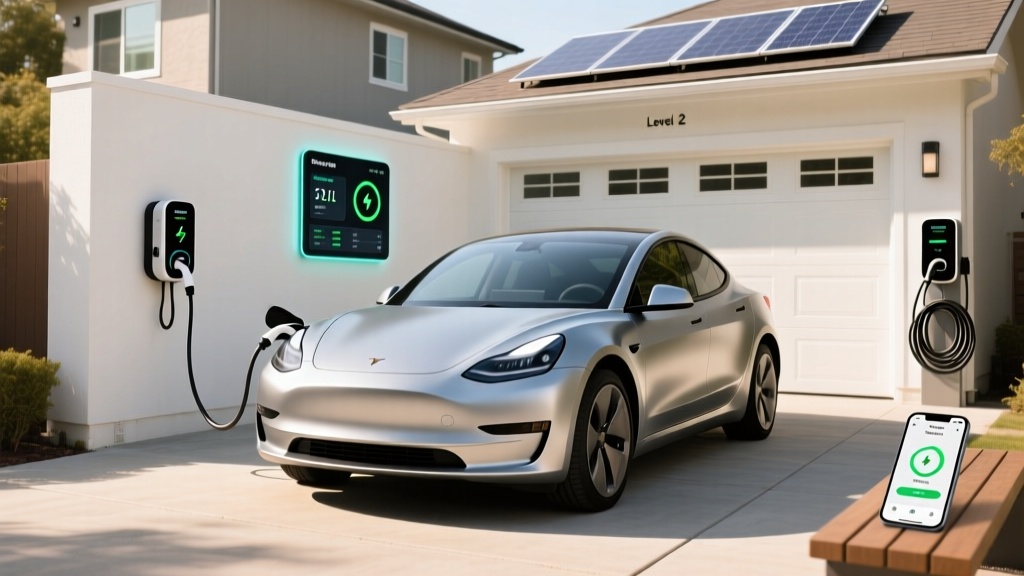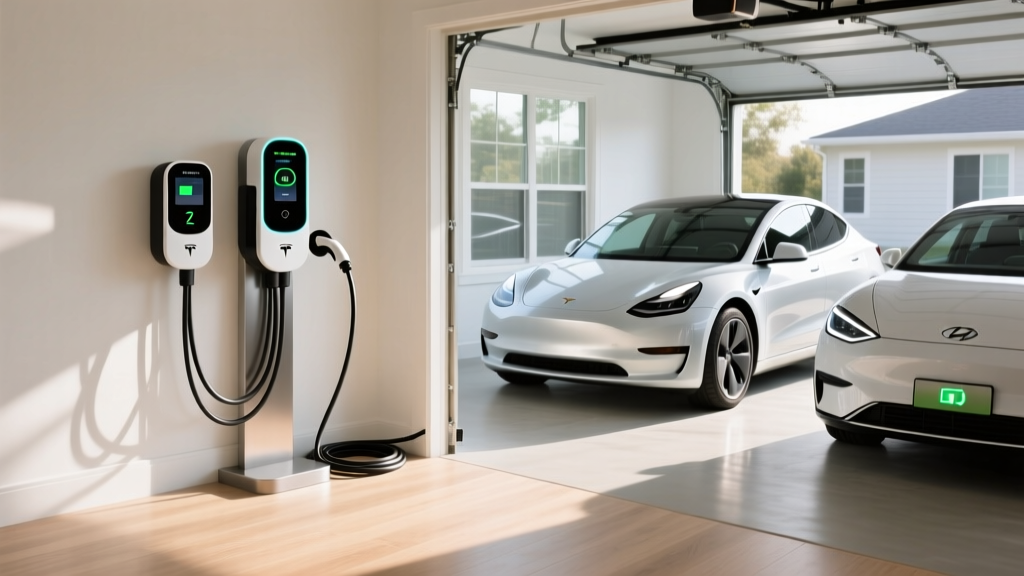
Buying an electric vehicle is only half the equation. The other half—where you'll actually refuel it on a daily basis—comes down to your home electrical setup. If you're researching the cost of home charging station installation, you've likely seen estimates ranging from $500 to $5,000+, and that spread isn't a mistake. The final price depends on your panel capacity, the distance from your electrical panel to the charger location, local permit fees, and whether you choose a hardwired unit or a plug-in model on a 240V outlet.
This guide breaks down every cost layer—equipment, labor, permits, and potential panel upgrades—using real 2026 pricing and installer data. We'll also cover charging speeds, connector compatibility, and exactly what you'll pay per mile compared to gasoline.
The Three Charging Levels: Speed, Power, and What They Mean for Your Home
Before calculating installation cost, you need to understand what each charging level delivers. EV charging is measured in kW (kilowatts), which is the rate of power delivery. The energy stored in your battery is measured in kWh (kilowatt-hours)—think of kW as the speed of water flowing through a hose and kWh as the total volume in the bucket. These units are not interchangeable.
| Level | Voltage | Max Power (kW) | Miles of Range Added Per Hour | Typical Use Case |
|---|---|---|---|---|
| Level 1 | 120V AC | 1.2–1.9 kW | 3–5 miles | Overnight top-up; PHEVs; low-mileage drivers |
| Level 2 | 240V AC | 3.3–19.2 kW | 12–75 miles | Daily home charging; the standard home setup |
| DC Fast Charging | 400–800V DC | 50–350+ kW | 150–1,200+ miles (theoretical) | Road trips; public stations; not for home install |
For home installation, Level 2 is the standard. Level 1 requires no special equipment—just a standard 120V household outlet—but adds so little range that it's impractical for most BEV owners who drive more than 30 miles per day. DC fast charging is a public-infrastructure technology; no residential setup delivers DC power to a vehicle.
Most home Level 2 chargers operate at 7.7 kW (32A on a 40A circuit) or 11.5 kW (48A on a 60A circuit). A 48A charger will replenish a 75 kWh battery (like the Tesla Model Y Long Range) from 10% to 80% in roughly 6.5 hours. A 32A unit takes closer to 9 hours for the same charge—still perfectly adequate for overnight charging.
How Much Does It Cost to Install a Home EV Charger? Full 2026 Breakdown
The total cost of home charging station installation in 2026 typically falls between $800 and $3,500 for a straightforward job, and $3,500 to $7,000+ if your home requires a panel upgrade or a long conduit run. Here's where every dollar goes:
| Cost Component | Simple Install Range | Complex Install Range | Notes |
|---|---|---|---|
| Level 2 Charging Equipment | $300–$500 | $500–$750 | Smart Wi-Fi chargers (ChargePoint, Emporia, Wallbox) vs. premium units (Tesla Universal Wall Connector) |
| Electrician Labor (Licensed) | $400–$800 | $800–$2,500 | Depends on run length, wall/foundation penetration, and local hourly rates ($75–$150/hr) |
| Electrical Permit | $50–$150 | $150–$400 | Varies by municipality; some jurisdictions bundle with inspection |
| Materials (conduit, wire, breaker) | $100–$250 | $250–$600 | 6 AWG copper for 48A circuits; longer runs = more wire cost |
| Panel Upgrade (if needed) | $0 | $1,500–$4,000 | Required if your panel is 100A or has no spare breaker slots; upgrading to 200A service |
| Total Estimated Cost | $850–$1,700 | $3,200–$8,250 | Most homeowners fall in the $1,200–$2,500 range |
What Triggers a Panel Upgrade?
Homes built before 1990 often have 100-amp electrical service. A 48A Level 2 charger draws approximately 11.5 kW continuously, which can consume 50–60% of a 100A panel's total capacity (after applying the NEC 80% continuous-load rule). If your panel is already near capacity with HVAC, electric range, dryer, and water heater loads, a licensed electrician will recommend upgrading to a 200-amp service panel before adding a dedicated EV circuit.
A panel upgrade costs $1,500 to $4,000 depending on your utility connection, panel brand, and whether the utility needs to replace the service drop. This is the single biggest variable in the cost of home charging station installation, and it's one many online estimates conveniently omit.
The 25C Tax Credit for Home Charging Equipment
The federal Alternative Fuel Vehicle Refueling Property Credit (IRS §30C) covers up to 30% of home charging equipment and installation costs, capped at $1,000. This credit applies to both the charger hardware and the electrician's labor. Eligibility requires that your home is located in a qualifying census tract (non-urban or low-income community). Check the IRS guidelines or consult a tax professional, as census-tract designations and credit rules are subject to legislative change.
Which Connector and Charger Is Compatible with My EV?
The connector landscape in 2026 has largely consolidated around two standards for new vehicles, but legacy connectors remain in use on older models. Here's what fits what:
| Connector | Brands Using It (2026) | Home Charger Availability | Notes |
|---|---|---|---|
| NACS (J3400) | Tesla, Ford, GM, Rivian, Hyundai, Kia, Volvo, Polestar, BMW, Toyota (bZ models) | Widely available—Tesla Universal Wall Connector, ChargePoint Home Flex (with NACS cable), Emporia Level 2 | Adopted as SAE J3400; now the dominant North American standard |
| CCS1 | Older VW ID.4 (pre-2025), some Stellantis models, legacy models | ChargePoint Home Flex, JuiceBox, Emporia (CCS cable option) | Being phased out for new models; adapters available (NACS-to-CCS) |
| CHAdeMO | Nissan Leaf (legacy) | Limited home charger options; mostly found at public DC stations | Effectively discontinued for new vehicles after 2025 |
Key takeaway for 2026 buyers: If you're purchasing a new EV from any major automaker, it almost certainly uses the NACS connector. Buy a NACS-equipped home charger. If you own an older CCS-equipped vehicle (like a 2022–2024 VW ID.4 or Hyundai Ioniq 5), you can either buy a CCS-cable charger or use a NACS-to-CCS adapter (approximately $150–$250) with a NACS charger for future-proofing.
Equipment Recommendations: Best Home Level 2 Chargers in 2026
Not all Level 2 chargers are created equal. Here are four proven units we recommend based on power output, build quality, smart features, and value:
Emporia Vue Level 2 EV Charger
- Power Output: Up to 11.5 kW (48A) — adjustable down to 16A for lower-capacity circuits
- Connector: NACS or CCS (select at purchase)
- Cable Length: 24 feet
- Smart Features: Wi-Fi connected; energy monitoring via Emporia app; solar integration; scheduled charging for off-peak rates
- Price: ~$350–$400
- Best For: Budget-conscious buyers who want full smart features and energy tracking
ChargePoint Home Flex (2nd Gen)
- Power Output: Up to 12 kW (50A) — DIP-switch configurable from 16A to 50A
- Connector: NACS or J1772/CCS (select cable at purchase)
- Cable Length: 23 feet
- Smart Features: Wi-Fi; ChargePoint app with scheduling, session history, and Alexa/Google Home integration
- Price: ~$550–$650
- Best For: Buyers who want a premium, proven brand with flexible amperage
Tesla Universal Wall Connector
- Power Output: Up to 11.5 kW (48A)
- Connector: NACS with built-in CCS adapter (Magic Dock-style)
- Cable Length: 24 feet
- Smart Features: Wi-Fi; Tesla app integration; automatic vehicle identification; power sharing between two units on one circuit
- Price: ~$600
- Best For: Tesla owners or mixed-EV households (charges both NACS and CCS vehicles without separate adapter)
Wallbox Pulsar Plus (48A)
- Power Output: Up to 11.5 kW (48A)
- Connector: NACS or J1772 (select at purchase)
- Cable Length: 25 feet
- Smart Features: Wi-Fi + Bluetooth; Wallbox app; Eco-Smart mode for solar/wind energy matching; Power Sharing for multi-charger setups
- Price: ~$500–$600
- Best For: Homes with solar panels who want to charge on renewable energy automatically
Charging Time Examples: How Long to Charge Common EV Batteries at Home
Charging time depends on your battery's usable capacity (kWh), the charger's power output (kW), and charging efficiency losses (typically 5–10%). Here are real-world estimates for a 10% to 90% charge at home:
| Vehicle (2026) | Usable Battery (kWh) | At 7.7 kW (32A) | At 11.5 kW (48A) |
|---|---|---|---|
| Tesla Model Y Long Range | 75 kWh | ~8.5 hours | ~6 hours |
| Ford Mustang Mach-E Extended Range | 88 kWh | ~10 hours | ~7 hours |
| Hyundai Ioniq 5 (84 kWh pack) | 77.4 kWh | ~9 hours | ~6.5 hours |
| Chevrolet Equinox EV | 85 kWh | ~9.5 hours | ~7 hours |
| Toyota bZ4X | 64 kWh | ~7.5 hours | ~5.5 hours |
| BMW i4 eDrive40 | 81 kWh | ~9 hours | ~6.5 hours |
For context, most EV owners charge from roughly 20–30% to 80–90% overnight, which takes 5–7 hours on a 48A circuit. You don't need to charge from 0% to 100% on a daily basis—in fact, most manufacturers recommend keeping NMC batteries between 20% and 80% for long-term health, unless your vehicle uses an LFP battery (which tolerates regular 100% charges).
Cost to Charge: Home vs. Public vs. Gas — The Per-Mile Reality
The economic case for home charging is overwhelming. Here's how costs compare across scenarios, using a national average electricity rate and typical EV efficiency:
| Scenario | Rate | Cost Per Mile (at 3.5 mi/kWh) | Annual Cost (12,000 mi) |
|---|---|---|---|
| Home — Off-Peak (Time-of-Use) | $0.08–$0.12/kWh | $0.026–$0.034 | $310–$410 |
| Home — Standard Rate | $0.14–$0.18/kWh | $0.040–$0.051 | $480–$615 |
| Public Level 2 (ChargePoint, EVgo L2) | $0.25–$0.49/kWh | $0.071–$0.140 | $855–$1,680 |
| DC Fast Charging (EA, Tesla Supercharger) | $0.30–$0.55/kWh | $0.086–$0.157 | $1,030–$1,885 |
| Gasoline (25 MPG avg, $3.30/gal) | $3.30/gal | $0.132 | $1,584 |
The math is clear: Home off-peak charging costs roughly 75–80% less per mile than gasoline. Even at standard residential rates, home charging is 60–70% cheaper. The moment you rely exclusively on public DC fast charging, your per-mile cost approaches or exceeds that of a fuel-efficient gas car—which is why home charging access is the single biggest factor in EV ownership satisfaction.
To maximize savings, enroll in your utility's time-of-use (TOU) rate plan and schedule your charger to operate during off-peak hours (typically 10 PM–6 AM). Most smart chargers and EV infotainment systems support scheduled charging natively.
Safety, Electrical Code, and Installation Best Practices
EV charging is a continuous high-amperage load—your charger will draw maximum current for 6–10 hours straight. This is fundamentally different from an oven or dryer, which cycles on and off. The National Electrical Code (NEC) treats EV charging as a continuous load, requiring the circuit to be rated at 125% of the charger's maximum draw. A 48A charger requires a 60A breaker and 6 AWG copper wire.
Key Code and Safety Requirements
- Dedicated circuit: Your EV charger must have its own dedicated breaker — no shared circuits with other appliances.
- GFCI protection: NEC 2023/2026 requires GFCI protection for all EV charging outlets (hardwired units are often exempt from this specific requirement, which is one reason electricians prefer hardwired installs).
- Outdoor rating: If your charger is installed outdoors (garage-adjacent wall, carport, driveway post), it must carry a NEMA 4 or NEMA 4X weatherproof rating. All chargers recommended above meet this standard.
- Hardwired vs. plug-in: A hardwired charger (directly connected to junction box) avoids the NEC GFCI requirement for receptacles and eliminates a failure point. A plug-in charger on a NEMA 14-50 outlet offers portability if you move homes.
- Permit and inspection: Virtually all jurisdictions require an electrical permit for a new 240V circuit. The inspection ensures proper wire gauge, breaker sizing, grounding, and GFCI compliance. Skipping the permit risks insurance denial in the event of an electrical fire.
A licensed electrician should perform a load calculation on your panel before installation. This calculation tallies your existing loads (HVAC, range, dryer, water heater) against your panel's total capacity to confirm you have headroom for a 40A or 60A EV circuit. If the calculation shows insufficient capacity, options include a panel upgrade, a smart load-management device (like the Emporia Smart Load Center or Tesla Gateway) that dynamically throttles charger amperage when other loads spike, or simply installing a lower-amperage charger (e.g., 32A instead of 48A).
Frequently Asked Questions
How much does it cost to install a home EV charger?
In 2026, expect to pay $850–$1,700 for a straightforward installation (short wire run, 200A panel with spare capacity) or $3,200–$8,250 if your home needs a panel upgrade or a long conduit run. The charger itself costs $300–$750; the rest is labor, materials, and permits. The federal §30C tax credit can offset up to $1,000 of the total cost if you're in a qualifying census tract.
How fast will each charging level add range?
Level 1 (120V) adds 3–5 miles of range per hour. Level 2 at 7.7 kW adds roughly 25–30 miles per hour. Level 2 at 11.5 kW adds roughly 40–45 miles per hour. DC fast charging at 150+ kW can add 150–300+ miles in 20–30 minutes, depending on the vehicle's charge curve and battery preconditioning.
Which connector/charger is compatible with my EV?
For 2026 model-year vehicles, nearly every major automaker has adopted the NACS (J3400) connector. This includes Tesla, Ford, GM, Hyundai, Kia, Rivian, BMW, Volvo, and Toyota. Older CCS-equipped vehicles (2022–2024 models) can use NACS chargers with a NACS-to-CCS adapter. CHAdeMO is effectively discontinued. Check your vehicle's charge port or the manufacturer's spec page to confirm.
How much does charging cost per mile vs. gas?
Home charging on an off-peak rate costs approximately $0.03 per mile. Home charging on a standard rate costs $0.04–$0.05 per mile. Gasoline at $3.30/gallon in a 25 MPG vehicle costs $0.13 per mile. Home charging is roughly 60–80% cheaper per mile than gasoline. Public DC fast charging at $0.35–$0.55/kWh costs $0.10–$0.16 per mile, which narrows or eliminates the savings.
What electrical upgrades might I need?
The most common upgrade is a panel replacement from 100A to 200A service, which costs $1,500–$4,000. You may also need a new breaker slot, heavier-gauge wire for long runs (over 50 feet from panel to charger), or a smart load-management device if your panel is near capacity but a full upgrade isn't feasible. Your electrician's load calculation will determine what's required.
Should I get a hardwired or plug-in (NEMA 14-50) charger?
Hardwired chargers are preferred for permanent installations: they avoid the NEC GFCI receptacle requirement (reducing nuisance trips), eliminate a connection failure point, and typically allow higher amperage (48A+). A NEMA 14-50 plug-in setup is better if you rent, plan to move, or want the flexibility to take the charger with you. Both are safe when installed to code.