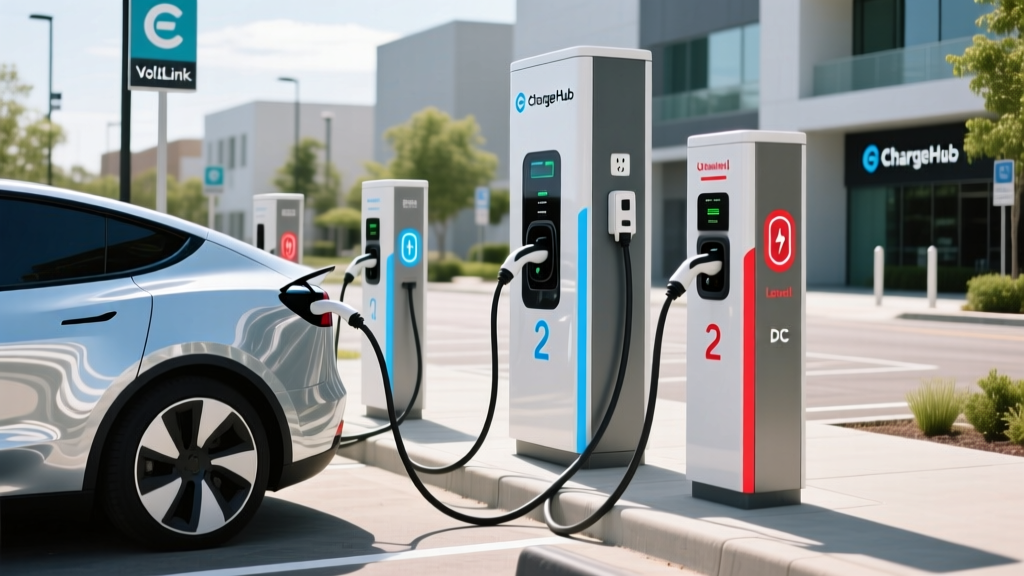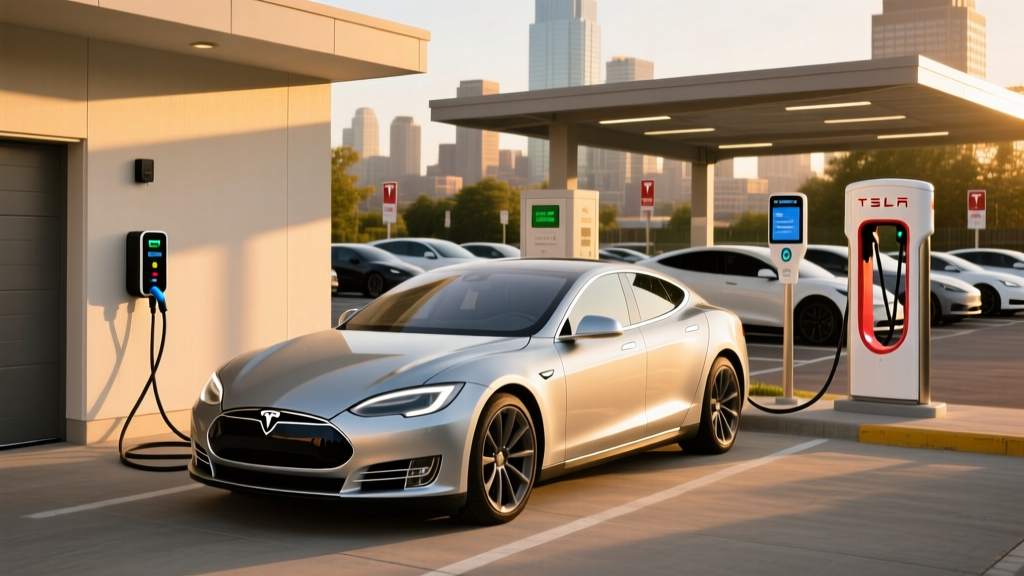
If you own a Tesla—or are about to buy one—the single most important ownership question isn't 0-60 time or Autopilot capability. It's this: what does it actually cost to keep the battery full? The answer depends entirely on where and how you charge. A Tesla Model Y charged at home on off-peak electricity might cost you 4 cents per mile, while the same car topped up at a third-party DC fast charger could run three to four times that.
This guide breaks down the real cost of charging a Tesla across every scenario—home Level 1, home Level 2, Tesla Superchargers, and public DC networks—using 2026 electricity rates, equipment prices, and installation costs. We'll also cover what you need to know about home charger installation, electrical panel upgrades, and which equipment actually delivers the fastest, most reliable charge.
Understanding kW vs. kWh: The Foundation of EV Charging Costs
Before calculating any cost, we need to clear up the most common EV confusion: kW (kilowatts) measures power—the rate of charging. kWh (kilowatt-hours) measures energy—the amount of electricity stored in your battery.
Think of it like water: kW is how wide the pipe is (flow rate), and kWh is how much water fills the bucket (total energy). When you pay for electricity, you're paying per kWh consumed. When you see a charger rated at 11.5 kW or 250 kW, that's the maximum rate it can deliver energy—not the total amount.
A Tesla Model Y Long Range has a usable battery capacity of approximately 75 kWh. A Model 3 Long Range sits around 79 kWh. The Model S and Model X carry roughly 95–100 kWh of usable capacity. These numbers are what determine your total cost-per-session.
Charging Levels Explained: Speed, Power, and Miles Added Per Hour
Every Tesla owner will encounter three charging tiers. Here's how they compare in real-world output:
| Level | Voltage | Power (kW) | Miles of Range Per Hour | Typical Use Case |
|---|---|---|---|---|
| Level 1 (120V) | 120V / 12A | ~1.4 kW | 3–5 mi/hr | Overnight trickle, emergency top-up |
| Level 2 (240V) | 240V / 32–48A | 7.7–11.5 kW | 25–44 mi/hr | Daily home charging, workplace |
| DC Fast Charging | 400V+ architecture | 150–250 kW (peak) | ~1,000+ mi/hr (peak) | Road trips, Superchargers, public DC |
Real-world context: A Tesla Model Y Long Range (EPA 320 miles) arriving at 10% state of charge (SoC) and charging to 80% at a V3 Supercharger (250 kW peak) will add approximately 220 miles of range in roughly 25–30 minutes. However, the charge curve tapers significantly above 80%—charging from 80% to 100% can take as long as the 10–80% session. This is why Tesla's navigation system typically recommends charging to 80% on road trips unless you need the full battery for your destination.
Level 1 charging via a standard 120V outlet is viable only for low-mileage drivers. If you drive 20 miles per day and plug in for 10 hours overnight, you'll recover roughly 30–50 miles—enough for commuting, but inadequate for anyone regularly exceeding 40 miles daily. For most Tesla owners, Level 2 is the practical baseline.
How Much Does It Cost to Install a Home EV Charger?
Home charging is where the cost of charging a Tesla drops to its lowest point—but the upfront installation investment varies dramatically based on your home's electrical infrastructure.
Electrical Requirements for Tesla Level 2 Charging
A Tesla Wall Connector or equivalent Level 2 charger requires a dedicated 240V circuit. Here's what different amperage levels deliver:
- 240V / 32A (40A breaker): 7.7 kW — adds ~30 miles of range per hour
- 240V / 40A (50A breaker): 9.6 kW — adds ~37 miles of range per hour
- 240V / 48A (60A breaker): 11.5 kW — adds ~44 miles of range per hour (maximum for most Teslas with single onboard charger)
The National Electrical Code (NEC) requires the circuit breaker to be rated at 125% of the continuous load. So a 48A charger needs a 60A breaker, and a 40A charger needs a 50A breaker. This is non-negotiable for safety and code compliance.
Installation Cost Breakdown
| Component | Simple Install (panel nearby, no upgrade) | Complex Install (long run, panel upgrade) |
|---|---|---|
| Level 2 Charger (hardware) | $400–$650 | $400–$650 |
| Electrician labor (2–4 hrs simple / 6–12 hrs complex) | $400–$800 | $1,200–$3,000 |
| Electrical permit | $50–$150 | $50–$200 |
| Conduit, wire, mounting hardware | $50–$200 | $200–$600 |
| Panel upgrade (if needed: 100A → 200A service) | N/A | $1,500–$4,000 |
| Total estimated cost | $900–$1,800 | $3,350–$8,450 |
The panel-upgrade wildcard: Homes built before 2000 often have 100-amp electrical service. Adding a 60A dedicated EV circuit to an already-loaded 100A panel may exceed safe capacity, requiring a service upgrade to 200A. This is the single largest variable in installation cost. Before budgeting, have a licensed electrician perform a load calculation on your panel—it's typically $100–$200 and will tell you definitively whether an upgrade is required.
Some utilities offer rebates of $250–$1,000 for Level 2 charger installation, and certain states provide additional incentives. Check with your local utility and state energy office before scheduling work.
The Real Cost to Charge a Tesla: Home vs. Supercharger vs. Public DC
This is the core question: how much does it actually cost per kWh and per mile? The variance is enormous.
| Charging Source | Avg. Cost per kWh | Cost to Add 200 Miles (Model Y LR, ~3.5 mi/kWh) | Cost per Mile |
|---|---|---|---|
| Home (national avg. residential, off-peak TOU) | $0.10–$0.16 | $5.70–$9.15 | $0.03–$0.05 |
| Home (California avg. residential) | $0.25–$0.35 | $14.30–$20.00 | $0.07–$0.10 |
| Tesla Supercharger V3/V4 (avg. US) | $0.28–$0.40 | $16.00–$22.85 | $0.08–$0.11 |
| Third-party DC fast (Electrify America, EVgo, etc.) | $0.35–$0.55 | $20.00–$31.40 | $0.10–$0.16 |
| Gasoline equivalent (25 MPG avg. sedan, $3.40/gal) | — | $27.20 | $0.14 |
Key takeaways:
- Home charging on a time-of-use (TOU) plan during off-peak hours (typically 9 PM–6 AM) is the cheapest option by a wide margin. At $0.12/kWh, fully charging a Model Y Long Range's 75 kWh battery costs about $9.00—yielding 320 EPA-rated miles.
- Tesla Superchargers are moderately priced for DC fast charging and offer the most reliable plug-and-charge experience in the US. Expect to pay $0.28–$0.40/kWh depending on location and time of day. Tesla has increasingly implemented time-of-use pricing at Superchargers, with lower rates during off-peak hours.
- Third-party DC fast chargers (Electrify America, EVgo, ChargePoint) are the most expensive option. Some networks charge idle fees if you remain plugged in after reaching your target SoC—always monitor your session via the app.
- Even at the highest public rates, a Tesla typically costs less per mile than a 25 MPG gasoline car at $3.40/gallon. The savings widen dramatically when charging at home.
Cost Per Mile: Tesla vs. Gasoline Vehicles
According to fueleconomy.gov, the 2025 Tesla Model Y Long Range achieves 122 MPGe combined (approximately 3.5 miles per kWh). Compare that to a popular gasoline crossover like the Toyota RAV4 at 30 MPG combined:
| Vehicle | Energy Source | Cost per Mile | Annual Cost (12,000 mi) |
|---|---|---|---|
| Tesla Model Y LR (home charging, $0.14/kWh avg.) | Electricity | $0.04 | $480 |
| Tesla Model Y LR (Supercharger only, $0.34/kWh avg.) | Electricity | $0.10 | $1,200 |
| Toyota RAV4 (30 MPG, $3.40/gal) | Gasoline | $0.11 | $1,360 |
A Tesla owner who charges primarily at home saves roughly $880–$1,280 per year compared to a comparable gas vehicle. Even exclusive Supercharger users save a modest amount—though the gap narrows significantly in high-electricity-cost states like California and Hawaii.
Connector Compatibility: NACS, CCS, and Adapters
As of 2026, the North American Charging Standard (NACS)—originally Tesla's proprietary connector—has become the dominant EV charging connector in the United States. Nearly every major automaker has adopted NACS for new vehicles starting with 2025–2026 model years.
| Connector | Used By | DC Fast Charge Capable? | Notes |
|---|---|---|---|
| NACS (Tesla) | All Tesla vehicles; Ford, GM, Rivian, Hyundai, and most others (2025+) | Yes (up to 250+ kW) | Native Tesla connector; no adapter needed for Teslas |
| CCS1 (Combo) | Legacy non-Tesla EVs (pre-2025); some still in production | Yes (up to 350 kW) | Tesla Superchargers now open to CCS vehicles via Magic Dock adapter at select stations |
| CHAdeMO | Nissan Leaf (legacy), Mitsubishi Outlander PHEV | Yes (up to 100 kW) | Phasing out; few new stations being installed |
For Tesla owners: Your vehicle has a native NACS port. You can charge at any Tesla Supercharger or Destination Charger without an adapter. For the growing number of non-Tesla CCS-equipped public chargers, Tesla sells a CCS Combo 1 Adapter (~$175) that allows you to use Electrify America, EVgo, and other CCS networks. This is worth carrying on road trips outside the Supercharger network.
For non-Tesla EV owners with NACS ports (2025+ models): You now have access to Tesla's Supercharger network using a NACS charge port or an included adapter (varies by manufacturer). This dramatically expands public charging options, as Tesla operates over 6,000 Supercharger stalls across the US.
Best Home Chargers for Tesla Owners: Equipment Picks
Not all Level 2 chargers are equal. Here are three proven options for Tesla owners in 2026, each offering different balances of power, features, and price:
Tesla Wall Connector (Gen 3)
- Power output: Up to 11.5 kW (48A on a 60A circuit)
- Connector: NACS (native Tesla)
- Cable length: 24 feet
- Smart features: Wi-Fi connectivity, over-the-air firmware updates, power sharing between multiple Wall Connectors, load management
- Price: ~$475
- Best for: Tesla-only households wanting maximum charge speed and seamless integration
ChargePoint Home Flex
- Power output: Up to 12 kW (50A, configurable from 16A–50A via DIP switches)
- Connector: NACS or J1772 (NACS version available for 2025+)
- Cable length: 23 feet
- Smart features: Wi-Fi, Alexa integration, scheduling, energy tracking via app, UL Energy Verified
- Price: ~$550–$650
- Best for: Multi-EV households (Tesla + non-Tesla) needing scheduling and detailed energy data
Emporia Vue Level 2 Charger
- Power output: Up to 11.5 kW (48A on a 60A circuit)
- Connector: NACS (2025+ version) or J1772
- Cable length: 24 feet
- Smart features: Wi-Fi, solar integration (pairs with Emporia Vue energy monitor), TOU scheduling, real-time cost tracking
- Price: ~$400–$450
- Best for: Solar-panel owners and budget-conscious buyers who still want 48A output
Important: Regardless of which charger you choose, ensure it is UL-listed (not just "CE" marked for European markets). UL certification is required by most US electrical codes for permanently installed EV supply equipment (EVSE). Hardwired installations are generally preferred over plug-in (NEMA 14-50) for reliability and to avoid the GFCI breaker nuisance-tripping issues that are common with 240V receptacles on EV circuits.
Safety, Code Compliance, and Common Installation Pitfalls
EV charging places a sustained, high-amperage load on your home's electrical system—unlike any other household appliance. Here are the critical safety and code considerations:
- Dedicated circuit: Your Level 2 charger must be on its own dedicated breaker. Sharing a circuit with other appliances (dryer, HVAC) is a code violation and a fire risk.
- GFCI protection: The 2020 NEC and later require GFCI protection for all EVSE receptacles. However, hardwired EVSE units are generally exempt from this requirement and avoid the nuisance-tripping issues that plague GFCI breakers on 240V receptacles. This is a strong argument for hardwiring.
- Outdoor rating: If your charger is installed outdoors (garage-exterior wall, carport, driveway post), ensure the unit carries a NEMA 4 or IP65 rating for weather resistance. The Tesla Wall Connector and ChargePoint Home Flex both meet this standard.
- Wire gauge: A 60A circuit requires 6 AWG copper wire (or 4 AWG aluminum). Undersized wire causes voltage drop, heat buildup, and potential fire. Your electrician should verify wire gauge for the circuit length—longer runs may need thicker wire to compensate for voltage drop.
- Permit and inspection: Virtually all jurisdictions require an electrical permit for EVSE installation. The inspection ensures proper grounding, wire sizing, breaker rating, and GFCI compliance. Skipping the permit risks insurance claim denial in the event of an electrical fire.
For detailed electrical code requirements, reference the National Electrical Code (NEC) Article 625 covering Electric Vehicle Charging Systems, and consult your local building department for jurisdiction-specific amendments.
Maximizing Your Tesla Charging Savings
Once your home charger is installed, these strategies will minimize your ongoing cost of charging:
- Enroll in a time-of-use (TOU) plan. Most utilities offer TOU rates where off-peak electricity (overnight) costs 40–60% less than peak afternoon rates. Schedule your Tesla to charge between 10 PM and 6 AM using the built-in Scheduled Charging feature.
- Set a daily charge limit of 80%. For NMC battery chemistry (used in Long Range and Performance Teslas), daily charging to 80% reduces degradation and extends battery lifespan. Charge to 100% only before long road trips. (LFP-equipped Standard Range models can be charged to 100% daily without degradation concerns.)
- Precondition before Supercharging. When you navigate to a Supercharger in your Tesla, the car automatically preconditions the battery—warming or cooling it to optimal temperature for the fastest charge curve. Arriving at a Supercharger without preconditioning (e.g., using a third-party app or driving there without navigation) can reduce peak charge rates by 30–50%, costing you more time and potentially more money if the station bills by the minute.
- Check for utility EV rate plans. Some utilities offer dedicated EV rate plans with significantly lower per-kWh pricing for charging circuits on a separate meter. PG&E's EV2-A plan in California, for example, offers off-peak rates as low as $0.10/kWh—nearly a third of standard residential rates.
- Use the Tesla app to monitor Supercharger pricing. Supercharger rates vary by station and time of day. The Tesla app shows real-time pricing before you navigate to a station, allowing you to choose the cheapest option along your route.
Frequently Asked Questions
How much does it cost to fully charge a Tesla Model Y at home?
At the US national average residential rate of ~$0.16/kWh, fully charging a Model Y Long Range (75 kWh usable) costs approximately $12.00 for 320 EPA-rated miles. On an off-peak TOU rate of $0.10/kWh, the same charge costs about $7.50. In California at $0.30/kWh, expect roughly $22.50.
Is it cheaper to charge a Tesla at home or at a Supercharger?
Home charging is almost always cheaper. The average US Supercharger rate of $0.28–$0.40/kWh is 2–3× the national average residential electricity rate of $0.14–$0.16/kWh. The exception is California, where high residential rates ($0.25–$0.35/kWh) can narrow the gap—making off-peak TOU plans essential.
Can I charge my Tesla with solar panels?
Yes. If you have a home solar system, charging during peak solar production hours (10 AM–3 PM) effectively gives you "free" fuel after the system is paid off. Pair your charger with a solar energy monitor (like the Emporia Vue system) to schedule charging when solar output is highest. A typical 8 kW solar system produces enough surplus energy to add 30–40 miles of range per day to a Tesla.
Do I need a 200-amp electrical panel to charge a Tesla at home?
Not necessarily. A 200A panel is recommended for a 48A (60A breaker) Level 2 charger, but many homes with 100A or 150A service can accommodate a 32A charger (40A breaker) without an upgrade—depending on existing loads. A licensed electrician's load calculation is the definitive answer. If an upgrade is needed, budget $1,500–$4,000 for the panel work alone.
Does Supercharging damage the Tesla battery?
Frequent DC fast charging causes marginally more battery degradation than Level 2 charging due to higher heat generation, but Tesla's thermal management system actively cools the battery during Supercharging to mitigate this. Data from high-mileage Tesla fleets shows that even vehicles that Supercharge regularly retain 85–90% of original battery capacity after 150,000 miles. The battery warranty covers degradation below 70% capacity for 8 years or 120,000 miles (125,000 for Model S/X), per Tesla's New Vehicle Limited Warranty.
What's the cheapest way to charge a Tesla on a road trip?
Tesla Superchargers are generally the most cost-effective public DC option, priced at $0.28–$0.40/kWh. Third-party networks like Electrify America and EVgo often charge $0.35–$0.55/kWh. To minimize road-trip charging costs: charge to 80% only (the fastest part of the curve), use the Tesla app to compare station pricing along your route, and take advantage of any free Supercharging credits on your account.