The Real Cost of Charging a Tesla at Home
If you've ordered a Model 3, Model Y, or are eyeing the refreshed Model S, the first ownership question is usually practical: how much will it actually cost to keep the battery full? The cost of charging a Tesla at home depends on three moving parts — your local electricity rate, the speed of the charger you install, and the upfront price of getting a Level 2 circuit run to your garage. Unlike gas, where the price per gallon is posted on a corner sign, home charging economics hide inside your utility bill and electrical panel.
This guide walks through every layer: what each charging level delivers in miles per hour, what an electrician will actually charge to install a 240V circuit, which wall connector makes sense in 2026, and how the per-mile cost stacks up against a comparable gas sedan. All figures use current 2026 Tesla specs and national average utility data.
Charging Levels Explained: kW, kWh, and Miles Per Hour
Before calculating cost, clarify the units. A kilowatt-hour (kWh) is a unit of energy — think of it like a gallon of gas. A Tesla Model Y Long Range AWD carries roughly 75 kWh of usable battery capacity. A kilowatt (kW) is a unit of power — the rate at which energy flows. A 11.5 kW Level 2 charger delivers 11.5 kWh of energy into the battery per hour (minus small losses to heat and conversion).
Mixing these up is the single most common EV mistake. When Tesla quotes a "250 kW" Supercharger peak, that's power; when the window sticker says "75 kWh battery," that's energy.
| Level | Voltage / Amps | Power (kW) | Miles of Range Added Per Hour | 10–80% Time (approx.) |
|---|---|---|---|---|
| Level 1 (standard 120V outlet) | 120V / 12A | ~1.4 kW | 3–5 mi/hr | 40+ hours |
| Level 2 (240V, 40A circuit) | 240V / 40A | ~9.6 kW | 30–34 mi/hr | ~5.5 hours |
| Level 2 (240V, 48A / Tesla Wall Connector) | 240V / 48A | 11.5 kW | 37–44 mi/hr | ~4.5 hours |
| DC Fast (V4 Supercharger) | 400V+ architecture | Peak 250 kW | ~170 mi in 15 min | ~25–28 min (10–80%) |
Two real-world caveats. First, DC fast charging follows a charge curve: the 250 kW peak only holds from roughly 10–30% State of Charge, then tapers to ~120 kW, then ~60 kW above 70%. That's why 10–80% takes 25+ minutes while 10–50% may take only 12. Second, Level 1 is fine for plug-in hybrids with small batteries but painfully slow for a 75 kWh Tesla — treat it as emergency or trickle top-up only.
Home Installation: Electrical Requirements and Cost Breakdown
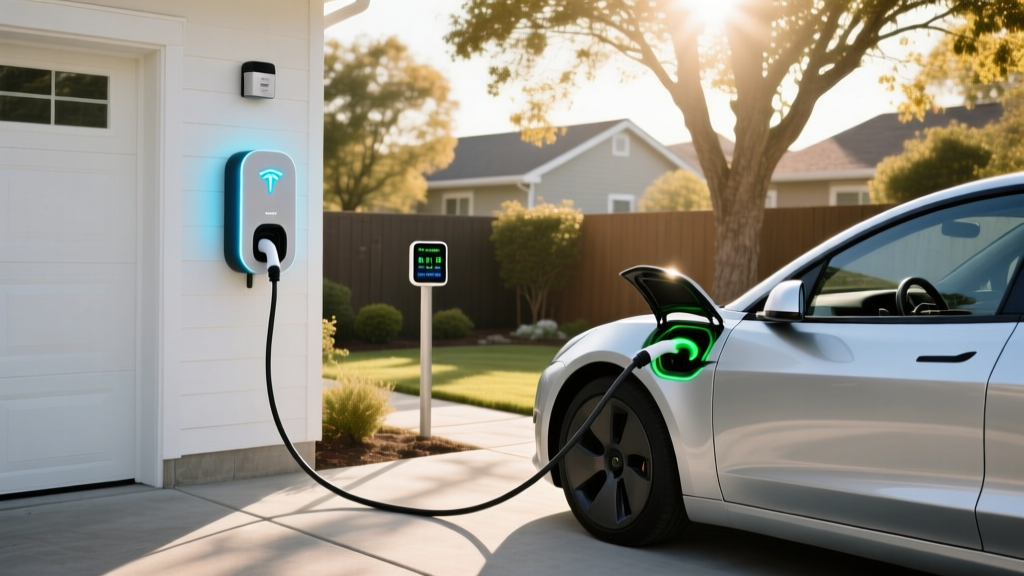
The headline number for a Level 2 install is wide — anywhere from $500 on the low end to $3,500+ if your panel needs an upgrade — because the variable isn't the charger, it's your home's wiring. A typical 2026 install for a Tesla Wall Connector on a 60A breaker (48A continuous) looks like this:
- Circuit: Dedicated 240V / 60A breaker, 6-gauge copper wire (or 4-gauge aluminum for longer runs)
- Connector: NACS (native Tesla plug, no adapter required on any 2026 Tesla)
- Location: Garage wall or exterior-rated post within ~18 feet of the parking spot (Tesla Wall Connector cable is 24 ft)
- Permit: Required in most jurisdictions; electrical permit typically $50–$200
| Component | Low End | Typical | High End |
|---|---|---|---|
| Tesla Wall Connector (hardware) | $420 | $420 | $475 (with J1772 adapter bundle) |
| Electrician labor (2–6 hours) | $300 | $700 | $1,500 |
| Wire, conduit, breaker, misc. | $150 | $350 | $700 |
| Permit and inspection | $50 | $125 | $250 |
| Electrical panel upgrade (if needed, 100A → 200A) | $0 | $0 (most homes don't need) | $2,000–$4,000 |
| Total (no panel upgrade) | $920 | $1,595 | $2,925 |
When a Panel Upgrade Becomes Necessary
Homes built before 1990 often have 100A main service. Adding a 60A EV circuit on top of existing loads (electric range, dryer, HVAC) can exceed safe capacity. An electrician will perform a load calculation per NEC Article 220. If your calculated load is near or over your main breaker rating, expect a $2,000–$4,000 panel upgrade to 200A. Newer homes (post-2000) with 200A service rarely need this. Some utilities and states offer rebates of $300–$1,000 specifically for panel upgrades tied to EV adoption — check your utility's EV program page before signing a contract.
How Much Does It Actually Cost to Charge a Tesla at Home?
The per-mile cost depends on your utility's rate structure. The U.S. Energy Information Administration reports a 2026 national residential average of about $0.17 per kWh, but real numbers range from $0.09/kWh in parts of Louisiana and Idaho to $0.33/kWh in California and Hawaii. Time-of-use (TOU) plans can drop off-peak overnight rates to $0.06–$0.12/kWh in many markets.
| Scenario | $/kWh | Cost Per Mile | Full 75 kWh Charge | Monthly Cost (1,000 mi) |
|---|---|---|---|---|
| Home off-peak (TOU overnight) | $0.10 | $0.028 | $7.50 | $28 |
| Home standard rate (national avg) | $0.17 | $0.047 | $12.75 | $47 |
| Home peak rate (summer evening) | $0.30 | $0.083 | $22.50 | $83 |
| Tesla Supercharger (avg 2026) | $0.35 | $0.097 | $26.25 | $97 |
| Electrify America / third-party DC | $0.48 | $0.133 | $36.00 | $133 |
| Gasoline sedan (30 MPG, $3.40/gal) | — | $0.113 | — | $113 |
A few takeaways from the table:
- On an off-peak TOU plan, a Model Y owner driving 1,000 miles per month pays roughly $28/month in electricity — less than a quarter of what the equivalent gas sedan spends.
- On standard residential rates, home charging still undercuts gas by about 60%.
- Exclusive reliance on DC fast charging erases most of the cost advantage. Home Level 2 is where the economics shine.
- Cold weather reduces efficiency by 15–30% (battery heating, cabin heat), so winter per-mile costs in Minnesota or New England will sit 20–25% higher than the table shows.
Which Connector and Charger Are Compatible With My Tesla?
As of 2026, every Tesla sold in North America uses the NACS (North American Charging Standard) connector natively. This is the same plug Tesla has used since the Model S launched, now formally adopted as SAE J3400. The practical result: Teslas plug directly into Tesla Wall Connectors, Mobile Connectors, and Superchargers with no adapter.
What's changed is the rest of the market. Ford, GM, Rivian, Hyundai, Kia, and most other OEMs now ship vehicles with NACS ports, so a Tesla Wall Connector can also charge non-Tesla EVs (and vice versa). Legacy CCS1 and CHAdeMO vehicles need adapters.
| Connector | Native Brands | Adapter Needed? |
|---|---|---|
| NACS (Tesla) | Tesla, Ford, GM, Rivian, Hyundai, Kia, Volvo, Polestar, Fisker, Lucid (with adapter) | No — native on most 2025+ models |
| CCS1 | Legacy VW ID.4, older BMW i4/iX, older Mercedes EQE/EQS, older Nissan Ariya | Yes — CCS-to-NACS adapter (~$200–$250) for Tesla Supercharger access |
| CHAdeMO | Nissan Leaf (legacy only, discontinued for new U.S. sales) | Yes — CHAdeMO-to-NACS adapters rare; best to use CHAdeMO stations |
2026 Home Charger Recommendations for Tesla Owners
Three chargers dominate the Tesla-owner short list. All deliver Level 2 power on a 240V circuit; differences come down to price, smart features, and whether you want to future-proof for a second, non-Tesla EV.
Tesla Wall Connector (Gen 4)
- Power: Up to 11.5 kW (48A) on a 60A breaker
- Connector: Native NACS, 24-ft cable
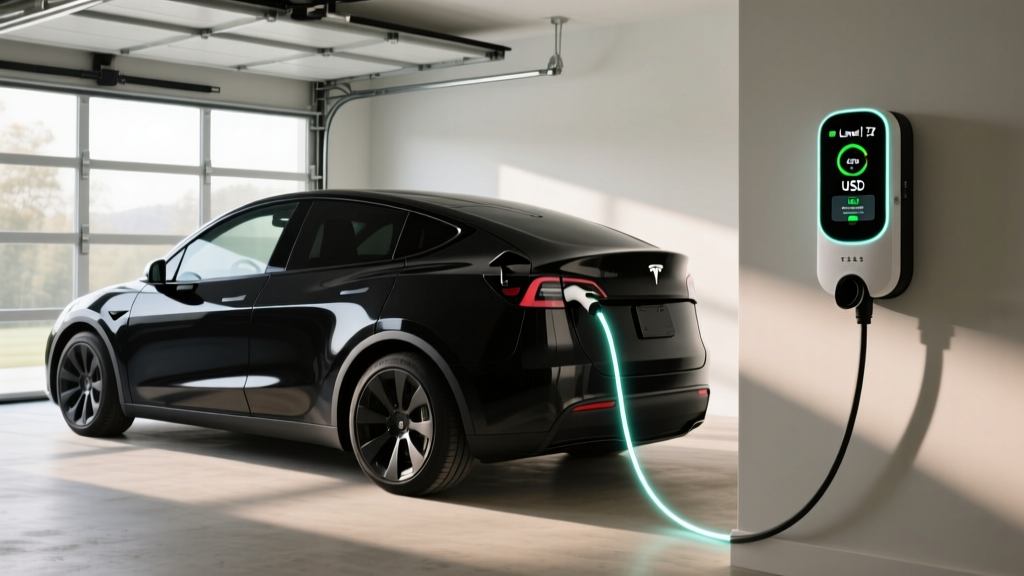
- Smart features: Wi-Fi, OTA updates, Power-Sharing (link two units on one circuit), scheduled charging via Tesla app, access control
- Outdoor rating: NEMA 4 (weatherproof)
- Price: ~$420
- Best for: Tesla-only households; simplest setup, best app integration
ChargePoint Home Flex
- Power: Up to 12 kW (50A) configurable via DIP switches
- Connector: NACS or J1772 versions, 23-ft cable
- Smart features: Wi-Fi, Alexa integration, detailed energy dashboard, TOU scheduling, works with most utility demand-response programs
- Outdoor rating: NEMA 4
- Price: ~$550–$650
- Best for: Mixed-EV households or utility demand-response participants
Emporia Vue + EV Charger Bundle
- Power: Up to 11.5 kW (48A)
- Connector: NACS or J1772
- Smart features: Whole-home energy monitoring via Emporia Vue panel sensors, solar-aware charging, V2H-ready (pending compatible vehicle firmware)
- Outdoor rating: NEMA 4
- Price: ~$600–$700 (charger + Vue monitor)
- Best for: Solar owners wanting to charge only on excess production
A note on the Alternative Fuel Vehicle Refueling Property Credit (IRS §30C): as of 2026, homeowners installing qualified EV charging equipment may be eligible for a 30% federal tax credit up to $1,000, subject to census-tract eligibility and prevailing-wage requirements per the Inflation Reduction Act. Always confirm eligibility with a tax professional and the current-year IRS guidance before counting on the credit.
Safety, Code, and Installation Gotchas
A licensed electrician is non-negotiable for a 240V circuit. Beyond the basics, these are the code and safety items that separate a clean install from a callback:
- Dedicated circuit: NEC requires the EV charger to have its own breaker — no sharing with a dryer or oven.
- Continuous-load derating: A 48A charger is a "continuous load" (runs 3+ hours), so NEC 210.20 requires the breaker to be rated at 125% of the load — hence a 60A breaker for a 48A charger.
- GFCI protection: 2023 NEC (and most 2026 local adoptions) requires GFCI on 240V receptacles. Hardwired Wall Connectors typically avoid this requirement, which is one reason Tesla and most electricians prefer hardwiring over a NEMA 14-50 outlet.
- Outdoor rating: Any unit exposed to weather must be NEMA 4 rated. All three chargers above qualify.
- Wi-Fi signal: Smart features (scheduling, OTA updates, demand response) require 2.4 GHz Wi-Fi at the install location. Test signal strength before the electrician arrives — a $30 Wi-Fi extender can prevent a $150 service call later.
- Permit and inspection: Skipping the permit risks insurance denial if a fault causes damage. Most jurisdictions inspect within 1–2 weeks of install.
Frequently Asked Questions
How much does it cost to install a home EV charger for a Tesla?
Most 2026 installs of a Tesla Wall Connector on an existing 200A panel run $1,200–$2,200 all-in (hardware, labor, wire, permit). Older homes needing a panel upgrade can see $3,000–$5,500 total. Get at least two quotes from licensed electricians and confirm they include the permit in the estimate.
How fast will each charging level add range to my Model Y?
Level 1 (120V) adds about 3–5 miles per hour — usable only for overnight top-ups of 30–40 miles. Level 2 (240V, 48A) adds 37–44 miles per hour, enough to fully replenish a day's driving in 30–60 minutes of plug-in time. DC fast charging (Supercharger V4) adds roughly 170 miles in 15 minutes at peak rate, tapering above 70% SoC.
Do I need an adapter to charge my Tesla at home?
No. Every 2026 Tesla uses the native NACS connector and plugs directly into a Tesla Wall Connector or any NACS-equipped Level 2 unit. The Tesla Mobile Connector (included with most new vehicles) ships with a NEMA 5-15 (120V) plug; a NEMA 14-50 adapter (~$35 from Tesla) enables 240V Level 2 at up to 7.7 kW without a wall unit.
How much does charging a Tesla cost per mile vs a gas car?
At the 2026 national average residential rate of $0.17/kWh, a Model Y Long Range costs roughly $0.047 per mile. A comparable 30 MPG gas sedan at $3.40/gallon costs about $0.113 per mile. On an off-peak TOU plan at $0.10/kWh, the Tesla drops to $0.028/mile — roughly 75% cheaper per mile.
What electrical upgrades might I need before installing a Tesla charger?
Most homes built after 2000 with 200A service need no upgrade. Older homes with 100A service may require a panel upgrade ($2,000–$4,000) if the electrician's load calculation shows the new 60A circuit would exceed capacity. Homes with long runs from panel to garage (100+ ft) may also need thicker 4-gauge wire, adding $200–$500 in materials.
Is there a federal tax credit for installing a home charger?
Possibly. IRS §30C offers a 30% credit up to $1,000 for qualified home charging equipment installed in eligible census tracts, with prevailing-wage requirements. Eligibility depends on your address and the installation year. Confirm current-year rules on irs.gov or with a tax professional before relying on the credit.
Does charging to 100% every night hurt the battery?
For Teslas with NMC (nickel manganese cobalt) batteries — most Long Range and Performance models — daily charging to 80% is recommended for longevity, with 100% reserved for road trips. Tesla's LFP-equipped Model 3 RWD can and should be charged to 100% regularly; LFP chemistry tolerates full SoC and needs it for accurate state-of-charge calibration. Set the charge limit in the Tesla app accordingly.
For authoritative efficiency data on specific Tesla trims, the EPA's fueleconomy.gov database lists MPGe, kWh/100mi, and range by model year. Tesla's own home charger installation guide walks through electrician requirements and permitting in detail.