The Real Cost of Charging an Electric Car: What You'll Actually Pay
The sticker price of an EV gets most of the attention, but the ongoing cost of fueling — or more accurately, charging — is where electric vehicles make or break their financial case. The cost of charging an electric car varies enormously depending on where and how you charge: a home Level 2 setup on an off-peak utility rate can cost as little as $0.03 per mile, while repeated DC fast charging on a road trip can approach or even exceed what you'd pay for gasoline.
This guide breaks down every charging scenario with real numbers — dollars per kilowatt-hour (kWh), cents per mile, installation costs for home chargers, and the equipment you need. We'll also clear up the single most common source of confusion: the difference between kW (kilowatts, the rate of power delivery — think of it as the size of the water pipe) and kWh (kilowatt-hours, the total energy stored or delivered — the total gallons of water that flowed through). Your EV's battery is measured in kWh; the charger's speed is measured in kW. Keeping those straight makes everything below far easier to follow.
- kWh (energy): The capacity of your battery. A 2026 Tesla Model Y Long Range has roughly 75 kWh of usable capacity; a Ford F-150 Lightning Extended Range has about 131 kWh.
- kW (power): How fast a charger delivers energy. A typical home Level 2 charger delivers 7.7 to 11.5 kW. A DC fast charger might peak at 150 to 350 kW.
- $ per kWh: The price you pay for electricity — the EV equivalent of dollars per gallon.
Charging Levels Explained: Speeds, Costs, and Miles Added Per Hour
There are three tiers of EV charging. Each serves a different use case, and the cost per mile scales roughly inversely with speed — the faster the charge, the more you typically pay per kWh.
| Level | Voltage / Current | Power (kW) | Miles of Range Added Per Hour | Typical Cost ($/kWh) | Best For |
|---|---|---|---|---|---|
| Level 1 (120V outlet) | 120V / 12A | 1.4 kW | 3–5 miles/hr | $0.12–$0.18 (home) | Overnight top-ups, PHEVs, low-mileage drivers |
| Level 2 (240V home/public) | 240V / 32–48A | 7.7–11.5 kW | 25–44 miles/hr | $0.12–$0.25 (home); $0.25–$0.49 (public) | Daily charging, home primary, workplace |
| DC Fast Charging | 400V–800V DC | 50–350 kW | 150–1,200+ miles/hr (at peak) | $0.30–$0.65+ (public networks) | Road trips, quick top-ups, no home charging |
A few realities the table doesn't fully capture:
- Level 1 is slow but nearly free to set up. You plug into a standard 120V household outlet using the mobile cord that ships with most EVs. For a plug-in hybrid with 30 miles of electric range, Level 1 is usually sufficient overnight. For a 75 kWh battery EV, a full Level 1 charge can take 50+ hours — impractical as a primary method.
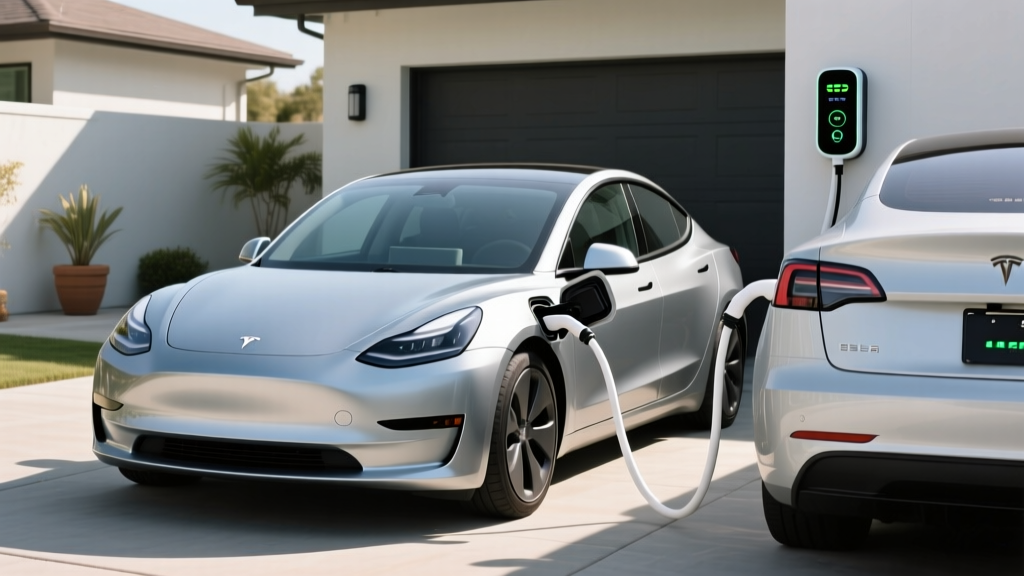
- Level 2 is the sweet spot for daily ownership. A 48-amp, 11.5 kW home charger can fully replenish a Tesla Model Y's 75 kWh battery in roughly 7–8 hours — perfect for overnight charging. Most EV owners do 80–90% of their charging at home on Level 2.
- DC fast charging speeds are peak, not sustained. A charger rated at 250 kW will only deliver that rate at a low state of charge (SoC) and with a battery preconditioned to the right temperature. Expect the charge curve to taper significantly above 80% SoC. A "10–80% in 18 minutes" claim assumes ideal conditions; real-world sessions with a cold battery or high SoC can take 25–35 minutes.
Home Charger Installation: Electrical Requirements, Costs, and Panel Upgrades
Installing a Level 2 home charger is the single most impactful investment you can make for EV ownership — and the cost varies wildly based on your home's electrical infrastructure.
What You Need Electrically
A typical Level 2 charger requires a dedicated 240-volt circuit, similar to what an electric dryer or oven uses. The most common configurations:
- 40-amp circuit (delivers 32 amps / 7.7 kW continuous to the car) — sufficient for most EVs, requires a NEMA 14-50 outlet or hardwired connection.
- 50-amp circuit (delivers 40 amps / 9.6 kW) — common for higher-output chargers.
- 60-amp circuit (delivers 48 amps / 11.5 kW) — maximum for most residential chargers; requires thicker-gauge wire and a panel with adequate capacity.
The National Electrical Code (NEC) requires that continuous loads (like EV charging, which runs for hours) use no more than 80% of a circuit's rated capacity. So a 48-amp charge requires a 60-amp breaker. This is non-negotiable and your electrician will enforce it.
Do You Need a Panel Upgrade?
This is where costs can jump significantly. Most modern homes built after 2000 have a 200-amp electrical panel, which typically has enough headroom for a 40–60 amp EV circuit. However:
- Older homes (pre-1990s) may have 100-amp or even 60-amp panels. Adding a 40–60 amp EV circuit to a 100-amp panel that's already near capacity (electric range, dryer, HVAC) can require a panel upgrade to 200 amps, which costs $1,500–$3,500+.
- Homes with electric heat, electric water heaters, and electric ranges may be closer to panel capacity even with a 200-amp service. Your electrician will perform a load calculation per NEC Article 220 to determine available headroom.
- Smart mitigation: Some newer chargers (like the Emporia Vue-linked Emporia Level 2 or the Enel X Way JuiceBox with smart sharing) offer load management — they monitor your panel's total draw and throttle the charger to avoid tripping the main breaker. This can avoid a panel upgrade in marginal situations, saving thousands.
Home Level 2 Charger Installation Cost Breakdown (2026 Estimates)
| Component | Simple Install (panel nearby, no upgrade) | Complex Install (long wire run, subpanel) | Panel Upgrade Scenario |
|---|---|---|---|
| Level 2 charger (equipment) | $350–$700 | $350–$700 | $350–$700 |
| Electrician labor (2–6 hrs) | $400–$800 | $800–$2,000 | $1,500–$3,500 (panel upgrade labor) |
| Materials (wire, conduit, breaker) | $100–$300 | $300–$800 | $200–$500 |
| Permit & inspection | $50–$200 | $50–$200 | $100–$300 |
| Total estimated cost | $900–$2,000 | $1,500–$3,700 | $2,150–$5,000+ |
Source: Based on 2025–2026 electrician rate surveys and real-world installation reports. Always get 2–3 quotes from licensed electricians. Check with your utility — many offer $250–$1,000 rebates for home charger installation, which can significantly offset these costs.
Safety and Code Requirements
Do not skip these — they protect your home and are required for permit approval:
- Dedicated circuit: Your EV charger must have its own breaker. Sharing a circuit with other appliances is a code violation and a fire risk.
- GFCI protection: The 2020 NEC and later require GFCI (Ground Fault Circuit Interrupter) protection for outdoor outlets. If your charger is outdoors, a GFCI breaker or a charger with built-in GFCI is required. Note: some EVs have experienced nuisance GFCI trips with certain breaker brands — your electrician will know which combinations work reliably.
- Outdoor rating: If the charger is mounted outside, it must carry a NEMA 4 or NEMA 4X rating for weather resistance. All major chargers from ChargePoint, Emporia, Grizzl-E, and Tesla carry appropriate outdoor ratings.
- Hardwired vs. plug: Hardwired connections (no plug) are required for circuits above 50 amps and are generally more reliable for outdoor installs. A NEMA 14-50 plug on a 50-amp breaker gives you portability but requires a GFCI breaker in many jurisdictions for outdoor use.
- Permit and inspection: Nearly all jurisdictions require a permit for a new 240V circuit. Skipping the permit risks insurance denial if an electrical fire occurs and may cause issues at home sale. The inspection typically costs $50–$200 and takes 1–2 weeks to schedule.
Connector Compatibility: NACS, CCS1, CHAdeMO, and Adapters
The charging connector landscape has consolidated significantly since 2024, when Ford, GM, Rivian, Volvo, and most other automakers committed to adopting Tesla's NACS (North American Charging Standard) for their vehicles. Here's where things stand for the 2026 model year:
| Connector | Brands Using It (2026 Models) | DC Fast Charge Networks | Adapter Needed? |
|---|---|---|---|
| NACS (Tesla standard) | Tesla (all), Ford, GM, Rivian, Volvo, Polestar, Mercedes, Fisker, Cadillac, Lincoln, and growing | Tesla Supercharger (open to NACS vehicles), Electrify America (adding NACS), EVgo, ChargePoint | No — native on new vehicles. CCS-to-NACS adapters available for older CCS vehicles (~$200–$250). |
| CCS1 (Combined Charging System) | Hyundai, Kia, Volkswagen, BMW, Stellantis (some), Porsche, Lucid, and legacy 2023–2025 models from Ford/GM | Electrify America, EVgo, ChargePoint, Ionity (EU) | NACS-to-CCS adapter needed to use Tesla Superchargers (~$200–$250 from Tesla or third parties). |
| CHAdeMO | Nissan Leaf (discontinued after 2025), Mitsubishi Outlander PHEV (older models) | Limited and declining infrastructure | CHAdeMO-to-CCS adapters exist but are expensive ($400+) and increasingly impractical. CHAdeMO is effectively legacy. |
For 2026 buyers: If you're purchasing a new EV, NACS is the clear standard going forward. If you own a 2023–2025 CCS-equipped vehicle (e.g., Hyundai Ioniq 5, VW ID.4, BMW iX), a NACS adapter from Tesla or a certified third party will unlock the Supercharger network. The adapter is a one-time $200–$250 purchase and is essential for road trips.
For home Level 2 charging, the connector distinction matters less — nearly all Level 2 chargers sold in North America now ship with a NACS connector or offer both NACS and J1772 (the legacy Level 2 standard used by CCS vehicles). If your EV has a CCS port, you'll use a J1772-to-CCS adapter for Level 2, which typically ships with the car.
Cost to Charge Per Mile: Home vs. Public vs. Gas
This is the comparison that matters most for your wallet. Let's calculate the cost per mile across scenarios using a representative EV: a 2026 Tesla Model Y Long Range with an EPA efficiency of approximately 3.5 miles per kWh (or about 28 kWh per 100 miles, per fueleconomy.gov).
| Charging Scenario | Price per kWh | Cost per 100 Miles | Cost per Mile | Equivalent MPG Gas Price |
|---|---|---|---|---|
| Home, off-peak utility rate | $0.10/kWh | $2.80 | $0.028 | ~$0.84/gallon |
| Home, average US residential rate | $0.17/kWh | $4.76 | $0.048 | ~$1.44/gallon |
| Home, high-cost state (CA, HI, Northeast) | $0.28/kWh | $7.84 | $0.078 | ~$2.35/gallon |
| Public Level 2 (workplace/shopping) | $0.35/kWh | $9.80 | $0.098 | ~$2.94/gallon |
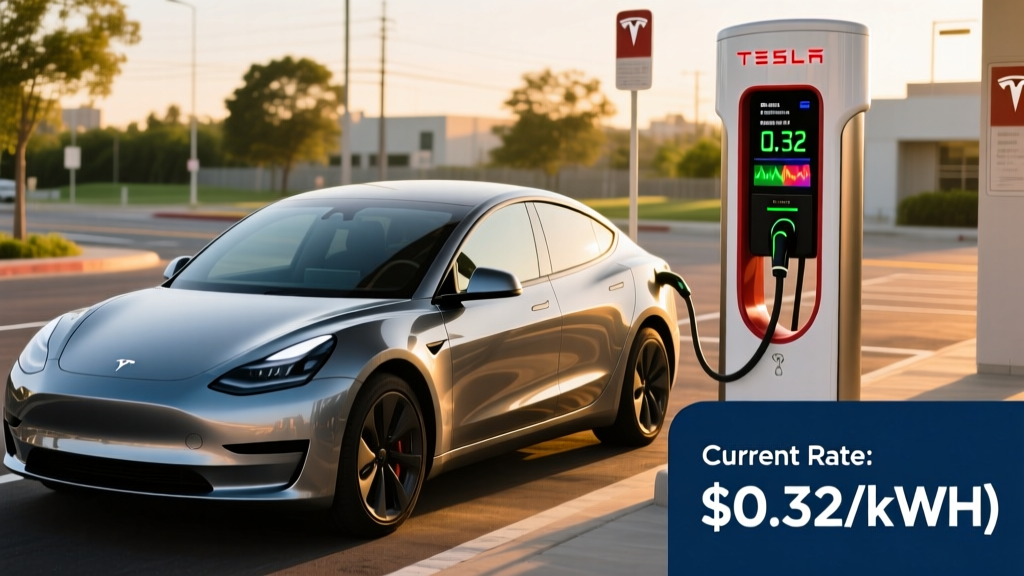
| DC fast charging (Electrify America, EVgo) | $0.48/kWh | $13.44 | $0.134 | ~$4.03/gallon |
| Tesla Supercharger (average 2026) | $0.35/kWh | $9.80 | $0.098 | ~$2.94/gallon |
| Gas comparison baseline: 28 MPG combined at $3.50/gallon = $12.50 per 100 miles = $0.125/mile | ||||
The takeaway: Home charging on an average or off-peak rate is dramatically cheaper than gasoline — typically one-third to one-quarter the per-mile cost. Public DC fast charging narrows the gap considerably, and in high-cost electricity markets, exclusive DC fast charging can approach or exceed the cost of fueling an efficient gasoline car.
This is why the financial case for an EV hinges on home charging access. If you can charge at home — even at a relatively high residential rate of $0.20/kWh — you'll pay roughly $0.057/mile versus $0.125/mile for a 28 MPG gas car at $3.50/gallon. Over 15,000 miles per year, that's $1,020 in annual fuel savings.
Time-of-Use Rates: How to Slash Your Home Charging Cost
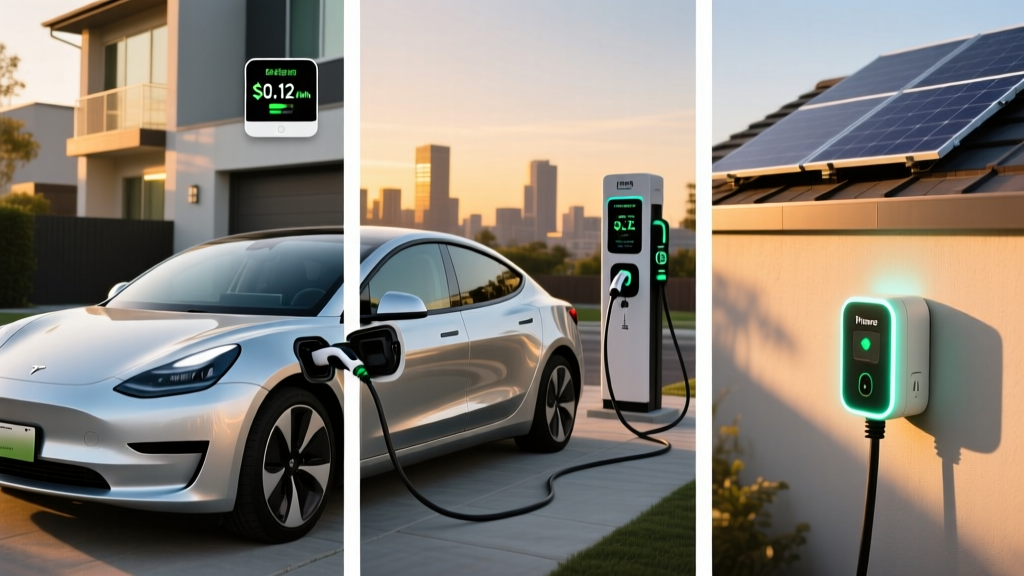
Many utilities offer Time-of-Use (TOU) plans where electricity is cheapest during off-peak hours (typically 10 PM to 6 AM). In some markets, off-peak rates drop to $0.06–$0.10/kWh, making EV charging absurdly cheap. Most Level 2 chargers and EVs have built-in scheduling — you plug in when you get home at 6 PM, but the charger doesn't start until 10 PM when rates drop.
Check your utility's EV-specific rate plans. Some utilities (PG&E, SCE, ConEd, Xcel Energy, and others) offer dedicated EV charging rates with super off-peak prices as low as $0.05/kWh. Combined with scheduled charging, this can push your per-mile cost below $0.02.
Charging Time Examples: How Long Does It Take?
Charging time depends on three factors: your battery's usable capacity (kWh), the charger's power output (kW), and the charge curve (how the battery management system throttles speed as SoC increases). Here are real-world examples for common battery sizes:
| Vehicle (Example) | Battery (usable kWh) | Level 1 (1.4 kW) 10–80% | Level 2 (11.5 kW) 10–80% | DC Fast (peak kW) 10–80% |
|---|---|---|---|---|
| 2026 Tesla Model Y LR | ~75 kWh | ~37 hours | ~4.5 hours | ~250 kW peak, ~18–22 min |
| 2026 Ford F-150 Lightning Ext. Range | ~131 kWh | ~65 hours | ~8 hours | ~170 kW peak, ~42–50 min |
| 2026 Hyundai Ioniq 5 Long Range | ~77.4 kWh | ~38 hours | ~4.7 hours | ~238 kW peak (800V), ~18–20 min |
| 2026 Chevrolet Equinox EV 3RS | ~85 kWh | ~42 hours | ~5.2 hours | ~150 kW peak, ~32–38 min |
| 2026 Toyota RAV4 PHEV (EV mode only) | ~18.1 kWh | ~9 hours | ~1.1 hours | N/A (no DC fast charge on most PHEVs) |
Recommended Home Level 2 Chargers (2026 Picks)
Here are five Level 2 chargers that represent the best combinations of reliability, features, and value for 2026 EV owners. All are UL-listed (critical for safety and insurance) and available with NACS connectors:
Best Overall: Emporia Level 2 Smart Charger
- Power output: 48 amps / 11.5 kW (on a 60A circuit)
- Connector: NACS (native); J1772 version also available
- Cable length: 24 feet
- Smart features: Wi-Fi, app scheduling, energy monitoring, load management (pairs with Emporia Vue panel monitor to avoid panel overload)
- Price: ~$399
- Why: Load management capability can save you a $2,000+ panel upgrade. Excellent app. Best value in smart chargers.
Best for Tesla Owners: Tesla Wall Connector
- Power output: 48 amps / 11.5 kW (on a 60A circuit)
- Connector: NACS (native Tesla); also ships with J1772 adapter
- Cable length: 24 feet
- Smart features: Wi-Fi, OTA updates, power sharing (daisy-chain two units on one circuit), access control
- Price: ~$475
- Why: Seamless integration with Tesla vehicles and Powerwall. Clean design. Power sharing is unique for two-EV households.
Most Durable (Outdoor): Grizzl-E Smart
- Power output: 40 amps / 9.6 kW (on a 50A circuit)
- Connector: NACS or J1772
- Cable length: 24 feet
- Smart features: Wi-Fi, app scheduling, OCPP-compatible (works with utility demand-response programs)
- Price: ~$449
- Why: Built like a tank in Canada. NEMA 4X rated. Ideal for harsh outdoor climates. 3-year warranty.
Budget Pick: Lectron V-BOX Pro
- Power output: 48 amps / 11.5 kW (on a 60A circuit)
- Connector: NACS or J1772
- Cable length: 20 feet
- Smart features: Basic app, scheduling
- Price: ~$299
- Why: Delivers full 48 amps at the lowest price point. Good for budget-conscious buyers who want maximum charge speed without smart-home integration.
Best for CCS Vehicles: ChargePoint Home Flex
- Power output: Up to 50 amps / 12 kW (on a 60A+ circuit); adjustable down to 16A for lower-capacity panels
- Connector: J1772 (for CCS vehicles); NACS adapter included in 2026 refresh
- Cable length: 23 feet
- Smart features: Wi-Fi, excellent app, Alexa/Google integration, flexible amperage setting
- Price: ~$599
- Why: Adjustable amperage lets you match the charger to your panel's available capacity — a 100-amp panel might only support 24A, and the Flex accommodates that without a hardware swap.
Frequently Asked Questions
How much does it cost to install a home EV charger?
For a straightforward installation (electrical panel close to the garage, no panel upgrade needed), expect $900–$2,000 total including the charger, electrician labor, materials, and permit. If the panel is far from the charger location or you need a subpanel, costs rise to $1,500–$3,700. If your home needs a panel upgrade from 100A to 200A, total costs can reach $2,150–$5,000+. Always get multiple quotes from licensed electricians, and check with your utility for rebates that can offset $250–$1,000 of the cost.
How fast will each charging level add range?
Level 1 (120V) adds roughly 3–5 miles of range per hour — adequate for PHEVs but impractical for full EVs. Level 2 (240V, 48A) adds 30–44 miles per hour, enough to fully recharge most EVs overnight. DC fast charging adds 150–1,200+ miles per hour at peak, but the rate tapers significantly above 80% SoC, so practical road-trip sessions (10–80%) take 18–50 minutes depending on the vehicle and charger.
Which connector and charger is compatible with my EV?
For 2026 models, most new EVs use NACS (Tesla's standard, now the North American norm). Hyundai/Kia, Volkswagen, BMW, and Porsche still use CCS1 on 2026 models, though many are transitioning. The older CHAdeMO standard is effectively discontinued. For home Level 2 charging, nearly all chargers now ship with NACS or include adapters. For DC fast charging on the road, CCS vehicles need a NACS adapter (~$200–$250) to access Tesla Superchargers. Check your vehicle's charge port before buying a charger.
How much does charging cost per mile compared to gas?
At the US average residential electricity rate of ~$0.17/kWh, an efficient EV like the Tesla Model Y (3.5 mi/kWh) costs about $0.048 per mile to charge at home. A comparable gas car getting 28 MPG at $3.50/gallon costs $0.125 per mile. That's a 62% reduction in fuel cost with home charging. However, exclusive DC fast charging at $0.48/kWh pushes the cost to $0.134/mile — more expensive than gas. The savings case for EVs depends heavily on home charging access.
What electrical upgrades might I need for a home charger?
The most common upgrade is running a new dedicated 240V circuit from your panel to the charger location. If your panel is older (pre-1990s) or already near capacity with electric appliances, you may need a panel upgrade from 100A to 200A ($1,500–$3,500). A load-management-capable charger (like the Emporia Level 2 paired with a panel monitor) can sometimes avoid a panel upgrade by throttling the charger when other appliances are drawing heavily. Your electrician will perform a NEC Article 220 load calculation to determine what's required. Also budget for a permit and inspection ($50–$200) — it's required by code and protects your insurance coverage.
Does the federal tax credit apply to home charger installation?
The Alternative Fuel Vehicle Refueling Property Credit (IRS Form 8911) was available for home charger equipment and installation but expired for residential installations after December 31, 2021, and was not reinstated in subsequent legislation as of 2026. However, many state and utility programs offer rebates of $250–$1,000 for home charger purchases and installation. Check your utility's website and the Alternative Fuels Data Center for current programs in your area. The separate §30D clean vehicle credit applies to the vehicle purchase, not the charger.
Editorial note: Electricity rates, utility programs, and charger pricing reflect 2026 data and are subject to change. Always verify current rates with your utility and confirm installation requirements with a licensed electrician. Safety data and code references are based on the 2023 NEC as adopted by most US jurisdictions; your local code may differ.