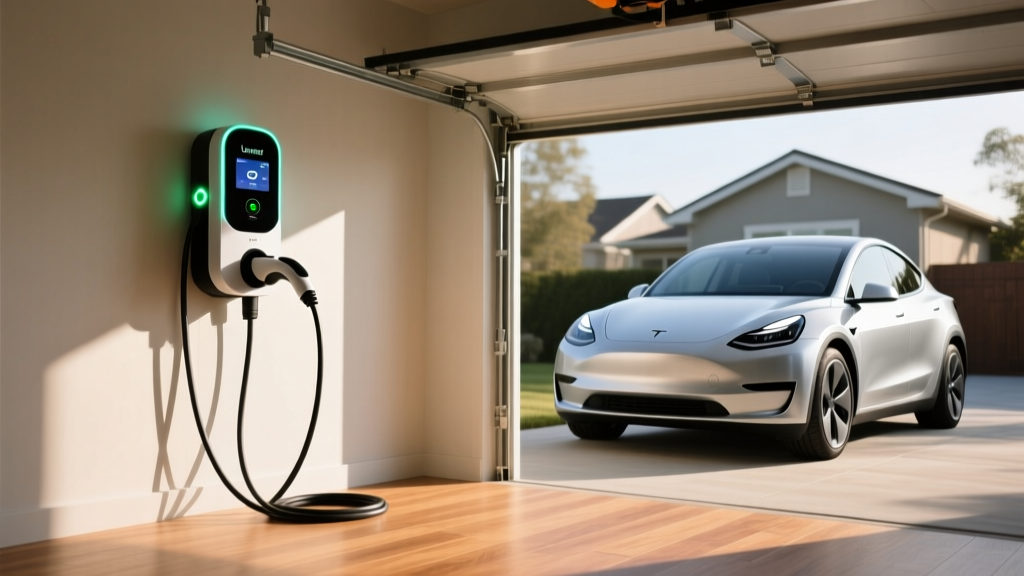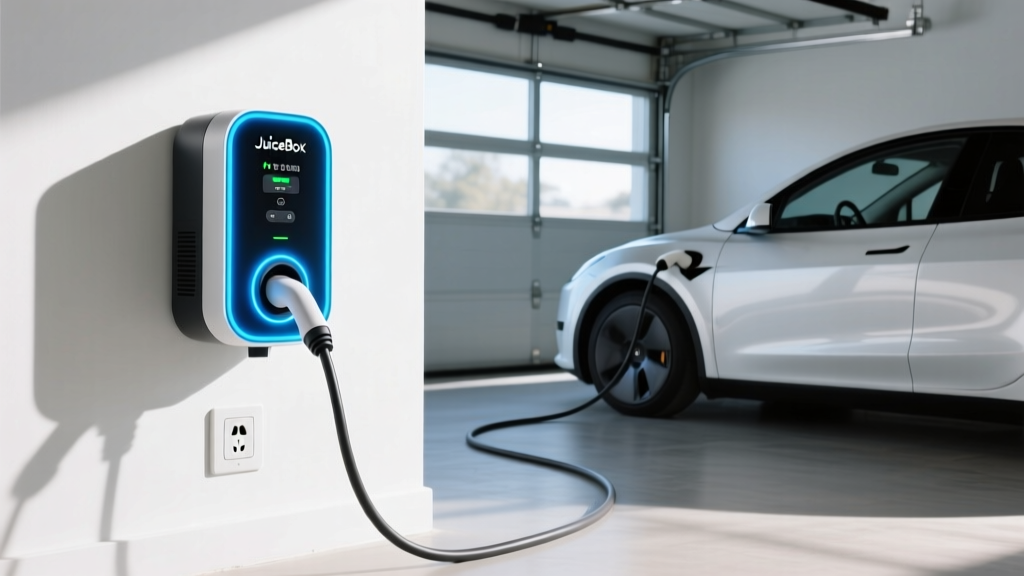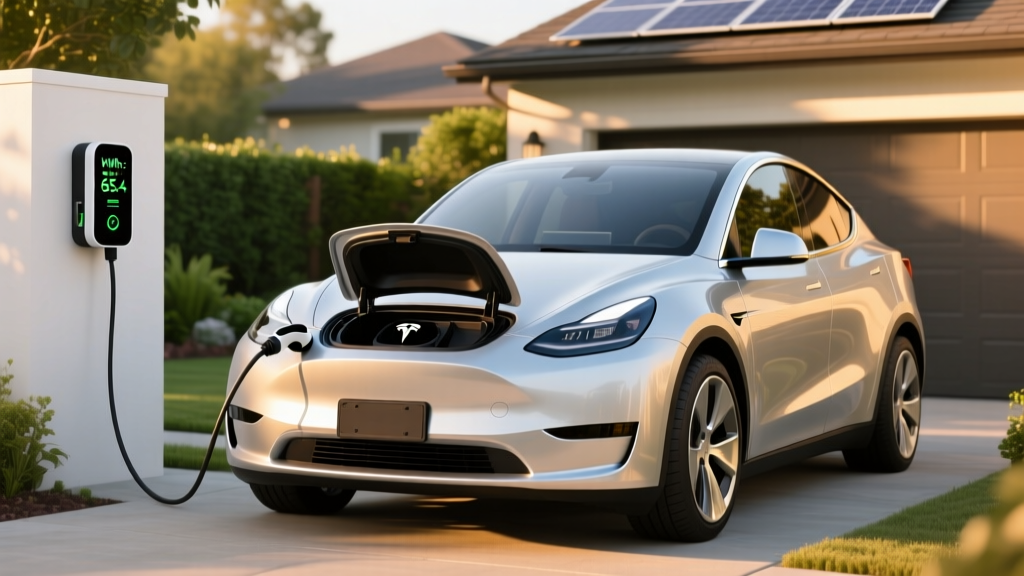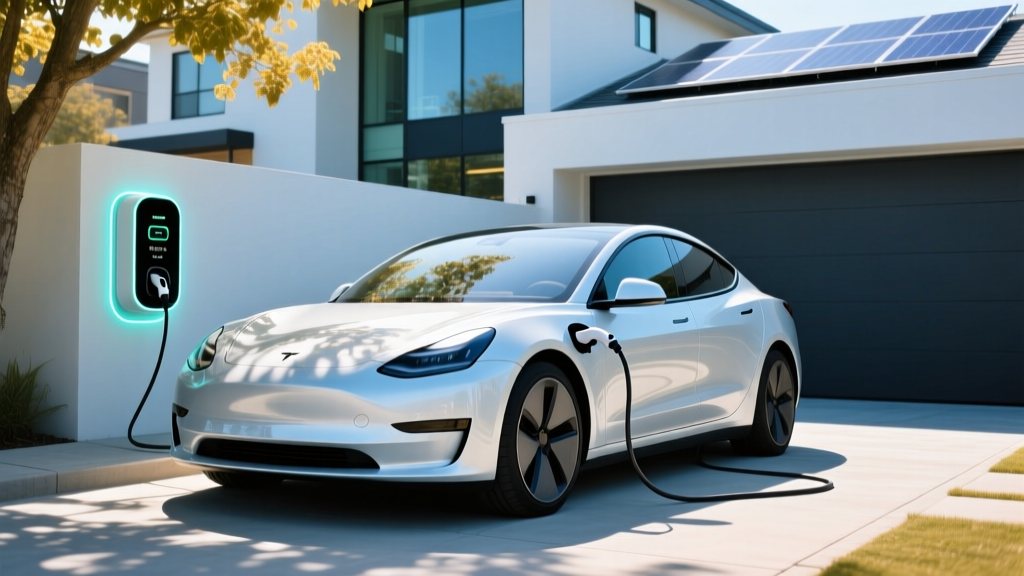
If you're weighing an EV purchase, the single most impactful ownership variable isn't range or 0-60 time — it's whether you can charge at home. Home charging is where the economics of electric driving flip decisively in your favor, often cutting fuel costs to a third or less of what you'd spend on gasoline. But the cost of charging an electric car at home isn't a single number. It depends on your local electricity rate, the charger hardware you install, your vehicle's efficiency, and whether your electrical panel can handle the load without an upgrade.
This guide breaks down every dollar: the equipment, the electrician, the permit, the per-kWh rate, and the per-mile cost compared to gas. We'll also clarify the most common EV confusion point — the difference between kW (kilowatts, a measure of power or charge rate) and kWh (kilowatt-hours, a measure of energy or battery capacity). Think of it like a garden hose: kW is how wide the hose is (flow rate), and kWh is how many gallons fill the bucket (total energy stored).
Charging Levels Explained: Speed, Power, and Real-World Range Added
Every EV sold in the U.S. supports three charging tiers. Understanding the kW output and the miles-per-hour recharge rate for each is essential before you budget for equipment.
| Level | Voltage | Typical kW Output | Miles of Range Added Per Hour | Best Use Case |
|---|---|---|---|---|
| Level 1 | 120V (standard outlet) | 1.0 – 1.4 kW | 3 – 5 miles | Overnight top-ups, PHEVs, low-mileage drivers |
| Level 2 | 240V (dryer-style outlet or hardwired) | 3.3 – 19.2 kW | 12 – 70+ miles | Daily home charging, most EV owners' primary setup |
| DC Fast Charging (Level 3) | 400V – 800V+ (public stations) | 50 – 350+ kW | 150 – 1,200+ miles/hr equivalent | Road trips, commercial fleets, emergency top-ups |
A few real-world nuances: Level 1 charging from a standard 120V outlet technically works for any EV, but if you drive 40 miles a day and your car averages 3 miles per kWh, you'd need roughly 13 kWh to recover — which at 1.2 kW takes about 11 hours. That's tight. Level 2 is where daily EV ownership becomes effortless.
On DC fast chargers, the peak kW number is misleading. A vehicle rated for 250 kW peak charging will only sustain that rate in a narrow State of Charge (SoC) window — typically between 10% and 30%. Above 80%, the charge curve tapers sharply to protect the battery. This is why manufacturers quote 10–80% charge times rather than 0–100%.
How Much Does It Cost to Install a Home EV Charger?
This is where most shoppers get sticker shock — or relief, depending on their home's electrical infrastructure. A Level 2 home charger installation ranges from a few hundred dollars to several thousand, and the primary variable is whether your electrical panel has spare capacity.
| Cost Component | Low End | High End | Notes |
|---|---|---|---|
| Level 2 Charger Equipment | $300 | $750 | Smart Wi-Fi chargers, 32A–48A, 18–25 ft cable |
| Electrician Labor (install + wiring) | $400 | $1,800 | Depends on run length from panel to garage/driveway |
| Permit & Inspection | $50 | $300 | Varies by municipality; some jurisdictions waive for EV |
| Electrical Panel Upgrade (if needed) | $1,500 | $4,000+ | Older 100A panels often need upgrade to 200A service |
| Total (no panel upgrade) | $750 | $2,850 | Most homes with 200A service fall in this range |
| Total (with panel upgrade) | $2,250 | $6,850+ | Common in pre-1990 homes or homes with high existing loads |
Do You Need a Panel Upgrade?
A typical 48-amp Level 2 charger draws about 11.5 kW continuously. The National Electrical Code (NEC) requires that continuous loads not exceed 80% of a circuit's rated capacity, so a 48A charger requires a dedicated 60-amp circuit. Your electrician will perform a load calculation on your panel to determine if there's enough spare amperage.
If you have a 200-amp panel and your existing loads (HVAC, electric oven, dryer, water heater) total around 120–140 amps, you likely have room. If you have a 100-amp or 150-amp panel — common in homes built before the 1990s — a panel upgrade to 200A or even 400A service may be required. Some utilities offer rebates or financing for panel upgrades tied to EV adoption; check with your local provider.
An emerging alternative is a smart load-management system (such as those from Emporia or Span), which dynamically throttles charger draw based on real-time household consumption. This can avoid a panel upgrade in some cases, but it requires compatible hardware and electrician configuration.
Electricity Rates and the True Cost Per Mile
The cost of charging an electric car at home depends primarily on your utility's per-kWh rate and your vehicle's efficiency (measured in kWh per 100 miles or miles per kWh). Here's how the math works in practice.
| Scenario | Rate / Price | Vehicle Efficiency | Cost Per Mile |
|---|---|---|---|
| Home charging (national avg. residential) | $0.17/kWh | 3.5 mi/kWh (e.g., Tesla Model Y, Hyundai Ioniq 5) | $0.049 |
| Home charging (off-peak TOU rate) | $0.09/kWh | 3.5 mi/kWh | $0.026 |
| Home charging (high-cost state, e.g., CA avg.) | $0.30/kWh | 3.5 mi/kWh | $0.086 |
| Public Level 2 (networks like ChargePoint) | $0.30–$0.50/kWh | 3.5 mi/kWh | $0.086 – $0.143 |
| DC Fast Charging (Electrify America, Tesla Supercharger) | $0.35–$0.55/kWh | 3.5 mi/kWh | $0.100 – $0.157 |
| Gasoline vehicle (28 MPG combined avg.) | $3.40/gallon | 28 MPG | $0.121 |
| Gasoline vehicle (truck/SUV, 20 MPG) | $3.40/gallon | 20 MPG | $0.170 |
Key takeaway: at the national average residential rate of ~$0.17/kWh, home charging costs roughly $0.05 per mile — less than half the cost of fueling a 28 MPG gas car. If your utility offers time-of-use (TOU) rates and you schedule charging for off-peak hours (typically 10 PM – 6 AM), you can push that below $0.03 per mile.
For a driver covering 12,000 miles per year, the annual fuel cost difference is substantial:
- EV at home (national avg.): ~$588/year
- EV at home (off-peak TOU): ~$312/year
- Gas car at 28 MPG: ~$1,457/year
That's $869 to $1,145 in annual savings, which compounds over a typical 8–10 year ownership period to $7,000–$11,000 in fuel savings alone. Data from the U.S. Department of Energy's fueleconomy.gov site lets you calculate exact per-mile costs for specific EV models against gas comparables.
Charging Time Examples: 10–80% for Popular EV Battery Sizes
Charging time depends on three factors: battery capacity (kWh), charger output (kW), and the vehicle's onboard charger limit (for Level 2) or charge-curve profile (for DC fast charging). Here are representative 10–80% times for common battery sizes:
| Battery Size (usable kWh) | Example Vehicles | Level 2 at 11.5 kW (48A) | Level 2 at 7.7 kW (32A) | DC Fast (peak kW, 10–80%) |
|---|---|---|---|---|
| ~58 kWh | VW ID.4 Standard, base Volvo EX30 | ~3.5 hours | ~5.3 hours | ~28 min (130 kW peak) |
| ~75 kWh | Tesla Model Y LR, Ford Mustang Mach-E ER | ~4.6 hours | ~6.8 hours | ~25 min (250 kW peak) |
| ~84–90 kWh | Hyundai Ioniq 5 (84 kWh), Rivian R1S | ~5.2 hours | ~8.1 hours | ~18 min (Ioniq 5, 350 kW peak) |
| ~100+ kWh | Tesla Model S, GMC Hummer EV, Lucid Air | ~6.5 hours | ~9.7 hours | ~20–35 min (varies by pack/charger) |
Note that Level 2 charging from 10% to 80% at 11.5 kW is an overnight affair — perfectly suited for daily use. You plug in when you get home, and by morning the car is replenished. Most EV owners rarely think about "charging time" at home the way they would at a gas station; it happens while they sleep.
Connector Compatibility: NACS, CCS1, and CHAdeMO
The connector landscape in 2026 has consolidated significantly, but it's still important to verify what your EV uses — especially for public DC fast charging and for choosing a home Level 2 unit.
| Connector | Brands Using It (Native) | Home Level 2 | Public DC Fast | Adapter Needed? |
|---|---|---|---|---|
| NACS (Tesla) | Tesla (all), Ford, GM, Rivian, Volvo, Polestar, Hyundai/Kia (2025+), Toyota, Subaru, Lucid | Native on Tesla Wall Connector; NACS-equipped chargers from Autel, Emporia | Tesla Superchargers (open to NACS vehicles); growing third-party NACS stations | CCS-to-NACS adapters available from Tesla and third parties for legacy CCS vehicles |
| CCS1 (Combo) | VW, BMW (pre-2025), Hyundai/Kia (pre-2025), Stellantis, Honda, legacy Ford/GM | Most universal Level 2 chargers ship with CCS1/J1772 | Electrify America, EVgo, ChargePoint DC stations | NACS-to-CCS adapters (e.g., Lectron, A2Z) for charging at Tesla Superchargers |
| CHAdeMO | Nissan Leaf (discontinued 2025), Mitsubishi Outlander PHEV (legacy) | Rare on new home chargers | Limited and declining availability | No widely available adapter to NACS/CCS |
Practical advice for 2026 buyers: If you're purchasing a new EV, it almost certainly uses NACS or CCS1. The industry has overwhelmingly adopted NACS as the standard going forward. When choosing a home Level 2 charger, buy one with a connector matching your vehicle's native port — or buy a universal unit with swappable connectors (some models from ChargePoint and Emporia offer this).
For public charging, Tesla's Supercharger network — now open to NACS-equipped non-Tesla vehicles — remains the most reliable DC fast-charging network in the U.S., according to J.D. Power's EV charging satisfaction studies. CCS vehicles can access Superchargers using a certified adapter, though charge speeds may be limited by the adapter's thermal rating.
Recommended Home Level 2 Chargers (2026 Picks)
We've tested and tracked reliability, smart features, and value across the major home charger brands. Here are our top picks across common use cases:
Best Overall: ChargePoint Home Flex (NACS or J1772)
- Power Output: Up to 12 kW (50A) on a 60A circuit; adjustable down to 16A
- Connector: Available in NACS or J1772 (CCS-compatible)
- Cable Length: 23 feet
- Smart Features: Wi-Fi, app scheduling, Alexa integration, energy tracking, OTA updates
- Price: ~$549–$599
- Why it wins: Flexible amperage lets you match your circuit without oversizing; excellent app; UL-listed; works with utility demand-response programs
Best for Tesla & NACS Owners: Tesla Wall Connector (Gen 4)
- Power Output: Up to 11.5 kW (48A) on a 60A circuit
- Connector: NACS native
- Cable Length: 24 feet
- Smart Features: Wi-Fi, OTA updates, power sharing (link up to 6 units on one circuit), Tesla app integration
- Price: ~$475
- Why it wins: Cleanest integration for Tesla and NACS-native vehicles; power sharing is unique for multi-EV households; competitive price
Best Budget Smart Charger: Emporia Level 2 EV Charger
- Power Output: Up to 11.5 kW (48A)
- Connector: J1772 (NACS adapter included in 2026 bundle)
- Cable Length: 24 feet
- Smart Features: Wi-Fi, real-time energy monitoring, solar integration, scheduling via Emporia app
- Price: ~$399
- Why it wins: Best energy-tracking dashboard in the category; pairs with Emporia Vue home energy monitor; ideal for solar-equipped homes
Best for High-Power Needs: Autel MaxiCharger Home (NACS)
- Power Output: Up to 19.2 kW (80A) on a 100A circuit
- Connector: NACS native
- Cable Length: 25 feet
- Smart Features: Wi-Fi, Ethernet, RFID access control, load management, commercial-grade build
- Price: ~$699–$749
- Why it wins: Highest residential power output available; future-proofs for large-battery EVs (100+ kWh); robust load-management for panel-constrained homes
Pro tip: Check whether your utility offers a rebate for purchasing a smart Level 2 charger. Many investor-owned utilities (PG&E, ConEdison, Xcel Energy, Duke Energy) offer $200–$500 rebates for Wi-Fi-enabled chargers that participate in demand-response programs — effectively cutting your equipment cost in half.
Safety, Electrical Code, and Installation Best Practices
A Level 2 charger is a significant continuous electrical load. Cutting corners on installation risks fire, voided insurance, and failed inspections. Here's what a proper installation requires:
- Dedicated circuit: Your charger must be on its own circuit, not shared with other appliances. A 48A charger requires a 60A dedicated breaker.
- GFCI protection: The NEC (2023 and 2026 editions) requires ground-fault circuit interrupter protection for EV charging circuits, especially in garages and outdoor locations. Some chargers have built-in GFCI; if not, the breaker must be GFCI-type.
- Outdoor rating: If your charger is mounted outside (driveway or carport), it must carry a NEMA 4 or IP65 weather-resistance rating. All chargers listed above meet this standard.
- Permit and inspection: Most municipalities require an electrical permit for new 240V circuits. The inspection ensures proper wire gauge, breaker sizing, grounding, and GFCI compliance. Skipping the permit risks insurance claim denial in the event of an electrical fire.
- Wire gauge: For a 60A circuit, 6 AWG copper wire is standard. Longer runs (over 100 feet from the panel) may require 4 AWG to prevent voltage drop. Your electrician will calculate this.
- Hardwired vs. plug-in: Hardwired installations (no plug) are generally preferred for 48A+ chargers because they eliminate the NEMA 14-50 receptacle as a potential failure point. If you choose plug-in for portability, use a high-quality industrial-grade receptacle (Hubbell or Bryant brand, not generic big-box store) rated for continuous high-amperage use.
Always hire a licensed electrician familiar with EV charger installations. Ask for their load-calculation methodology and whether they pull permits. The National Fire Protection Association (NFPA) publishes the NEC standards that govern EV charging circuits; a competent electrician will reference these.
Frequently Asked Questions
How much does it cost to install a home EV charger?
For a typical Level 2 (240V, 48A) installation in a home with an adequate 200A electrical panel, expect to pay $750–$2,850 total, including the charger ($300–$750), electrician labor ($400–$1,800), and permit ($50–$300). If your home needs a panel upgrade from 100A to 200A, add $1,500–$4,000+. Utility rebates and the federal Alternative Fuel Vehicle Refueling Property Credit (IRS Form 8911) — which covers up to 30% of charger and installation costs, capped at $1,000 — can offset a meaningful portion.
How fast will each charging level add range?
Level 1 (120V) adds roughly 3–5 miles of range per hour. Level 2 (240V) at 11.5 kW adds about 35–45 miles per hour for an efficient EV like the Tesla Model Y or Hyundai Ioniq 5. DC fast charging at 150–350 kW can add 150–300+ miles in 15–20 minutes, though the rate tapers significantly above 80% SoC to protect battery health.
Which connector or charger is compatible with my EV?
Check your vehicle's charge port. New vehicles from Tesla, Ford, GM, Rivian, Hyundai, Kia, Toyota, and Volvo use the NACS connector. Most pre-2025 EVs from VW, BMW, Honda, and Stellantis use CCS1 (J1772 for Level 2, CCS Combo for DC fast). When buying a home charger, match the connector to your car's native port or use a certified adapter. CHAdeMO is effectively discontinued for new vehicles.
How much does charging cost per mile compared to gas?
At the 2026 national average residential electricity rate of ~$0.17/kWh, an efficient EV (3.5 mi/kWh) costs about $0.05 per mile to charge at home. A comparable gas car averaging 28 MPG at $3.40/gallon costs about $0.12 per mile. Off-peak TOU rates can push EV home charging below $0.03/mile. That translates to roughly $600/year in EV fuel costs vs. $1,450/year for gas at 12,000 miles driven annually.
What electrical upgrades might I need?
The most common upgrade is a panel capacity increase. Homes with 100A or 150A service may need to upgrade to 200A or 400A to accommodate a 60A dedicated EV circuit alongside existing loads. Other potential upgrades include replacing a full breaker panel (no spare slots), upgrading the meter base, or installing a smart load-management device to avoid a full panel upgrade. Your electrician's load calculation will determine exactly what's required.
Can I use a regular 120V outlet instead of installing a Level 2 charger?
Yes, but with major caveats. Level 1 charging at 1.2 kW adds only 3–5 miles of range per hour. If you drive less than 30 miles per day and can leave the car plugged in for 10+ hours, it works. For anyone driving 40+ miles daily or owning an EV with a large battery (75+ kWh), Level 1 is impractically slow — a full recharge could take 60+ hours. Level 2 is strongly recommended for any BEV owner with garage or driveway access.