The Real Cost of Installing a Tesla Charger at Home
If you own a Tesla—or any EV using the North American Charging Standard (NACS)—home charging is the single most impactful upgrade you can make for daily convenience and long-term ownership cost. But the sticker price of a wall connector only tells part of the story. The total cost of installing a Tesla charger at home in 2026 ranges from roughly $500 on the very low end to $4,500+ if your electrical panel needs an upgrade.
This guide breaks down every line item: the charger hardware, the electrical work, permits, panel capacity, and what you'll actually pay per mile to charge at home versus filling up a gas car. We'll also cover connector compatibility for non-Tesla EVs now adopting NACS, and recommend specific equipment based on real-world use.
Understanding Charging Levels: Speeds in kW and Miles Per Hour
Before budgeting for an installation, you need to understand the three charging levels available to EV owners. The critical distinction: kW (kilowatts) measures power—how fast energy flows into your car—while kWh (kilowatt-hours) measures energy—the total capacity of your battery. Think of kW as the width of a hose and kWh as the size of the bucket.
| Level | Voltage | Power (kW) | Miles of Range Added Per Hour | Typical Use Case |
|---|---|---|---|---|
| Level 1 | 120V (standard outlet) | 1.0–1.4 kW | 3–5 mi/hr | Overnight trickle; PHEVs; emergency |
| Level 2 | 240V (dryer/outlet or hardwired) | 3.3–19.2 kW | 12–75 mi/hr | Daily home charging; the standard |
| DC Fast Charging | 400–800V DC | 50–350 kW | 150–1,000+ mi/hr (peak) | Road trips; public stations |
For a Tesla Model Y with its ~75 kWh usable battery, Level 1 charging would take roughly 75+ hours from empty to full—essentially useless for daily driving. A Level 2 Tesla Wall Connector at 11.5 kW (48A) can replenish that same battery in about 7 hours, meaning you wake up every morning with a full charge. DC fast charging is reserved for road trips; it's not something you install at home.
Installation Cost Breakdown: Equipment, Electrician, and Permits
The total cost of installing a Tesla charger at home depends on four variables: the charger unit, the complexity of the electrical run, whether your panel can handle the load, and local permit fees.
| Line Item | Simple Install (panel nearby, capacity exists) | Complex Install (long run or panel upgrade) |
|---|---|---|
| Tesla Wall Connector (hardware) | $400–$475 | $400–$475 |
| Electrician labor (2–4 hrs simple / 6–12 hrs complex) | $300–$700 | $800–$2,500 |
| Materials (conduit, wire, breaker) | $50–$150 | $200–$600 |
| Permit fee | $50–$150 | $50–$250 |
| Electrical panel upgrade (if needed) | $0 | $1,500–$3,500 |
| Total estimated range | $800–$1,475 | $2,950–$7,325 |
When Do You Need a Panel Upgrade?
Most homes built after 2000 have a 200-amp electrical panel, which can usually accommodate a 60A dedicated circuit for a Tesla Wall Connector without issue. However, if your home has a 100-amp panel (common in houses built before the 1980s), or if your panel is already near capacity with existing loads (electric oven, dryer, HVAC, water heater), a licensed electrician may recommend upgrading to 200A or even 400A service.
A panel upgrade adds $1,500 to $3,500 to the project but is sometimes unavoidable. Some utilities offer rebates for panel upgrades that support EV charging—check with your local provider. Additionally, the federal Residential Clean Energy Credit does not cover EV chargers directly (that's the separate §30C Alternative Fuel Vehicle Refueling Property Credit, capped at $1,000 for residential charging equipment), but some state and utility incentive programs do offset panel work.
The Permit Requirement
Virtually every jurisdiction in the U.S. requires a permit for new 240V circuit installation. This is not optional—it ensures the work meets National Electrical Code (NEC) standards, particularly NEC Article 625 covering EV charging. Permit fees typically range from $50 to $250 depending on your municipality. Your electrician will usually pull the permit and schedule the inspection. Skipping a permit can void your homeowner's insurance coverage for electrical fires and create problems when you sell your home.
Electrical Requirements: Voltage, Amperage, and Circuit Specs
The Tesla Wall Connector is configurable across multiple amperage settings, but to get its maximum output, you need the right circuit:
- Maximum output: 11.5 kW (48 amps continuous draw)
- Required circuit: 60-amp dedicated breaker (NEC requires circuits to be rated at 125% of continuous load, so 48A × 1.25 = 60A)
- Voltage: 240V (split-phase, standard U.S. residential)
- Wire gauge: Typically 6 AWG copper (THHN in conduit) or 4 AWG aluminum, depending on run length and local code
- Connection method: Hardwired (recommended) or NEMA 14-50 receptacle
Hardwiring is generally preferred for Tesla Wall Connectors because it eliminates the receptacle as a potential failure point, allows the full 48A output, and avoids the NEC requirement for a GFCI breaker on receptacles (which can cause nuisance tripping with EV chargers). If you opt for a NEMA 14-50 outlet instead, the Wall Connector is limited to 40A continuous (9.6 kW), and you'll need a GFCI breaker, which adds $100–$200 to the materials cost.
Safety and Code Considerations
Beyond the basic circuit, keep these code and safety requirements in mind:
- Dedicated circuit: The EV charger must be on its own breaker—no sharing with other appliances.
- GFCI protection: Required for receptacle-based installs (NEMA 14-50) per NEC 2020/2023. Hardwired installations do not require GFCI at the breaker.
- Outdoor rating: The Tesla Wall Connector is NEMA 3R rated (suitable for outdoor installation). If mounting outside, ensure conduit entries are sealed and the unit is positioned to avoid direct sprinkler spray.
- Cable management: The Wall Connector comes with a 24-foot cable. Plan your mount location so the cable reaches your charge port without stretching across a walkway.
- Load management: If your panel is tight on capacity but you don't want to upgrade, the Tesla Wall Connector can be configured to a lower amperage (down to 16A/3.8 kW) via its internal DIP switches. Some smart panels and energy management systems (like the Span smart panel) can dynamically adjust charger draw based on real-time home load.
Connector Compatibility: NACS, CCS, and Adapters
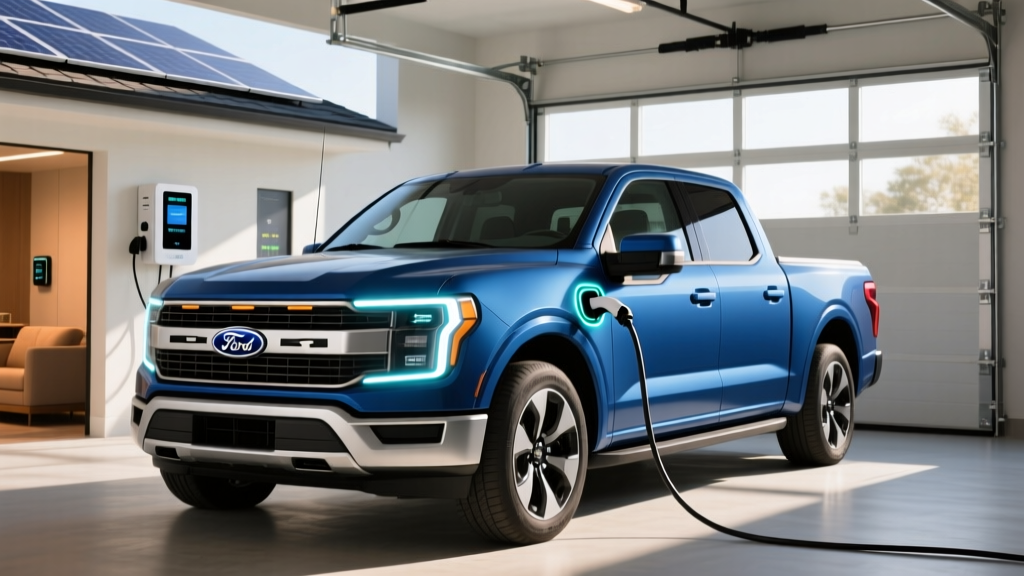
The Tesla Wall Connector uses the North American Charging Standard (NACS) connector—the same proprietary connector Tesla has used since 2012 and which is now being adopted industry-wide. As of 2026, Ford, GM, Rivian, Volvo, Polestar, Mercedes-Benz, BMW, and several other automakers have transitioned to NACS charge ports on new vehicles.
| EV Brand / Charge Port | Native NACS? | Compatible with Tesla Wall Connector? | Adapter Needed? |
|---|---|---|---|
| Tesla (all models) | Yes | Yes — native | None |
| Ford (2025+ F-150 Lightning, Mustang Mach-E) | Yes | Yes — native | None |
| GM (2025+ Blazer EV, Equinox EV, Silverado EV) | Yes | Yes — native | None |
| Rivian (2025+ R1T, R1S) | Yes | Yes — native | None |
| Hyundai / Kia (CCS1 port) | No | Yes, with adapter | CCS1-to-NACS adapter ($150–$250) |
| VW ID.4 (CCS1 port, pre-2026) | No | Yes, with adapter | CCS1-to-NACS adapter |
| Nissan Leaf (CHAdeMO) | No | Not practical | No widely available adapter |
If you drive a non-Tesla EV with a CCS1 port, you can still use a Tesla Wall Connector with a third-party CCS1-to-NACS adapter. However, for CCS1-native vehicles, a universal Level 2 charger with a J1772/CCS connector (like the Emporia Vue or ChargePoint Home Flex) may be a simpler choice that avoids the adapter altogether. Tesla also sells a J1772 adapter for $150 that allows non-Tesla EVs to charge from a Tesla Wall Connector, though at reduced convenience.
Charging Time Examples: What to Expect With a Tesla Wall Connector
Here's how long it takes to charge common Tesla battery sizes from 10% to 80% State of Charge (SoC) using a Tesla Wall Connector at its maximum 11.5 kW output. Note that Level 2 charging is relatively linear—unlike DC fast charging, there's minimal taper below 80%.
| Vehicle | Usable Battery (kWh) | 10–80% Energy Needed | Estimated Time (10–80%) |
|---|---|---|---|
| Tesla Model 3 RWD (LFP) | ~57.5 kWh | ~40.3 kWh | ~3.5 hours |
| Tesla Model 3 Long Range | ~75 kWh | ~52.5 kWh | ~4.6 hours |
| Tesla Model Y Long Range | ~75 kWh | ~52.5 kWh | ~4.6 hours |
| Tesla Model S Plaid | ~95 kWh | ~66.5 kWh | ~5.8 hours |
| Tesla Cybertruck AWD | ~123 kWh | ~86.1 kWh | ~7.5 hours |
| Ford F-150 Lightning Ext. Range | ~131 kWh | ~91.7 kWh | ~8.0 hours |
For context, the average American drives roughly 37 miles per day according to FHWA data. In a Model Y Long Range (roughly 3.5 mi/kWh), that's about 10.6 kWh—easily replenished in under one hour on an 11.5 kW Wall Connector. Most EV owners who charge at home plug in nightly and never think about it again.
Cost to Charge: Home Electricity vs. Gas vs. Public Charging
One of the strongest arguments for home charging is cost. Electricity prices vary enormously by state and utility, but the economics consistently favor home Level 2 charging over gasoline and public DC fast charging.
| Scenario | Rate | Cost per Mile (Tesla Model Y, ~3.5 mi/kWh) | Annual Cost (13,500 mi/yr) |
|---|---|---|---|
| Home (national avg. residential, off-peak) | $0.14/kWh | $0.040 | $540 |
| Home (California, peak TOU) | $0.35/kWh | $0.100 | $1,350 |
| Home (Texas, off-peak) | $0.11/kWh | $0.031 | $423 |
| Public Level 2 (ChargePoint, EVgo) | $0.25–$0.40/kWh | $0.071–$0.114 | $963–$1,543 |
| DC Fast Charging (Tesla Supercharger) | $0.28–$0.40/kWh | $0.080–$0.114 | $1,080–$1,543 |
| Gasoline car (28 MPG combined, $3.40/gal) | $3.40/gal | $0.121 | $1,637 |
The savings are substantial. A Model Y owner charging primarily at home on the national average rate saves roughly $1,100 per year compared to a 28 MPG gas car. Even in high-cost California, scheduling charging during off-peak hours (typically 12 AM–6 AM via your car's scheduled charging feature) can cut costs dramatically. Most utilities offer time-of-use (TOU) plans specifically designed for EV owners—contact yours to ask about EV-specific rate plans.
The U.S. Department of Energy's Alternative Fuels Data Center provides a state-by-state electricity rate tool to help you calculate your personal cost per mile.
Recommended Equipment: Tesla Wall Connector and Alternatives
If you own a Tesla or a NACS-equipped vehicle, the Tesla Wall Connector is the default recommendation. But depending on your needs, there are strong alternatives worth considering.
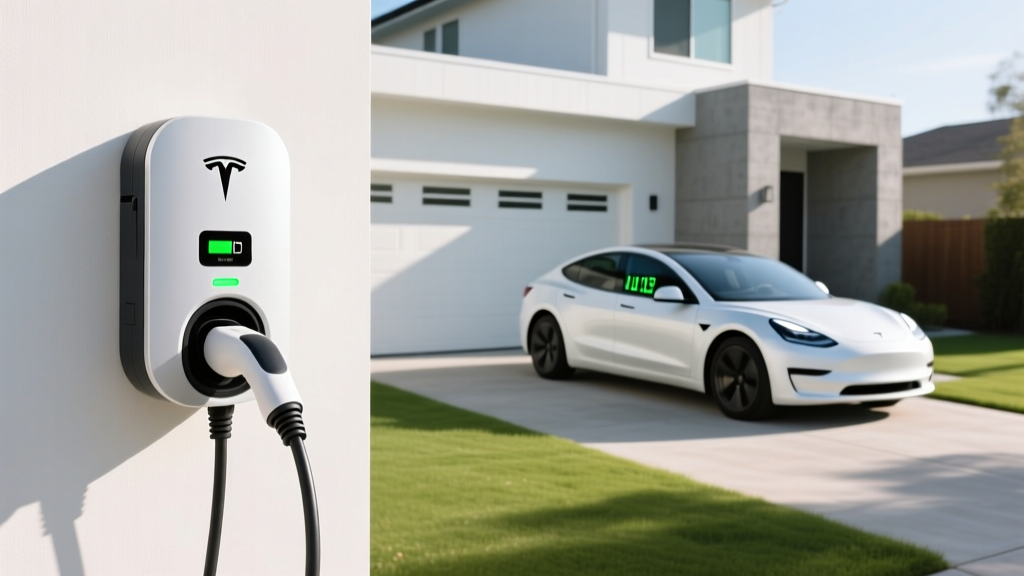
Tesla Wall Connector (Gen 3)
- Price: $400–$475 (direct from Tesla)
- Max power: 11.5 kW (48A) on a 60A circuit
- Connector: NACS (native Tesla)
- Cable length: 24 feet
- Smart features: Wi-Fi connected, OTA updates, load sharing (up to 6 units on one circuit), Tesla app integration, access control
- Indoor/outdoor: NEMA 3R rated (indoor or outdoor)
- Warranty: 4 years
The Tesla Wall Connector is purpose-built for the Tesla ecosystem. Load sharing is a standout feature: if you have two Teslas and limited panel capacity, two Wall Connectors can share a single 60A circuit and dynamically split the available amperage between vehicles.
Alternatives for Mixed-EV Households
If your household includes both a Tesla and a non-Tesla EV with a J1772 or CCS1 port, consider a universal charger:
- ChargePoint Home Flex: ~$549, up to 12 kW (50A), J1772 connector (Tesla owners use the J1772 adapter that comes with every Tesla). NEMA 4 outdoor rated, 23-foot cable, app scheduling, Alexa integration.
- Emporia Level 2 EV Charger: ~$399, up to 11.5 kW (48A), J1772 connector. Real-time energy monitoring via the Emporia app, 24-foot cable, works with Emporia Vue home energy monitor for solar integration.
- Grizzl-E Smart: ~$499, up to 10 kW (40A), J1772 connector. Built in Canada, rated to -40°F for extreme cold climates, 24-foot cable, OCPP-compatible for utility demand-response programs.
For a pure Tesla household, the Wall Connector's seamless integration, load sharing, and sleek design make it the best choice. For mixed fleets, a J1772 charger plus the Tesla-included J1772 adapter is the most flexible approach.
Federal Tax Credit and Utility Rebates for Home Charger Installation
The §30C Alternative Fuel Vehicle Refueling Property Credit provides a federal tax credit of up to 30% of the cost of home EV charging equipment and installation, capped at $1,000. This credit covers both the charger hardware and the electrician labor for installation.
However, there's a significant geographic restriction: under the Inflation Reduction Act, the §30C credit is only available for installations in census tracts classified as "low-income communities" or "non-urban areas." You can check your eligibility using the IRS §30C guidance page or the Argonne National Laboratory's mapping tool. Consult a tax professional to confirm your eligibility before claiming.
Beyond the federal credit, many utilities and states offer additional rebates:
- Utility rebates: Many electric utilities offer $250–$1,000 rebates for purchasing and installing a Level 2 charger, especially if you enroll in a TOU rate plan.
- State incentives: States like California, Colorado, Massachusetts, and New York offer additional rebates that can stack with utility programs. Check the Alternative Fuels Data Center state incentive database for your area.
- Panel upgrade assistance: Some utilities (notably in California under the EV Infrastructure pilot programs) cover part or all of a panel upgrade cost when it's needed for EV charging.
Frequently Asked Questions
How much does it cost to install a Tesla charger at home?
Most homeowners pay between $800 and $1,700 for a straightforward installation (Tesla Wall Connector + electrician + permit on an existing 200A panel). If your panel needs upgrading or the circuit run is long and complex, total costs can reach $2,500 to $7,000+. The Wall Connector hardware itself costs $400–$475.
Can I install a Tesla Wall Connector myself?
Technically, a licensed electrician is required for any new 240V circuit installation in virtually all U.S. jurisdictions. DIY electrical work on a 60A circuit carries serious fire and electrocution risk, will not pass inspection, and may void your homeowner's insurance. Always hire a licensed electrician and pull a permit.
Do I need a 200-amp panel for a Tesla charger?
Not always. A 100-amp panel can sometimes support a lower-amperage charger (e.g., 32A/7.7 kW) if the rest of your home's electrical load is modest. Your electrician will perform a load calculation per NEC Article 220 to determine what your panel can handle. If you're already near capacity, a panel upgrade to 200A or 400A may be necessary.
How fast will a Tesla Wall Connector charge my car?
At its maximum 11.5 kW (48A), the Wall Connector adds roughly 37–44 miles of range per hour to a Tesla Model 3 or Model Y. A full overnight session (8 hours) can add 300+ miles—more than enough to replenish any daily driving. Charging speed is ultimately limited by your car's onboard charger; all current Tesla models can accept the full 11.5 kW.
Is it cheaper to charge at home or at a Tesla Supercharger?
Home charging is almost always cheaper. The national average residential rate of ~$0.14/kWh translates to about $0.04 per mile in a Model Y, while Tesla Superchargers typically cost $0.28–$0.40/kWh ($0.08–$0.11 per mile). Over 13,500 annual miles, home charging saves $500–$1,000 compared to exclusive Supercharger use.
What's the difference between hardwired and NEMA 14-50 installation?
A hardwired Wall Connector connects directly to your electrical panel via a junction box, supports the full 48A output, and doesn't require a GFCI breaker. A NEMA 14-50 receptacle install plugs into a 50A outlet (like an electric dryer), is limited to 40A/9.6 kW, and requires a GFCI breaker per NEC code. Hardwired is generally preferred for reliability and maximum speed, but a 14-50 outlet offers portability if you might move the charger later.
Will a Tesla Wall Connector work with my Ford or GM electric vehicle?
Yes—if your Ford, GM, Rivian, or other vehicle has a native NACS charge port (standard on most 2025+ models from these brands), the Tesla Wall Connector will plug in directly. For older EVs with CCS1 ports, you'll need a CCS1-to-NACS adapter, or you may prefer a universal J1772 charger instead.