Buying an electric vehicle is only half the equation. The other half — and the one that surprises more first-time EV owners — is figuring out how to charge it at home efficiently, safely, and affordably. If you've searched for the cost of installing electric car charger hardware and come away with vague estimates ranging from "$500 to "\$5,000+," you're not alone. The real answer depends on your home's electrical panel, the distance from that panel to your parking spot, local permit fees, and which Level 2 charger you choose.
This guide breaks down every line item, from the charger itself to the electrician's hourly rate, the permit, and the panel upgrade you may or may not need. We'll also cover charging speeds, connector compatibility, and how home charging cost per mile compares to gasoline — so you can budget accurately before you schedule that electrician visit.
Charging Levels Explained: Speeds, Power, and Range Added Per Hour
Before discussing installation cost, you need to understand what you're installing. EV charging is divided into three levels, defined by power output (measured in kilowatts, or kW). Don't confuse kW (the rate of energy flow, like water pressure) with kWh (kilowatt-hours, the total energy stored in your battery, like gallons in a tank). This distinction matters because charger power (kW) determines how fast your battery (kWh) fills.
| Level | Voltage | Max Power (kW) | Miles of Range Added Per Hour | Typical Use Case |
|---|---|---|---|---|
| Level 1 | 120V AC | 1.4–1.9 kW | 3–5 miles | Overnight top-up; PHEVs; emergency backup |
| Level 2 | 240V AC | 3.3–19.2 kW | 12–75 miles | Primary home and workplace charging |
| DC Fast Charging | 400–800V DC | 50–350 kW | 150–1,000+ miles (equivalent) | Road trips; 10–80% in 15–45 min |
Level 1 plugs into a standard 120V household outlet. It requires no installation but delivers painfully slow charging — roughly 4 miles of range per hour. A 75 kWh battery (like the Ford Mustang Mach-E Extended Range) would take over 40 hours from empty to full. Level 1 is viable only for plug-in hybrids with small batteries (e.g., the Toyota RAV4 Prime's 18.1 kWh pack) or as a backup.
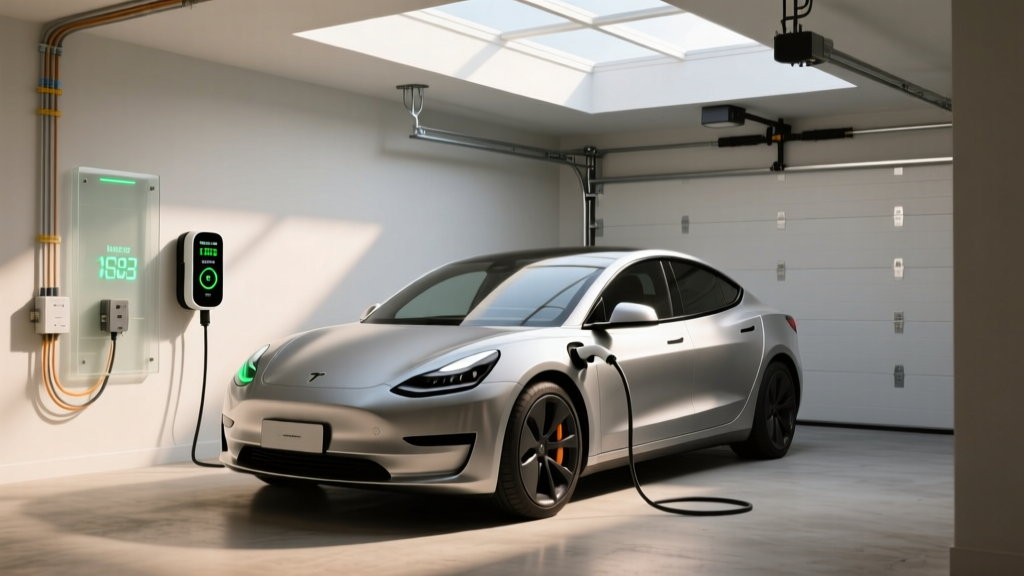
Level 2 is what most EV owners install at home. Running on 240V (the same voltage as your electric dryer or oven), Level 2 chargers deliver between 3.3 kW and 19.2 kW. A 48-amp (11.5 kW) charger — the sweet spot for most homes — adds roughly 35–45 miles of range per hour, enough to fully recharge a 75 kWh battery overnight in about 7–8 hours.
DC Fast Charging is public-only infrastructure delivering 50–350 kW directly to your battery. You can't install this at home (costs exceed $50,000 and require commercial-grade utility connections). For daily use, Level 2 is the standard.
How Much Does It Cost to Install a Home EV Charger?
The total cost of installing electric car charger equipment at home breaks down into four categories: the charger unit, the electrician's labor, the electrical permit, and any necessary panel or wiring upgrades. Here's a realistic 2026 breakdown based on national averages and typical residential installations.
| Component | Low-End Estimate | Typical Range | High-End Estimate | Notes |
|---|---|---|---|---|
| Level 2 Charger (hardware) | $300 | $400–$700 | $1,200 | Hardwired units cost less than NEMA 14-50 plug-in models |
| Electrician Labor | $400 | $800–$2,000 | $4,000+ | Depends on run length, wall type, and conduit routing |
| Electrical Permit | $50 | $100–$300 | $500 | Varies by municipality; some jurisdictions waive for EV installs |
| Panel Upgrade (if needed) | $1,500 | $2,000–$4,000 | $6,000+ | Required if existing panel lacks capacity (common in pre-2000 homes) |
| Total (no panel upgrade) | $750 | $1,300–$3,000 | $5,700 | Most homes with 200A service fall in this range |
| Total (with panel upgrade) | $2,250 | $3,300–$7,000 | $11,700 | Older 100A panels almost always need upgrading |
Let's unpack the variables that push costs toward the high end:
Run Length and Conduit
If your electrical panel is in the basement and your parking spot is in an attached garage on the same floor, you're looking at a short wire run — maybe 20–30 feet. That's the $800–$1,200 labor scenario. If the panel is on the opposite side of the house, in a crawlspace, or requires running conduit along an exterior wall or underground to a detached garage, labor can easily double or triple. Copper wire (6 AWG for a 50A circuit) costs $4–$8 per foot, and long runs add up fast.
Hardwired vs. Plug-In (NEMA 14-50)
Hardwired chargers connect directly to your panel via a junction box — no outlet needed. They're slightly cheaper to install (no $60–$90 receptacle), allow higher amperage (up to 48A continuous on a 60A breaker), and are generally safer since there's no plug to overheat. Plug-in units use a NEMA 14-50 outlet, which gives you portability (take the charger when you move) but limits you to 40A continuous draw and adds a failure point. We recommend hardwired for most homeowners.
The Panel Upgrade Variable
This is the line item that catches people off guard. Most homes built after 2005 have a 200-amp electrical panel, which can typically support a 40A or 50A EV circuit alongside existing loads. Homes built before the 1990s often have 100A or even 60A panels. Adding a 50A EV charger to a 100A panel risks overloading the system — your electrician will perform a load calculation (per NEC Article 220) to determine whether an upgrade is necessary. A panel upgrade from 100A to 200A typically costs $2,000–$4,000 depending on your utility's requirements and whether a new meter or service drop is needed.
What Electrical Upgrades Might I Need?
Beyond the panel itself, several electrical considerations affect your installation:
- Dedicated Circuit: Your Level 2 charger requires its own dedicated circuit — it cannot share with other appliances. A 48A charger needs a 60A breaker; a 32A charger needs a 40A breaker. The National Electrical Code (NEC) requires that continuous loads (defined as running 3+ hours, which EV charging qualifies as) use no more than 80% of the breaker's rated capacity.
- Wire Gauge: A 60A circuit requires 6 AWG copper wire (or 4 AWG aluminum). A 40A circuit uses 8 AWG copper. Longer runs may require thicker wire to prevent voltage drop.
- GFCI Protection: The 2020 NEC (adopted in most states by 2026) requires GFCI (Ground Fault Circuit Interrupter) protection for all EV charging outlets. Hardwired chargers with built-in ground-fault protection satisfy this requirement. Your electrician will verify compliance.
- Outdoor Rating: If your charger is installed outside (carport, driveway pedestal), it needs a NEMA 4 or NEMA 4X weather rating. Most quality Level 2 chargers meet this standard, but the disconnect switch and conduit fittings must also be outdoor-rated.
- Utility Service Capacity: In rare cases, your utility's transformer or service drop may not support a 200A upgrade. This is more common in older neighborhoods. Check with your utility before committing to a panel upgrade.
Which Connector and Charger Is Compatible with My EV?
The connector landscape shifted dramatically between 2023 and 2026. Tesla's North American Charging Standard (NACS) has been adopted by nearly every major automaker, but millions of CCS-equipped EVs remain on the road. Here's where things stand for 2026 model-year vehicles:
| Connector | Brands Using It (2026) | Adapter Needed? | Notes |
|---|---|---|---|
| NACS (Tesla plug) | Tesla, Ford, GM, Rivian, Volvo, Polestar, Mercedes, Nissan, Honda, Fisker, Lucid (new) | CCS-to-NACS adapter for non-Tesla Superchargers with CCS cables | Standard on most new 2025+ models; retrofits available for older CCS vehicles |
| CCS1 | Hyundai, Kia, BMW, VW, Audi, Porsche, Stellantis (remaining models) | NACS-to-CCS adapter to use Tesla Superchargers | Still used on carryover models; Hyundai/Kia expected to switch by 2027 |
| CHAdeMO | Nissan Leaf (legacy only; 2026 Leaf uses NACS) | Limited adapters available | Effectively discontinued; avoid new CHAdeMO-only vehicles |
What this means for your home charger purchase: If you own or plan to buy a 2025+ EV from Ford, GM, Rivian, Tesla, Volvo, or most other brands, buy a NACS-connector home charger. If you drive a Hyundai Ioniq 5, Kia EV6, or BMW i4, buy a CCS1-connector charger (or a NACS charger with an adapter). Most Level 2 charger manufacturers now offer both connector options at checkout.
Recommended Level 2 Home Chargers for 2026
Based on reliability data, charging performance, smart features, and value, here are our top picks across common use cases. All units below support 240V installation and are available in hardwired or plug-in configurations.
Best Overall: ChargePoint Home Flex (2nd Gen)
- Power Output: Up to 12 kW (50A) on a 60A circuit; adjustable down to 16A for smaller panels
- Connector: Available in NACS or CCS1 (J1772 adapter included)
- Cable Length: 23 feet
- Smart Features: Wi-Fi, app scheduling, energy tracking, Alexa integration, load sharing with second unit
- Price: ~$550–$650
- Why We Recommend It: The amperage adjustability is key — if your panel is tight on capacity, you can dial this down to 32A or 40A without buying a different unit. UL-listed, NEMA 4 rated for outdoor use.
Best for Tesla/NACS Owners: Tesla Wall Connector
- Power Output: Up to 11.5 kW (48A) on a 60A circuit
- Connector: NACS native (includes J1772 adapter for non-Tesla guests)
- Cable Length: 24 feet
- Smart Features: Wi-Fi, over-the-air updates, Power-Share with two units on one circuit, Tesla app integration
- Price: ~$475
- Why We Recommend It: The best value in NACS charging. Clean design, fast 48A output, and seamless Tesla ecosystem integration. The J1772 adapter means visiting friends with non-Tesla EVs can still charge.
Best for High Power: Emporia Level 2 EV Charger
- Power Output: Up to 11.5 kW (48A); configurable via DIP switches
- Connector: J1772 (NACS and CCS adapters sold separately)
- Cable Length: 24 feet
- Smart Features: Wi-Fi, real-time energy monitoring, solar integration with Emporia Vue panel monitor, time-of-use scheduling
- Price: ~$400
- Why We Recommend It: The solar integration is unique — pair it with Emporia's whole-home energy monitor to charge only when your solar panels are producing excess energy. Ideal for solar-equipped homes.
Best Budget Pick: Lectron V-BOX Pro
- Power Output: Up to 11.5 kW (48A) on a 60A circuit
- Connector: J1772 (NACS adapter available)
- Cable Length: 20 feet
- Smart Features: Basic — no Wi-Fi or app; LED status indicators only
- Price: ~$280–$320
- Why We Recommend It: If you don't need smart scheduling or energy tracking and just want a reliable, UL-listed 48A charger at the lowest price, the V-BOX Pro delivers. Hardwired only.
How Much Does Charging Cost Per Mile vs. Gas?
One of the strongest financial arguments for home charging is the per-mile cost advantage over gasoline. But the savings depend heavily on where and when you charge. Let's run the numbers using a real-world example: a 2026 Tesla Model Y Long Range with an EPA efficiency of 28 kWh per 100 miles (roughly 120 MPGe combined, per fueleconomy.gov).
| Charging Scenario | Cost per kWh | Cost per 100 Miles | Cost per Mile | Equivalent Gas MPG at $3.50/gal |
|---|---|---|---|---|
| Home, off-peak (time-of-use rate) | $0.08–$0.12 | $2.24–$3.36 | $0.022–$0.034 | 103–156 MPG |
| Home, standard residential rate | $0.14–$0.18 | $3.92–$5.04 | $0.039–$0.050 | 70–89 MPG |
| Public Level 2 (ChargePoint, EVgo L2) | $0.25–$0.40 | $7.00–$11.20 | $0.070–$0.112 | 31–50 MPG |
| DC Fast Charging (Electrify America, Tesla Supercharger) | $0.35–$0.55 | $9.80–$15.40 | $0.098–$0.154 | 23–36 MPG |
| Gasoline comparison (25 MPG average ICE car) | $3.50/gallon | $14.00 | $0.140 | 25 MPG (baseline) |
The takeaway: home charging on an off-peak rate is 4–6x cheaper per mile than gasoline. Even at a standard residential rate with no time-of-use optimization, you're paying roughly $0.04/mile — equivalent to driving a 88 MPG gas car at $3.50/gallon. However, exclusive reliance on DC fast charging narrows the gap substantially, approaching gasoline costs in some markets. This is why home Level 2 installation pays for itself quickly: if you drive 12,000 miles/year, the difference between home off-peak charging ($0.03/mile) and gasoline ($0.14/mile) saves approximately $1,320 per year — meaning a $2,000 charger installation pays back in roughly 18 months.
To maximize savings, contact your utility about EV-specific time-of-use (TOU) rates. Many utilities offer super-off-peak rates between midnight and 6 AM as low as $0.05–$0.08/kWh. Your charger's app scheduling feature (or your car's built-in charge scheduling) can automate charging during these windows.
Charging Time Examples: How Long Does a Full Charge Take?
Charge time depends on two numbers: your battery's usable capacity (kWh) and your charger's power output (kW). Here are real-world estimates for common 2026 EVs charging at home on a 48A (11.5 kW) Level 2 circuit:
- 2026 Tesla Model Y Long Range (75 kWh usable): 0–100% in ~7 hours; 10–80% in ~5 hours
- 2026 Ford F-150 Lightning Extended Range (131 kWh usable): 0–100% in ~12 hours; 10–80% in ~8.5 hours
- 2026 Hyundai Ioniq 5 (77.4 kWh usable): 0–100% in ~7.5 hours; 10–80% in ~5.5 hours
- 2026 Chevrolet Equinox EV (85 kWh usable): 0–100% in ~8 hours; 10–80% in ~6 hours
- 2026 Toyota RAV4 Prime PHEV (18.1 kWh usable): 0–100% in ~2 hours on Level 2
A critical note on charging curves: EVs do not charge at peak power the entire session. Most batteries accept maximum charge rate up to roughly 50–60% state of charge, then taper progressively to protect battery health. The "10–80%" times above account for this taper. Charging from 80–100% can add another 30–50% to total session time — which is why most EV owners set their charge limit to 80% for daily use and only charge to 100% before long road trips.
For DC fast charging on the road, the same vehicles achieve 10–80% much faster: the Ioniq 5 on a 350 kW charger peaks at ~240 kW and reaches 10–80% in approximately 18 minutes. The Model Y on a V4 Supercharger (250 kW) achieves 10–80% in roughly 22 minutes. These speeds are irrelevant to home installation but matter for road-trip planning.
Safety, Permits, and Code Compliance
EV charger installation is regulated electrical work, and cutting corners risks fire, insurance claim denials, and failed home inspections. Here's what you need to know:
- Always pull a permit. Most jurisdictions require an electrical permit for new 240V circuits. The permit fee is typically $50–$300, and it triggers an inspection that verifies the work meets NEC code. Unpermitted work can void your homeowner's insurance if an electrical fire occurs.
- Use a licensed electrician. EV charging circuits draw sustained high current for hours — this is not a DIY project. Verify your electrician holds a current license and carries liability insurance. Ask if they've done EV charger installations before; the 80% continuous-load rule and GFCI requirements trip up generalists.
- Verify NEC compliance. The 2020 NEC (Article 625) governs EV charging installations. Key requirements include: dedicated circuit, GFCI protection for receptacles, proper wire gauge, and a disconnect within sight of the charger if hardwired. The 2023 NEC, adopted in many states by 2026, adds requirements for EV-ready panels in new construction.
- Consider a whole-home surge protector. A $200–$400 Type 2 surge protective device (SPD) installed at your panel protects your charger, vehicle, and home electronics from voltage spikes. Given that EV chargers contain sensitive electronics and communicate with your car over data lines, this is prudent insurance.
Tax Credits and Incentives That Reduce Installation Cost
The federal Alternative Fuel Vehicle Refueling Property Credit (IRS Form 8911) covers 30% of the cost of home EV charger installation — including both equipment and labor — up to a maximum credit of $1,000. However, this credit has important restrictions, per IRS guidelines:
- The property must be located in an eligible census tract (generally rural or low-income communities as defined by the IRS). The IRS provides a census tract lookup tool — check before purchasing.
- The credit applies to both the charger hardware and the electrical installation labor.
- The credit is non-refundable (it reduces your tax liability to zero but won't generate a refund beyond that).
- State and utility rebates may stack on top. Many utilities offer $250–$750 rebates for installing a smart Level 2 charger, and some states (notably California, Colorado, and Massachusetts) offer additional incentives. Check your utility's website and the AFDC state incentive database.
Even without the federal credit, a $2,000 installation effectively costs $1,400 with a $600 utility rebate — and the fuel savings pay back the remaining cost within a year for most drivers.
Frequently Asked Questions
Can I install an EV charger myself?
Technically, if you're a skilled homeowner, you can install a NEMA 14-50 outlet — but we strongly advise against it. EV charging draws sustained high current (40–50 amps for 6–8 hours), and any wiring error creates a fire risk. Most jurisdictions require a licensed electrician to pull the permit, and your homeowner's insurance may deny claims related to unpermitted or DIY electrical work. The labor cost ($800–$2,000) is worth the safety assurance and code compliance.
Do I need a 200-amp electrical panel for an EV charger?
Not necessarily. A 200A panel can comfortably support a 48A (60A breaker) EV circuit alongside typical household loads. However, a 100A panel may still work if your overall household load is low — your electrician will perform a NEC Article 220 load calculation. If you have electric heat, an electric oven, an electric dryer, and central AC on a 100A panel, an upgrade is almost certainly required. Homes with gas appliances and a 100A panel often have enough headroom for a 32A or 40A EV circuit without upgrading.
Will a Level 2 charger work with any EV?
Yes, as long as the connector matches. All Level 2 chargers deliver 240V AC, and all EVs have onboard chargers that accept it. The only variable is the physical connector: NACS (Tesla and most 2025+ brands) or CCS1/J1772 (Hyundai, Kia, BMW, VW). If you buy a charger with the "wrong" connector, adapters are available ($150–$300) to bridge the gap. Avoid buying a CHAdeMO-only charger in 2026 — the standard is effectively obsolete.
How long does the installation take?
The physical installation typically takes 2–6 hours for a straightforward setup (panel in the garage, charger on the same wall). Complex runs involving attic crawls, exterior conduit, or trenching to a detached garage can take a full day or more. The permitting and inspection process adds 1–3 weeks depending on your municipality's backlog. Plan ahead: schedule your electrician 2–4 weeks before your EV delivery date.
Is it worth getting a smart charger with Wi-Fi?
For most owners, yes. Smart chargers enable time-of-use scheduling (charge only when electricity is cheapest), energy monitoring (track your charging costs), and remote management. The price premium over a "dumb" charger is typically $100–$200, and the energy savings from off-peak scheduling alone can exceed that within the first year. The one exception: if your car handles charge scheduling internally (most Teslas, Fords, and GMs do), a dumb charger is functionally equivalent since the car controls when charging begins.
What happens to my charger if I sell my house?
Hardwired chargers are considered fixtures and typically convey with the home (like a built-in microwave). Plug-in chargers on a NEMA 14-50 outlet can be unplugged and taken with you. If you're planning to move within a few years, a plug-in unit offers more flexibility — but remember that the 240V outlet itself adds value for the next homeowner, who may also own an EV.