Can You Actually Install a Tesla Supercharger at Home?
When shoppers search for the cost to install a Tesla Supercharger at home, they're usually asking two different questions. The first: how much to set up a home charger that lets you wake up to a full battery every morning (what Tesla calls a Wall Connector, which is a Level 2 unit). The second: whether it's possible — or financially sane — to put an actual DC fast charger in your garage. These are fundamentally different projects with wildly different price tags.
A Tesla Supercharger stall is a commercial-grade DC fast charger delivering up to 250 kW (V3) or 350 kW (V4) of power. Tesla does not sell these to residential customers. The hardware alone for a single DC fast-charging pedestal runs $30,000–$70,000+ before you account for the utility transformer upgrade, three-phase power delivery, concrete pad, and commercial permitting that such a system demands. Most residential electrical panels deliver 200 amps of single-phase 240V power — nowhere near the 480V three-phase service a DC fast charger requires.
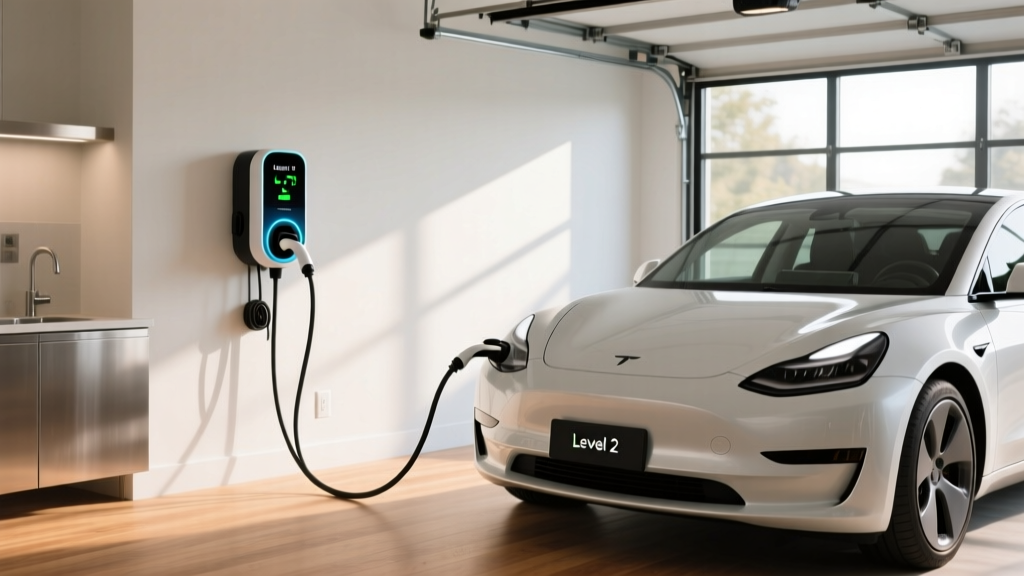
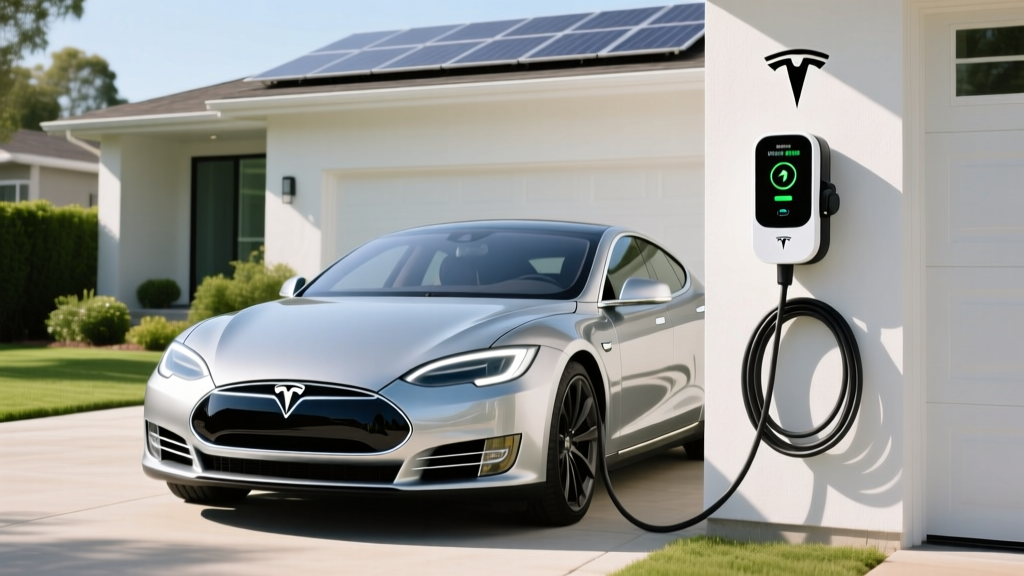
What you can install at home is a Tesla Wall Connector (Level 2, up to 11.5 kW) or a third-party Level 2 charger with a NACS connector. This guide breaks down every cost layer — from the $400 Wall Connector to the electrical panel upgrade that can push a simple install past $3,000 — and explains why Level 2 is the right move for virtually every EV owner.
Charging Levels Explained: kW, Miles Per Hour, and Real Charge Times
Before evaluating cost, you need to understand what each charging level delivers. A critical distinction: kW (kilowatts) measures power — how fast energy flows into the battery. kWh (kilowatt-hours) measures energy — the total capacity of the battery itself. Think of kW as the width of the pipe and kWh as the size of the tank.
| Level | Voltage | Max Power (kW) | Miles of Range / Hour | 10–80% Time (75 kWh Battery) | Typical Use |
|---|---|---|---|---|---|
| Level 1 | 120V AC | 1.4–1.9 kW | 3–5 mi/hr | ~30+ hours | Emergency / overnight trickle |
| Level 2 | 240V AC | 7.2–19.2 kW | 20–60 mi/hr | ~4–7 hours | Home daily charging |
| DC Fast (Tesla V3 Supercharger) | 400–800V DC | 250 kW (peak) | ~1,000 mi/hr (peak) | ~15–25 minutes | Road trips, commercial |
| DC Fast (Tesla V4 / CCS 350 kW) | 400–800V DC | 350 kW (peak) | ~1,200 mi/hr (peak) | ~12–20 minutes | Commercial corridors |
Real-world caveat: DC fast chargers do not sustain peak power for the entire session. A Tesla V3 Supercharger may peak at 250 kW from roughly 10% to 30% State of Charge (SoC), then taper to ~150 kW through 50%, and drop below 50 kW past 80%. That's why manufacturers and testers quote 10–80% times rather than 0–100%. Charging past 80% on DC fast is painfully slow and stresses the battery — most EVs default to an 80% limit for daily use.
Home EV Charger Installation Cost: The Full Breakdown
Here is where most online estimates fall short. A "$500 installation" quote assumes a new construction home with a 200-amp panel, an empty breaker slot, and the charger mounted 10 feet from the panel. Reality is rarely that clean. Below is a realistic cost breakdown for a Level 2 home installation in 2026.
| Component | Low End | Typical | High End | Notes |
|---|---|---|---|---|
| Level 2 Charger (hardware) | $350 | $500 | $750 | Tesla Wall Connector ~$420; ChargePoint Home Flex ~$550; Emporia ~$350 |
| Electrician labor (install) | $300 | $800 | $1,500 | Depends on run length, conduit, drywall work |
| Permit & inspection | $50 | $150 | $400 | Varies by municipality; some bundle with electrical |
| Electrical panel upgrade (if needed) | $0 | $0 | $2,500–$5,000 | Required if panel is maxed out or is 100A/older |
| Conduit, wiring, breaker | $100 | $250 | $600 | Longer runs from panel to garage/driveway cost more |
| Total (no panel upgrade) | $800 | $1,700 | $3,250 | Most homes with 200A panels fall here |
| Total (with panel upgrade) | $3,300 | $4,200 | $8,250 | Older homes, 100A service, or no spare breaker slots |
How Much Does It Cost to Install a Home EV Charger?
For a straightforward Level 2 installation with an adequate existing panel, expect to spend $800–$3,250 all-in (hardware + electrician + permit). The national average clusters around $1,500–$2,000. If your home needs a panel upgrade from 100A to 200A service — common in homes built before 1990 — add $2,500–$5,000. Some municipalities and utilities offer rebates of $250–$1,000 that offset this cost; check your local utility's EV program before scheduling work.
Electrical Requirements: What Your Home Needs for Level 2 Charging
A Level 2 charger requires a dedicated 240V circuit, similar to what powers a clothes dryer or electric oven. The specific amperage depends on the charger:
- 40A circuit (32A continuous draw): Sufficient for 7.7 kW charging. Works for most EVs and requires 6 AWG copper wire.
- 50A circuit (40A continuous): Delivers 9.6 kW. Requires 6 AWG copper. Good for larger batteries like the Ford F-150 Lightning (131 kWh usable) or Rivian R1S.
- 60A circuit (48A continuous): Delivers 11.5 kW — the Tesla Wall Connector's maximum. Requires 4 AWG copper. The fastest practical home speed.
What Electrical Upgrades Might I Need?
Your electrician will perform a load calculation per NEC Article 220 to determine if your panel can handle the added draw. Common upgrade scenarios:
- 100-amp panel: Almost certainly needs a 200A upgrade. This is the single biggest variable in install cost.
- 200-amp panel near capacity: If you're running electric heat, an electric oven, a dryer, and A/C simultaneously, a 48A charger may push you over. Solutions include a smart panel monitor (like the Emporia Vue) that dynamically throttles the charger to stay within limits, avoiding a panel upgrade.
- Subpanel needed: If your charger location is far from the main panel (detached garage, long driveway), a subpanel adds $500–$1,500.
Safety and Code Considerations
Per the National Electrical Code (NEC), a Level 2 EV charger must be on a dedicated circuit — it cannot share a breaker with other outlets. For outdoor installations, the receptacle or hardwired unit must carry a NEMA 4 or NEMA 4X rating (weatherproof). A GFCI breaker is required for any receptacle-based (plug-in) installation per NEC 625. Hardwired units (like the Tesla Wall Connector) are exempt from the GFCI requirement in most jurisdictions, which simplifies the install and reduces nuisance trips. Always pull a permit — unpermitted electrical work can void home insurance and complicate resale.
Connector Compatibility: NACS, CCS1, and CHAdeMO in 2026
The connector landscape has consolidated dramatically. As of the 2026 model year, the North American Charging Standard (NACS) — originally developed by Tesla — is the dominant connector for new EVs sold in North America. Ford, GM, Rivian, Volvo, Polestar, Hyundai, Kia, BMW, and others have adopted NACS for their 2025–2026 models. The CCS1 connector persists on some 2024–2025 vehicles still on dealer lots, and CHAdeMO is effectively legacy (Nissan Leaf being the last major holdout, now discontinued in the US).
| Connector | Brands Using It (2026) | Public Charging Access | Adapter Needed? |
|---|---|---|---|
| NACS (Tesla) | Tesla, Ford, GM, Rivian, Hyundai, Kia, Volvo, Polestar, BMW, Mercedes | Tesla Supercharger network + growing NACS third-party | CCS-to-NACS adapters available (~$200) for older CCS vehicles |
| CCS1 | Legacy 2023–2025 models (VW ID.4, some Stellantis) | Electrify America, EVgo, ChargePoint DC stations | NACS-to-CCS adapter needed for Tesla Superchargers |
| CHAdeMO | Discontinued (Nissan Leaf ended US sales) | Declining availability | No reliable adapter to NACS or CCS |
Which Connector/Charger Is Compatible with My EV?
If you're buying a 2026 model-year EV, it almost certainly has a NACS port. For home charging, the Tesla Wall Connector ships with a NACS plug natively and is the most seamless option for Tesla and NACS-equipped vehicles. If you own a CCS1-ported EV (purchased 2023–2025), choose a charger with a CCS1 plug or use a NACS-to-CCS adapter. The ChargePoint Home Flex ships with a J1772/NACS combo cable that covers most scenarios.
Level 2 Charger Recommendations: Equipment Picks for 2026
Not all Level 2 chargers are equal. Here are the units that deliver the best combination of power, reliability, and smart features based on hands-on use and market availability in 2026.
Tesla Wall Connector (Gen 4)
- Max Power: 11.5 kW (48A)
- Connector: NACS native
- Cable Length: 24 ft
- Smart Features: Wi-Fi, OTA updates, power sharing between two units, Tesla app integration
- Price: ~$420
- Best For: Tesla owners and any NACS-equipped EV; cleanest ecosystem integration
ChargePoint Home Flex
- Max Power: 12 kW (50A adjustable down to 16A)
- Connector: NACS or J1772 (configurable)
- Cable Length: 23 ft
- Smart Features: Wi-Fi, Alexa, scheduling, ChargePoint network stats, flexible amperage
- Price: ~$550
- Best For: Multi-EV households, non-Tesla NACS vehicles, renters who may move
Emporia Level 2 EV Charger
- Max Power: 11.5 kW (48A)
- Connector: NACS or J1772
- Cable Length: 24 ft
- Smart Features: Wi-Fi, energy monitoring via Emporia Vue panel integration, solar-aware charging
- Price: ~$350
- Best For: Budget-conscious buyers; solar panel owners wanting to charge only from excess solar
Grizzl-E Smart
- Max Power: 10 kW (40A)
- Connector: NACS or J1772
- Cable Length: 24 ft
- Smart Features: OCPP-compatible, works with multiple apps, extreme cold rating (-40°F)
- Price: ~$500
- Best For: Cold-climate owners (tested to -40°C); built in Canada
Cost to Charge: Home vs. Public vs. Gas — The Per-Mile Math
The strongest financial argument for home Level 2 charging is the per-mile fuel cost. Electricity rates vary enormously by region, but home charging is almost always cheaper than gasoline per mile — and dramatically cheaper than public DC fast charging.
| Scenario | Rate ($/kWh) | Efficiency (kWh/100mi) | Cost per 100 Miles | Cost per Mile |
|---|---|---|---|---|
| Home (national avg electricity) | $0.17 | 30 kWh | $5.10 | $0.051 |
| Home (off-peak TOU rate) | $0.09 | 30 kWh | $2.70 | $0.027 |
| Home (high-cost state: CA, HI) | $0.35 | 30 kWh | $10.50 | $0.105 |
| Public Level 2 (ChargePoint, etc.) | $0.30–$0.49 | 30 kWh | $9.00–$14.70 | $0.09–$0.147 |
| DC Fast Charging (Tesla Supercharger) | $0.28–$0.45 | 30 kWh | $8.40–$13.50 | $0.084–$0.135 |
| DC Fast (Electrify America / EVgo) | $0.40–$0.58 | 30 kWh | $12.00–$17.40 | $0.12–$0.174 |
| Gasoline (28 MPG avg, $3.40/gal) | — | — | $12.14 | $0.121 |
How Much Does Charging Cost Per Mile vs. Gas?
At the national average electricity rate of ~$0.17/kWh and an EV efficiency of 30 kWh per 100 miles (typical for a midsize crossover like the Tesla Model Y or Hyundai Ioniq 5), home charging costs roughly $0.05 per mile. A comparable gas vehicle at 28 MPG with $3.40/gallon fuel costs about $0.12 per mile. That's a 58% fuel savings at home. Even at California's higher rates ($0.35/kWh), home charging roughly matches gas on cost per mile — and off-peak time-of-use (TOU) plans can cut your rate in half. Public DC fast charging, however, often equals or exceeds gasoline cost per mile. The economics of EV ownership depend heavily on home charging access.
The DC Fast Charger Reality: Why "Tesla Supercharger at Home" Isn't Practical
For the small number of readers exploring whether they can install an actual DC fast charger (Tesla Supercharger-class hardware) on residential property, here is the unvarnished reality:
- Hardware cost: A single DC fast-charging pedestal (not Tesla-branded, as Tesla doesn't sell Superchargers to consumers) from manufacturers like Tritium, ABB, or BTC Power costs $30,000–$70,000 per unit.
- Utility service: DC fast chargers require 480V three-phase power. Most residential areas only have single-phase 240V service. Upgrading to three-phase involves a utility transformer installation, which can cost $10,000–$50,000+ depending on distance from the nearest three-phase line.
- Permitting: Commercial-grade electrical work requires commercial permits, potential environmental review, and utility interconnection agreements.
- Space: DC fast chargers need a concrete pad, bollards, ventilation clearance, and ADA-compliant access in many jurisdictions.
- ROI: Even running the charger 8 hours daily, payback on a residential DC fast charger would take 15–25 years at consumer electricity rates.
The practical alternative — and what 99% of EV owners actually need — is a Level 2 home charger that fully replenishes your battery overnight while you sleep. A 75 kWh battery charged at 11.5 kW goes from 10% to 100% in about 6 hours. For the average American who drives 37 miles per day (per FHWA data), a Level 2 charger replaces the day's driving in under two hours.
Federal and State Incentives for Home Charger Installation
The federal Alternative Fuel Vehicle Refueling Property Credit (IRS Form 8911) provides a tax credit of up to 30% of the cost of home EV charging equipment and installation, capped at $1,000. This credit applies to both the charger hardware and the electrician's labor. Key constraints per the IRS:
- The property must be installed at your principal residence.
- The credit is non-refundable — it can reduce your tax liability to zero but won't generate a refund beyond that.
- Eligibility is restricted to census tracts that are not classified as "urban" or that meet low-income community criteria (per the Inflation Reduction Act amendments). Check the IRS eligibility tool or consult a tax professional, as tract-level eligibility is complex.
Beyond federal credits, many utilities offer rebates of $250–$1,000 for installing a Level 2 charger, especially if you enroll in a time-of-use rate plan. Some utilities (PG&E, ConEdison, Xcel Energy) offer free or discounted chargers bundled with smart-charging programs. Check your utility's EV page before purchasing equipment.
Frequently Asked Questions
How fast will each charging level add range to my EV?
Level 1 (120V standard outlet) adds roughly 3–5 miles of range per hour — enough for a plug-in hybrid with 30 miles of electric range, but inadequate for a full-size BEV. Level 2 (240V, 40–48A) adds 20–60 miles per hour depending on the vehicle's onboard charger capacity. A Tesla Model Y on an 11.5 kW Wall Connector gains approximately 44 miles of range per hour. DC fast charging can add 200+ miles in 15–20 minutes but is designed for road trips, not daily use.
Can I use a Tesla Wall Connector with a non-Tesla EV?
Yes. As of 2026, the Tesla Wall Connector uses the NACS plug, which is now the standard connector on most new EVs from Ford, GM, Hyundai, Kia, Rivian, and others. If your EV has a CCS1 port (common on 2023–2025 models), you'll need a NACS-to-CCS adapter (approximately $200) or choose a charger with a CCS1 or J1772 cable.
Does a home EV charger need its own circuit breaker?
Yes. The NEC requires a dedicated circuit for any EV charging equipment. A 48A charger requires a 60A breaker; a 40A charger requires a 50A breaker. Sharing the circuit with other appliances is a code violation and a fire risk. Your electrician will verify that your panel has adequate spare slots and ampacity before installation.
Is it cheaper to charge an EV at home or at a public Supercharger?
Home charging is significantly cheaper. At the national average residential rate of ~$0.17/kWh, you'll pay about $0.05 per mile. Tesla Supercharger rates average $0.28–$0.45/kWh depending on location and time of day, translating to $0.08–$0.14 per mile. Over 12,000 miles of annual driving, home charging saves $400–$1,000+ compared to exclusive Supercharger use.
What if my home only has a 100-amp electrical panel?
A 100-amp panel is generally insufficient for Level 2 EV charging alongside existing electric appliances. You'll likely need a panel upgrade to 200A service, which costs $2,500–$5,000 depending on your area and the complexity of the utility connection. An alternative is a smart load-management device (like the Emporia Vue or Span smart panel) that dynamically limits charger draw to stay within your panel's capacity, potentially avoiding an upgrade.
How long does it take to charge a 75 kWh battery at home?
At 11.5 kW (48A, 240V — the Tesla Wall Connector's maximum), a fully depleted 75 kWh battery charges from 0% to 100% in approximately 6.5 hours. In practice, most owners charge from 20–30% to 80–90% overnight, which takes 3–4 hours. This is more than adequate for daily driving needs. Per fueleconomy.gov, the average EV efficiency is around 3–4 miles per kWh, so a 75 kWh battery delivers roughly 225–300 miles of real-world range depending on conditions.