The Real Cost to Install a Tesla Charger at Home
If you own a Tesla—or any EV with a NACS port—home Level 2 charging is the single biggest quality-of-life upgrade you can make. But the sticker price of a Wall Connector is only the beginning. The true cost to install a Tesla charger depends on your home's electrical panel capacity, the distance from that panel to your parking spot, local permit fees, and whether you need a service upgrade.
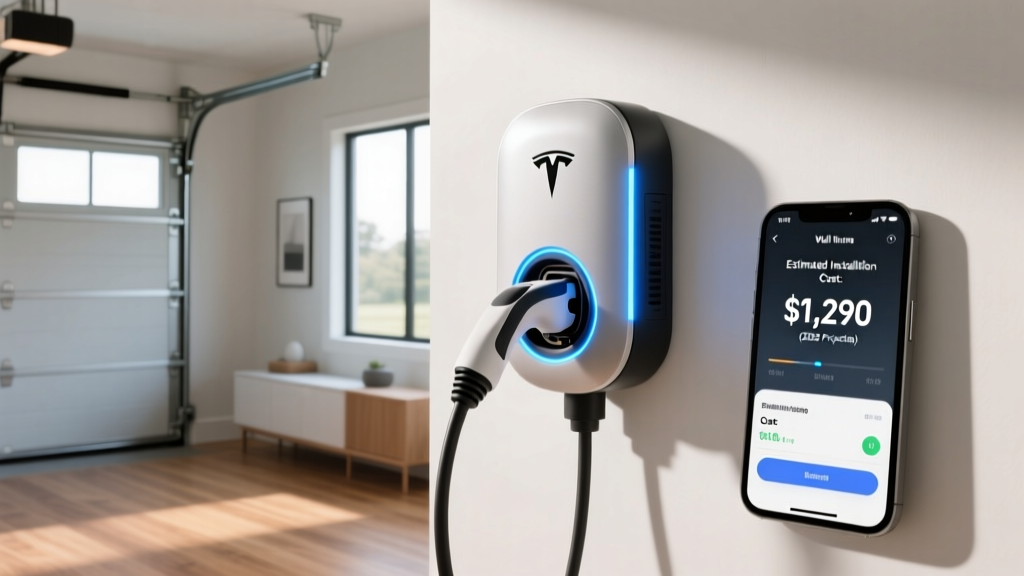
In 2026, most homeowners spend between $800 and $3,500 total for a complete Tesla Wall Connector installation, including equipment, labor, and permits. Homes needing a 200-amp panel upgrade can see costs climb to $4,500–$7,000+. This guide breaks down every line item so you can budget accurately before calling an electrician.
Charging Levels Explained: Speeds in kW and Miles per Hour
Before pricing an installation, you need to understand what you're buying. EV charging falls into three tiers, defined by power output (measured in kilowatts, or kW). The energy stored in your battery is measured in kilowatt-hours (kWh)—a different unit entirely. Think of kW as the speed of water flowing through a hose, and kWh as the total volume of the tank you're filling.
| Level | Voltage | Max Power (kW) | Miles of Range Added per Hour | Typical Use |
|---|---|---|---|---|
| Level 1 | 120V AC | 1.4 kW | 3–5 mi/hr | Emergency/trickle (standard outlet) |
| Level 2 | 240V AC | 7.2–19.2 kW | 20–60+ mi/hr | Home & destination charging |
| DC Fast Charge | 400–800V DC | 50–350 kW | 150–1,000+ mi/hr | Road trips, commercial stations |
A Tesla Wall Connector is a Level 2 device. On a 60-amp circuit, it delivers up to 11.5 kW (48 amps continuous, per the 80% NEC rule). That translates to roughly 35–44 miles of range per hour of charging for a Model Y, depending on efficiency. A full charge from 20% to 80% on a 75 kWh battery takes approximately 4–5 hours at this rate—perfect for overnight replenishment.
- Tesla Model Y (75 kWh battery, ~60 kWh usable for 10-80%): ~5.2 hours at 11.5 kW
- Tesla Model 3 Long Range (82 kWh, ~65 kWh usable): ~5.7 hours at 11.5 kW
- Tesla Model S (100 kWh, ~80 kWh usable): ~7 hours at 11.5 kW
- Ford F-150 Lightning Extended Range (131 kWh, ~105 kWh usable): ~9.1 hours at 11.5 kW
Note: Charging slows significantly above 80% State of Charge (SoC) to protect battery health. Most daily driving requires only a 20–80% cycle.
Installation Cost Breakdown: Equipment, Electrician, and Permits
The total cost to install a Tesla charger at home has four components. Here's what each typically runs in 2026:
| Cost Component | Low End | Typical | High End | Notes |
|---|---|---|---|---|
| Tesla Wall Connector (equipment) | $420 | $475 | $475 | Gen 3 Wall Connector, 24-ft cable, Wi-Fi enabled |
| Electrician labor | $300 | $800 | $2,000+ | Depends on run length, conduit, wall/floor penetrations |
| Electrical materials (wire, conduit, breaker) | $100 | $300 | $800 | Longer runs = more copper wire cost |
| Permit and inspection | $50 | $150 | $400 | Varies by municipality; some jurisdictions waive for EV |
| Total (no panel upgrade) | $870 | $1,725 | $3,675 | |
| Panel upgrade (if needed) | $1,500 | $3,000 | $5,000+ | 100A → 200A service upgrade |
| Total (with panel upgrade) | $2,370 | $4,725 | $8,675+ |
What drives the cost up or down?
Lower-cost installs ($800–$1,200) happen when your electrical panel is near your parking spot (under 10 feet of wire run), has spare capacity for a 60-amp breaker, and requires minimal conduit work. A garage-adjacent panel is the ideal scenario.
Higher-cost installs ($2,500–$4,000+) result from long wire runs (50+ feet through attic, crawlspace, or underground trenching), multiple wall penetrations, or the need to mount the connector on an exterior wall exposed to weather.
Panel upgrades are the wildcard. If your home has a 100-amp service or your panel is already near capacity (common in older homes with electric ranges, dryers, and HVAC), adding a 60-amp EV circuit may require upgrading to a 200-amp panel. This alone costs $1,500–$5,000 depending on utility connection requirements. Always have an electrician perform a load calculation before committing to a circuit size.
The IRS §30C Alternative Fuel Vehicle Refueling Property Credit covers 30% of home charger equipment and installation costs, up to $1,000. Eligibility depends on census-tract requirements and income thresholds. This credit is separate from the §30D vehicle purchase credit. Consult a tax professional to confirm your eligibility for the current tax year.
Electrical Requirements: What Your Home Needs
The Tesla Gen 3 Wall Connector is a hardwired, 240-volt device. It does not plug into a standard outlet. Here are the electrical specifications your electrician will work with:
- Circuit breaker: 60-amp (allows 48 amps continuous draw, per NEC 80% rule)
- Wire gauge: 6 AWG copper (for runs under 50 feet) or 4 AWG (longer runs to reduce voltage drop)
- Voltage: 240V single-phase (standard US residential split-phase)
- Dedicated circuit: Required — the Wall Connector cannot share a breaker with other appliances
- GFCI protection: The Gen 3 Wall Connector has built-in ground-fault protection, but some local codes require an external GFCI breaker; your electrician will advise
- Outdoor rating: The Wall Connector is NEMA 3R rated (suitable for outdoor installation, protected from rain and ice)
Can I install on a 50-amp or 40-amp circuit instead?
Yes. The Wall Connector is configurable via its internal DIP switches or software settings. On a 50-amp breaker, it delivers up to 40 amps continuous (9.6 kW). On a 40-amp breaker, it delivers 32 amps (7.7 kW). This flexibility is useful if your panel has limited headroom. You'll sacrifice some charging speed—roughly 28–30 miles of range per hour at 9.6 kW versus 35–44 at 11.5 kW—but for most daily commutes, the difference is negligible overnight.
Connector Compatibility: NACS, CCS, and Adapters
The Tesla Wall Connector ships with a NACS (North American Charging Standard) plug—the same connector used on all Tesla vehicles since 2012. As of 2025–2026, Ford, Rivian, GM, Volvo, Polestar, and several other automakers have adopted NACS on new models, meaning the Wall Connector is now cross-brand compatible without adapters for these vehicles.
| Connector Type | Brands Using It | Works with Tesla Wall Connector? | Adapter Needed? |
|---|---|---|---|
| NACS (Tesla) | Tesla, Ford (2025+), Rivian (2025+), GM (2025+), Volvo, Polestar, Hyundai/Kia (2026+ select) | Yes — native | None |
| CCS1 (Combo) | VW ID.4, BMW iX, older Ford/GM EVs, Honda Prologue (pre-NACS) | No — different plug | Tesla sells a CCS-to-NACS adapter (~$190); or use a CCS-native charger |
| CHAdeMO | Nissan Leaf (legacy) | No | No reliable adapter exists; use a CHAdeMO charger |
If you own a non-Tesla EV with a CCS1 port, the Tesla CCS adapter enables Level 2 home charging via the Wall Connector. However, for public DC fast charging, CCS vehicles should use Electrify America, EVgo, or other CCS-native networks unless the station has been upgraded to NACS.
Cost to Charge: Per-Mile Cost vs. Gas
Once your charger is installed, the ongoing cost to charge at home is dramatically lower than gasoline. Here's how the math works in 2026, using a Tesla Model Y Long Range (rated at 28 kWh/100 miles, per fueleconomy.gov) as the baseline:
| Scenario | Average $/kWh | Cost per 100 Miles | Cost per Mile | Equivalent Gas Price (at 25 MPG) |
|---|---|---|---|---|
| Home (off-peak utility rate) | $0.09–$0.13 | $2.52–$3.64 | $0.025–$0.036 | $0.63–$0.91/gallon |
| Home (standard residential rate) | $0.14–$0.18 | $3.92–$5.04 | $0.039–$0.050 | $0.98–$1.26/gallon |
| Home (high-cost states: CA, HI, MA) | $0.25–$0.40 | $7.00–$11.20 | $0.070–$0.112 | $1.75–$2.80/gallon |
| Public Level 2 (ChargePoint, etc.) | $0.20–$0.35 | $5.60–$9.80 | $0.056–$0.098 | $1.40–$2.45/gallon |
| DC Fast Charge (Tesla Supercharger) | $0.25–$0.45 | $7.00–$12.60 | $0.070–$0.126 | $1.75–$3.15/gallon |
| Gasoline (US avg, 2026) | — | $13.00–$15.00 | $0.13–$0.15 | $3.25–$3.75/gallon |
Even in expensive electricity markets, home charging costs less per mile than gasoline in almost every scenario. The savings are most dramatic with off-peak time-of-use (TOU) rates, which many utilities offer specifically for EV owners. Set your Wall Connector to charge between 10 PM and 6 AM and you'll typically pay $0.09–$0.13/kWh—translating to roughly $3 per 100 miles driven, compared to $13–$15 for a comparable gas vehicle.
Over 15,000 annual miles, home charging saves most drivers $1,200–$1,800 per year versus gasoline. That means the installation cost of a Tesla charger typically pays for itself within 1–3 years.
Recommended Home EV Chargers: Specs and Pricing
The Tesla Wall Connector is the obvious pick for Tesla owners, but several alternatives offer competitive features—especially if you need CCS compatibility without an adapter. Here are the top Level 2 chargers for 2026:
Tesla Gen 3 Wall Connector
- Max Power: 11.5 kW (48A on 60A circuit)
- Connector: NACS (native Tesla)
- Cable Length: 24 feet
- Smart Features: Wi-Fi, OTA updates, Tesla app integration, load sharing (up to 6 units on one circuit), access control
- Price: ~$475
- Best For: Tesla owners and NACS-adopting EVs; multi-Tesla households
ChargePoint Home Flex
- Max Power: 12 kW (50A on 60A circuit) — configurable down to 16A
- Connector: NACS (2025+ models) or J1772/CCS
- Cable Length: 23 feet
- Smart Features: Wi-Fi, ChargePoint app, Alexa integration, flexible amperage settings, detailed energy tracking
- Price: ~$550–$650
- Best For: Mixed-EV households; those wanting granular amperage control
Emporia Level 2 EV Charger
- Max Power: 11.5 kW (48A on 60A circuit)
- Connector: J1772 (CCS vehicles) or NACS version available
- Cable Length: 24 feet
- Smart Features: Wi-Fi, Emporia energy-monitoring ecosystem integration, solar-charging coordination, scheduling
- Price: ~$399
- Best For: Budget-conscious buyers; homes with Emporia energy monitors or solar panels
Grizzl-E Smart
- Max Power: 10 kW (40A on 50A circuit)
- Connector: J1772 (NACS adapter available)
- Cable Length: 24 feet
- Smart Features: Wi-Fi, OCPP protocol, adjustable amperage, extreme cold rating (-40°F)
- Price: ~$449
- Best For: Cold-climate installations; those wanting open OCPP compatibility
For pure Tesla owners, the Gen 3 Wall Connector is hard to beat: it's compact, reliable, integrates directly with your Tesla app, and supports load sharing so you can install two units on a single 60-amp circuit (each delivering up to 48A when only one car is charging, splitting to 24A each when both charge simultaneously). For mixed-EV households, the ChargePoint Home Flex offers the broadest compatibility and the most flexible amperage configuration.
Safety, Permits, and Code Considerations
A Level 2 EV charger draws substantial current for hours at a time—this isn't a phone charger. Proper installation isn't optional; it's a fire-safety issue. Here's what the National Electrical Code (NEC) and most local jurisdictions require:
- Dedicated circuit: The charger must have its own breaker. No sharing with outlets, lights, or appliances.
- Proper wire gauge: Undersized wire causes overheating. 6 AWG copper minimum for 60-amp circuits in most runs.
- Permit required: Nearly all US jurisdictions require an electrical permit for a new 240V circuit. Permit costs range from $50–$400.
- Inspection: A city or county inspector will verify the installation meets NEC Article 625 (Electric Vehicle Charging System Equipment). Don't skip this—it's required for insurance validity.
- GFCI: The Wall Connector includes internal ground-fault protection. Some jurisdictions still require a GFCI breaker; check with your electrician and local code.
- Outdoor installations: The Wall Connector is rated for outdoor use, but the junction box and conduit connections must be weather-sealed. If mounting on an exterior wall, ensure the wire entry point is properly caulked and flashed.
One often-overlooked consideration: utility notification. Some electric utilities require you to inform them before installing a Level 2 charger, particularly if you're adding a significant new load. They may offer a dedicated EV meter or time-of-use rate plan that substantially reduces your charging cost. Check with your utility before installation.
Frequently Asked Questions
How much does it cost to install a home EV charger?
Most homeowners pay between $870 and $3,675 for a complete Tesla Wall Connector installation (equipment + electrician + materials + permit) without a panel upgrade. If your home needs a 100A-to-200A panel upgrade, add $1,500–$5,000. The national average in 2026 is approximately $1,700–$2,000 for a straightforward garage installation.
How fast will each charging level add range?
Level 1 (120V outlet) adds roughly 3–5 miles of range per hour—adequate only for plug-in hybrids with small batteries or emergency top-ups. Level 2 (240V, like a Wall Connector) adds 20–44+ miles per hour depending on amperage. DC Fast Charging adds 150–1,000+ miles per hour but is designed for road-trip stops, not daily use, and charging speed tapers significantly above 80% SoC.
Which connector is compatible with my EV?
If you own a Tesla, Rivian (2025+), Ford (2025+), GM (2025+), or other NACS-equipped vehicle, the Tesla Wall Connector plugs in natively. If your EV has a CCS1 port (VW ID.4, older Ford/GM EVs, Hyundai Ioniq 5 pre-2026), you'll need a CCS-to-NACS adapter (~$190 from Tesla) or should choose a CCS-native charger like the ChargePoint Home Flex. CHAdeMO vehicles (Nissan Leaf) have no reliable adapter and should use a CHAdeMO-compatible charger.
How much does charging cost per mile versus gas?
Home charging on off-peak utility rates costs approximately $0.025–$0.050 per mile for a Tesla Model Y. Gasoline for a comparable 25-MPG crossover at $3.50/gallon costs $0.14 per mile. That's a 65–80% per-mile savings for home EV charging. Even DC fast charging at $0.35/kWh ($0.10/mile) undercuts gasoline.
What electrical upgrades might I need?
The most common upgrade is a panel replacement from 100-amp to 200-amp service, required if your existing panel lacks capacity for a new 60-amp circuit. Other potential upgrades include: replacing a Federal Pacific or Zinsco panel (known fire hazards, often flagged during inspection), adding a sub-panel in a detached garage, or upgrading the utility service drop if your home has an older 100A or 60A main feed. A licensed electrician will perform a load calculation per NEC Article 220 to determine whether your panel can handle the additional circuit.
Can I install a Tesla Wall Connector myself?
Tesla's installation guide provides wiring diagrams, and technically skilled homeowners sometimes attempt DIY. However, a 240V/60A hardwired circuit is not a beginner project. Errors can cause fire, void your home insurance, and fail municipal inspection. Most jurisdictions require a licensed electrician to pull the permit. Budget $300–$2,000 for professional labor—it's worth the investment for safety and code compliance.