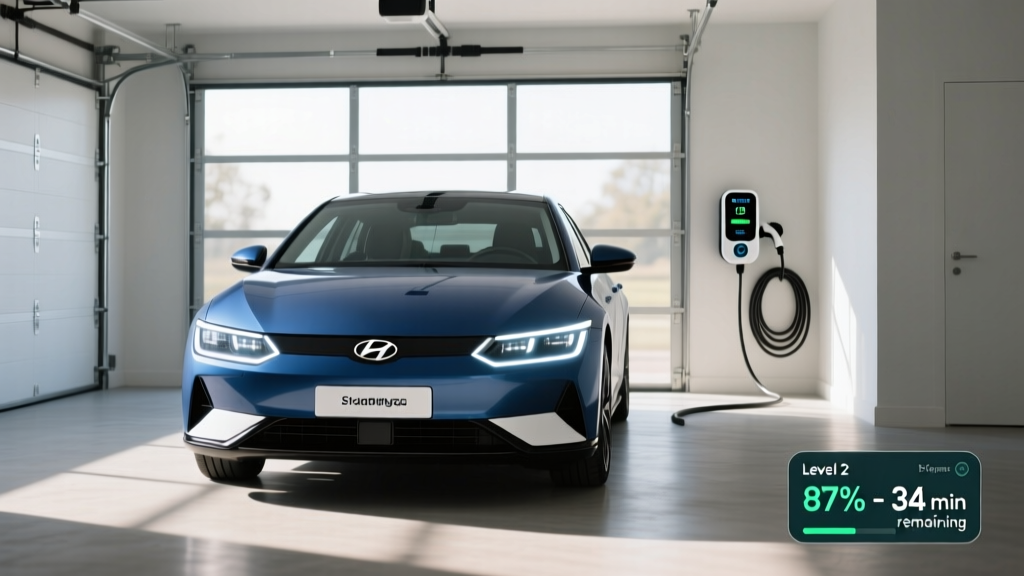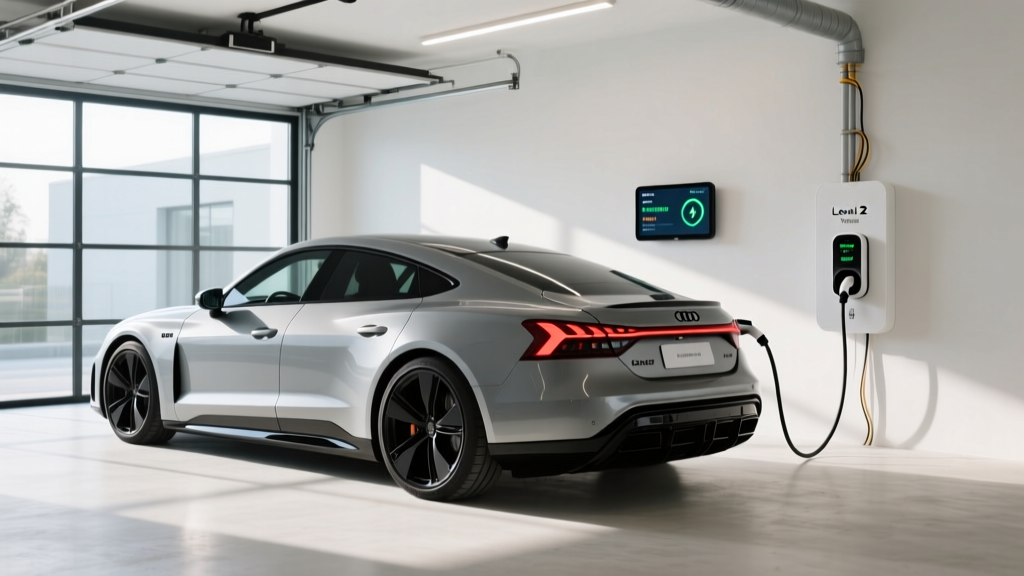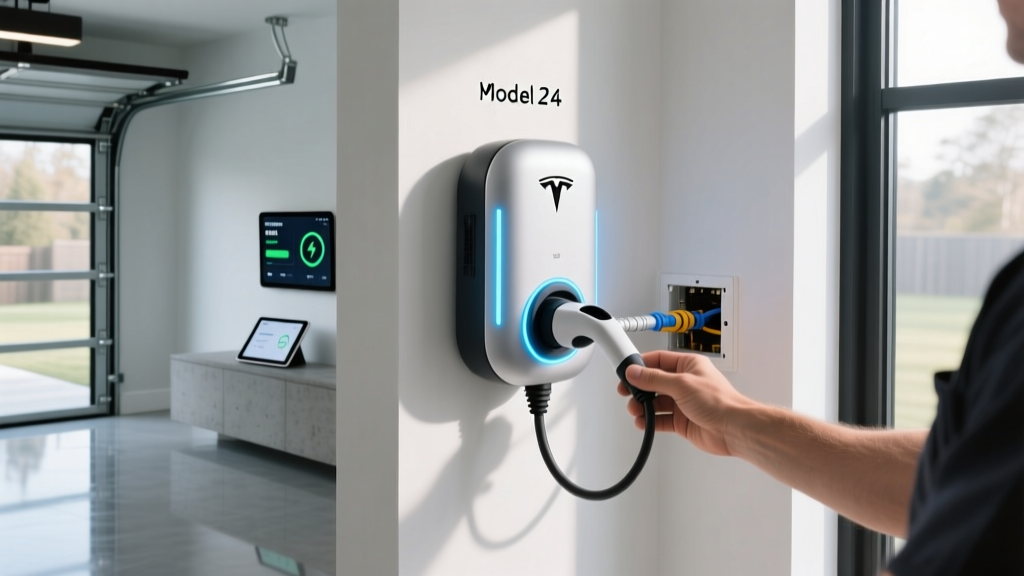
If you've taken delivery of a Tesla Model Y, Model 3, Cybertruck, or any newer NACS-equipped EV, one of the first ownership decisions you'll face is how to charge at home. Relying on a standard 120V wall outlet (Level 1) adds roughly 3–5 miles of range per hour — fine for plug-in hybrids, but inadequate for a 75–100 kWh battery pack. The practical answer for most Tesla owners is a hardwired Level 2 wall connector on a dedicated 240V circuit.
This guide breaks down the exact cost to install a Tesla charger at home in 2026, including equipment, electrician labor, permit fees, potential panel upgrades, and the ongoing cost per mile compared to gasoline. We'll also cover what you need to know if you drive a non-Tesla EV with a NACS port (such as the Ford F-150 Lightning, Hyundai Ioniq 5 N, or Rivian R2) and want to use Tesla's Wall Connector.
Understanding EV Charging Levels: Speeds in kW and Miles per Hour
Before discussing installation costs, it's essential to distinguish between kW (kilowatts, a measure of power — the rate at which energy flows) and kWh (kilowatt-hours, a measure of energy — the total capacity of your battery). Think of kW as the width of the hose and kWh as the size of the bucket. A wider hose fills the bucket faster.
| Charging Level | Voltage / Amperage | Max Power (kW) | Miles of Range Added per Hour | Typical Use Case |
|---|---|---|---|---|
| Level 1 | 120V / 12A | ~1.4 kW | 3–5 mi/hr | Overnight trickle, PHEVs, emergencies |
| Level 2 (Home) | 240V / 32–48A | 7.7–11.5 kW | 25–44 mi/hr | Daily home charging, primary method |
| DC Fast Charging | 400–800V DC | 50–350 kW | 150–1,000+ mi/hr (peak) | Road trips, public stations |
For a Tesla Model Y Long Range with an ~75 kWh usable battery, a Level 2 home charger delivering 11.5 kW (48A) will add roughly 44 miles of range per hour, taking the battery from 10% to 80% in approximately 4.5–5 hours. A DC Supercharger at 250 kW can accomplish a 10–80% charge in about 20–25 minutes, though the charge curve tapers significantly above 80% to protect battery health. Charging at home overnight remains the most cost-effective and convenient method for daily driving.
How Much Does It Cost to Install a Tesla Charger at Home?
The total cost to install a Tesla charger at home depends on four variables: the charger unit itself, electrician labor, local permit fees, and whether your electrical panel needs an upgrade. Here's a realistic breakdown based on 2026 pricing.
| Cost Component | Low End | Typical | High End | Notes |
|---|---|---|---|---|
| Tesla Wall Connector (Gen 3, 48A) | $400 | $400 | $475 | Hardwired, 24-foot cable, Wi-Fi enabled |
| Electrician Labor (run 60A circuit) | $600 | $1,200 | $2,500 | Depends on run length, wall type, conduit |
| Electrical Permit | $50 | $150 | $400 | Varies by municipality |
| Panel Upgrade (if needed) | $1,500 | $2,500 | $5,000+ | 100A → 200A service; not always required |
| Total (no panel upgrade) | $1,050 | $1,750 | $3,375 | Most homes with 200A panels |
| Total (with panel upgrade) | $2,550 | $4,250 | $8,375+ | Older homes with 100A or 150A service |
When is a panel upgrade required?
Your electrician will perform a load calculation per NEC Article 220. If your home has a 200-amp electrical panel and you're not already near capacity (e.g., electric range, dryer, HVAC, water heater all running), adding a 60A dedicated circuit for a 48A continuous charger is usually feasible. Homes with 100A or 150A service — common in houses built before the 1990s — often need a panel upgrade to 200A before adding a high-power EV circuit. Some jurisdictions now require smart load-management devices (like the Emporia VUE or SPAN panel) as an alternative to a full upgrade, which can save $1,000–$3,000.
IRS §30E Alternative Fuel Infrastructure Tax Credit
The federal §30E tax credit covers up to 30% of home EV charging equipment and installation costs, capped at $1,000 for residential property. Eligibility depends on your census tract meeting specific low-income or non-urban criteria. Check the IRS eligibility map before counting on this credit — many suburban and urban tracts no longer qualify as of 2026. Always consult a tax professional for your specific situation.
Equipment Recommendations: Which Tesla Charger Should You Buy?
Tesla offers one primary home charging product in 2026, but several third-party options also work with NACS-equipped vehicles. Here's a comparison of the top choices:
Tesla Wall Connector (Gen 3)
- Power Output: Up to 11.5 kW (48A continuous on a 60A circuit)
- Connector: NACS (Tesla) — native fit for all Tesla vehicles and NACS-equipped EVs (Ford, GM, Rivian, Hyundai/Kia 2025+)
- Cable Length: 24 feet
- Smart Features: Wi-Fi connectivity, OTA firmware updates, load sharing (up to 6 units on one circuit), Tesla app integration, access control
- Price: ~$400–$475
- Verdict: Best value for Tesla owners. Sleek design, reliable firmware, and load-sharing capability make it ideal for multi-EV households.
ChargePoint Home Flex (NACS Configuration)
- Power Output: Up to 12 kW (50A adjustable) on a 60A circuit
- Connector: Available with NACS plug (2025+ update)
- Cable Length: 23 feet
- Smart Features: Wi-Fi, Alexa integration, detailed ChargePoint app scheduling, utility demand-response programs
- Price: ~$550–$650
- Verdict: Strong pick for mixed-EV households or those participating in utility time-of-use demand-response programs.
Emporia Level 2 EV Charger (NACS)
- Power Output: Up to 11.5 kW (48A)
- Connector: NACS or J1772 (configurable)
- Cable Length: 24 feet
- Smart Features: Integrated energy monitoring (pairs with Emporia VUE panel monitor), solar-aware charging, scheduling
- Price: ~$400–$500
- Verdict: Best for solar-panel owners who want to charge exclusively from excess solar production.
All three chargers require hardwiring by a licensed electrician on a dedicated 240V circuit. The Tesla Wall Connector remains the default recommendation for Tesla owners due to its price, reliability, and seamless vehicle integration.
Connector Compatibility: NACS, CCS, and Adapter Realities
As of 2026, the North American Charging Standard (NACS) — originally Tesla's proprietary connector — has become the dominant light-duty EV charging connector in the United States. Ford, GM, Rivian, Volvo, Polestar, Hyundai, and Kia all ship vehicles with native NACS ports. However, millions of CCS1-equipped EVs remain on the road.
| Connector Type | Compatible Vehicles (2026) | Tesla Wall Connector Compatible? | Adapter Needed? |
|---|---|---|---|
| NACS (Tesla) | All Tesla models, Ford F-150 Lightning/Mach-E, GM Ultium vehicles, Rivian R1S/R1T/R2, Hyundai Ioniq 5/6, Kia EV6/EV9 (2025+) | Yes — native | None |
| CCS1 | VW ID.4, BMW i4/iX, older Hyundai/Kia EVs (pre-2025), Lucid Air, Porsche Taycan | No — requires CCS-to-NACS adapter (not widely available for home use) | Use a CCS-equipped charger (ChargePoint, Emporia J1772+adapter) |
| CHAdeMO | Nissan Leaf (legacy); essentially discontinued for new vehicles | No | Separate CHAdeMO charger required |
If you own a CCS1 vehicle and are considering the Tesla Wall Connector, note that Tesla sells a NACS-to-CCS adapter (~$250) that allows CCS vehicles to use Tesla Superchargers, but this adapter does not enable CCS vehicles to plug into a NACS Wall Connector at home. For CCS vehicles, choose a charger with a J1772 or CCS plug instead.
Charging Cost per Mile: Home vs. Public vs. Gasoline
One of the strongest financial arguments for home charging is the per-mile cost advantage. Electricity prices vary by state and time of use, but the math consistently favors home Level 2 over public DC fast charging — and both dramatically beat gasoline.
| Charging Scenario | Avg. $/kWh | Cost to Add 200 Miles (75 kWh Battery, ~3 mi/kWh) | Cost per Mile |
|---|---|---|---|
| Home Level 2 (off-peak TOU rate) | $0.08–$0.14 | $2.00–$3.50 | $0.010–$0.018 |
| Home Level 2 (standard residential rate) | $0.13–$0.20 | $3.25–$5.00 | $0.016–$0.025 |
| Public Level 2 (ChargePoint, EVgo L2) | $0.25–$0.49 | $6.25–$12.25 | $0.031–$0.061 |
| Tesla Supercharger (DC fast, avg.) | $0.25–$0.40 | $6.25–$10.00 | $0.031–$0.050 |
| Gasoline (25 MPG combined, $3.50/gal) | — | $28.00 | $0.140 |
Source: National average electricity rates via U.S. EIA; gasoline prices via AAA national average.
For a Tesla Model Y driver covering 12,000 miles per year, home charging at $0.12/kWh costs roughly $480 annually. The same distance in a 25 MPG gasoline SUV at $3.50/gallon costs $1,680. That's a $1,200/year fuel savings — meaning the charger installation typically pays for itself within 1–2 years.
Safety, Electrical Code, and Installation Best Practices
EV charging represents a significant continuous electrical load. The National Electrical Code (NEC) treats it seriously, and so should you. Here's what a proper installation requires:
- Dedicated Circuit: Your Wall Connector must be on its own dedicated circuit — not shared with other appliances. A 48A continuous charger requires a 60A breaker (NEC requires circuits rated at 125% of continuous load: 48A × 1.25 = 60A).
- Wire Gauge: Typically 6 AWG copper (THHN in conduit) or 4 AWG aluminum for a 60A circuit. Longer runs may require upsizing to prevent voltage drop.
- GFCI Protection: The 2023 NEC (adopted by most states by 2026) requires GFCI protection for all EV charging outlets rated 60A or less. Hardwired installations may have different requirements depending on jurisdiction — your electrician will ensure compliance.
- Outdoor Rating: The Tesla Wall Connector is rated NEMA 3R (suitable for outdoor installation, protected from rain and ice). However, if mounted in an exposed location, consider a protective cover or mounting under an eave.
- Permit and Inspection: Virtually all jurisdictions require an electrical permit and post-installation inspection for a new 240V circuit. Never skip this — it protects your home insurance coverage and ensures safe installation.
- Wi-Fi Signal: The Wall Connector requires Wi-Fi for firmware updates, scheduling, and load-sharing features. If your garage has weak signal coverage, consider a Wi-Fi extender or mesh node before installation day.
Always hire a licensed electrician experienced with EV charger installations. According to NFPA's NEC guidelines, improper EV charging installations can create fire hazards from undersized wiring, overloaded panels, or missing overcurrent protection. The savings from a DIY approach are never worth the risk.
Charging Time Examples for Common Tesla Battery Sizes
How long a full home charge takes depends on your vehicle's usable battery capacity and the charger's sustained power output. Here are realistic estimates for 2026 Tesla models on a Tesla Wall Connector at 11.5 kW (48A):
| Vehicle | Usable Battery (kWh) | EPA Range | 10%–80% Charge Time (11.5 kW) | Full Charge (0%–100%) |
|---|---|---|---|---|
| Model 3 RWD (LFP) | ~57.5 kWh | 272 mi | ~3.5 hours | ~5.5 hours |
| Model 3 Long Range AWD | ~75 kWh | 363 mi | ~4.5 hours | ~7 hours |
| Model Y Long Range AWD | ~75 kWh | 330 mi | ~4.5 hours | ~7 hours |
| Model S Long Range | ~95 kWh | 402 mi | ~5.7 hours | ~9 hours |
| Cybertruck AWD | ~100 kWh | 340 mi | ~6.0 hours | ~9.5 hours |
Important LFP note: Tesla recommends charging Model 3 RWD (LFP battery) to 100% at least once per week to maintain accurate state-of-charge calibration. NMC batteries (Long Range, Performance trims) benefit from daily charging limits of 80% to prolong longevity. The Tesla app allows you to set custom charge limits for each scenario.
Frequently Asked Questions
Can I plug a Tesla Wall Connector into a regular outlet?
No. The Tesla Wall Connector is a hardwired unit — it connects directly to your electrical panel via a dedicated 240V circuit with no plug. Tesla previously offered a Mobile Connector with NEMA 14-50 plug adapter for portable use, but the Wall Connector itself requires professional hardwiring.
Do I need a Tesla Wall Connector if I drive a non-Tesla NACS vehicle?
No, but it works. The Tesla Wall Connector can charge any vehicle with a native NACS port (2025+ Ford, GM, Rivian, Hyundai, Kia models). However, non-Tesla vehicles won't have access to Tesla-app scheduling or vehicle-specific charge management. Third-party chargers like the ChargePoint Home Flex offer more cross-brand app features.
How much does it cost to install a Tesla charger if I already have a 240V outlet?
If you have an existing NEMA 14-50 outlet (common for electric dryers or ranges) on a dedicated 50A circuit, you can use a Tesla Mobile Connector with a 14-50 adapter (~$300 for the kit) instead of installing a Wall Connector. This delivers up to 9.6 kW (40A) — slightly slower than the Wall Connector but significantly cheaper, as no new circuit is needed. However, the outlet must be on a dedicated circuit and in good condition; sharing with a dryer is not code-compliant.
Will installing a Tesla charger increase my home insurance premium?
Most insurers do not increase premiums for a properly permitted and inspected Level 2 home charger installation. However, you should notify your insurer, as some offer EV-owner discounts. An unpermitted installation could void coverage in the event of an electrical fire.
Is it worth getting a 200A panel upgrade just for EV charging?
If your home has 100A service and you plan to stay long-term, a panel upgrade ($2,000–$5,000) is a worthwhile investment that supports not only EV charging but future electrification (heat pump, induction cooktop, solar). If you're unsure about longevity, ask your electrician about a smart load-management device that allows EV charging without a full panel upgrade by dynamically shedding non-essential loads.
Can I install a Tesla Wall Connector myself?
Tesla's installation guide is detailed, and technically inclined homeowners with electrical experience may be tempted. However, a 60A 240V circuit carries lethal current and must meet NEC requirements for wire sizing, overcurrent protection, torque specifications, and GFCI compliance. Most jurisdictions require a licensed electrician to pull the permit. DIY installation that fails inspection or causes a fire will not be covered by homeowner's insurance.