If you own a Tesla—or are about to buy one—the single most common ownership question is straightforward: how much does it cost to charge a Tesla at a Supercharger? The answer depends heavily on where you charge, what time of day you plug in, and which Tesla model you drive. In this guide, we break down real 2026 pricing across Tesla's Supercharger network, compare it to home charging, and show you exactly what you'll spend per mile versus a comparable gas car.
Tesla Supercharger Pricing in 2026: What You'll Actually Pay
Tesla Supercharger rates are not a single flat number. Pricing varies by station location, time of day, and whether you're a Tesla owner or driving a non-Tesla EV using the network (via the built-in Magic Dock or NACS connector). Here's what the landscape looks like:
- Typical Tesla owner rate: $0.25–$0.48 per kWh, depending on market
- Peak-hour urban rates: $0.40–$0.58/kWh in high-demand metro areas (California, New York, Florida)
- Off-peak/rural rates: $0.20–$0.30/kWh at lower-traffic stations
- Non-Tesla EV rate (via Magic Dock/NACS): Typically 25–35% higher than Tesla owner pricing, often $0.48–$0.69/kWh
- Idle fees: $0.50/minute if your car remains plugged in after reaching its charge limit, doubling to $1.00/minute when the station is at full capacity
Let's translate that into real dollars. A Tesla Model 3 Long Range (82 kWh usable battery, NMC chemistry) needing a 10–80% charge (roughly 57 kWh added) at a station charging $0.35/kWh would cost approximately $19.95. At a peak California station at $0.52/kWh, that same session runs $29.64.
Supercharger Cost Per Mile vs. Gas: The Numbers
Per-kWh pricing only tells half the story. What matters for your budget is cost per mile. Here's how Supercharger charging stacks up against gasoline for popular Tesla models and a comparable gas sedan:
| Vehicle | Efficiency | Supercharger ($0.35/kWh) | Supercharger ($0.50/kWh) | Gas Equivalent ($3.40/gal) |
|---|---|---|---|---|
| Tesla Model 3 LR (AWD) | 25 kWh/100 mi (EPA 341 mi) | $0.088/mi | $0.125/mi | $0.113/mi (30 MPG) |
| Tesla Model Y LR (AWD) | 28 kWh/100 mi (EPA 320 mi) | $0.098/mi | $0.140/mi | $0.131/mi (26 MPG) |
| Tesla Model S LR (AWD) | 30 kWh/100 mi (EPA 402 mi) | $0.105/mi | $0.150/mi | $0.136/mi (25 MPG) |
| Tesla Cybertruck AWD | 47 kWh/100 mi (EPA 340 mi) | $0.165/mi | $0.235/mi | $0.194/mi (17.5 MPG) |
Key takeaway: At average Supercharger rates (~$0.35/kWh), a Model 3 costs roughly $0.09/mile to charge—about 20% less than fueling a 30-MPG gas sedan at $3.40/gallon. But at peak rates ($0.50/kWh), Supercharging a Model Y actually costs more per mile than gas. This is why home charging is the financial backbone of EV ownership.
Home Charging: Where the Real Savings Live
Most Tesla owners do 80–90% of their charging at home, and that's where the economics decisively favor electric. The national average residential electricity rate in early 2026 sits around $0.17/kWh (per EIA data), though this varies enormously—from $0.11/kWh in Louisiana to $0.33/kWh in California.
Using that national average of $0.17/kWh and a Model 3 Long Range at 25 kWh/100 miles:
- Home charging cost per mile: $0.043
- Full 10–80% charge at home (57 kWh): ~$9.69
- Annual cost for 12,000 miles: ~$510 (vs. ~$1,360 for gas at 30 MPG / $3.40 gal)
If your utility offers time-of-use (TOU) rates with off-peak pricing, you might pay $0.08–$0.12/kWh overnight. That drops the Model 3's per-mile cost to $0.02–$0.03—roughly one-fifth the cost of gasoline.
Charging Levels Explained: Speed, Power, and Range Added
Understanding charging speed requires keeping two units straight: kW (kilowatts) measures power—how fast energy flows into your car. kWh (kilowatt-hours) measures energy—how much total capacity your battery holds. Think of kW as the flow rate of a hose and kWh as the size of the bucket.
| Charging Level | Power Output | Connector | Miles of Range Added Per Hour | Typical Use Case |
|---|---|---|---|---|
| Level 1 (120V) | 1.0–1.4 kW | NACS / J1772 (with adapter) | 3–5 miles/hour | Overnight trickle; PHEV top-ups |
| Level 2 (240V) | 7.2–19.2 kW | NACS / J1772 | 25–55 miles/hour | Daily home/work charging |
| DC Fast (V3 Supercharger) | Up to 250 kW | NACS (native Tesla) | ~750–1,000 miles/hour (peak) | Road trips, rapid top-ups |
| DC Fast (V4 Supercharger) | Up to 350 kW (cabinet) | NACS (with Magic Dock for CCS) | ~900–1,200 miles/hour (peak) | Next-gen high-speed corridors |
For a Tesla Model Y Long Range (81 kWh usable, NMC battery), here's what charging times look like in practice:
- Level 1 (120V, 12A): 10–80% in approximately 55–65 hours (impractical for BEVs)
- Level 2 (240V, 48A / 11.5 kW via Wall Connector): 10–80% in about 5.5–6 hours
- V3 Supercharger (250 kW peak): 10–80% in approximately 27–32 minutes
- V4 Supercharger (350 kW capable, vehicle-limited): 10–80% in approximately 20–28 minutes (Model 3 Highland/Y Juniper with improved thermal management)
How Much Does It Cost to Install a Home EV Charger?
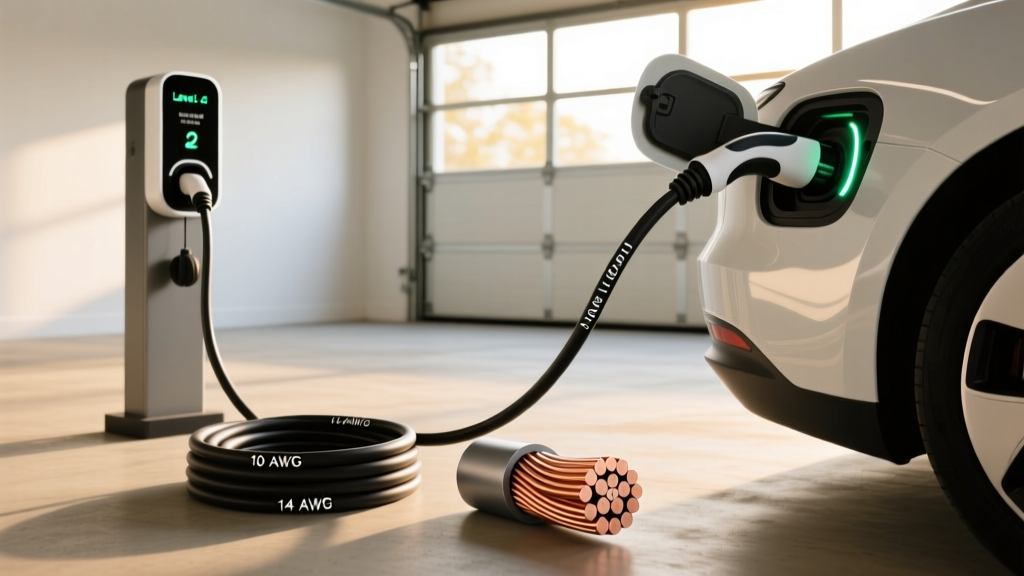
A Level 2 home charging setup requires a dedicated 240-volt circuit, typically 40–60 amps. Your total cost depends on your electrical panel's capacity, the distance from panel to charger location, and local permit fees. Here's a realistic breakdown:
| Cost Component | Simple Install (panel near garage) | Complex Install (long run / panel upgrade) |
|---|---|---|
| Level 2 Charger (hardware) | $400–$650 | $400–$650 |
| Electrician labor (240V/50A circuit) | $500–$1,200 | $1,500–$3,500 |
| Electrical permit | $50–$150 | $50–$200 |
| Panel upgrade (100A → 200A, if needed) | $0 (not required) | $1,500–$3,500 |
| Conduit/wiring materials | $100–$300 | $300–$800 |
| Total estimated cost | $1,050–$2,300 | $3,750–$8,650 |
Panel upgrade reality check: Homes built before 1990 often have 100-amp electrical service. Adding a 40–60A dedicated EV circuit may exceed available capacity, requiring a panel upgrade to 200A. This is the single biggest cost variable in home charger installation—and one many buyers overlook until the electrician's assessment. Always get a load calculation done before committing to equipment.
Some utilities offer rebates of $200–$500 for Level 2 charger installation, and the federal Residential Clean Energy Credit (IRS §25D) may cover 30% of charger hardware and installation costs up to $1,000 through 2032—check current-year eligibility with a tax professional.
Connector Compatibility: NACS, CCS, and Adapters
As of 2026, the North American Charging Standard (NACS)—originally Tesla's proprietary connector—has become the dominant EV charging connector in the US. Here's where things stand:
| Connector Type | Native Vehicles | DC Fast Network Access | Adapter Needed? |
|---|---|---|---|
| NACS (Tesla) | All Tesla models (3, Y, S, X, Cybertruck); Ford F-150 Lightning (2025+), GM Ultium vehicles (2025+), Rivian (2025+) | Tesla Superchargers natively; growing third-party NACS stations | No (native Tesla); CCS→NACS adapter for non-Tesla EVs at Superchargers with Magic Dock |
| CCS1 | Hyundai Ioniq 5/6, Kia EV6/EV9, BMW iX, VW ID.4 (pre-2025), most legacy EVs | Electrify America, EVgo, ChargePoint DC network | NACS→CCS adapter needed for Tesla Superchargers (Tesla sells one for ~$250) |
| CHAdeMO | Nissan Leaf (legacy only—discontinued) | Shrinking network; most operators have deprioritized CHAdeMO | No native adapter to NACS/CCS for DC fast charging |
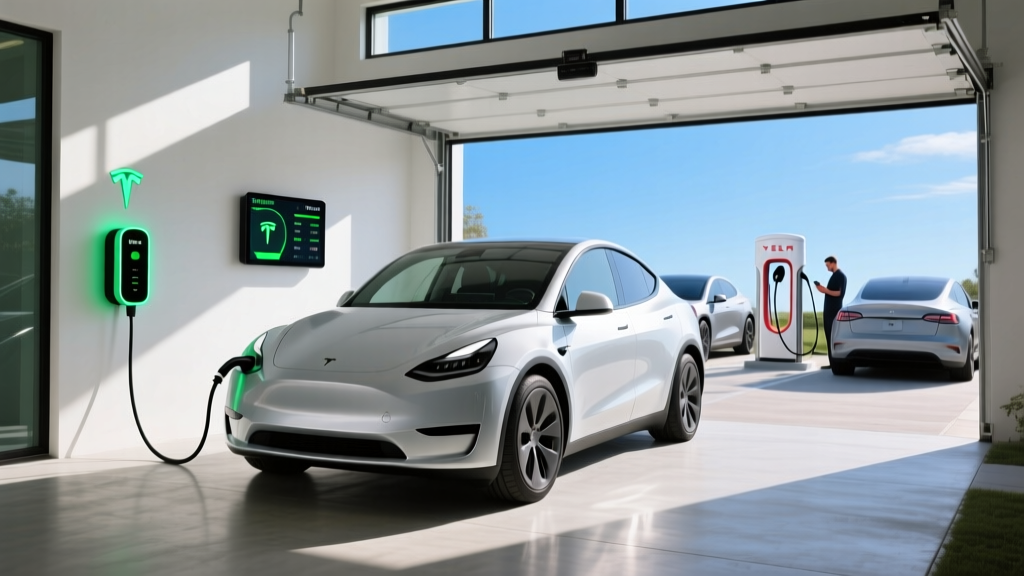
If you drive a Tesla, you plug directly into any Supercharger with no adapter. If you drive a non-Tesla NACS-equipped vehicle (2025+ Ford, GM, Rivian), you can access Superchargers via Tesla's app. CCS-vehicle owners need Tesla's CCS-to-NACS adapter to use Supercharger stalls equipped with the Magic Dock.
Level 2 Home Charger Recommendations for Tesla Owners
Here are proven, well-reviewed Level 2 chargers that pair well with Tesla vehicles. All figures reflect current 2026 retail pricing:
Tesla Wall Connector (Gen 4)
- Power output: Up to 11.5 kW (48A on a 60A circuit)
- Connector: Native NACS—no adapter needed
- Cable length: 24 feet
- Smart features: Wi-Fi enabled, OTA firmware updates, load sharing between multiple units, Tesla app integration, power-sharing for multi-charger setups
- Price: ~$475
- Best for: Tesla-only households wanting seamless integration
ChargePoint Home Flex (NACS variant)
- Power output: Up to 12 kW (50A on a 60A circuit); adjustable down to 16A
- Connector: Available in NACS or J1772 (with NACS adapter included)
- Cable length: 23 feet
- Smart features: Wi-Fi, ChargePoint app with scheduling and cost tracking, Alexa/Google Home integration, amperage configurable via app
- Price: ~$599
- Best for: Multi-EV households (Tesla + non-Tesla) or renters who may move
Emporia Vue Level 2 Charger
- Power output: Up to 11.5 kW (48A); adjustable 6A–48A
- Connector: J1772 (NACS adapter included in 2025+ kits)
- Cable length: 24 feet
- Smart features: Wi-Fi, Emporia app, solar-integration scheduling, energy monitoring, circuit-sharing with Emporia Vue energy monitor
- Price: ~$399
- Best for: Budget-conscious buyers; solar-panel households wanting charge-to-excess scheduling
Safety and Electrical Code Considerations
EV charging draws sustained high current for hours—far longer than most household appliances. This makes proper installation non-negotiable. Key requirements:
- Dedicated circuit: Your Level 2 charger must be on its own dedicated breaker—never shared with other outlets or appliances. A 48A charger requires a 60A breaker (NEC requires circuits rated at 125% of continuous load).
- GFCI protection: NEC 2020 and later require GFCI protection for all EV charging outlets. Hardwired chargers (like the Wall Connector) have GFCI built in; receptacle-based setups need a GFCI breaker.
- Outdoor rating: If installing outside, both the charger and any receptacle must carry a NEMA 4 (weatherproof) rating. The Tesla Wall Connector and ChargePoint Home Flex are both rated for outdoor use.
- Wire gauge: A 60A circuit typically requires 6 AWG copper wire (THHN in conduit) or 4 AWG for longer runs to minimize voltage drop. Your electrician will calculate this based on distance.
- Permit and inspection: Virtually all jurisdictions require an electrical permit and post-installation inspection for EV charger circuits. Skipping this can void home insurance coverage and create a fire risk.
Always hire a licensed electrician familiar with NEC Article 625 (Electric Vehicle Charging System Equipment). Ask for a load calculation on your panel before installation begins.
Frequently Asked Questions
How much does it cost to charge a Tesla at a Supercharger on a road trip?
For a Model 3 Long Range (82 kWh battery), a typical highway road-trip charge from 10% to 80% adds about 57 kWh. At an average Supercharger rate of $0.35/kWh, that session costs roughly $20. On a 600-mile trip requiring two Supercharger stops, expect to spend $35–$50 total—still less than gasoline for most comparable sedans, but more than home charging.
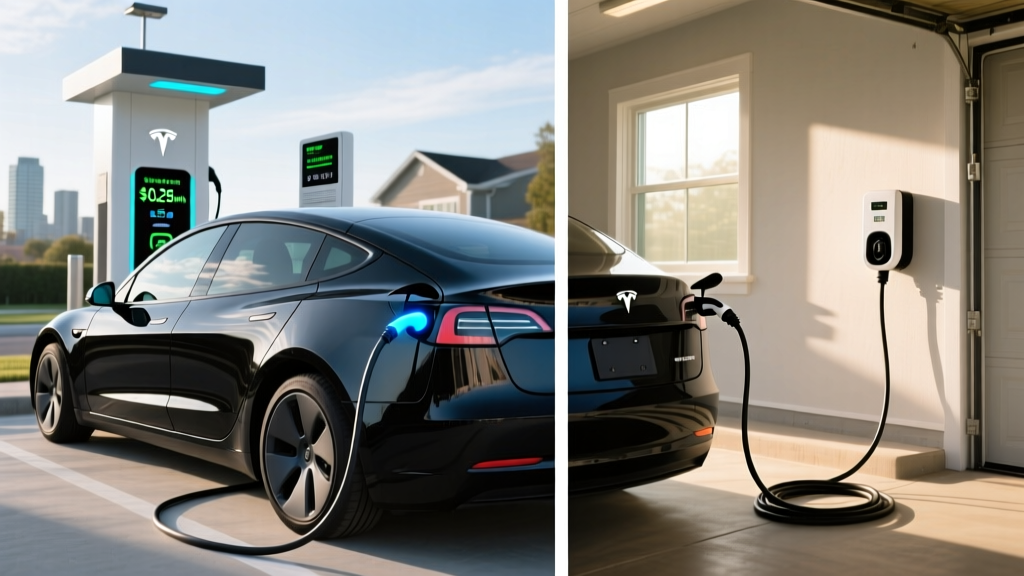
Is it cheaper to charge a Tesla at home or at a Supercharger?
Home charging is dramatically cheaper in almost every US market. At the national average of $0.17/kWh, a full Model Y charge costs about $13.77 at home versus $28–$40 at a Supercharger. Over a year of 12,000 miles, exclusive home charging saves $600–$1,200 compared to exclusive Supercharger use. Most owners use Superchargers for road trips and charge at home daily.
Can I use a regular 120V outlet to charge my Tesla?
Yes, using the Tesla Mobile Connector with the included NACS 120V adapter. However, Level 1 charging delivers only 1.0–1.4 kW, adding roughly 3–5 miles of range per hour. A full 10–80% charge on a Model 3 would take 50+ hours. It's suitable for emergency top-ups or PHEV owners, but impractical as a primary charging strategy for a battery-electric vehicle.
Do Tesla Supercharger prices vary by time of day?
Yes, at many urban and high-demand stations, Tesla implements time-of-use pricing. Peak hours (typically 4–9 PM weekdays) can cost 30–50% more than off-peak (overnight and mid-morning). The Tesla app and in-car navigation display the current rate at each station before you arrive.
What electrical upgrades might I need for a home charger?
The most common upgrade is a panel capacity increase from 100A to 200A service, which costs $1,500–$3,500 depending on your utility and municipality. Other potential upgrades include: replacing a Federal Pacific or Zinsco panel (common in pre-1990 homes, flagged as fire hazards—$2,000–$4,000 replacement), adding a sub-panel in an attached garage, or upgrading the utility service drop if your home's total load calculation exceeds available supply. Get a professional load calculation before purchasing equipment.
Does frequent Supercharging degrade my Tesla battery faster?
DC fast charging generates more heat than Level 2 charging, and heat is the primary driver of lithium-ion battery degradation. However, Tesla's battery thermal management system actively cools the pack during Supercharging, substantially mitigating this effect. Real-world fleet data from Tesla's Impact Reports shows Model 3/Y batteries retain approximately 85–90% capacity after 150,000 miles regardless of charging mix. For daily use, Level 2 home charging is gentler; Supercharging on road trips a few times per month has negligible long-term impact.