What Is the CompTech Supercharger and Where Does It Fit in 2026?
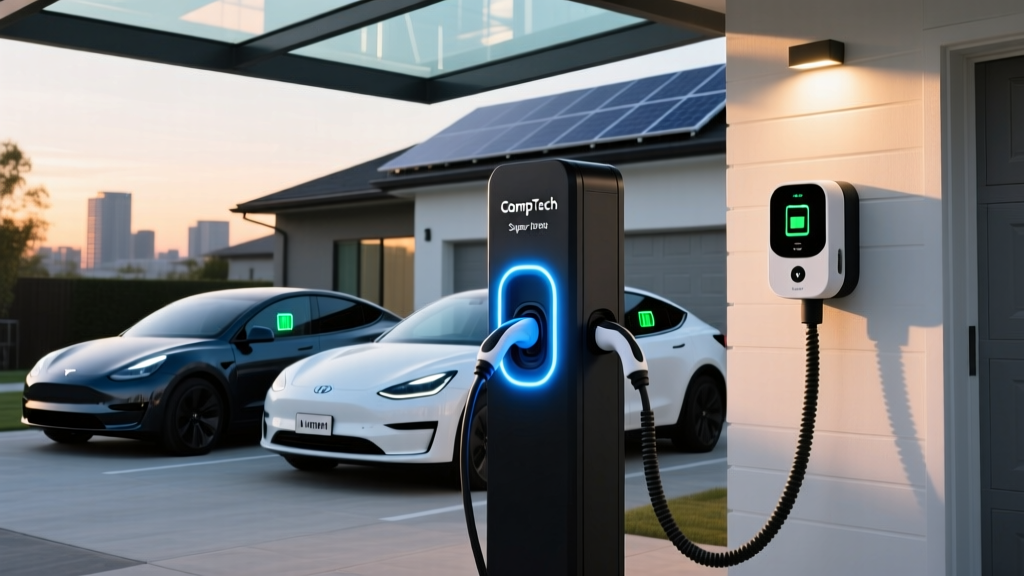
If you've been searching for CompTech Supercharger equipment, you're likely evaluating high-output Level 2 home chargers or third-party DC fast-charging hardware aimed at fleet and commercial use. CompTech-branded charging hardware has surfaced in specialty EV forums and commercial fleet discussions as a high-amperage Level 2 and compact DC fast-charging solution. However, as of early 2026, CompTech does not operate a public consumer charging network comparable to Tesla Superchargers, Electrify America, or EVgo.
This guide covers what CompTech Supercharger-class hardware offers, how it compares to mainstream Level 2 and DC fast chargers, and everything you need to know about installing high-output charging equipment at home — including electrical requirements, costs, connector compatibility, and real-world charging times.
Charging Levels Explained: Speeds in kW and Miles Per Hour
Before evaluating any charger — CompTech or otherwise — you need to understand the three charging levels and what each delivers in practical terms. The critical distinction: kW (kilowatts) measures power — how fast energy flows into your battery. kWh (kilowatt-hours) measures energy — the total capacity stored in your battery. Think of kW as the width of a hose and kWh as the size of the bucket.
| Level | Voltage | Power (kW) | Miles of Range Added Per Hour | Typical Use |
|---|---|---|---|---|
| Level 1 | 120V AC | 1.0–1.4 kW | 3–5 mi/hr | Overnight trickle; PHEVs; emergency backup |
| Level 2 | 240V AC | 3.3–19.2 kW | 12–70+ mi/hr | Home daily charging; workplace; destination |
| DC Fast (Level 3) | 400–900V DC | 50–400 kW | 150–1,200+ mi/hr (peak) | Road trips; commercial fleet; highway corridors |
A typical 75 kWh battery (like the one in a Tesla Model Y Long Range) charged on Level 1 at 1.2 kW would take over 60 hours from empty to full. That same battery on a 48-amp Level 2 circuit (11.5 kW) refills in roughly 7 hours. On a 250 kW DC fast charger, you can go from 10% to 80% in approximately 20–25 minutes, depending on the vehicle's charge curve and battery preconditioning.
Home Installation: Electrical Requirements and Costs
Installing a high-output Level 2 charger like a CompTech Supercharger-class unit (typically 48–80 amps) requires careful electrical planning. Here's what's involved:
Electrical Requirements by Circuit Size
- 32-amp charger (7.7 kW): Requires a 40-amp dedicated 240V circuit (NEC requires circuits rated 125% above continuous load)
- 48-amp charger (11.5 kW): Requires a 60-amp dedicated 240V circuit
- 64-amp charger (15.4 kW): Requires an 80-amp dedicated 240V circuit
- 80-amp charger (19.2 kW): Requires a 100-amp dedicated 240V circuit — uncommon in residential settings
Most modern homes with a 200-amp electrical panel can accommodate a 60-amp circuit for a 48-amp Level 2 charger without a panel upgrade. Older homes with 100-amp or 150-amp service may need a panel upgrade to 200 amps, which is one of the largest variables in installation cost.
Installation Cost Breakdown
| Component | Low Estimate | High Estimate | Notes |
|---|---|---|---|
| Level 2 Charger Equipment | $350 | $1,200 | Varies by brand, amperage, smart features |
| Electrician Labor | $500 | $2,500 | Depends on run length, conduit, wall type |
| Electrical Permit | $50 | $300 | Required in most jurisdictions; varies by city |
| Panel Upgrade (if needed) | $1,500 | $4,000 | Only if existing panel lacks capacity |
| Total (no panel upgrade) | $900 | $4,000 | Most common scenario |
| Total (with panel upgrade) | $2,400 | $8,000 | Older homes with 100A service |
Short cable runs from the panel to the garage (under 20 feet, same wall) keep costs near the low end. Detached garages, long conduit runs, or finished-wall retrofits push costs higher. Always get at least three quotes from licensed electricians and confirm they pull a permit — unpermitted work can void home insurance coverage.
Safety and Code Considerations
- Dedicated circuit: NEC Article 625 requires EV charging equipment to be on its own dedicated circuit — no sharing with other outlets or appliances
- GFCI protection: The 2020 NEC update requires GFCI protection for indoor and outdoor EV receptacles; many modern hardwired chargers include built-in ground-fault protection
- Outdoor rating: If mounting outside, ensure the charger is NEMA 4 or NEMA 4X rated for weather resistance
- UL/ETL certification: Only purchase chargers with UL (Underwriters Laboratories) or ETL (Intertek) listing — uncertified units may not pass inspection and pose fire risk
- Cable management: Use a wall-mounted holster or retractor to prevent tripping hazards and cable damage
Connector Compatibility: NACS, CCS1, and CHAdeMO
The connector landscape has shifted dramatically. As of 2026, NACS (North American Charging Standard) — originally Tesla's proprietary connector — has become the dominant standard. Ford, GM, Rivian, Volvo, Hyundai, and most major automakers have adopted NACS on new vehicles. CCS1 remains on many 2021–2025 model-year EVs. CHAdeMO is effectively legacy, found only on older Nissan Leaf and Mitsubishi vehicles.
| Connector | Brands Using It (New Vehicles) | Adapter Needed? |
|---|---|---|
| NACS (Tesla) | Tesla, Ford, GM, Rivian, Volvo, Polestar, Hyundai/Kia (2025+), Mercedes, BMW | N/A — native |
| CCS1 | VW ID.4 (2021–2024), older Hyundai/Kia, BMW i4/iX (2022–2024), Stellantis | CCS-to-NACS adapter ($100–$250) for Tesla Supercharger access |
| CHAdeMO | Nissan Leaf (legacy), Mitsubishi Outlander PHEV (older) | No adapter available to NACS/CCS; limited public network |
For Level 2 home charging, most non-Tesla EVs from 2021–2024 use a J1772 connector. Tesla provides a J1772 adapter with every vehicle. If you own a CCS-equipped EV, a NACS-to-CCS adapter (available from Tesla for ~$199 or third-party manufacturers) unlocks access to the Tesla Supercharger network. Verify that any CompTech Supercharger-class unit includes the correct connector for your vehicle, or budget for an adapter.
Charging Times: 10–80% Examples for Common Battery Sizes
Real-world charging time depends on battery capacity (kWh), charger power output (kW), the vehicle's onboard charger limit (for Level 2), and the battery's charge curve. Most EVs accept peak charge rates only between roughly 10% and 50% State of Charge (SoC), then taper significantly above 80% to protect battery health.
| Battery Size | Example Vehicle | 48A Level 2 (11.5 kW) | 80A Level 2 (19.2 kW) | 150 kW DC Fast | 250 kW DC Fast |
|---|---|---|---|---|---|
| 62 kWh | Chevy Equinox EV | ~4.5 hrs | ~2.7 hrs | ~28 min | ~22 min |
| 75 kWh | Tesla Model Y LR | ~5.5 hrs | ~3.2 hrs | ~30 min | ~20 min |
| 84 kWh | Hyundai Ioniq 5 LR | ~6.0 hrs | ~3.6 hrs | ~25 min | ~18 min |
| 100 kWh | Ford F-150 Lightning Ext. | ~7.5 hrs | ~4.3 hrs | ~40 min | ~28 min |
| 123 kWh | GMC Sierra EV | ~9.0 hrs | ~5.3 hrs | ~45 min | ~32 min |
Cost to Charge: Per-Mile Comparison vs. Gas
Charging cost varies enormously depending on where and when you plug in. Here's a realistic breakdown using 2026 electricity and fuel prices:
| Scenario | Rate | Vehicle Efficiency | Cost Per Mile |
|---|---|---|---|
| Home Level 2 (off-peak utility rate) | $0.09/kWh | 3.0 mi/kWh (120 MPGe) | $0.030 |
| Home Level 2 (national avg. residential) | $0.17/kWh | 3.0 mi/kWh (120 MPGe) | $0.057 |
| Public Level 2 (network pricing) | $0.30/kWh | 3.0 mi/kWh (120 MPGe) | $0.100 |
| DC Fast Charging (Electrify America, EVgo) | $0.48/kWh | 3.0 mi/kWh (120 MPGe) | $0.160 |
| Gasoline Vehicle (30 MPG combined) | $3.40/gal | 30 MPG | $0.113 |
| Gasoline Vehicle (22 MPG truck/SUV) | $3.40/gal | 22 MPG | $0.155 |
The economics are clear: home charging at off-peak rates delivers fuel costs roughly one-quarter to one-third of gasoline. Even public DC fast charging at premium rates is comparable to or slightly above gasoline costs for efficient vehicles. The savings multiply if your utility offers time-of-use (TOU) rates with cheap overnight power.
For a driver covering 12,000 miles per year in an efficient EV (3 mi/kWh):
- Home charging at $0.09/kWh: ~$360/year
- Home charging at $0.17/kWh: ~$680/year
- Exclusive DC fast charging at $0.48/kWh: ~$1,920/year
- Gas vehicle at 30 MPG: ~$1,360/year
Equipment Recommendations: Level 2 Chargers for Home
Whether you're considering CompTech hardware or mainstream alternatives, here are proven Level 2 chargers with exact specifications:
Tesla Wall Connector
- Power: Up to 48A (11.5 kW) on a 60A circuit
- Connector: NACS (J1772 adapter included)
- Cable: 24 feet
- Smart features: Wi-Fi, OTA updates, power sharing between two units, access control
- Price: ~$475
- Certification: UL listed
ChargePoint Home Flex
- Power: Configurable 16–50A (up to 12 kW) via DIP switches
- Connector: J1772 (NACS adapter available)
- Cable: 23 feet
- Smart features: Wi-Fi, Alexa integration, scheduling, energy tracking
- Price: ~$550–$700
- Certification: UL listed, ENERGY STAR
Emporia Level 2 EV Charger
- Power: Up to 48A (11.5 kW) on a 60A circuit
- Connector: J1772 (NACS version available)
- Cable: 24 feet
- Smart features: Wi-Fi, solar integration, load management, real-time energy monitoring
- Price: ~$400
- Certification: UL listed
Grizzl-E Smart
- Power: Configurable 16–40A (up to 9.6 kW)
- Connector: J1772
- Cable: 24 feet
- Smart features: OCPP-compatible, adjustable amperage, extreme cold rated (-40°F)
- Price: ~$450
- Certification: UL listed, NEMA 4X outdoor rated
If you're evaluating a CompTech Supercharger-class unit, verify its UL/ETL listing, connector type, maximum amperage, and whether it supports OCPP (Open Charge Point Protocol) for smart scheduling and utility demand-response programs. Equipment without these certifications may fail municipal inspection.
Frequently Asked Questions
How much does it cost to install a home EV charger?
Expect $900–$4,000 for a standard Level 2 installation on an existing 200-amp panel (equipment + electrician + permit). If your home requires a panel upgrade from 100A to 200A, total costs can reach $2,400–$8,000. Get a load calculation from a licensed electrician before purchasing a high-amperage charger.
How fast will each charging level add range?
Level 1 (120V) adds roughly 3–5 miles per hour. Level 2 (240V) adds 12–70+ miles per hour depending on amperage (16A to 80A). DC fast charging adds 150–1,200+ miles per hour at peak rates, though real-world sessions average much less due to charge-curve taper above 80% SoC. For daily driving, Level 2 at 48 amps replenishes most EVs overnight.
Which connector/charger is compatible with my EV?
Check your vehicle's charge port. 2025–2026 models from Tesla, Ford, GM, Rivian, Hyundai, Kia, Volvo, and others use NACS. Older CCS1 vehicles (2021–2024 VW, BMW, Stellantis) can use a CCS-to-NACS adapter (~$100–$250) for Tesla Supercharger access. CHAdeMO vehicles (older Nissan Leaf) have no adapter path and face a shrinking public network. For home Level 2, a J1772 connector works with all non-Tesla EVs; Tesla includes a J1772 adapter.
How much does charging cost per mile vs. gas?
Home charging at off-peak rates ($0.09/kWh) costs roughly $0.03 per mile — about one-quarter the cost of a 30 MPG gas vehicle at $3.40/gallon ($0.113/mile). Even at the national average residential rate ($0.17/kWh), EV fuel costs are about half of gasoline. DC fast charging at public rates ($0.48/kWh) roughly equals gasoline costs. According to fueleconomy.gov, most EVs achieve 100–130 MPGe combined, translating to 3–4 miles per kWh.
What electrical upgrades might I need?
If your home has a 200-amp panel with available breaker slots, a 60-amp circuit for a 48-amp Level 2 charger typically installs without upgrades. Homes with 100-amp or 150-amp service, or panels near capacity (common with electric heating, EV charging, and hot tubs running simultaneously), may need a panel upgrade to 200 or 400 amps. A licensed electrician can perform a NEC Article 220 load calculation to determine your panel's headroom. Some utilities offer rebates for panel upgrades that support EV adoption — check with your local provider.
Can I install a CompTech Supercharger at home?
CompTech Supercharger-class units rated for Level 2 (240V AC, up to 80A) can be installed at home if your electrical panel supports the required circuit. Units rated for DC fast charging (400V+ DC, 50+ kW) are commercial/industrial equipment requiring three-phase power and are not suitable for residential installation. Always confirm the specific model's voltage, amperage, and UL certification before purchasing.
Sources: U.S. EPA fueleconomy.gov, IRS §30D Clean Vehicle Credits, NFPA National Electrical Code (NEC)