If you've encountered the phrase "compressed air supercharging cost" while researching alternative vehicle power systems, you're likely trying to understand how pneumatic energy storage stacks up against the rapidly maturing battery-electric vehicle (EV) charging ecosystem. The short answer: compressed air as a primary vehicle propulsion method remains experimental and commercially unavailable for consumer passenger vehicles in 2026, while EV charging infrastructure is well-established with transparent, measurable costs. This guide covers what compressed air vehicle concepts promise, what they actually cost to operate where tested, and then provides a complete, numbers-driven breakdown of what EV drivers pay to charge at home and on the road today.
What Is Compressed Air Supercharging and Why Does Its Cost Matter?
Compressed air vehicle (CAV) technology uses high-pressure air stored in tanks to drive a pneumatic motor, either as a sole propulsion source or as a range-extending supplement to a small internal combustion engine. Companies like Tata Motors (India) and MDI (Luxembourg/France) have demonstrated prototypes, but no compressed air passenger vehicle is currently sold or certified for US road use as of 2026.
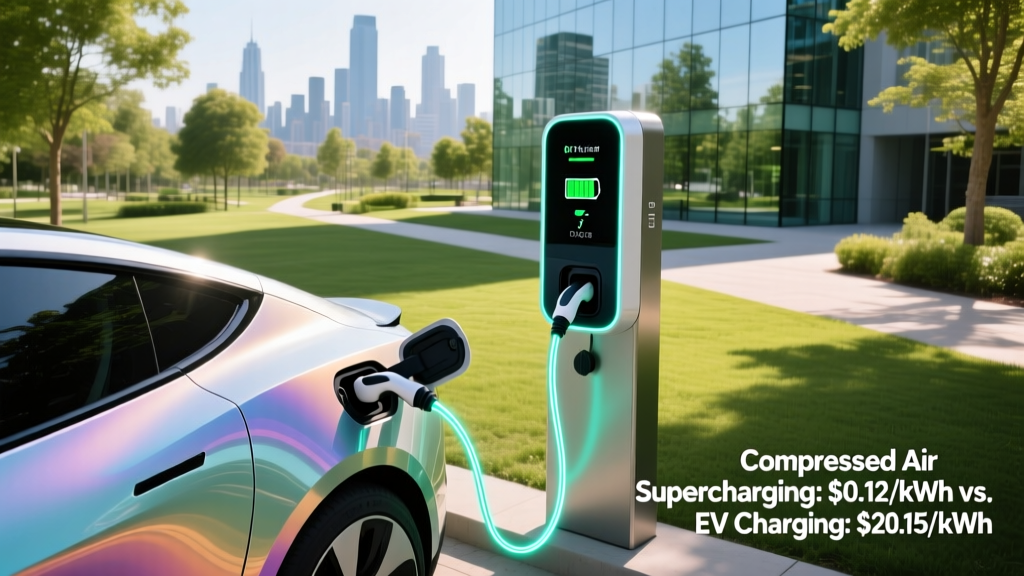
The term "supercharging" in this context sometimes refers to using a mechanical compressor—driven by the vehicle's motor or an external station—to rapidly refill air tanks, analogous in concept (though not in physics) to DC fast charging an EV battery. The compressed air supercharging cost in prototype environments has been cited at roughly $1.50–$3.00 per full tank fill at public compressor stations in test markets, translating to approximately 60–100 miles of range in lightweight urban prototypes. That works out to roughly $0.02–$0.04 per mile in best-case scenarios—but these figures come from controlled demonstrations, not consumer-available products.
For comparison, the average US EV driver in 2026 pays between $0.03 and $0.12 per mile depending on charging method, with home Level 2 charging being the most economical. Let's map out exactly what that looks like.
EV Charging Levels Explained: Speeds, Power, and Range Added
Understanding EV charging requires distinguishing between kW (kilowatts — the rate of power delivery, like water pressure from a hose) and kWh (kilowatt-hours — the total energy delivered, like gallons of water in a bucket). A 48 kW Level 2 charger delivers energy at 48 kilowatts; an 84 kWh battery stores 84 kilowatt-hours of total usable energy.
| Level | Voltage | Power (kW) | Miles of Range Added/Hour | Typical Use Case |
|---|---|---|---|---|
| Level 1 | 120V AC | 1.2–1.9 kW | 3–5 mi/hr | Overnight top-off, PHEV owners, no install needed |
| Level 2 | 240V AC | 7.2–19.2 kW | 20–60 mi/hr | Home daily charging, workplace, destination |
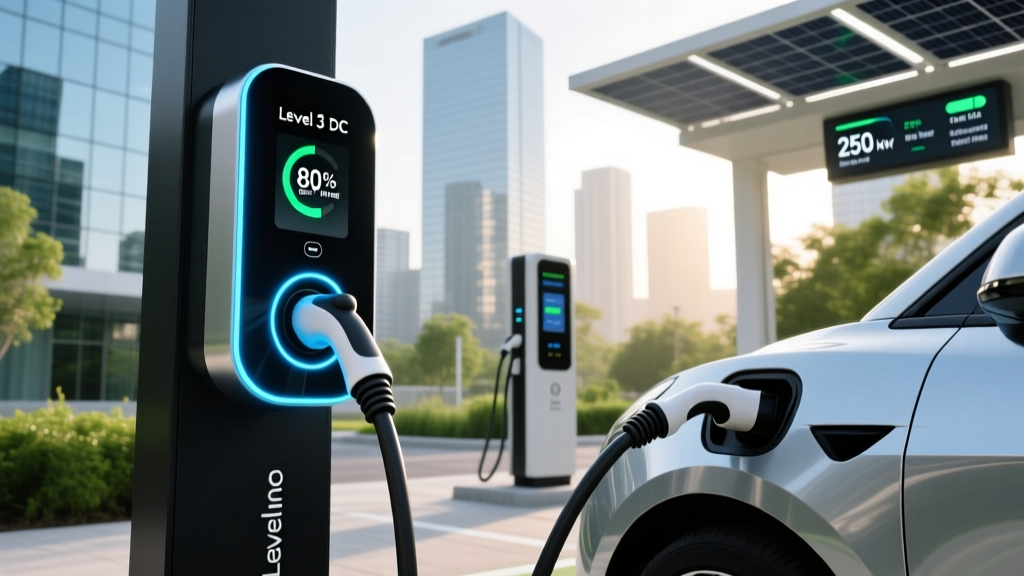
| DC Fast (Level 3) | 400–800V DC | 50–350 kW | 150–1,200 mi/hr (peak) | Road trips, highway corridors, 10–80% in 15–40 min |
A critical real-world note: DC fast chargers do not sustain peak power throughout a session. A charger rated at 250 kW may deliver that rate only between 10–40% State of Charge (SoC), then taper as the battery management system protects cell health. Expect a typical 10–80% session on a 250 kW-capable vehicle (like the Hyundai Ioniq 5 or Tesla Model 3) to take 18–25 minutes, not the theoretical minimum. Above 80%, charging slows dramatically — this is why most road-trip guides recommend charging to 80% and moving on.
How Much Does It Cost to Install a Home EV Charger?
Home Level 2 charging is the backbone of practical EV ownership. Most drivers install a 240V/48A hardwired wall connector on a dedicated 60A circuit. The total installed cost varies widely based on your electrical panel's capacity, the distance from panel to charger location, and local permit fees.
| Component | Low Estimate | High Estimate | Notes |
|---|---|---|---|
| Level 2 EVSE equipment (charger unit) | $350 | $750 | Smart Wi-Fi models cost more; basic units less |
| Electrician labor (2–6 hours) | $500 | $2,000 | Depends on run length, conduit, wall type |
| Electrical panel upgrade (if needed) | $1,500 | $4,000 | Older 100A panels often need upgrade to 200A |
| Permit and inspection | $50 | $300 | Varies by municipality; some waive for EV installs |
| Total (no panel upgrade) | $900 | $3,050 | Most homes with 200A service fall here |
| Total (with panel upgrade) | $2,400 | $7,050 | Common in pre-2000 homes with 100A panels |
Panel upgrade reality: This is the single most overlooked cost in EV home charging. If your home has a 100-amp main panel (common in homes built before 2000), adding a 60A dedicated EV circuit may push total load beyond code-safe limits. A licensed electrician will perform a load calculation per NEC Article 220. If an upgrade is required, budget an additional $1,500–$4,000 and 1–3 weeks for utility coordination.
Some utilities and states offer rebates of $250–$1,000 for home charger installation — check with your local provider and your state energy office. The federal Alternative Fuel Vehicle Refueling Property Credit (IRC §30C) covers up to 30% of home charging equipment and installation costs (capped at $1,000), but eligibility depends on census-tract requirements. Consult a tax professional for your specific situation.
Connector Compatibility: NACS, CCS1, and CHAdeMO
The connector landscape has shifted dramatically. As of 2026, the North American Charging Standard (NACS), developed by Tesla, has become the dominant connector for new EVs. Most legacy CCS1 vehicles can access Tesla Supercharger networks via adapter.
| Connector | Brands Using It (Native) | Adapter Needed For | Notes |
|---|---|---|---|
| NACS (Tesla-style) | Tesla, Ford, GM, Rivian, Volvo, Polestar, Nissan (2025+), Hyundai/Kia (2025+) | CCS1 public chargers (adapter included or ~$200) | Now the dominant US standard; access to 25,000+ Superchargers |
| CCS1 (Combined Charging System) | Legacy VW ID.4, BMW iX (pre-2025), some Stellantis models | NACS Superchargers (adapter ~$200–$250) | Being phased out on new models; still widely available at Electrify America, EVgo |
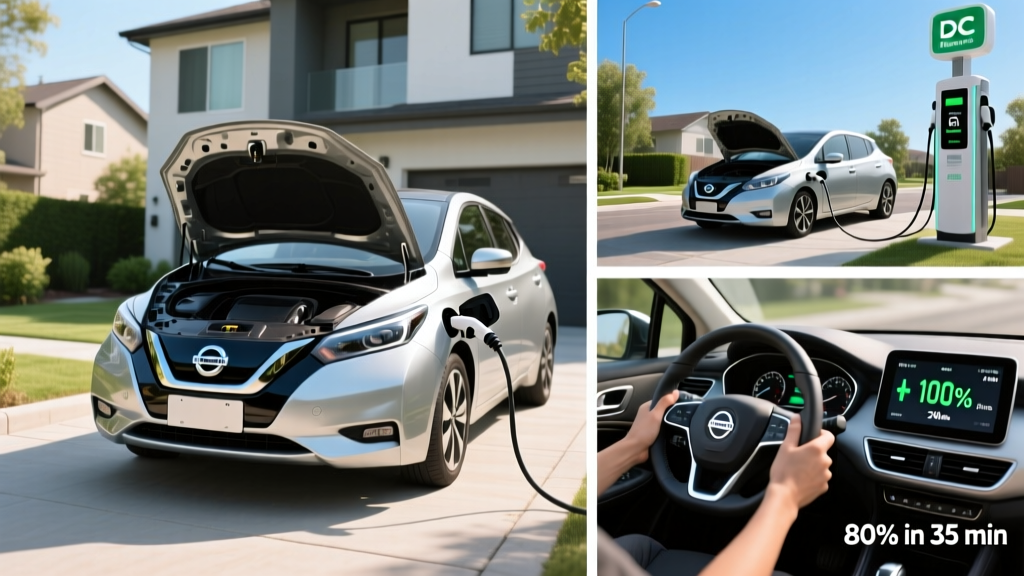
| CHAdeMO | Nissan Leaf (legacy only) | No practical NACS adapter available | Declining network; not recommended for new purchases |
For home Level 2 charging, most wall connectors now ship with a NACS plug or include a J1772 adapter (the older universal Level 2 standard). If you own a vehicle with a CCS1 port, confirm that your chosen home charger includes or supports a J1772 connector, which remains the standard for Level 2 AC charging across all brands.
Cost Per Mile: EV Charging vs. Gas vs. Compressed Air Concepts
Here's where the numbers get practical. We'll compare charging costs across common scenarios using a representative 2026 EV with 3.5 miles per kWh efficiency (roughly the average for a midsize crossover like the Tesla Model Y or Hyundai Ioniq 5) against a comparable 28 MPG gasoline vehicle at $3.40/gallon.
| Charging Scenario | Rate ($/kWh) | Cost Per Mile | Annual Cost (12,000 mi) |
|---|---|---|---|
| Home Level 2 — off-peak utility rate | $0.09–$0.13 | $0.026–$0.037 | $310–$445 |
| Home Level 2 — standard residential rate | $0.14–$0.18 | $0.040–$0.051 | $480–$615 |
| Home solar (amortized) | $0.04–$0.07 | $0.011–$0.020 | $135–$240 |
| Public Level 2 (ChargePoint, etc.) | $0.25–$0.49 | $0.071–$0.140 | $855–$1,680 |
| DC Fast Charging (Electrify America, Tesla) | $0.32–$0.56 | $0.091–$0.160 | $1,095–$1,920 |
| Gasoline (28 MPG, $3.40/gal) | — | $0.121 | $1,457 |
| Compressed air (prototype estimates) | — | $0.020–$0.040 | $240–$480 (not consumer-available) |
The takeaway: Home-charged EVs consistently beat gasoline on per-mile cost by 60–80%. Even exclusive DC fast charging is roughly cost-competitive with gas. The compressed air supercharging cost figures from prototypes appear attractive but remain irrelevant to US consumers since no CAV is available for purchase, and the energy density of compressed air (~0.05 kWh per liter at 300 bar) is far below that of lithium-ion batteries (~0.25–0.30 kWh per liter), limiting range severely.
Charging Time Examples: 10–80% for Common Battery Sizes
Charging time depends on battery capacity (kWh), the vehicle's maximum accepted charge rate (kW), and the charger's output. Here are real-world benchmarks for popular 2026 models:
- Tesla Model Y Long Range (75 kWh usable, NMC, 250 kW peak): 10–80% in ~22 minutes on a V3 Supercharger (250 kW). Tapers to ~45 kW above 80%.
- Hyundai Ioniq 5 (77.4 kWh usable, NMC, 240 kW peak on 800V architecture): 10–80% in ~18 minutes on a 350 kW-capable charger. Sustains high power longer due to 800V system.
- Ford F-150 Lightning Extended Range (131 kWh usable, NMC, 150 kW peak): 10–80% in ~41 minutes on a 150+ kW DC charger. Larger battery means longer sessions despite decent charge rate.
- Chevrolet Equinox EV (85 kWh usable, NMC, 150 kW peak): 10–80% in ~30 minutes on a 150 kW DC fast charger.
- BMW iX xDrive50 (105.2 kWh usable, NMC, 200 kW peak): 10–80% in ~31 minutes on a 200+ kW charger.
On a home Level 2 charger at 11.5 kW (48A), any of these batteries will fully charge overnight in 7–12 hours — more than sufficient for daily driving needs given the average American drives 37 miles per day (FHWA data).
Recommended Home Level 2 Chargers for 2026
Emporia Level 2 Smart Charger (48A)
- Power output: 11.5 kW (240V/48A)
- Connector: NACS (J1772 adapter available)
- Cable length: 24 ft
- Smart features: Wi-Fi, app scheduling, energy monitoring, solar integration, utility demand-response compatible
- Price: ~$399
- Best for: Budget-conscious buyers wanting full smart features and energy tracking
Tesla Wall Connector (48A)
- Power output: 11.5 kW (240V/48A)
- Connector: NACS native
- Cable length: 24 ft
- Smart features: Wi-Fi, OTA updates, power sharing (link up to 6 units on one circuit), access control
- Price: ~$450
- Best for: Tesla owners and NACS-native vehicle owners; cleanest integration
ChargePoint Home Flex (50A)
- Power output: 12 kW (240V/50A, configurable down to 16A)
- Connector: J1772 (NACS adapter available separately)
- Cable length: 23 ft
- Smart features: Wi-Fi, Alexa integration, detailed app analytics, flexible amperage dial for older panels
- Price: ~$599
- Best for: Homes with limited panel capacity (adjustable amperage avoids panel upgrade)
Grizzl-E Smart (40A)
- Power output: 9.6 kW (240V/40A)
- Connector: J1772 (NACS version available)
- Cable length: 24 ft
- Smart features: Wi-Fi, OCPP-compatible, extreme cold rating (-40°F), aluminum case
- Price: ~$499
- Best for: Cold-climate installations, outdoor mounting, durability priority
Safety, Code, and Electrical Requirements
Every home EV charger installation must comply with the National Electrical Code (NEC) and local amendments. Key requirements include:
- Dedicated circuit: Your Level 2 charger must be on its own dedicated breaker — no sharing with other appliances. A 48A charger requires a 60A breaker (NEC requires 125% overhead for continuous loads).
- GFCI protection: NEC 2020 and later require GFCI protection for all EVSE receptacles. Hardwired units typically include ground-fault protection internally.
- Outdoor rating: If mounting outdoors, ensure the unit carries a NEMA 4 (or IP65+) rating for weather resistance. All recommended chargers above meet this standard.
- Wire gauge: 6 AWG copper for 48A/60A circuits; 4 AWG for 50A/60A circuits at longer runs. Your electrician will size based on run length and local code.
- Permit and inspection: Required in most jurisdictions. A final inspection ensures code compliance and is often required for utility rebate eligibility.
Do not attempt a DIY install on a 240V circuit without licensed electrical oversight. Improperly installed high-amperage circuits pose fire risk and will void most homeowner insurance coverage for related incidents.
Frequently Asked Questions
How much does it cost to install a home EV charger?
Expect $900–$3,050 total if your electrical panel has sufficient capacity (200A service with available breaker slots). If a panel upgrade from 100A to 200A is needed, total cost rises to $2,400–$7,050. The charger unit itself costs $350–$750; the rest is electrician labor, materials, and permits.
How fast will each charging level add range?
Level 1 (120V): 3–5 miles per hour. Level 2 (240V, 48A): 30–45 miles per hour for most EVs. DC Fast Charging (150–350 kW): 150–1,200 miles per hour at peak, though sustained rates taper significantly above 50% SoC. A typical DC fast session adds 150–200 miles in 20 minutes.
Which connector/charger is compatible with my EV?
For 2025–2026 model year vehicles, most new EVs use NACS. Older CCS1 vehicles (pre-2025 VW, BMW, Stellantis) can use NACS Superchargers with a $200–$250 adapter. CHAdeMO is limited to legacy Nissan Leafs. For home Level 2 charging, J1772 remains the universal AC connector standard, though NACS home chargers are now common.
How much does charging cost per mile vs gas?
Home off-peak Level 2 charging costs $0.026–$0.037 per mile — about 70–75% less than a 28 MPG gasoline vehicle at $3.40/gallon ($0.121/mile). Even exclusive DC fast charging ($0.09–$0.16/mile) is competitive with or cheaper than gasoline. According to fueleconomy.gov, EVs convert 77–85% of grid energy to wheels versus 12–30% for gasoline vehicles.
What electrical upgrades might I need?
The most common upgrade is a panel replacement from 100A to 200A service ($1,500–$4,000). You may also need a new breaker slot, upgraded service wire from the utility, or a sub-panel if the charger is far from the main panel (e.g., detached garage). A licensed electrician's load calculation will determine exact needs.
Is compressed air supercharging a viable alternative to EV charging?
Not for US consumers in 2026. While compressed air supercharging cost estimates from prototype programs ($0.02–$0.04/mile) appear competitive with home EV charging, no compressed air vehicle is available for purchase in the United States. The energy density limitations of compressed air storage (roughly 1/5th that of lithium-ion batteries by volume) restrict practical range to under 100 miles in lightweight prototypes. EV charging infrastructure, by contrast, serves millions of drivers with proven, measurable economics.