If you are shopping for an electric vehicle in 2026, you have probably noticed that the EPA range sticker is only the starting point. A car rated for 320 miles might deliver 240 on a cold highway day, while a 270-mile EV with superior efficiency and faster charging could outperform it on a real road trip. Understanding how to compare electric car ranges means looking beyond the sticker and matching range to your charging infrastructure—because a 400-mile battery is useless if you cannot charge it overnight at home.
This guide walks you through the range-versus-charging equation: how each charging level affects your daily usability, what home installation actually costs, which connectors fit your vehicle, and how per-mile charging costs compare to gasoline.
Why EPA Range Is Only Half the Story
The EPA range estimate on fueleconomy.gov is measured under controlled conditions that include city and highway driving cycles. It is a useful baseline for comparing vehicles, but real-world range depends on factors the sticker does not capture:
- Highway speed: Sustained 75 mph driving typically reduces range by 15–25% versus the EPA combined figure due to aerodynamic drag, which scales with the square of velocity.
- Cold weather: Lithium-ion batteries lose 20–40% of usable capacity below 32°F. Heat pumps (standard on vehicles like the Hyundai Ioniq 5 and Tesla Model Y) mitigate cabin energy draw but cannot fully offset cell-level losses.
- Battery chemistry: LFP (lithium iron phosphate) batteries tolerate 100% state-of-charge daily better than NMC/NCA, effectively giving you more usable range day-to-day even if the EPA number is lower.
- Charging speed: A vehicle that adds 200 miles of range in 18 minutes at a DC fast charger is more road-trip-capable than one with 30 extra EPA miles but a sluggish charge curve.
Charging Levels Explained: Speeds, Power, and Range Added
The single most important distinction in EV charging is kW (kilowatts) versus kWh (kilowatt-hours). Kilowatts measure power—the rate at which energy flows into your battery. Kilowatt-hours measure energy—the total capacity of your battery, like gallons in a gas tank. A 75 kWh battery charged at 11.5 kW takes roughly 6.5 hours from empty to full. The same battery at 150 kW DC fast charging can reach 80% in about 25 minutes.
| Level | Voltage | Power (kW) | Miles of Range Added per Hour | Typical Use Case |
|---|---|---|---|---|
| Level 1 | 120V AC | 1.0–1.4 kW | 3–5 miles | Overnight top-up, PHEVs, low-mileage drivers |
| Level 2 (Home) | 240V AC | 7.2–11.5 kW | 25–45 miles | Daily home charging, most BEV owners |
| Level 2 (Commercial) | 208–240V AC | 6.6–19.2 kW | 22–65 miles | Workplace, apartments, destination charging |
| DC Fast (50 kW) | 200–500V DC | 50 kW | ~150 miles/hour | Older public stations, backup road-trip option |
| DC Fast (150–350 kW) | 200–920V DC | 150–350 kW | 400–1,000+ miles/hour (peak) | Road trips, highway corridor charging |
Critical nuance on DC fast charging: Peak kW is not sustained kW. Most EVs hit peak charge rate only between roughly 10–40% state of charge, then taper progressively. A vehicle advertising "250 kW peak" might sustain that rate for 5 minutes and spend the rest of the session at 80–120 kW. Always look at the 10–80% charge time rather than peak kW alone. For example:
- Tesla Model Y (75 kWh battery, 250 kW peak): 10–80% in ~25 minutes at a V3 Supercharger
- Hyundai Ioniq 5 (77.4 kWh, 800V architecture, 240 kW peak): 10–80% in ~18 minutes
- Ford F-150 Lightning (131 kWh extended, 150 kW peak): 10–80% in ~41 minutes
Home Charger Installation: Electrical Requirements and Real Costs
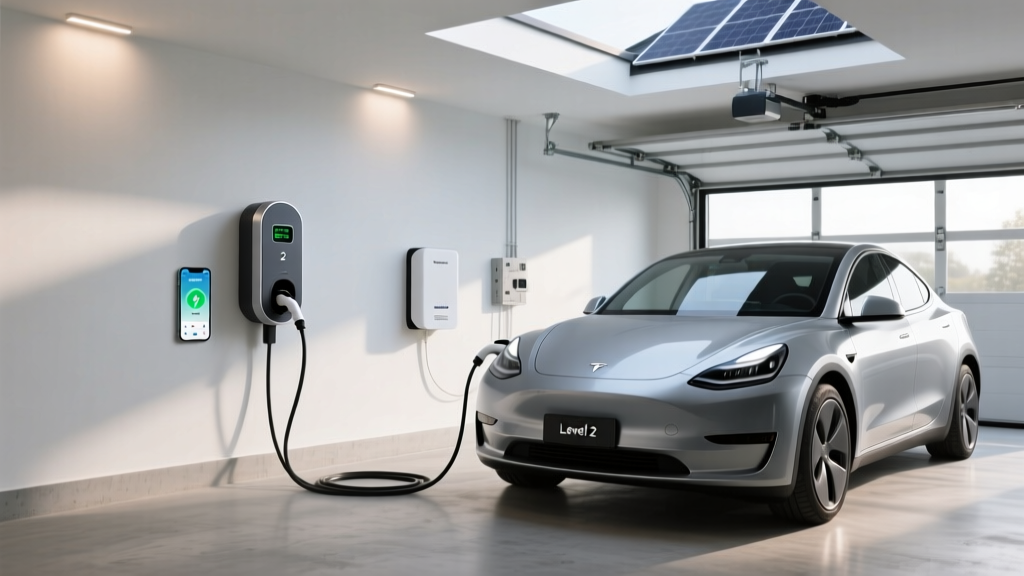
Installing a Level 2 home charger is the single highest-impact upgrade for EV ownership. The majority of charging happens at home, and a proper Level 2 setup means waking up to a full battery every morning. But installation costs vary enormously based on your electrical panel, distance from panel to charger location, and local code requirements.
Electrical Requirements
A typical Level 2 home charger requires a 240V dedicated circuit—the same voltage as your electric dryer or oven. The most common setups:
- 40-amp circuit / 32-amp continuous: Delivers up to 7.7 kW. Sufficient for most EVs and requires 6 AWG copper wire.
- 50-amp circuit / 40-amp continuous: Delivers up to 9.6 kW. Ideal for larger batteries (100+ kWh) or faster overnight fills.
- 60-amp circuit / 48-amp continuous: Delivers up to 11.5 kW. Requires 4 AWG copper wire and a panel with adequate spare capacity. Best for high-capacity EVs like the F-150 Lightning or Rivian R1T.
The National Electrical Code (NEC) requires that continuous loads (defined as running 3 hours or more—EV charging qualifies) use only 80% of a circuit's rated capacity. A 40-amp breaker therefore supports a maximum 32-amp continuous draw.
Panel Upgrade Reality
Many homes built before 2000 have 100-amp or 150-amp main panels that may lack spare capacity for a new 40–60 amp circuit. If your panel is already near capacity (running electric heat, AC, dryer, water heater, and oven), adding a 50-amp EV circuit could require a panel upgrade to 200 amps, which adds $1,500–$3,500 to the project. Some utilities offer load-management devices that allow EV charging without a panel upgrade by throttling charger amperage when other large loads are active.
| Cost Component | Simple Install (panel nearby, no upgrade) | Complex Install (long wire run or panel upgrade) |
|---|---|---|
| Level 2 Charger Equipment | $350–$700 | $350–$700 |
| Electrician Labor (2–4 hours simple, 6–10 hours complex) | $400–$1,000 | $1,200–$2,500 |
| Electrical Permit | $50–$200 | $50–$200 |
| Panel Upgrade (if needed) | $0 | $1,500–$3,500 |
| Wire and Conduit Materials | $100–$300 | $300–$800 |
| Total Estimated Cost | $900–$2,200 | $3,400–$7,700 |
The IRS §30D tax credit does not cover charger installation directly, but the separate §30C Alternative Fuel Vehicle Refueling Property Credit offers up to $1,000 (30% of cost) for home charging equipment and installation, subject to census-tract eligibility. Consult a tax professional for your specific situation.
Connector Compatibility: NACS, CCS, and CHAdeMO in 2026
The connector landscape has consolidated significantly. Tesla's North American Charging Standard (NACS) is now the dominant connector for new vehicles sold in the US, with Ford, GM, Rivian, Volvo, Polestar, and others having adopted it for 2025–2026 model-year vehicles. CCS1 (Combined Charging System) remains on many 2022–2024 models and is still supported at most public DC fast stations. CHAdeMO is effectively legacy, found only on the Nissan Leaf and a few discontinued models.
| Connector | Brands Using It (New Vehicles) | Public DC Network Access | Adapter Needed? |
|---|---|---|---|
| NACS (Tesla standard) | Tesla, Ford, GM, Rivian, Volvo, Polestar, Hyundai (2026+), Kia (2026+), Mercedes-Benz | Tesla Supercharger (17,000+ US stalls), Electrify America (NACS stalls rolling out), ChargePoint, EVgo | CCS-to-NACS adapter for older CCS stations (~$200–$250) |
| CCS1 | 2022–2025 models from VW, BMW, Hyundai, Kia, Stellantis; legacy inventory | Electrify America, EVgo, ChargePoint, Ionity (Europe) | NACS-to-CCS adapter for Tesla Superchargers (available from Tesla, ~$250) |
| CHAdeMO | Nissan Leaf (discontinued after 2025); no new US vehicles | Limited; Electrify America phasing out | No adapter available for DC fast charging to other standards |
For Level 2 home charging, all non-Tesla EVs use the J1772 connector. Tesla vehicles include a J1772 adapter in the glovebox, so any Level 2 home charger works with any EV regardless of DC fast-charge connector.
Charging Cost Per Mile: Home vs. Public vs. Gas
One of the strongest economic arguments for EVs is lower fuel cost per mile—but only if you charge primarily at home on off-peak electricity rates. Public DC fast charging has become competitive with gasoline in some markets, eroding the savings advantage for drivers who cannot charge at home.
| Scenario | Rate | Cost per Mile (EV at 3.0 mi/kWh) | Annual Fuel Cost (12,000 mi/yr) |
|---|---|---|---|
| Home, off-peak utility rate | $0.08–$0.14/kWh | $0.03–$0.05 | $360–$600 |
| Home, standard residential rate | $0.14–$0.20/kWh | $0.05–$0.07 | $600–$840 |
| Public Level 2 (ChargePoint, etc.) | $0.25–$0.49/kWh | $0.08–$0.16 | $960–$1,920 |
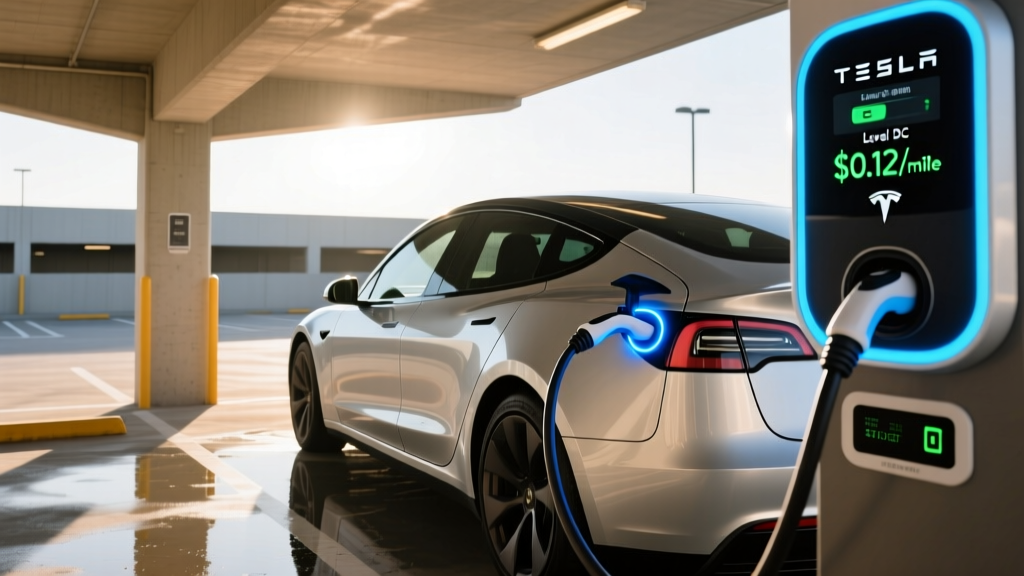
| DC Fast Charging (Electrify America, EVgo) | $0.35–$0.55/kWh | $0.12–$0.18 | $1,440–$2,160 |
| Tesla Supercharger (member pricing) | $0.25–$0.40/kWh | $0.08–$0.13 | $960–$1,560 |
| Gasoline vehicle (28 MPG combined, $3.40/gal) | $3.40/gallon | $0.12 | $1,440 |
The takeaway: home-charged EVs save $800–$1,100 per year versus gasoline. Drivers relying exclusively on DC fast charging may break even or pay slightly more than a fuel-efficient gas car. This is why home charger installation is the single best investment in EV ownership.
Recommended Home Level 2 Chargers (2026)
Below are proven Level 2 chargers that balance reliability, features, and value. All support J1772 (compatible with every EV, including Tesla via included adapter) and are UL-listed for safety.
ChargePoint Home Flex
- Power Output: Up to 11.5 kW (48A) on a 60A circuit; configurable down to 16A
- Connector: J1772 (NACS adapter included for newer Tesla owners)
- Cable Length: 23 feet
- Smart Features: Wi-Fi, app scheduling, utility demand-response integration, Alexa
- Price: ~$550–$650
Tesla Wall Connector
- Power Output: Up to 11.5 kW (48A) on a 60A circuit
- Connector: NACS native; J1772 adapter available separately (~$40)
- Cable Length: 24 feet
- Smart Features: Wi-Fi, over-the-air updates, power sharing (multiple units on one circuit), load management
- Price: ~$425–$475
Emporia Level 2 Smart Charger
- Power Output: Up to 11.5 kW (48A); also available in 40A version
- Connector: J1772
- Cable Length: 24 feet
- Smart Features: Wi-Fi, app with energy monitoring, solar integration, scheduled charging
- Price: ~$350–$400 (best value pick)
Safety, Code, and Installation Best Practices
EV charging draws sustained high current for hours—more like an electric furnace than a phone charger. Proper installation is non-negotiable for safety and insurance coverage.
- Dedicated circuit: Your Level 2 charger must be on its own dedicated breaker. Never share a circuit with another major appliance.
- GFCI protection: NEC 2020 and later requires GFCI (ground-fault circuit interrupter) protection for all EV charging outlets. Many modern hardwired chargers have built-in GFCI; plug-in units require a GFCI breaker.
- Outdoor rating: If installing outdoors or in an unenclosed carport, ensure the charger is rated NEMA 4 (weatherproof). All chargers listed above carry this rating.
- Hardwired vs. plug: Hardwired installations (no plug) avoid the NEC GFCI-breaker requirement and eliminate a failure point, but a NEMA 14-50 outlet gives you portability if you move. Discuss the trade-off with your electrician.
- Permit and inspection: Most jurisdictions require an electrical permit for EV charger installation. Skipping this can void your homeowner's insurance in the event of a fire. Budget $50–$200 for the permit and a final inspection visit.
Frequently Asked Questions
How much does it cost to install a home EV charger?
A straightforward Level 2 installation (panel has capacity, charger mounts within 20 feet of the panel) typically costs $900–$2,200 including equipment, labor, wire, and permit. If your panel needs upgrading to 200 amps or the wire run is long through finished walls, expect $3,400–$7,700. Get three quotes from licensed electricians and confirm they have EV charger experience.
How fast will each charging level add range?
Level 1 (120V standard outlet) adds 3–5 miles of range per hour—adequate for PHEVs with small batteries but impractical for full EVs. Level 2 (240V) adds 25–45 miles per hour, fully recharging most EVs overnight in 6–10 hours. DC fast charging adds 150–1,000+ miles per hour at peak rates, with 10–80% charges taking 18–45 minutes depending on the vehicle's charge curve and battery size.
Which connector/charger is compatible with my EV?
For home Level 2 charging, every EV uses J1772 (or NACS with a J1772 adapter included by Tesla). Any J1772 home charger works with any EV. For DC fast charging, check whether your vehicle has NACS or CCS1. New 2025–2026 models from Ford, GM, Rivian, and Tesla use NACS and access Tesla Superchargers natively. Older CCS1 vehicles can use Superchargers with a ~$250 adapter. CHAdeMO (Nissan Leaf) has limited and shrinking public infrastructure.
How much does charging cost per mile vs. gas?
Home charging on off-peak rates costs $0.03–$0.05 per mile—roughly one-third to one-quarter the cost of gasoline at $3.40/gallon in a 28 MPG vehicle ($0.12/mile). Public DC fast charging at $0.35–$0.55/kWh costs $0.12–$0.18 per mile, which is comparable to or slightly more than gasoline. The economic case for EV ownership is strongest when you can charge at home.
What electrical upgrades might I need?
If your home has a 100-amp or 150-amp main panel and you already run electric heating, AC, a dryer, and an electric range, you may need a panel upgrade to 200 amps ($1,500–$3,500) to add a 40–60 amp EV circuit. Alternatives include load-sharing devices that dynamically reduce charger amperage when other large loads are active, or installing a lower-amperage charger (16–24 amp) that draws less from the panel. A licensed electrician can perform a load calculation to determine your options.
Does the federal tax credit cover home charger installation?
The §30D new clean vehicle credit does not cover charger installation. However, the §30C Alternative Fuel Vehicle Refueling Property Credit provides a credit of up to 30% of the cost of home charging equipment and installation, capped at $1,000. Eligibility depends on your property being in a qualifying census tract (non-urbanized area or low-income community). Verify your eligibility on the IRS website and with a tax professional before claiming.