Circle K Is Quietly Building One of America's Largest EV Fast-Charging Networks
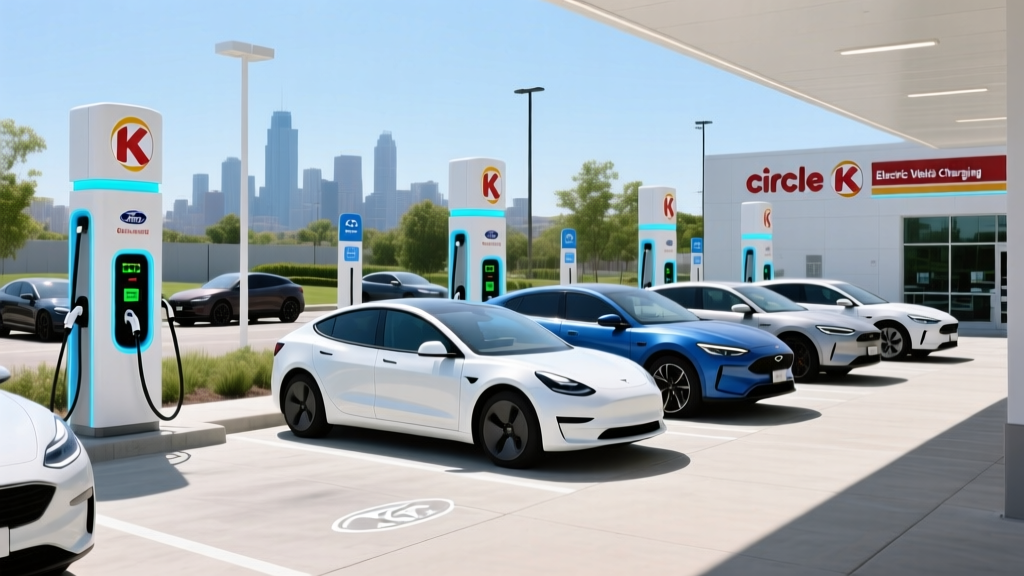
When most EV owners think of public fast-charging networks, Tesla Supercharger, Electrify America, and EVgo come to mind. But Circle K — the convenience-store chain with more than 7,200 locations across the United States — has been aggressively deploying DC fast chargers at its fuel-canopy sites since 2022, and by early 2026 the chain operates one of the broadest convenience-store-based charging footprints in North America. If you've searched for a "circle k electric vehicle charging station" on PlugShare or your car's native route planner, you've likely already seen the listings.
This guide covers exactly what you'll find when you pull up to a Circle K charger in 2026: the hardware (mostly Triton and Alpitronic Hypercharger cabinets), the connector mix, pricing structures, real-world charge speeds, and how the network stacks up against Superchargers and Electrify America for road-trip reliability.
Where Are Circle K EV Chargers Located, and What Hardware Do They Use?
Circle K's EV charging rollout has concentrated in three geographic clusters: the Southwest (Arizona, New Mexico, Texas), the Southeast (Florida, Georgia, the Carolinas), and the Midwest corridor along I-80/I-90. Most installations are at high-traffic travel plazas co-branded with Circle K's parent company, Alimentation Couche-Tard, which also owns the Ingo brand in Europe where Circle K has operated chargers since 2019.
The hardware mix as of Q1 2026:
- Alpitronic Hypercharger HYC 300/400 — the most common cabinet, delivering up to 300 kW per dispenser (or 400 kW on the newest sites). Dual-CCS/NACS liquid-cooled cables.
- Triton TR500 series — older deployments, typically 150-175 kW peak, still common at smaller rural sites.
- ABB Terra 360 — a handful of flagship locations, capable of 360 kW peak on a single vehicle.
Most Circle K sites have 2-4 DC fast-charging stalls under the existing fuel canopy, which means pull-through capability for vehicles towing trailers — a genuine advantage over many dedicated EV charging plazas that require tight perpendicular parking.
Connector Compatibility: NACS, CCS1, and the CHAdeMO Situation
Circle K's 2026 deployments reflect the industry-wide shift to the North American Charging Standard (NACS). Here's the current connector availability:
| Connector | Availability | Notes |
|---|---|---|
| NACS (Tesla standard) | All new and retrofitted sites | Native for Tesla, Rivian, Ford, GM, Hyundai/Kia 2025+ models |
| CCS1 (Combo) | ~70% of sites (dual-cable dispensers) | Legacy EVs: 2020-2024 VW ID.4, older Bolt EV, early Mach-E |
| CHAdeMO | Rare, legacy only | Nissan Leaf owners should carry a CHAdeMO-to-CCS adapter or plan alternate stops |
If you drive a 2025+ Hyundai Ioniq 5, Kia EV6, or Ford F-150 Lightning built after the NACS transition, you'll plug directly into the NACS cable. Owners of older CCS-equipped EVs should verify connector availability in the Circle K app or PlugShare before routing to a specific site — a small number of early deployments are NACS-only.
Adapter reality check: Tesla's official CCS-to-NACS adapter ($175) and the Lectron V-BOX adapter both work at Circle K's CCS1 dispensers, but expect a ~5-8 kW reduction in peak charge rate due to the adapter's thermal limits. For a 250 kW-capable vehicle, that means ~220 kW peak instead of 250 kW.
Charging Speeds: What kW Means and What You'll Actually See
Before we get to specific numbers, a critical distinction that trips up many new EV owners: kW (kilowatts) measures power — the rate at which energy flows into your battery. kWh (kilowatt-hours) measures energy — the total capacity of your battery. Think of kW as the width of the hose, and kWh as the size of the bucket. A 300 kW charger fills your battery faster, but the battery's chemistry and thermal state determine how long it can sustain that rate.
Circle K's chargers advertise peak rates up to 350-400 kW, but your vehicle's onboard charge curve determines the real-world result. Here's what to expect for common EV battery sizes:
| Vehicle (example) | Battery (usable kWh) | Peak charge rate | 10-80% time | Miles added in 15 min |
|---|---|---|---|---|
| Tesla Model Y LR (2025) | 75 kWh | 250 kW | ~22 min | ~145 mi |
| Hyundai Ioniq 5 (2025, 800V) | 77.4 kWh | 240 kW (sustained) | ~18 min | ~175 mi |
| Ford F-150 Lightning ER | 131 kWh | 150 kW | ~41 min | ~95 mi |
| Chevy Equinox EV (2025) | 85 kWh | 150 kW | ~32 min | ~110 mi |
| VW ID.4 (2024, CCS) | 77 kWh | 135 kW | ~34 min | ~95 mi |
The charge-curve reality: No EV sustains peak kW for the entire session. A Hyundai Ioniq 5 on a 350 kW Circle K Hypercharger will pull ~238 kW from 10-40% SoC, taper to ~180 kW by 55%, and drop to ~60 kW above 75%. The "18-minute" claim is specifically for the 10-80% window — charging past 80% at a DC fast charger is rarely worth the time, as the curve flattens dramatically.
Preconditioning matters. If your EV's battery is cold (below 50°F / 10°C), expect peak rates 30-50% lower until the thermal management system warms the pack. Navigate to the Circle K station using your car's built-in route planner when possible — most modern EVs will begin preconditioning the battery automatically when a charger is set as the destination.
How Much Does Charging at Circle K Cost? Price Per kWh and Cost-Per-Mile Math
Circle K's pricing varies by state, site, and time of day, but the 2026 national average for DC fast charging at Circle K locations is $0.39-$0.48 per kWh, with some high-demand urban sites reaching $0.55/kWh during peak hours. This places Circle K in the mid-tier of public charging networks — more expensive than Electrify America's off-peak rates but often cheaper than EVgo's peak pricing.
Circle K offers a membership program (Circle K Charge Club) for $4.99/month that reduces per-kWh pricing by approximately 15-20%, bringing typical rates to $0.31-$0.38/kWh. For road-trippers who charge publicly more than twice a month, the membership pays for itself.
Here's the cost-per-mile comparison that matters for your budget:
| Scenario | Rate | Cost per mile (3 mi/kWh EV) | Cost per mile (25 MPG gas car at $3.40/gal) |
|---|---|---|---|
| Circle K DC fast (average) | $0.43/kWh | $0.143 | $0.136 |
| Circle K Charge Club member | $0.34/kWh | $0.113 | $0.136 |
| Home Level 2 (national avg electricity) | $0.16/kWh | $0.053 | $0.136 |
| Home Level 2 (off-peak TOU rate) | $0.09/kWh | $0.030 | $0.136 |
The math is clear: home charging at off-peak rates is 4-5x cheaper per mile than gasoline. Circle K DC fast charging at member rates is competitive with gas on a per-mile basis, and significantly cheaper if you drive an efficient EV like the Hyundai Ioniq 5 (3.5-4.0 mi/kWh highway). Larger, less efficient EVs like the F-150 Lightning (1.8-2.2 mi/kWh) will see higher per-mile costs at public chargers.
Circle K vs. Tesla Supercharger vs. Electrify America: A Network Comparison
Circle K doesn't compete directly with Tesla's Supercharger network on speed or reliability — Superchargers still hold the uptime crown at ~99.2% availability nationally, according to PlugShare community data. But Circle K fills a specific niche that Superchargers and Electrify America often miss: convenience-store charging with immediate access to food, restrooms, and shelter without the awkwardness of parking-lot chargers in strip-mall locations.
Key comparison points for 2026:
- Uptime: Circle K averages ~94-96% charger availability — solid but below Supercharger (99%) and Electrify America (~97%). Rural Circle K sites occasionally experience connectivity issues that require a restart via the app.
- Payment: Circle K accepts all major credit cards at the dispenser (tap-to-pay), plus the Circle K app with stored payment. No RFID card required — an advantage over some EVgo stations.
- Amenities: This is Circle K's genuine differentiator. Clean restrooms, hot food, coffee, and indoor seating while you wait. Many sites also have dedicated EV parking with clear signage, unlike chargers crammed into the back of a grocery-store lot.
- Plug-and-charge: Circle K supports ISO 15118 plug-and-charge for compatible vehicles (2023+ Ford, GM, Rivian, Hyundai/Kia). Plug in and the session starts automatically — no app interaction needed.
Finding and Using a Circle K EV Charger: App, Route Planning, and Real-World Tips
The most reliable way to locate a Circle K electric vehicle charging station is through one of three methods:
- PlugShare app — filter by "Circle K" under network. Shows real-time availability, user photos, and recent check-in comments about charger status.
- Your EV's native navigation — Tesla, Ford, GM, and Hyundai/Kia route planners now include Circle K in their public charging databases. The car will precondition the battery automatically when routing to a Circle K DCFC.
- Circle K app — shows all charging locations, real-time stall availability, and allows remote session start/stop.
Road-trip tip: Circle K chargers are often positioned along interstate corridors at 60-90 mile intervals in the Southwest and Southeast. For vehicles with 250+ miles of EPA range, this means you can typically charge from 15-80% (a 20-25 minute stop) and still have a comfortable buffer to the next Circle K or alternate charger. In the Midwest and Northeast, spacing is wider — plan backup options on A Better Routeplanner (ABRP) before departing.
According to the U.S. Department of Energy's Alternative Fuels Data Center, convenience-store-based charging is the fastest-growing segment of the public DC fast-charging network, with deployments increasing 38% year-over-year from 2024 to 2025.
Home Charging Setup: What You Need to Know If You're Relying on Circle K as Backup
Even if Circle K chargers are part of your regular routine, most EV owners do 80-90% of their charging at home on a Level 2 (240V) circuit. Here's a concise overview of what a home installation requires, since this affects your overall charging strategy and how often you'll need public chargers at all.
| Component | Typical cost range | Notes |
|---|---|---|
| Level 2 charger (hardware) | $350-$700 | Emporia Vue, ChargePoint Home Flex, Wallbox Pulsar Plus |
| Electrician labor (standard install) | $500-$1,200 | Assumes panel is nearby; longer conduit runs add cost |
| Electrical permit | $50-$200 | Varies by municipality; required in most jurisdictions |
| Panel upgrade (if needed) | $1,500-$3,500 | Older 100A panels often need upgrade to 200A for a 40A/48A EV circuit |
| Total (no panel upgrade) | $900-$2,100 | Most homes built after 2000 won't need a panel upgrade |
| Total (with panel upgrade) | $2,400-$5,600 | Common for homes built before 1990 with original 100A service |
Electrical requirements for a typical Level 2 home charger: A 240V dedicated circuit at 40A or 48A (requires a 50A or 60A breaker, respectively — the National Electrical Code requires circuits to be rated 125% above continuous load). A NEMA 14-50 outlet is the most common configuration, allowing portable chargers like the Tesla Mobile Connector to be used. Hardwired installations (no outlet) are required for circuits above 48A and are generally recommended by licensed electricians for cleaner, safer setups.
Panel upgrade reality: If your home has a 100A main panel and you're already running central AC, an electric dryer, and an electric range, adding a 48A EV circuit will likely require a panel upgrade to 200A. This is the single biggest variable in home charging cost. Some utilities offer rebates of $500-$1,000 for panel upgrades tied to EV adoption — check with your local provider. The IRS §30D tax credit does not cover home charging equipment for most taxpayers after 2023, though the separate §25C Energy Efficient Home Improvement Credit may cover up to $1,000 of electrical panel upgrades — consult a tax professional for eligibility.
Frequently Asked Questions About Circle K EV Charging
Are Circle K EV chargers free to use?
No. Circle K charges per kWh at all its DC fast-charging locations. As of 2026, rates range from $0.31/kWh (Charge Club members at select sites) to $0.55/kWh (peak-hour urban locations). There are no idle fees at most Circle K sites, though a small number of high-traffic locations have implemented $0.10/minute idle fees after a 5-minute grace period post-charge.
Can I charge a Tesla at a Circle K station?
Yes. All new and retrofitted Circle K sites include native NACS connectors, which are the same connector Tesla uses. Tesla owners can plug directly in without an adapter. Circle K chargers are also listed in Tesla's in-car navigation as of late 2024.
How fast will a Circle K charger add range to my EV?
At a 300+ kW Hypercharger site, efficient EVs like the Hyundai Ioniq 5 or Kia EV6 can add approximately 175 miles of range in a 15-minute session. Larger-battery vehicles like the F-150 Lightning add roughly 95 miles in 15 minutes due to lower peak charge rates. Actual speed depends on battery temperature, state of charge, and the vehicle's charge-curve profile.
Is Circle K charging reliable for long road trips?
Circle K is a viable road-trip network in the Southwest and Southeast, where sites are spaced 60-90 miles apart along interstates. In the Midwest and Northeast, coverage is sparser and should be supplemented with Electrify America, EVgo, or Tesla Supercharger stops. Always check real-time charger status on PlugShare before committing to a Circle K-only route in unfamiliar territory.
Do Circle K chargers work with CHAdeMO vehicles like the Nissan Leaf?
CHAdeMO connectors are available at only a small number of legacy Circle K sites. Nissan Leaf owners should plan charging around dedicated CHAdeMO networks (EVgo has the broadest CHAdeMO coverage) or carry a CHAdeMO-to-CCS adapter, which costs $200-$350 and may reduce charge speed.