Quick Verdict: Charging the Chrysler Charger EV at Home and on the Road
The Chrysler Charger EV (marketed under the Dodge Charger Daytona nameplate for its initial launch) represents Stellantis's first serious entry into the high-performance electric muscle car segment. Built on the STLA Large platform, the Charger Daytona R/T and Scat Pack variants bring 496 to 670 horsepower and up to 317 miles of EPA-estimated range. But owning an EV this powerful means understanding exactly how to keep its large battery pack charged — efficiently, affordably, and safely.
This guide breaks down every charging scenario for the Chrysler Charger EV: what each charging level delivers in real-world miles, what a Level 2 home installation actually costs (including the panel upgrade scenario nobody talks about), which connectors you need, and how the per-mile cost stacks up against a gas-powered muscle car. We'll also recommend specific home charging equipment with exact specs and pricing.
Charging Levels Explained: How Fast Does Each Level Add Range?
Before we get into specific numbers for the Charger EV, let's clarify a critical distinction: kW (kilowatts) measures power — the rate at which energy flows into your car. kWh (kilowatt-hours) measures energy — the total capacity of the battery. Think of kW as the width of a pipe and kWh as the size of the tank you're filling. A wider pipe (higher kW) fills the tank faster.
The Chrysler Charger Daytona R/T carries a 100.5 kWh (gross) battery pack, while the Scat Pack variant uses the same pack tuned for higher output. Here's what each charging level delivers for a battery of this size:
| Charging Level | Voltage / Amps | Power (kW) | Miles of Range Added per Hour | Use Case |
|---|---|---|---|---|
| Level 1 (Standard Outlet) | 120V / 12A | ~1.4 kW | ~3–5 mi/hr | Overnight top-off, emergency |
| Level 2 (Home / Workplace) | 240V / 32–48A | 7.7–11.5 kW | ~22–35 mi/hr | Daily home charging, overnight full charge |
| DC Fast Charging | 400V architecture | Up to ~175 kW peak | ~200+ mi in ~28 min (10–80%) | Road trips, quick stops |
Real-world note: The EPA-estimated 317-mile range (Charger Daytona R/T) drops to approximately 240–270 miles in sustained highway driving at 70+ mph, and further in cold weather (below 30°F). Plan your charging stops accordingly — a 10–80% DC fast charge at a 175 kW station will take roughly 25–32 minutes depending on battery temperature and state of charge. The charge curve tapers significantly above 80%, so charging to 100% on DC fast is rarely worth the wait.
Home Charger Installation: Electrical Requirements and Real Costs
Installing a Level 2 home charger is the single biggest quality-of-life upgrade for any EV owner. For the Chrysler Charger EV, a Level 2 charger is essentially mandatory — Level 1 on a 100.5 kWh battery would take over 70 hours for a full charge, which is impractical for daily use.
Electrical Requirements for the Charger EV
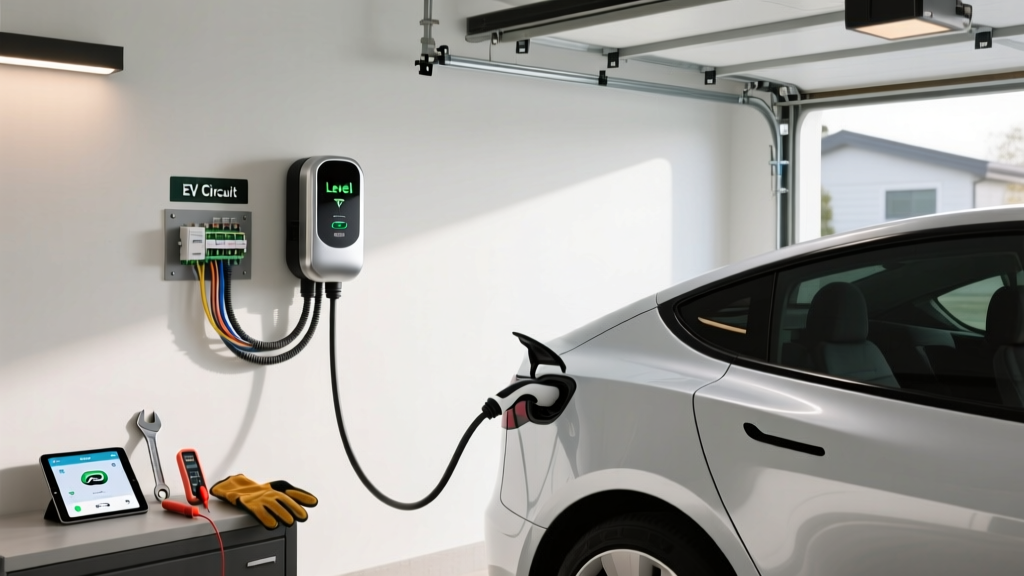
A Level 2 home charger for the Charger EV requires a 240-volt dedicated circuit, typically rated at 40 to 60 amps. The vehicle's onboard charger accepts up to 11.5 kW on Level 2 (48A). To deliver this, you need:
- A 60-amp dedicated breaker in your electrical panel (for a 48A continuous load, NEC code requires the breaker to be rated at 125% of the continuous load: 48A × 1.25 = 60A)
- 6 AWG copper wire (or 4 AWG aluminum) from the panel to the charger location
- A NEMA 14-60 outlet (if using a plug-in charger) or direct hardwiring
- Minimum 200-amp electrical service to the home is strongly recommended, especially if you run other high-draw appliances (electric range, dryer, HVAC)
What Electrical Upgrades Might You Need?
Here's the cost reality that catches many homeowners off guard. If your home has a 100-amp service panel (common in homes built before 1990), you'll likely need a panel upgrade to 200 amps before adding a 60A EV circuit. This is not optional — your electrician will flag it as a code and safety requirement.
Even with a 200A panel, you may need to check available capacity. If your panel is already near capacity (running electric heat, a dryer, range, and water heater), a load calculation may show you don't have room for another 60A circuit. Solutions include:
- Installing a lower-amperage charger (32A instead of 48A — still delivers ~22 mi/hr, sufficient for most daily driving)
- A smart load-management device (e.g., Emporia VUE with smart panel integration) that dynamically shares capacity
- Panel upgrade or sub-panel addition ($1,500–$3,500+ depending on your utility and local codes)
| Cost Component | Low Estimate | High Estimate | Notes |
|---|---|---|---|
| Level 2 Charger Equipment | $350 | $750 | 40A–48A smart charger (ChargePoint, Emporia, Wallbox) |
| Electrician Labor (standard install) | $400 | $1,200 | Depends on panel-to-charger distance, wall type, conduit |
| Electrical Materials (wire, conduit, breaker) | $150 | $500 | Longer runs and outdoor installs cost more |
| Permit & Inspection | $50 | $300 | Varies by municipality; some waive for EV installs |
| Panel Upgrade (if needed) | $1,500 | $3,500+ | 100A→200A service upgrade; may require utility coordination |
| Total (no panel upgrade) | $950 | $2,750 | Most homeowners fall in the $1,200–$2,000 range |
| Total (with panel upgrade) | $2,450 | $6,250+ | Older homes are the most likely to need this |
Federal incentive: The IRS §30C Alternative Fuel Vehicle Refueling Property Credit offers up to 30% of home charger equipment and installation costs, capped at $1,000. This credit is subject to income limitations and is only available for installations in eligible census tracts (low-income or non-urban areas). Check IRS.gov §30C details and consult a tax professional before relying on this credit. Some utilities also offer rebates of $200–$500 for Level 2 installations — check with your local provider.
Connector Compatibility: NACS, CCS, and What the Charger EV Uses
The Chrysler Charger Daytona ships with a CCS1 (Combined Charging System) port for its initial model years. Stellantis has announced plans to transition its North American EV lineup to the NACS (North American Charging Standard / Tesla connector), but as of the current model year, expect CCS1 on the Charger EV.
Here's what this means for your charging options:
| Connector Type | Network Compatibility | Adapter Needed for Charger EV? |
|---|---|---|
| CCS1 (your car's port) | Electrify America, EVgo, ChargePoint DC fast stations | No — native connector |
| NACS (Tesla) | Tesla Supercharger network (18,000+ stalls in North America) | Yes — CCS-to-NACS adapter (~$200–$250 from Tesla or third party) |
| CHAdeMO | Largely legacy; few new stations | Not recommended — no practical adapter exists |
| J1772 (Level 2 AC) | Public Level 2 chargers, home chargers | No — your CCS port includes J1772 for AC charging |
Practical recommendation: Buy a CCS-to-NACS adapter. Tesla's Supercharger network remains the most reliable DC fast-charging network in North America, and access to it dramatically improves road-trip charging experiences. Stellantis has confirmed that future models will adopt NACS natively, and many current CCS vehicles are gaining Supercharger access via adapters.
For home Level 2 charging, your Charger EV uses the J1772 portion of the CCS connector. Any standard Level 2 home charger with a J1772 plug will work — no adapter needed at home.
Cost to Charge: Per-Mile Economics vs. a Gas Muscle Car
One of the strongest arguments for the Charger EV over its gas-powered predecessors is fuel cost. Let's run real numbers comparing the Charger Daytona R/T against a comparable gas muscle car (e.g., Dodge Charger R/T with 5.7L Hemi V8, rated at ~19 MPG combined per fueleconomy.gov).
| Charging Scenario | Rate ($/kWh) | Cost for 100 kWh (Full Charge) | Cost per Mile (~280 mi usable) |
|---|---|---|---|
| Home — Off-Peak / Time-of-Use | $0.08–$0.12 | $8.00–$12.00 | $0.03–$0.04 |
| Home — Standard Residential Rate | $0.14–$0.18 | $14.00–$18.00 | $0.05–$0.06 |
| Public Level 2 (workplace, shopping) | $0.20–$0.35 | $20.00–$35.00 | $0.07–$0.13 |
| DC Fast Charging (Electrify America, EVgo) | $0.35–$0.55 | $35.00–$55.00 | $0.13–$0.20 |
Gas comparison: At $3.50/gallon and 19 MPG combined, the gas Charger R/T costs approximately $0.18 per mile. Even at standard residential electricity rates, the Charger EV costs roughly $0.05 per mile — a savings of over $0.13 per mile, or about $1,950 per year at 15,000 miles driven.
If you can charge at home on an off-peak or time-of-use rate (many utilities offer $0.06–$0.10/kWh overnight), the savings widen to over $2,400 annually. Over five years of ownership, home charging can save $10,000–$12,000 in fuel costs alone compared to the gas equivalent.
Caveat: If you rely exclusively on DC fast charging at $0.45+/kWh, your per-mile cost approaches $0.16 — nearly matching gas. Home charging access is the economic linchpin of EV ownership.
Charging Time Examples: What to Expect with the Charger EV's 100.5 kWh Battery
The Charger EV's large battery means longer charge times than smaller EVs. Here are practical time estimates for common scenarios:
- Level 1 (120V, 1.4 kW): 0–100% in ~72 hours. Only useful for maintaining charge or adding ~40 miles overnight. Not viable as a primary charging method for this vehicle.
- Level 2 (240V, 48A / 11.5 kW): 0–100% in ~9 hours. 10–80% in approximately 6 hours. A full overnight charge from near-empty to full — ideal for daily use.
- Level 2 (240V, 32A / 7.7 kW): 0–100% in ~13 hours. Sufficient if your daily driving is under 100 miles and you charge every night.
- DC Fast Charging (peak 175 kW): 10–80% in ~28 minutes. Expect the charge rate to taper from ~175 kW (at low SoC) to under 50 kW above 80%. Charging from 10–90% takes closer to 40 minutes.
Charge curve reality: Like all EVs, the Charger EV does not charge at its peak rate for the entire session. The battery management system (BMS) throttles charge speed as the battery fills to protect cell health. You'll see ~175 kW from 10–30% SoC, tapering to ~120 kW by 50%, ~75 kW by 70%, and below 50 kW past 80%. This is why the industry standard metric is 10–80% time — charging past 80% on DC fast is painfully slow and best reserved for destination Level 2 charging.
Cold weather impact: Below 30°F, expect DC fast charging speeds to drop by 20–40% unless the battery is preconditioned. The Charger EV's thermal management system includes battery preconditioning when you navigate to a DC fast charger — always use the in-car navigation to route to a charger so the system can warm the battery before you arrive.
Recommended Home Charging Equipment for the Charger EV
For a 100.5 kWh battery, you want a Level 2 charger that delivers at least 40A (9.6 kW) to ensure a full overnight charge. Here are three proven options with exact specs:
Emporia Level 2 EV Charger (48A)
- Power Output: 11.5 kW (48A @ 240V)
- Connector: J1772 (compatible with Charger EV natively)
- Cable Length: 24 feet
- Smart Features: Wi-Fi connected, app scheduling, energy monitoring, solar integration, load management with Emporia VUE panel monitor
- Price: ~$399
- Best for: Budget-conscious buyers who want full smart features and solar/load-management integration
ChargePoint Home Flex (up to 50A)
- Power Output: Up to 12 kW (50A, configurable down to 16A for lower-capacity panels)
- Connector: J1772
- Cable Length: 23 feet
- Smart Features: Wi-Fi, app scheduling, Alexa/Google integration, amperage adjustable via dip switch to match your circuit
- Price: ~$549–$699
- Best for: Flexibility — adjustable amperage means it works with 20A to 60A circuits without replacing the unit
Wallbox Pulsar Plus (48A)
- Power Output: 11.5 kW (48A @ 240V)
- Connector: J1772
- Cable Length: 25 feet
- Smart Features: Wi-Fi + Bluetooth, app control, Power Sharing (daisy-chain two chargers on one circuit), Eco-Smart solar mode
- Price: ~$549
- Best for: Two-EV households (Power Sharing lets two cars share a single 60A circuit intelligently)
Installation tip: All three chargers above support both hardwired and NEMA 14-60 plug-in installation. Hardwired is preferred for 48A+ units — it eliminates the outlet as a failure point and is required by some local codes for circuits above 40A. Ask your electrician which method your jurisdiction requires.
Safety, Code, and Permit Considerations
EV charger installation is electrical work that must comply with the National Electrical Code (NEC Article 625) and your local building codes. Here's what to verify:
- Dedicated circuit: Your EV charger must have its own dedicated breaker — it cannot share a circuit with other appliances or outlets.
- GFCI protection: NEC 2020 and later requires GFCI protection for all EV charging outlets. Hardwired chargers may be exempt in some jurisdictions, but a GFCI breaker is good practice regardless.
- Outdoor rating: If your charger is installed outdoors (carport, driveway), ensure the unit is rated NEMA 4 (weatherproof) and the connector holster protects the plug from rain and debris. All three recommended chargers above carry NEMA 4 ratings.
- Permit and inspection: Most municipalities require an electrical permit for EV charger installation ($50–$300). Your electrician typically pulls this. After installation, an inspector will verify the work meets code. Do not skip this step — unpermitted work can void home insurance claims and complicate future home sales.
- Wire gauge: For a 48A charger on a 60A breaker, 6 AWG copper wire is standard. For runs over 50 feet, your electrician may upsized to 4 AWG to minimize voltage drop.
Never use an extension cord for EV charging. If your charger cable doesn't reach your car's charge port, relocate the charger or have an electrician move it — extension cords introduce resistance, heat, and fire risk at these amperages.
Frequently Asked Questions
How much does it cost to install a home EV charger for the Chrysler Charger EV?
Expect $950–$2,750 for a standard installation (equipment, electrician labor, materials, and permit) if your electrical panel has sufficient capacity. If your home needs a panel upgrade from 100A to 200A service, add $1,500–$3,500+, bringing the total to $2,450–$6,250. Get at least two quotes from licensed electricians and confirm they have specific EV charger installation experience.
How fast will each charging level add range to the Charger EV?
Level 1 (120V) adds roughly 3–5 miles per hour — essentially useless for a 100+ kWh battery as a primary method. Level 2 (240V, 48A) adds about 30–35 miles per hour, fully charging overnight in ~9 hours. DC fast charging at peak rate can add 150+ miles in about 20 minutes, with a 10–80% session taking ~28 minutes at a 175 kW station.
Which connector does the Chrysler Charger EV use, and do I need an adapter?
The Charger Daytona currently uses CCS1. For home Level 2 charging, no adapter is needed — any J1772 charger plugs directly into the CCS port. For DC fast charging on Tesla's Supercharger network, you'll need a CCS-to-NACS adapter ($200–$250). For Electrify America, EVgo, and other CCS networks, no adapter is required.
How much does charging the Charger EV cost per mile compared to a gas Charger?
At home on a standard residential rate (~$0.16/kWh), the Charger EV costs about $0.05–$0.06 per mile. A gas Dodge Charger R/T at 19 MPG and $3.50/gallon costs about $0.18 per mile. That's a savings of $0.12–$0.13 per mile, or roughly $1,800–$1,950 per year at 15,000 miles. Off-peak home charging widens this gap further.
What electrical upgrades might my home need for a Level 2 charger?
The most common upgrade is a panel capacity increase from 100A to 200A service ($1,500–$3,500+). Even with a 200A panel, you may need a load calculation to confirm available capacity. If capacity is tight, you can install a 32A charger instead of 48A (still adds ~22 mi/hr overnight), or add a smart load-management system that dynamically shares panel capacity between the EV charger and other appliances.
Does the Chrysler Charger EV qualify for the federal EV tax credit?
Federal §30D tax credit eligibility depends on the vehicle's MSRP, your household income, battery component sourcing, and critical mineral requirements — all of which are subject to annual IRS rule updates. The credit can be up to $7,500, and as of current rules, can be transferred to the dealer as a point-of-sale discount. Check the latest eligibility on IRS.gov §30D and verify with your tax professional before purchasing, as rules change frequently.
Can I charge the Charger EV on a regular 120V outlet?
Technically yes, but practically no. At ~1.4 kW, a full 0–100% charge takes over 70 hours. You'd add roughly 40 miles overnight — fine for a short commute day, but inadequate for regular use. A Level 2 installation is strongly recommended as the primary charging solution for any EV with a battery over 80 kWh.