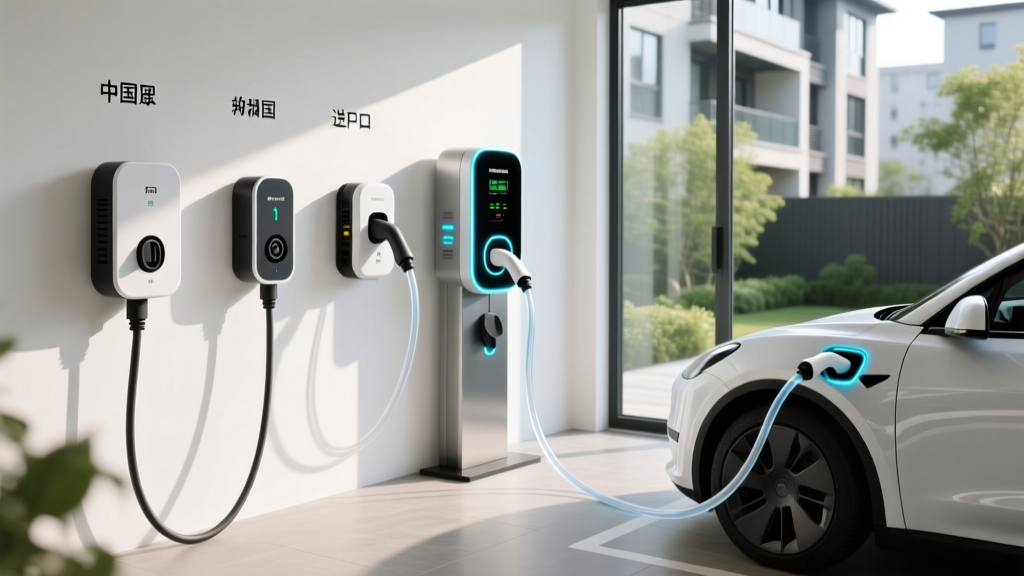
If you've browsed Amazon, AliExpress, or eBay for a Level 2 home EV charger, you've likely noticed a flood of options priced between $120 and $250 — roughly half what established brands like ChargePoint or Enel X charge. Most of these are manufactured in China, often sold under unfamiliar brand names or even white-labeled by Western-sounding companies. The question every cost-conscious EV owner asks: are these China chargers safe, reliable, and genuinely capable of delivering the power they advertise?
The short answer: some are perfectly fine, and some are genuinely dangerous. The difference comes down to safety certifications, build quality, and whether the unit can actually sustain its claimed output without overheating. This guide breaks down exactly what to look for, what to avoid, and how imported chargers fit into a real home installation.
Understanding Charging Levels: What Speeds Are We Talking About?
Before evaluating any charger — imported or domestic — you need to understand what each charging level delivers. Power is measured in kW (kilowatts), which is the rate of energy flow. Your battery capacity is measured in kWh (kilowatt-hours), which is the total energy stored. Confusing these two is the single most common EV literacy mistake. A 48 kW charger delivers 48 kW of power; a 75 kWh battery holds 75 kWh of energy.
| Level | Voltage / Amps | Power (kW) | Miles of Range Per Hour | Typical Use |
|---|---|---|---|---|
| Level 1 | 120V / 12-16A | 1.4 – 1.9 kW | 3 – 5 mi/hr | Overnight trickle, PHEVs, emergencies |
| Level 2 (Home) | 240V / 16-48A | 3.8 – 11.5 kW | 14 – 44 mi/hr | Daily home charging, most common setup |
| Level 2 (Public/Commercial) | 208-240V / 48-80A | 10 – 19.2 kW | 38 – 70 mi/hr | Workplace, apartments, destination charging |
| DC Fast Charging | 400-800V DC | 50 – 350 kW | 150 – 1,200 mi/hr (peak) | Road trips, highway corridors |
Most China-sourced chargers sold to US consumers are Level 2 units rated between 7 kW (32A) and 11.5 kW (48A) at 240V. A few budget models are dual-voltage (120V/240V) with included NEMA adapter plugs. DC fast chargers are not sold directly to consumers for home use — they require utility-grade infrastructure costing $50,000+.
Safety Certifications: The Non-Negotiable Checklist
The most critical differentiator between a safe China-manufactured charger and a dangerous one is third-party safety certification. In the United States, the National Electrical Code (NEC) requires that permanently installed EV supply equipment (EVSE) be listed by a Nationally Recognized Testing Laboratory (NRTL). The certifications that matter:
- UL Listed (UL 2594 / UL 2231-1/2): The gold standard. UL tests for electrical shock, fire, thermal overload, and ground fault protection. Most US jurisdictions require UL listing for permitted installations.
- ETL Listed (Intertek): Functionally equivalent to UL — tests to the same standards. Accepted by all US jurisdictions.
- CE Mark (European): Not accepted as a standalone US certification. Many China chargers carry CE only, which means they were not tested to US-specific NEC and UL requirements.
- CCC (China Compulsory Certification): Required for sale within China. Does not satisfy US electrical code requirements.
Reputable China-manufactured chargers that do carry legitimate UL/ETL listings include units from brands like Autel, Lectron, and Emporia (which sources hardware from China but engineers and certifies for the US market). The issue isn't country of origin — it's whether the manufacturer invested $50,000–$150,000 in the certification process.
Home Installation: Electrical Requirements and Real Costs
A Level 2 charger needs a dedicated 240V circuit. The most common configurations:
- 32A charger: Requires a 40A breaker (NEC requires circuits be rated at 125% of continuous load). Uses 6 AWG copper wire.
- 40A charger: Requires a 50A breaker. Uses 6 AWG copper wire.
- 48A charger: Requires a 60A breaker. Uses 4 AWG copper wire (or 6 AWG for short runs with THHN in conduit).
Do You Need a Panel Upgrade?
This is where costs can spiral. Most modern homes have a 200A main panel. If your panel is already near capacity (running electric heat, electric oven, electric dryer, etc.), adding a 40-60A EV circuit may require a panel upgrade to 400A or a secondary subpanel. Homes with 100A service — common in pre-1980 construction — almost certainly need an upgrade for anything above a 16A Level 2 charger.
A licensed electrician will perform a load calculation per NEC Article 220 to determine if your panel can handle the additional circuit. Some utilities and states offer rebates for panel upgrades tied to EV adoption.
| Component | Typical Cost Range | Notes |
|---|---|---|
| Level 2 Charger (Equipment) | $130 – $700 | China brands: $130-$350; US/EU brands: $350-$700 |
| Electrician Labor (standard install) | $300 – $800 | Short run from panel to garage; 2-4 hours typical |
| Electrical Permit | $50 – $200 | Varies by municipality; some waive for EV installs |
| Wire & Conduit Materials | $100 – $400 | Depends on run length; long runs add significantly |
| Panel Upgrade (if needed) | $1,500 – $4,000 | 100A→200A or adding subpanel; not always required |
| Total (no panel upgrade) | $580 – $2,100 | Most homeowners fall in $800-$1,400 range |
| Total (with panel upgrade) | $2,080 – $6,100 | Older homes with 100A service |
As of 2026, the federal Residential Clean Energy Credit (IRC §25D) covers 30% of home EV charger equipment and installation costs, up to $1,000. This credit applies to both the charger and the electrical work, including panel upgrades if they are solely to support the EVSE circuit. Income caps do not apply to §25D (unlike the §30D vehicle credit), making it broadly available. Check with a tax professional for your specific situation.
Connector Compatibility: Will a China Charger Plug Into Your EV?
The US EV market in 2026 has largely consolidated around two connectors, but legacy standards still exist:
| Connector | Brands Using It (2026) | Notes |
|---|---|---|
| NACS (J3400) | Tesla, Ford, GM, Rivian, Volvo, Polestar, Mercedes, Fisker, Lucid, Honda (2025+) | Now the dominant US standard; SAE formalized as J3400 |
| CCS1 | Hyundai, Kia, Volkswagen, BMW, Stellantis/Jeep, Subaru, Toyota (bZ series) | Still common; NACS adapters widely available |
| CHAdeMO | Nissan Leaf (legacy), Mitsubishi Outlander PHEV (legacy) | Effectively discontinued; no new models use it |
Most China-manufactured chargers sold in the US market ship with a J1772 connector (the Level 2 predecessor to CCS1's AC portion). If you drive a NACS-equipped vehicle (Tesla or any brand that switched to NACS for 2025+), you'll need a J1772-to-NACS adapter ($30-$60) to use a J1772-terminated home charger. Tesla's Mobile Connector and Wall Connector natively use NACS.
Some China chargers now ship with a native NACS plug, but verify the pin configuration matches the SAE J3400 standard. Early "Tesla-compatible" chargers from 2022-2023 sometimes used a proprietary pinout that worked with Teslas but not with Ford or GM NACS vehicles.
Equipment Recommendations: China Chargers vs. Established Brands
Below are specific models across the price spectrum, including China-manufactured units that carry legitimate US certifications alongside established Western brands for comparison:
Budget: Lectron V-BOX Pro (China-manufactured, ETL Listed)
- Power Output: 48A / 11.5 kW (240V, hardwired) or 40A / 9.6 kW (NEMA 14-50 plug)
- Connector: J1772 (NACS adapter sold separately)
- Cable Length: 20 ft
- Smart Features: None — basic dumb charger, no Wi-Fi or app
- Price: ~$200 (plug-in) / ~$230 (hardwired)
- Verdict: Solid output for the price. ETL certification means it meets US safety standards. Lack of smart features means no scheduling for off-peak utility rates — you'll need to manage that through your EV's built-in charge scheduler.
Budget: Emporia Vue Link (China-sourced, UL Listed)
- Power Output: 48A / 11.5 kW (hardwired) or 40A / 9.6 kW (14-50 plug)
- Connector: J1772
- Cable Length: 24 ft
- Smart Features: Wi-Fi, app scheduling, energy monitoring, solar integration
- Price: ~$250
- Verdict: Best value in smart chargers. Energy monitoring pairs with the Emporia Vue home energy panel. App is functional but occasionally laggy. UL Listed and US-supported.
Mid-Range: Autel MaxiCharger AC Lite (China-manufactured, UL Listed)
- Power Output: 50A / 12 kW (hardwired) or 40A / 9.6 kW (14-50)
- Connector: J1772
- Cable Length: 25 ft
- Smart Features: Wi-Fi, Bluetooth, app, RFID access control, load balancing
- Price: ~$350
- Verdict: Autel is a major automotive diagnostics company. The load-balancing feature is useful for homes with tight panel capacity — it dynamically reduces charge rate when other appliances draw power. Build quality noticeably above the cheapest options.
Premium: ChargePoint Home Flex (US-engineered, UL Listed)
- Power Output: Up to 50A / 12 kW (adjustable 16-50A via dip switches)
- Connector: J1772 or NACS (configurable at purchase)
- Cable Length: 23 ft
- Smart Features: Wi-Fi, app scheduling, Alexa/Google integration, detailed energy reports, utility demand-response programs
- Price: ~$550
- Verdict: The benchmark for home chargers. Adjustable amperage means you can match it precisely to your circuit. Excellent app and utility integration. NACS option eliminates the adapter need for Tesla/Ford/GM owners.
Charging Time Examples: What to Expect With Real Battery Sizes
Charge time depends on your vehicle's onboard charger capacity, battery size, and the circuit's available power. Here are realistic 10-80% charge times for common 2025-2026 EVs on a 48A (11.5 kW) Level 2 circuit — the output of a typical higher-end China charger:
| Vehicle | Battery (usable kWh) | Onboard Charger Limit | 10-80% Time at 11.5 kW |
|---|---|---|---|
| Tesla Model Y (2025) | 75 kWh | 11.5 kW | ~4.5 hours |
| Ford Mustang Mach-E ER | 91 kWh | 10.5 kW | ~6 hours |
| Hyundai Ioniq 5 (84 kWh) | 77.4 kWh | 10.9 kW | ~5 hours |
| Chevrolet Equinox EV | 85 kWh | 11.5 kW | ~5.2 hours |
| Toyota bZ4X | 64 kWh | 7.4 kW | ~5 hours (limited by onboard charger) |
Note that vehicles like the Toyota bZ4X have a lower onboard charger limit (7.4 kW), meaning even a 48A charger will only deliver 7.4 kW to the battery. The charger can only supply what the car's onboard charger can accept.
Cost to Charge: Home vs. Public vs. Gas
The economics of EV charging depend heavily on where and when you charge. Here are realistic 2026 scenarios:
| Scenario | Rate ($/kWh) | Cost for 75 kWh Fill | Cost Per Mile (at 3.5 mi/kWh) |
|---|---|---|---|
| Home Off-Peak (Time-of-Use rate) | $0.08 – $0.12 | $6.00 – $9.00 | $0.023 – $0.034 |
| Home Standard Rate | $0.14 – $0.18 | $10.50 – $13.50 | $0.040 – $0.051 |
| Public Level 2 (ChargePoint, etc.) | $0.20 – $0.35 | $15.00 – $26.25 | $0.057 – $0.100 |
| DC Fast Charging (Electrify America, EVgo) | $0.35 – $0.55 | $26.25 – $41.25 | $0.100 – $0.157 |
| Tesla Supercharger (average 2026) | $0.28 – $0.38 | $21.00 – $28.50 | $0.080 – $0.109 |
| Gasoline (30 MPG at $3.40/gal) | — | — | $0.113 |
Home off-peak charging is dramatically cheaper than gas — roughly $0.03/mile vs. $0.11/mile, a savings of about $1,200 per year for a driver covering 15,000 miles. However, exclusive reliance on DC fast charging at $0.40-$0.55/kWh can actually cost more than gas, which is why home charging access remains the single biggest factor in EV satisfaction.
Many utilities now offer EV-specific time-of-use (TOU) rates that drop electricity to $0.06-$0.10/kWh between midnight and 6 AM. Smart chargers (or your car's built-in scheduler) can automate charging during these windows. A "dumb" China charger without scheduling features means you rely on your vehicle's charge timer — which most modern EVs include.
Safety and Code Considerations for Home Installations
Regardless of whether you buy a $150 China charger or a $600 ChargePoint, the installation must meet NEC requirements:
- Dedicated Circuit: Your EV charger must have its own dedicated breaker — it cannot share a circuit with other outlets or appliances.
- GFCI Protection: NEC 2020 and later requires GFCI protection for all EVSE outlets. Hardwired units typically have GFCI built into the charger itself. If you're installing a NEMA 14-50 receptacle, your electrician must use a GFCI breaker ($80-$120 additional) — this is a common inspection failure point.
- Outdoor Rating: If your charger will be installed outdoors (driveway, exterior wall), the unit must carry a NEMA 4 or IP65 weather rating. Many budget China chargers are rated only for indoor use — check the spec sheet before buying.
- Cable Management: NEC requires that the charging cable not create a trip hazard. Wall-mounted cord reels or cable management systems ($30-$60) are practical additions.
- Permit and Inspection: Most jurisdictions require an electrical permit for new 240V circuits. The inspection verifies correct wire gauge, breaker sizing, grounding, and GFCI protection. An unpermitted install can void insurance coverage and create problems during a home sale.
Verdict: When a China Charger Makes Sense (and When It Doesn't)
Choose a China-manufactured charger if:
- It carries a legitimate UL or ETL listing (not just CE/CCC)
- You want maximum amperage (48A) on a tight equipment budget
- You're comfortable managing charge scheduling through your vehicle's app rather than a charger app
- The brand has US-based customer support and a clear warranty process (minimum 2 years)
Choose an established US/EU brand if:
- You want native NACS connectivity without adapters
- Smart features like utility demand-response, detailed energy monitoring, or solar integration matter to you
- You want a proven warranty track record and easy replacement if the unit fails
- Your electrician or utility requires a specific approved equipment list for rebates
The country where a charger is manufactured matters less than the safety certifications it carries and the company standing behind it. A UL-listed Autel or Lectron charger made in Shenzhen is safer and more reliable than an uncertified unit from an unknown brand — regardless of where either was assembled. Budget $200-$350 for the equipment, $500-$1,000 for installation, and verify the UL file number before clicking buy.
Frequently Asked Questions
How much does it cost to install a home EV charger?
A typical Level 2 home charger installation costs $580 to $2,100 all-in (equipment + electrician + permit + materials) if your electrical panel has sufficient capacity. If a panel upgrade from 100A to 200A is needed, total costs range from $2,080 to $6,100. The federal §25D tax credit covers 30% of the total, up to $1,000, with no income cap.
How fast will each charging level add range?
Level 1 (120V) adds 3-5 miles per hour — suitable only for PHEVs or overnight trickle charging. Level 2 (240V, 32-48A) adds 14-44 miles per hour, fully replenishing most EV batteries overnight. DC fast charging (50-350 kW) adds 150-1,200 miles per hour at peak, enabling 10-80% charges in 18-30 minutes on road trips.
Which connector/charger is compatible with my EV?
For 2025-2026 model years: Tesla, Ford, GM, Rivian, Volvo, and several others use NACS (J3400). Hyundai, Kia, VW, BMW, and Stellantis still use CCS1. Most Level 2 home chargers ship with J1772 connectors, which plug directly into CCS1 vehicles. NACS vehicles need a J1772-to-NACS adapter (~$40) unless you buy a charger with a native NACS cable.
How much does charging cost per mile vs. gas?
Home off-peak charging costs approximately $0.02-$0.03 per mile — roughly 75% cheaper than gasoline at $3.40/gallon and 30 MPG ($0.11/mile). Standard home rates bring the cost to $0.04-$0.05/mile. Exclusive DC fast charging at $0.40+/kWh can match or exceed gas costs at $0.10-$0.16/mile.
What electrical upgrades might I need?
If your home has a 200A panel with available capacity, you likely only need a new dedicated 40-60A breaker and a wire run to your garage or parking spot. Homes with 100A service, or panels already near capacity, may require a panel upgrade ($1,500-$4,000) or a smart load-management device ($150-$300) that dynamically adjusts charging amperage to avoid overloading the panel.