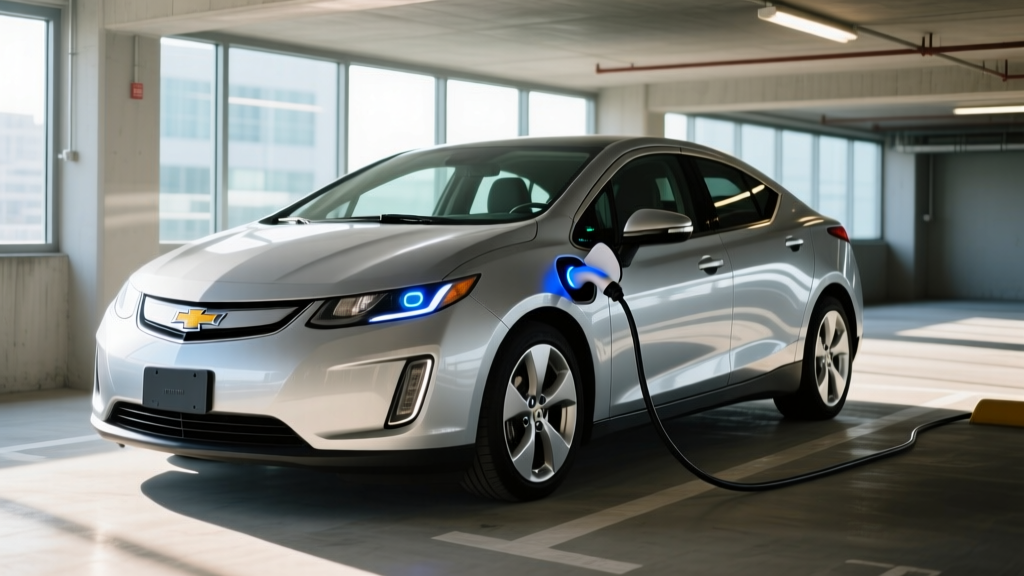
The Chevrolet Volt (produced 2011–2019) remains one of the most practical plug-in hybrids on the used market. With 38–53 miles of EPA-rated electric range depending on the model year and a gas engine for backup, it eliminates range anxiety while still delivering meaningful daily electric driving. But extracting every last electric mile from a Volt depends entirely on how you charge it — and how well you understand the relationship between its battery capacity, charging speed, and real-world efficiency.
This guide covers everything a Volt owner or prospective buyer needs to know about charging: how fast each level adds range, what home installation actually costs, which connectors you'll encounter, and how the per-mile cost stacks up against gasoline. Whether you're plugging into a standard 120V outlet or installing a dedicated 240V Level 2 station, the numbers below will help you optimize your Volt's electric driving.
Understanding the Chevy Volt's Battery and Electric Range
The Volt's plug-in range varies significantly by generation. The first-generation Volt (2011–2015) carries an 18.4 kWh battery pack (approximately 10.3 kWh usable) and achieves an EPA-rated 38 miles of electric range. The second generation (2016–2019) upgraded to an 18.4 kWh pack with a revised 14.0 kWh usable window, pushing the EPA rating to 53 miles on 2017–2019 models (the 2016 model is rated at 53 miles as well after a mid-year battery revision).
EPA vs. Real-World Volt Electric Range: The EPA sticker assumes mixed driving at moderate temperatures. In real-world use, expect 30–35 electric miles from a Gen 1 Volt and 40–48 miles from a Gen 2 on a full charge. Highway driving at 70+ mph, cold weather below 40°F, and aggressive acceleration can reduce electric range by 20–35%. In winter, a Gen 2 Volt may deliver only 30–35 electric miles before the gas engine engages.
Because the Volt's usable battery capacity tops out around 14 kWh (Gen 2), charging it is relatively quick compared to a full battery-electric vehicle. This is actually an advantage for home charging — you don't need the fastest charger on the market to fill up overnight.
Charging Levels Explained: How Fast Each Adds Range
EV charging is measured in kilowatts (kW), which represents the rate of power delivery. The energy stored in your Volt's battery is measured in kilowatt-hours (kWh). Think of kW as the speed of water flowing through a hose and kWh as the total volume of water in the bucket. These units are not interchangeable.
| Charging Level | Voltage | Power (kW) | Miles of Range Added Per Hour | Full Charge Time (Gen 2, ~14 kWh usable) |
|---|---|---|---|---|
| Level 1 (120V outlet) | 120V | 1.2–1.4 kW | ~4–5 miles/hour | 12–14 hours |
| Level 2 (240V station) | 240V | 3.3–3.6 kW (Volt's onboard charger limit) | ~12–14 miles/hour | 4–4.5 hours |
| DC Fast Charging | 400V+ | N/A — Volt does not support DCFC | N/A | N/A |
A critical detail for Volt owners: the car's onboard charger is limited to 3.6 kW maximum (Gen 2; Gen 1 is limited to 3.3 kW). This means even if you plug into a 7.2 kW or 11.5 kW Level 2 station, the Volt will only draw 3.6 kW. You will not charge faster by buying a more powerful Level 2 charger — but a higher-capacity unit gives you flexibility to charge future EVs at their full rate.
The Volt does not support DC fast charging. There is no CCS or CHAdeMO port on any model year. All charging is AC, handled by the car's internal converter. For a PHEV with a small battery, this is standard — DC fast charging infrastructure is designed for larger BEV batteries.
Home Charger Installation: Costs, Electrical Requirements, and Permits
Most Volt owners start with Level 1 charging using the included 120V portable cord. For daily driving under 35 miles, Level 1 may be sufficient — it adds roughly 40–50 miles of electric range overnight (10–12 hours). But if your commute exceeds that, or you want the flexibility of a full charge in just 4 hours, a Level 2 home station is the upgrade to make.
Electrical Requirements for Level 2
A Level 2 charger requires a dedicated 240V circuit, similar to what powers an electric dryer or oven. The specific amperage depends on the charger you select:
- 16A circuit (3.8 kW): Requires a 20A breaker. Sufficient for the Volt's 3.6 kW maximum.
- 32A circuit (7.7 kW): Requires a 40A breaker. Recommended if you plan to own a BEV in the future.
- 48A circuit (11.5 kW): Requires a 60A breaker. Overkill for the Volt but future-proof.
Most homes built after 1990 have a 100A or 200A electrical panel with available capacity for a 240V circuit. Older homes with 60A or 100A service may need a panel upgrade — a significant additional cost.
Installation Cost Breakdown
| Component | Typical Cost Range | Notes |
|---|---|---|
| Level 2 charger equipment | $250–$700 | Varies by power output, cable length, and smart features |
| Electrician labor (standard install) | $500–$1,500 | Depends on run length from panel to garage/carport |
| Electrical permit | $50–$200 | Required in most jurisdictions; varies by municipality |
| Panel upgrade (if needed) | $1,500–$3,500 | Only if existing panel lacks capacity for a new 240V circuit |
| Total (standard install, no panel upgrade) | $800–$2,400 | National average ~$1,200 for a straightforward garage install |
| Total (with panel upgrade) | $2,300–$5,900 | Common in pre-1980 homes with 60–100A service |
Always hire a licensed electrician and pull a permit. Unpermitted electrical work can void homeowner's insurance and create fire hazards. The National Electrical Contractors Association maintains a directory of qualified installers.
Safety and Code Considerations
Key National Electrical Code (NEC) requirements for home EV charging include:
- Dedicated circuit: Your EV charger must have its own breaker — no sharing with other appliances.
- GFCI protection: NEC 2020 and later require ground-fault circuit interrupter protection for outdoor receptacles and many indoor garage installations.
- Outdoor rating: If your charger is mounted outside, it must carry a NEMA 4 or NEMA 4X weather-resistance rating.
- Circuit sizing: The breaker must be rated at 125% of the charger's continuous draw (e.g., a 32A charger needs a 40A breaker).
- Wire gauge: Your electrician will size wire to match the circuit — typically 8 AWG for 40A or 6 AWG for 60A copper runs.
Connector Compatibility: What Plugs Into a Chevy Volt
The Chevy Volt uses the SAE J1772 connector for all AC charging. This is the standard AC plug for all non-Tesla EVs and PHEVs sold in North America. Every Level 1 cord and Level 2 station sold in the U.S. comes with a J1772 connector by default.
| Connector Type | Chevy Volt Compatible? | Notes |
|---|---|---|
| SAE J1772 (AC Level 1/2) | Yes — native | Standard on all Volt model years |
| NACS / Tesla (AC & DC) | No — adapter available for AC only | Tesla sells a J1772-to-NACS adapter; DC not applicable to Volt |
| CCS1 (DC Fast) | No | Volt has no DC fast-charge port |
| CHAdeMO (DC Fast) | No | Volt has no DC fast-charge port |
If you own a Tesla Wall Connector (NACS), you can purchase a Tesla J1772 adapter to charge your Volt from the Tesla unit. The reverse — using a J1772 station to charge a Tesla — also works with the adapter included with every Tesla vehicle.
As the industry shifts toward NACS (Tesla's connector, now standardized as SAE J3400), new public Level 2 stations are increasingly shipping with NACS connectors. For Volt owners, a simple J1772-to-NACS adapter ($40–$100) ensures continued compatibility at public chargers through 2026 and beyond.
Level 2 Charger Recommendations for the Chevy Volt
Because the Volt's onboard charger maxes out at 3.6 kW, you don't need a 48A powerhouse. A 16A or 32A station will charge the Volt at its maximum rate. However, buying a 32A or 40A unit provides headroom for a future BEV without rewiring. Below are proven options at various price points:
Emporia Level 2 EV Charger
- Power output: 48A max (11.5 kW) — Volt will draw 3.6 kW
- Connector: J1772 (NACS adapter available)
- Cable length: 24 feet
- Smart features: Wi-Fi, app scheduling, energy monitoring, solar integration
- Price: ~$350–$400
- Best for: Budget-conscious buyers who want smart scheduling for off-peak rates
ChargePoint Home Flex
- Power output: Configurable 16A–50A (3.8–12 kW) — set via dip switch
- Connector: J1772 (NACS version now available)
- Cable length: 23 feet
- Smart features: Wi-Fi, Alexa integration, app-based scheduling, charge history
- Price: ~$550–$700
- Best for: Flexible amperage settings to match your panel's available capacity
Tesla Wall Connector (J1772 version)
- Power output: 48A max (11.5 kW)
- Connector: J1772 (Tesla also sells NACS-native version)
- Cable length: 24 feet
- Smart features: Wi-Fi, over-the-air updates, power sharing between two units
- Price: ~$450–$550
- Best for: Multi-EV households mixing Tesla and non-Tesla vehicles
For Volt-only households, the Emporia at ~$350 is the value pick — its smart scheduling lets you charge during off-peak utility windows to minimize cost. If you anticipate adding a BEV (like a Chevy Equinox EV or Tesla Model Y) within a few years, the ChargePoint Home Flex's adjustable amperage is worth the premium.
Cost to Charge: Volt Electric Miles vs. Gasoline
One of the Volt's strongest selling points is the cost advantage of electric driving. Here's how the per-mile economics break down across common charging scenarios:
| Scenario | Rate | Cost to Fully Charge Gen 2 (~14 kWh usable) | Cost Per Mile (53 mi electric range) |
|---|---|---|---|
| Home Level 1/2 — off-peak utility rate | $0.09/kWh | $1.26 | $0.024/mile |
| Home Level 1/2 — average U.S. residential rate | $0.17/kWh | $2.38 | $0.045/mile |
| Home Level 1/2 — high-cost state (CA, HI, Northeast) | $0.30/kWh | $4.20 | $0.079/mile |
| Public Level 2 (ChargePoint, EVgo, etc.) | $0.25–$0.49/kWh | $3.50–$6.86 | $0.066–$0.13/mile |
| Gasoline (Volt as hybrid, ~42 MPG combined) | $3.30/gallon (2026 avg) | N/A | $0.079/mile |
At the U.S. average residential electricity rate of roughly $0.17/kWh (per EIA data), charging a Gen 2 Volt at home costs about $2.38 for a full charge — or 4.5 cents per electric mile. That's roughly 40–50% cheaper than driving on gasoline at current fuel prices.
The economics flip if you rely exclusively on expensive public Level 2 chargers at $0.49/kWh. At that rate, electric driving costs about $0.13/mile — more expensive than gasoline in the Volt's hybrid mode. The financial case for a Volt depends heavily on home charging access.
For Volt owners on time-of-use (TOU) utility plans, scheduling charges during overnight off-peak windows (typically 10 PM – 6 AM) can reduce electricity cost to $0.07–$0.10/kWh, making electric miles as cheap as 2 cents each. Most smart Level 2 chargers (and the Volt's own built-in charge scheduling) support delayed-start charging to exploit these windows.
Public Charging with the Chevy Volt: What to Expect
The Volt's J1772 connector is compatible with virtually every public Level 2 station in the United States. Networks like ChargePoint, EVgo, Blink, and Electrify America all offer J1772 Level 2 connectors. Simply plug in and authenticate via the network's app or RFID card.
However, public Level 2 charging at 6.6–7.2 kW stations will not charge the Volt any faster than a home unit — remember, the car's 3.6 kW onboard charger is the bottleneck. Expect roughly 4 hours at any public Level 2 station for a full charge.
A practical note: public DC fast chargers (CCS or NACS) are useless to the Volt. Don't waste time pulling into a DCFC-only station. Apps like PlugShare let you filter for J1772 Level 2 stations specifically, which is the most efficient way to find compatible public charging.
For daily use, most Volt owners find that home charging (Level 1 or Level 2) covers all their electric driving needs. The gas engine seamlessly takes over for longer trips, making the Volt one of the most forgiving PHEVs for drivers without reliable public charging access.
Frequently Asked Questions
How much does it cost to install a home EV charger for a Chevy Volt?
A standard Level 2 installation (no panel upgrade) typically costs $800–$2,400 total, including the charger ($250–$700), electrician labor ($500–$1,500), and permit ($50–$200). If your home's electrical panel needs an upgrade to handle a new 240V circuit, add $1,500–$3,500. Many Volt owners successfully use Level 1 (120V) charging with no installation cost at all.
How fast will each charging level add range to my Volt?
Level 1 (120V) adds approximately 4–5 miles of electric range per hour. Level 2 (240V) adds approximately 12–14 miles per hour. A full Level 2 charge takes about 4–4.5 hours for a Gen 2 Volt. The Volt does not support DC fast charging.
Which connector is compatible with my Chevy Volt?
All Chevy Volt model years use the SAE J1772 connector for AC charging. This is the standard plug on virtually all Level 1 cords and Level 2 stations in North America. If you encounter a NACS (Tesla-style) connector, a J1772-to-NACS adapter ($40–$100) will work for Level 2 AC charging.
How much does charging a Volt cost per mile vs. gas?
At the U.S. average residential electricity rate ($0.17/kWh), Volt electric driving costs about $0.045/mile. Gasoline in the Volt's hybrid mode (42 MPG combined) costs about $0.079/mile at $3.30/gallon. Home charging with off-peak rates can drop to $0.02–$0.03/mile — roughly 60% cheaper than gas.
What electrical upgrades might I need for a Level 2 charger?
You need a dedicated 240V circuit with a breaker rated at 125% of the charger's continuous draw. For a 32A charger, that means a 40A breaker. Homes with 200A service rarely need a panel upgrade. Homes with 60A or 100A service, or panels that are already near capacity, may require a panel upgrade ($1,500–$3,500). A licensed electrician can assess your panel during a site visit.
Can I charge a Chevy Volt with a Tesla Wall Connector?
Yes. Tesla sells a J1772 version of the Wall Connector, and also offers a J1772 adapter for the NACS version. Either configuration will charge a Volt at the car's maximum 3.6 kW rate.
Does the Chevy Volt qualify for any tax credits in 2026?
The Volt was discontinued after the 2019 model year, so it does not qualify for the new-vehicle §30D federal tax credit. However, a used Volt purchased from a dealer for $25,000 or less may qualify for the used clean vehicle credit of up to $4,000 (30% of sale price, capped at $4,000), subject to buyer income limits ($75,000 single / $150,000 joint). Verify eligibility with a tax professional.