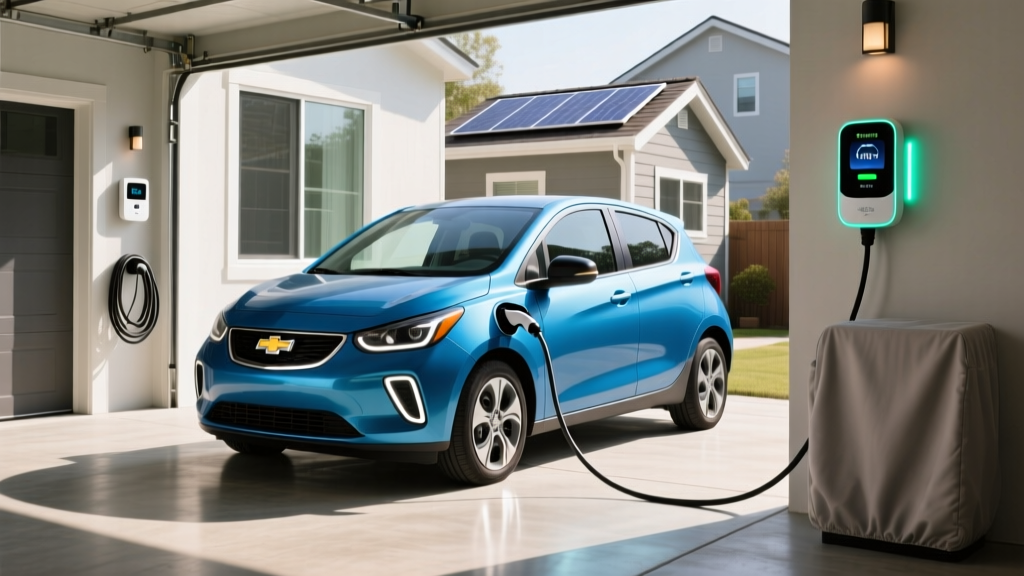
The Chevrolet Spark EV was one of the first mass-market battery-electric vehicles sold in the United States, arriving in 2013 and bowing out after the 2016 model year. Though no longer in production, it remains a popular entry point on the used-EV market, with well-maintained examples frequently selling between $6,000 and $11,000. If you own one, are considering one, or simply want to understand how a small early-generation EV charges on today's infrastructure, this guide covers the real-world range of the Chevy Spark EV alongside a full breakdown of home and public charging options available in 2026.
Real-World Range of the Chevy Spark EV: What the EPA Number Misses
The Spark EV shipped with two battery configurations across its production run. The 2013–2015 models carried a 21.3 kWh lithium-ion (NMC chemistry) pack, while the 2016 model year received a slightly smaller but more energy-dense 18.4 kWh LG Chem pack. Despite the reduced capacity, the 2016 version matched or slightly improved the earlier EPA rating thanks to drivetrain refinements.
| Spec | 2013–2015 | 2016 |
|---|---|---|
| Usable Battery Capacity | ~19 kWh (of 21.3 kWh gross) | ~16.5 kWh (of 18.4 kWh gross) |
| EPA Range | 82 miles | 82 miles |
| EPA Combined MPGe | 119 MPGe | 119 MPGe |
| Motor Output | 114 hp / 400 lb-ft torque | 143 hp / 327 lb-ft torque |
| 0–60 mph | ~8.5 seconds | ~7.2 seconds |
| DC Fast Charge (max) | 50 kW (SAE Combo/CCS option) | 50 kW (CCS) |
| Onboard Charger (L2 max) | 3.3 kW | 3.3 kW |
| Battery Warranty (original) | 8 yr / 100,000 mi | 8 yr / 100,000 mi |
Because the Spark EV is now 10+ years old, battery degradation is a significant variable. Most surviving packs show 10–20% capacity loss depending on climate history and charging habits. A 2014 Spark EV with 15% degradation may deliver only 65–70 real-world miles in mixed conditions. Before purchasing, request a State of Health (SoH) reading via an OBD-II scanner with EV-capable software (such as LeafSpy-equivalent tools or GM-specific diagnostics) to confirm remaining capacity.
Charging the Spark EV: Levels, Speeds, and What to Expect
Understanding the difference between kW (kilowatts) and kWh (kilowatt-hours) is essential here. Kilowatts measure the rate of charging — like the flow rate of a hose. Kilowatt-hours measure the total energy stored in the battery — like the size of the bucket. The Spark EV's ~18–21 kWh battery is the bucket; your charger's kW rating determines how fast you fill it.
| Level | Voltage / Current | Power (kW) | Miles of Range Added per Hour | 0–100% Time (Approx.) |
|---|---|---|---|---|
| Level 1 (Standard Outlet) | 120V / 12A | ~1.4 kW | ~4–5 mi/hr | 13–16 hours |
| Level 2 (Home/Public AC) | 240V / 16A (vehicle-limited) | 3.3 kW (max onboard) | ~12–14 mi/hr | 5–6 hours |
| DC Fast Charge (CCS) | 400V DC | Up to 50 kW peak | ~120–150 mi/hr (peak) | ~30 min (0–80%) |
Key limitation: The Spark EV's onboard AC charger maxes out at 3.3 kW. Even if you plug into a 48-amp Level 2 wall connector capable of 11.5 kW, the car will only accept 3.3 kW. This is a vehicle-side constraint, not a charger fault. A 3.3 kW rate means a full charge from empty still takes roughly 5–6 hours on Level 2 — adequate for overnight replenishment but slower than modern EVs accepting 7–19 kW onboard.
DC fast charging on the Spark EV requires the optional SAE Combo (CCS1) port, which was not standard on all 2013–2015 models. Some early examples shipped with CHAdeMO compatibility or no DC fast-charge capability at all. Verify the port configuration on any used Spark EV before relying on public fast charging. At 50 kW peak, the charge curve tapers significantly above 80% State of Charge — the 0–80% sprint takes roughly 30 minutes, but 80–100% can add another 25–30 minutes.
Home Charger Installation: Costs, Electrical Requirements, and Panel Reality
Even though the Spark EV only accepts 3.3 kW on Level 2, installing a higher-capacity home charger is a sound investment. It future-proofs your setup for a next EV and allows other household vehicles to charge faster. Most EV owners install a 240V / 40-amp circuit with a charger rated for 32 amps continuous (9.6 kW output), which the Spark will simply underutilize.
| Component | Cost Range | Notes |
|---|---|---|
| Level 2 EVSE Equipment (smart charger, 32–48A) | $350–$700 | Wi-Fi-enabled, NEMA 14-50 or hardwired |
| Electrician Labor (240V circuit run, ~50 ft) | $600–$1,800 | Varies by region, conduit length, and wall type |
| Electrical Permit | $50–$200 | Required in most jurisdictions |
| Panel Upgrade (if needed: 100A → 200A) | $1,500–$3,500 | Common in homes built before 1990; older panels may lack capacity for a new 40A circuit |
| Total (no panel upgrade) | $1,000–$2,700 | Most common scenario for modern 200A panels |
| Total (with panel upgrade) | $2,500–$6,200 | Significant but adds home value and EV-ready capacity |
Electrical requirements for a standard Level 2 install: A dedicated 240V circuit, typically 40 amps (for a 32A continuous charger) or 50 amps (for a 40A continuous charger), using a NEMA 14-50 receptacle or hardwired connection. The National Electrical Code requires the circuit breaker to be rated at 125% of the continuous load — hence a 32A charger needs a 40A breaker. GFCI protection is required for outdoor receptacles in most jurisdictions under the 2020 NEC and later.
Panel upgrade gotcha: Homes with 100-amp service or older Federal Pacific / Zinsco panels almost always require an upgrade before adding a 40A EV circuit. Even some 200-amp panels are near capacity if you run electric heat, an electric dryer, and an electric range simultaneously. A licensed electrician will perform a load calculation per NEC Article 220 to determine whether your panel can accommodate the new circuit. Do not skip this step — overloaded panels are a fire risk.
Connector Compatibility: What Plugs Into the Spark EV?
The connector landscape has shifted dramatically since the Spark EV left showrooms. Here is where the Spark fits in the 2026 ecosystem:
| Connector | Standard On | Spark EV Compatible? | Adapter Needed? |
|---|---|---|---|
| J1772 (Level 1 & L2 AC) | All pre-2025 non-Tesla EVs | Yes — native | None |
| CCS1 (DC Fast) | Most 2014+ GM, Ford, VW, Hyundai | Yes (2014+ with DC option) | None if equipped |
| CHAdeMO (DC Fast) | Early Nissan Leaf, Mitsubishi i-MiEV | Some 2013–2014 models | None if equipped |
| NACS (Tesla / 2025+ industry standard) | All Tesla vehicles; 2025+ Ford, GM, Rivian, etc. | No — not native | CCS-to-NACS adapter (~$200–$250) for DC charging at Superchargers; J1772-to-NACS adapter (~$100–$150) for L2 destination charging |
The NACS transition matters for Spark EV owners because General Motors adopted the North American Charging Standard (NACS) for all new vehicles beginning in 2025, and Tesla Supercharger stations now welcome non-Tesla EVs via the built-in Magic Dock adapter or third-party CCS-to-NACS adapters. If you want access to Tesla's 17,000+ Supercharger network in the US, you will need a CCS1-to-NACS adapter — but confirm your Spark EV actually has the CCS port first. Without DC fast charging capability, a NACS adapter provides limited benefit (Level 2 destination charging only).
For public Level 2 charging (grocery stores, workplaces, parking garages), the Spark EV's J1772 inlet plugs in natively. No adapter required. Networks like ChargePoint, Blink, and EVgo maintain thousands of J1772-equipped Level 2 stations.
Cost to Charge: Home vs. Public vs. Gasoline Comparison
One of the strongest arguments for owning even an older EV like the Spark EV is the per-mile energy cost. Let us run the numbers against a comparable gasoline subcompact (approximately 30 MPG combined).
| Scenario | Rate | Spark EV Cost/Mile | Gas Car Cost/Mile (30 MPG) |
|---|---|---|---|
| Home charging (off-peak utility rate) | $0.11/kWh | $0.031 | $0.117 |
| Home charging (national avg residential) | $0.17/kWh | $0.048 | $0.117 |
| Public Level 2 (network pricing) | $0.35/kWh | $0.099 | $0.117 |
| DC Fast Charge (public) | $0.48/kWh | $0.136 | $0.117 |
How these numbers are calculated: The Spark EV averages approximately 0.28 kWh per mile (derived from its 119 MPGe rating per fueleconomy.gov). Multiply that by the $/kWh rate for each scenario. For gasoline, divide $3.50/gallon (2026 national average) by 30 MPG.
At home on off-peak rates, the Spark EV costs roughly 75% less per mile than the gas equivalent. Even at public DC fast-charger rates, the cost is comparable to gasoline — though frequent DC fast charging is both more expensive and harder on the battery long-term. For a 40-mile daily commute charged at home overnight, expect to spend roughly $1.30–$1.90 per day on electricity, versus $4.65 on gasoline.
Recommended Home Charging Equipment for the Spark EV
Since the Spark EV caps at 3.3 kW onboard, you might wonder why anyone would install a more powerful charger. The answer: you are buying for your next EV, not just this one. A quality 40-amp or 48-amp wall connector will serve a future Hyundai Ioniq 5, Ford F-150 Lightning, or Chevy Equinox EV at full speed. Here are three proven options in 2026:
ChargePoint Home Flex (Level 2)
- Power Output: Up to 12 kW (50A circuit) — adjustable via dip switch
- Connector: J1772 (native for Spark EV)
- Cable Length: 23 feet
- Smart Features: Wi-Fi, app scheduling, utility demand-response integration, Alexa
- Price: ~$549
- Best For: Spark EV owners who want app-based energy tracking and plan to keep the charger through their next EV purchase
Emporia Level 2 EV Charger
- Power Output: Up to 11.5 kW (48A continuous, 60A circuit)
- Connector: J1772
- Cable Length: 24 feet
- Smart Features: Wi-Fi, solar integration, real-time energy monitoring via Emporia app, load management
- Price: ~$399
- Best For: Budget-conscious installers; pairs well with Emporia whole-home energy monitor
Wallbox Pulsar Plus
- Power Output: Up to 11.5 kW (48A)
- Connector: J1772
- Cable Length: 25 feet
- Smart Features: Wi-Fi + Bluetooth, app control, Power Sharing (two chargers on one circuit), Eco-Smart solar mode
- Price: ~$599
- Best For: Multi-EV households needing dual-charger load balancing
All three chargers deliver far more power than the Spark EV can accept, which is precisely the point. You install the circuit once; you swap chargers only when you want to. If budget is extremely tight and you do not anticipate another EV, a basic Lectron 32A Level 2 charger (~$230, 7.7 kW, J1772) will still charge the Spark at its 3.3 kW maximum and is adequate for the task.
Safety, Code, and Installation Best Practices
EV charging draws sustained high current for hours — more similar to a welder than a phone charger. Proper installation is not optional. Here are the non-negotiables:
- Dedicated circuit: Your Level 2 charger must be on its own breaker, shared with nothing else. No outlets, lights, or appliances on the same circuit.
- GFCI protection: Required for all outdoor 240V receptacles under NEC 2020 §625.54. Hardwired installations may be exempt depending on local code, but GFCI breakers add a layer of protection against ground faults.
- Outdoor rating: If your charger is mounted outside or in an unconditioned garage, ensure the EVSE carries a NEMA 4 (weatherproof) rating. All three chargers recommended above are outdoor-rated.
- Wire gauge: A 40A circuit requires minimum 8 AWG copper wire; a 50A circuit requires 6 AWG. Your electrician will size this correctly, but verify on the permit application.
- Permit and inspection: Every jurisdiction in the US requires an electrical permit for a new 240V circuit. The inspection ensures the work meets NEC code. Skipping the permit can void home insurance coverage in the event of an electrical fire. Per the National Electrical Code, Article 625 governs EV charging installations specifically.
- Utility notification: Some utilities require notification before adding a Level 2 charger, especially if they offer time-of-use (TOU) rate plans or demand-response rebates. Check with your provider — you may qualify for a $200–$500 installation rebate or a free smart charger.
Frequently Asked Questions
How much does it cost to install a home EV charger for the Chevy Spark EV?
Expect $1,000–$2,700 for a standard Level 2 installation on a home with an adequate 200-amp panel. If your home requires a panel upgrade (common in pre-1990 construction), add $1,500–$3,500. The Spark EV's 3.3 kW onboard limit means even a modest 24-amp / 5.8 kW charger is sufficient, but most owners install a 40-amp circuit to future-proof for their next EV.
How fast will each charging level add range to the Spark EV?
Level 1 (120V wall outlet) adds approximately 4–5 miles of range per hour. Level 2 (240V) adds approximately 12–14 miles per hour, limited by the car's 3.3 kW onboard charger. DC fast charging at 50 kW can add roughly 60 miles of range in 20 minutes under optimal conditions, though the charge curve tapers significantly above 80% SoC.
Which connector is compatible with the Chevy Spark EV?
For Level 1 and Level 2 AC charging, the Spark EV uses the standard J1772 connector — universally compatible with all non-Tesla public Level 2 stations. For DC fast charging, most 2014–2016 models with the optional DC package use CCS1 (SAE Combo). Some 2013–2014 models were equipped with CHAdeMO. To access Tesla Superchargers (now open to non-Tesla EVs), you need a CCS1-to-NACS adapter, available from Tesla and third-party manufacturers for approximately $200–$250.
How much does charging the Spark EV cost per mile vs. a gas car?
At the national average residential electricity rate of $0.17/kWh, the Spark EV costs approximately $0.048 per mile to charge at home — roughly 60% less than a 30 MPG gasoline subcompact at $3.50/gallon ($0.117/mile). Off-peak utility rates as low as $0.11/kWh push the EV cost down to $0.031/mile. Public DC fast charging at $0.48/kWh is the one scenario where EV charging can exceed gasoline cost per mile.
What electrical upgrades might my home need for an EV charger?
The most common upgrade is a panel replacement from 100A to 200A service ($1,500–$3,500), required in older homes that lack spare breaker capacity. You may also need conduit runs from the panel to the garage or driveway, a new NEMA 14-50 receptacle, and a GFCI breaker for outdoor installs. A licensed electrician performs a load calculation to determine whether your existing panel can handle a 40A or 50A dedicated circuit. Some utilities and state programs offer rebates covering part of the upgrade cost — check the IRS §30D and §25E guidelines for potential federal credits on charger installation (up to $1,000 under §30C for qualifying census tracts).
Is the Chevy Spark EV still worth buying in 2026?
For a city commuter with reliable home charging and a sub-40-mile round trip, a well-maintained Spark EV at $7,000–$10,000 remains one of the cheapest ways to drive electric. The 82-mile EPA range is limiting for highway trips, and the 3.3 kW onboard charger is slow by 2026 standards. Battery degradation should be verified before purchase. If your budget allows, newer used EVs like the 2019+ Chevy Bolt EV (238-mile EPA range, 7.2 kW onboard charging) offer substantially more capability for $12,000–$16,000.